Within Long Future
Can AI build stronger pandemic defences?
AI could strengthen pandemic preparedness by spotting threats earlier, supporting research and improving responses while requiring careful biological
On this page
- Early detection and outbreak prediction
- AI assisted medical research and response
- Biological misuse risks and safeguards
Page outline Jump by section
Introduction
Could AI build stronger pandemic defences? The most realistic answer is yes, but not by replacing public health systems with a single predictive machine. AI could strengthen a global disease defence network by helping detect unusual outbreaks earlier, accelerating medical research, improving emergency coordination and helping governments act on better information. The long-term AI bloom case is that intelligence becomes a civilisational resource: societies gain greater ability to anticipate shocks and protect human life. In pandemics, that means moving from a reactive model — discovering a crisis after it spreads — towards a more continuous system of surveillance, prediction and rapid response.
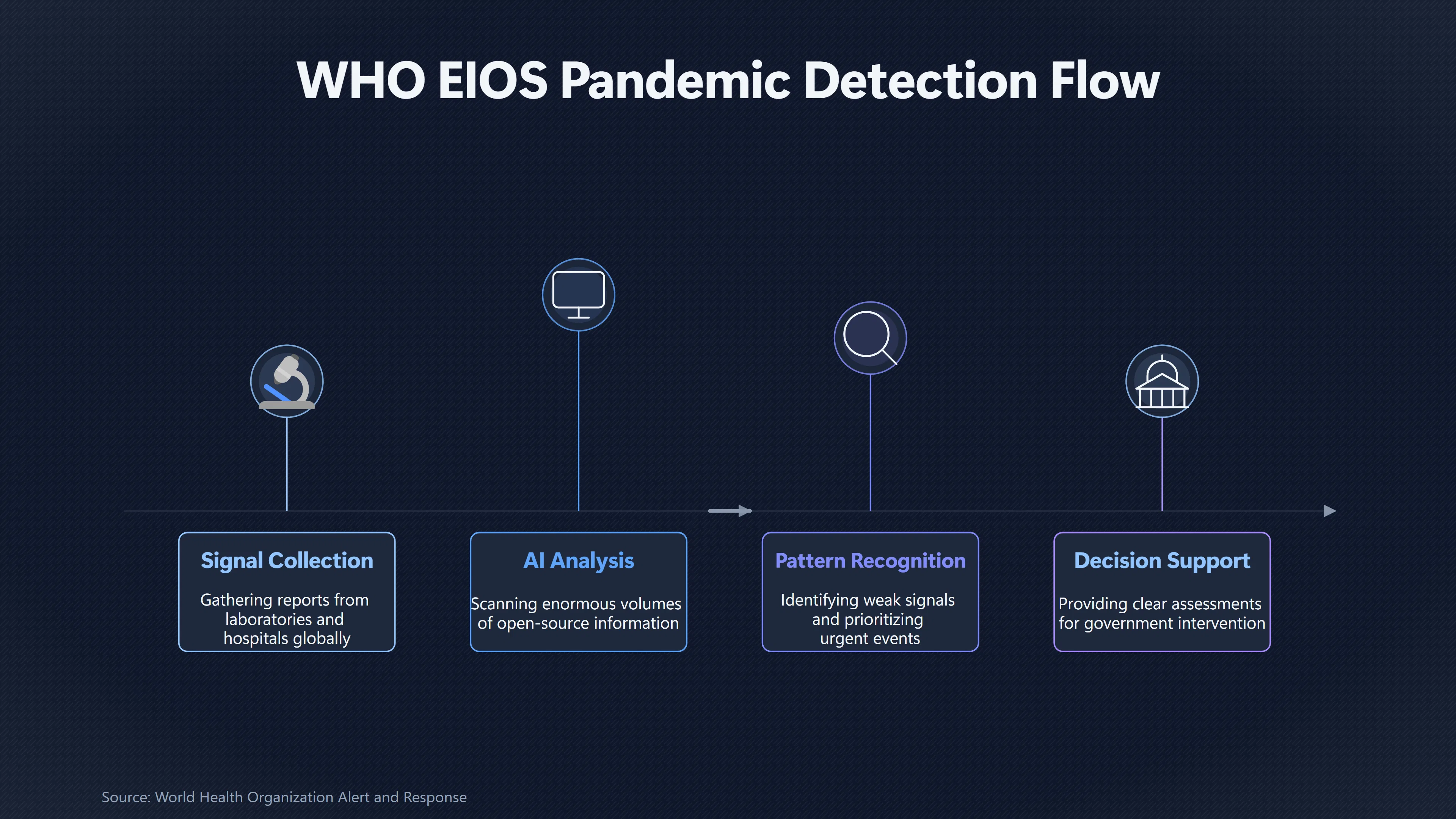
The gains are potentially large because infectious disease threats are shaped by speed. A pathogen detected days or weeks earlier can mean fewer infections, faster research and more targeted interventions. But AI pandemic defence also reveals a central tension in advanced technology: the same capabilities that help humanity understand biology could also increase the ability to misuse it. Stronger resilience therefore depends not only on better algorithms, but on trusted institutions, international cooperation and safeguards.[World Health Organization]who.intWorld Health Organization Alert and ResponseWorld Health Organization Alert and Response
Early detection and outbreak prediction
A future AI pandemic defence network would begin with earlier awareness. Today, health agencies already combine reports from laboratories, hospitals, governments, media and other signals to identify possible outbreaks. AI can extend this approach by scanning enormous volumes of information, recognising weak signals and helping analysts prioritise events that deserve attention. The World Health Organization’s Epidemic Intelligence from Open Sources (EIOS) system, for example, uses AI-supported analysis of open-source information to improve the speed and efficiency of public health threat detection.[World Health Organization]who.intWorld Health OrganizationThe WHO Hub in Berlin: driving innovation to make the world safer from health threatsJune 17, 2025…
The practical advantage is not that AI can perfectly predict the next pandemic. Disease emergence is influenced by biology, human behaviour, climate, travel and many unpredictable factors. Instead, AI can improve the early warning layer: finding patterns humans may miss, comparing events across regions and helping experts decide where limited attention should go. A 2025 systematic review of AI in infectious disease early warning systems found that researchers are using machine learning, deep learning and natural language processing across diverse data sources, including epidemiological records, climate information and wastewater signals.[PubMed Central (PMC)]pmc.ncbi.nlm.nih.govPubMed Central (PMC)Artificial intelligence in early warning systems for infectious disease surveillance: a systematic review - PMCJune 2…
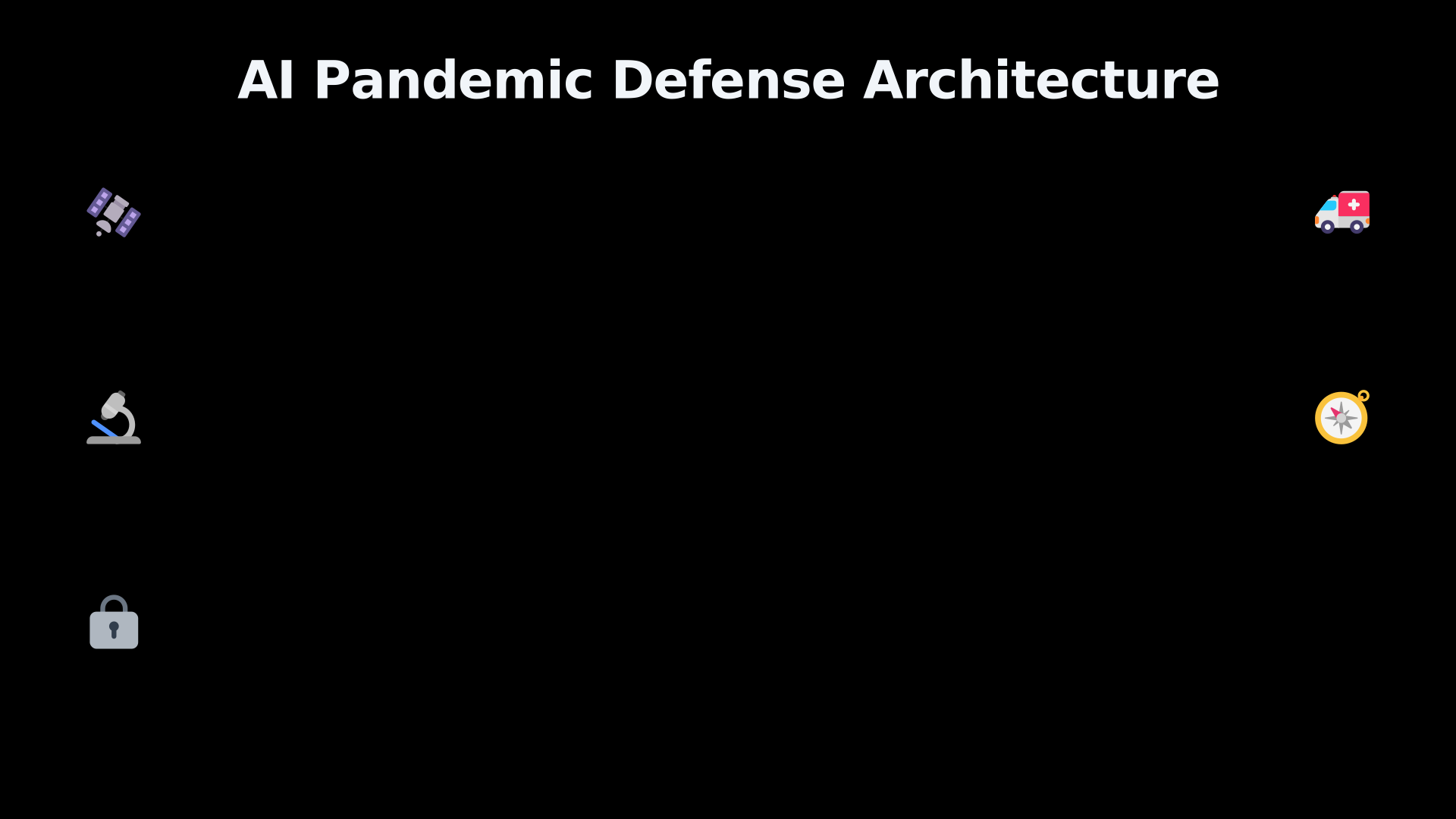
The most valuable systems are likely to be networks rather than isolated models. A resilient pandemic defence architecture could connect:
- Global surveillance: AI systems continuously analyse disease reports, genomic data and public information for unusual patterns.
- Local health intelligence: hospitals and laboratories use AI tools to identify clusters or changes in disease behaviour.
- Scientific analysis: researchers use AI to interpret pathogen characteristics and estimate possible risks.
- Decision support: governments receive clearer assessments of where preparation or intervention may be needed.
This approach mirrors other areas of civilisational resilience: the goal is not eliminating every threat, but giving societies more time and capability to respond.
AI-assisted medical research and response
The second major gain is speed. During a pandemic, scientific progress becomes a race against transmission. AI can help researchers search biological data, identify possible drug targets, design experiments and analyse complex molecular structures.
The COVID-19 response showed both the promise and the limits of this approach. AI-based methods contributed to areas such as protein structure prediction and biomedical research, but they worked best as accelerators for human scientists rather than replacements for laboratories, clinical trials and public health systems. The broader lesson is that AI increases scientific capacity most effectively when combined with strong institutions and real-world validation.
Future systems could make pandemic research faster in several ways:
- Faster vaccine and treatment discovery: AI can help identify promising candidates from large biological datasets.
- Better understanding of pathogens: models can assist researchers in analysing genetic and molecular information.
- Improved clinical response: AI tools can support medical decision-making, resource allocation and hospital planning.
- Adaptive responses: systems could help update strategies as new evidence appears.
The potential importance for the long-term future is that AI may reduce one of civilisation’s recurring vulnerabilities: the time lag between recognising a biological threat and developing a response. A more capable scientific ecosystem could mean fewer deaths, shorter disruptions and greater confidence in humanity’s ability to withstand future outbreaks.
However, scientific acceleration does not automatically produce equal benefits. Countries with stronger research infrastructure may initially gain advantages, and access to AI-enabled medical tools could become another area where global inequality matters. A flourishing future requires that pandemic defence capabilities become widely available rather than concentrated among a small number of institutions or nations.

The biological misuse challenge
The same AI capabilities that could strengthen pandemic preparedness could also create new risks. Biology is a dual-use field: knowledge that helps develop vaccines, medicines and diagnostics can also be relevant to harmful applications. As AI systems become more capable in biological reasoning and scientific assistance, security researchers have argued that safeguards must develop alongside innovation.[Frontier Model Forum]frontiermodelforum.orgFrontier Model Forum Preliminary Taxonomy of AI-Bio Misuse MitigationsFrontier Model ForumPreliminary Taxonomy of AI-Bio Misuse Mitigations - Frontier Model Forum…
This does not mean AI will inevitably cause biological disasters. It means that a mature AI-enabled defence system must include protection against misuse. Important safeguards include:
- Capability testing: evaluating advanced AI systems before deployment to understand whether they could meaningfully assist harmful activities.
- Access controls: considering whether certain high-risk biological capabilities require additional restrictions.
- Monitoring and detection: improving systems that identify suspicious use patterns.
- International standards: creating shared expectations between governments, researchers and technology developers.
The UK’s AI Security Institute and other safety organisations have emphasised the importance of evaluating misuse safeguards rather than assuming that safety measures work automatically. Their work focuses on testing whether technical protections can withstand attempts to bypass them.[AI Security Institute]aisi.gov.ukOpen source on aisi.gov.uk.
This balance is central to the wider AI bloom question. A civilisation becomes more resilient when it gains intelligence without losing control of that intelligence. Pandemic defence is therefore not only a medical challenge; it is also a governance challenge.
Building a global immune system for civilisation
The deepest promise of AI pandemic defence is not a single breakthrough technology. It is the possibility of creating a more intelligent global response system: one that notices threats earlier, learns faster and coordinates better.
Such a system would still depend on human choices. AI cannot compensate for weak institutions, poor information sharing or political failures. The COVID-19 pandemic demonstrated that scientific capability alone is insufficient without cooperation, trust and effective implementation. The World Health Organization continues to emphasise that rapid detection, assessment and communication are foundations of effective emergency response.[World Health Organization]who.intWorld Health Organization Health emergenciesWorld Health Organization Health emergencies
If developed responsibly, AI could help shift pandemic defence from emergency reaction towards continuous preparation. Instead of waiting for a disease to become a global crisis, humanity could maintain a standing intelligence network watching for emerging threats and supporting faster scientific action.
That would represent a meaningful resilience gain within the broader AI bloom vision: not the elimination of risk, but a civilisation increasingly capable of protecting life, recovering from shocks and preserving the possibility of a much longer human future.
Amazon book picks
Further Reading
Books and field guides related to Can AI build stronger pandemic defences?. Use these as the next step if you want deeper reading beyond the article.
Enlightenment Now
Rating: 4.5/5 from 6 Google Books ratings
INSTANT NEW YORK TIMES BESTSELLER A NEW YORK TIMES NOTABLE BOOK OF 2018 ONE OF THE ECONOMIST'S BOOKS OF THE YEAR "My new favorite book of...
The Rules of Contagion: Why Things Spread - and Why They Stop
An Observer Book of the Year A Times Science Book of the Year A New Statesman Book of the Year A Financial Times Science Book of the Year...
The Premonition: A Pandemic Story
NEW YORK TIMES BESTSELLER For those who could read between the lines, the censored news out of China was terrifying. But the president in...
Spillover: Animal Infections and the Next Human Pandemic
Examines the emergence and causes of new diseases all over the world, describing a process called “spillover” where illness originates in...
eBay marketplace picks
Marketplace Samples
Live-tested eBay searches with available results related to this page.
Selected frommedical science poster oneBay.co.uk.



Endnotes
1.
Source: who.int
Title: World Health Organization Alert and Response
Link:https://www.who.int/emergencies/alert-and-response
2.
Source: frontiermodelforum.org
Title: [Frontier]({{ ‘compute-controls/’ | relative_url }}) Model Forum Preliminary Taxonomy of AI-Bio Misuse Mitigations
Link:https://www.frontiermodelforum.org/issue-briefs/preliminary-taxonomy-of-ai-bio-misuse-mitigations/
Source snippet
Frontier Model ForumPreliminary Taxonomy of AI-Bio Misuse Mitigations - Frontier Model Forum...
3.
Source: who.int
Link:https://www.who.int/news/item/17-06-2025-the-who-hub-in-berlin-driving-innovation-to-make-the-world-safer-from-health-threats
Source snippet
World Health OrganizationThe WHO Hub in Berlin: driving innovation to make the world safer from health threatsJune 17, 2025...
Published: June 17, 2025
4.
Source: pmc.ncbi.nlm.nih.gov
Link:https://pmc.ncbi.nlm.nih.gov/articles/PMC12230060/
Source snippet
PubMed Central (PMC)Artificial intelligence in early warning systems for infectious disease surveillance: a systematic review - PMCJune 2...
5.
Source: aisi.gov.uk
Link:https://www.aisi.gov.uk/frontier-ai-trends-report
6.
Source: aisi.gov.uk
Link:https://www.aisi.gov.uk/research/principles-for-evaluating-misuse-safeguards-of-frontier-ai-systems
7.
Source: who.int
Title: World Health Organization Health emergencies
Link:https://www.who.int/our-work/health-emergencies
8.
Source: who.int
Link:https://www.who.int/about/accountability/results/who-results-report-2020-mtr/output/pb-2024-2025/2.3.1-potential-health-emergencies-rapidly-detected–and-risks-assessed-and-communicated
9.
Source: governance.ai
Link:https://www.governance.ai/research-paper/technical-report-towards-a-common-standard-for-evaluating-frontier-ai-safeguards-against-biological-misuse
10.
Source: pubmed.ncbi.nlm.nih.gov
Link:https://pubmed.ncbi.nlm.nih.gov/42181087/
11.
Source: pmc.ncbi.nlm.nih.gov
Link:https://pmc.ncbi.nlm.nih.gov/articles/PMC13194078/
12.
Source: pubmed.ncbi.nlm.nih.gov
Link:https://pubmed.ncbi.nlm.nih.gov/42181087/?fc=20210409042823&ff=20260531193229&v=2.20.0
13.
Source: emro.who.int
Title: int WH O EMRO
Link:https://www.emro.who.int/media/news/who-regional-office-for-the-eastern-mediterranean-launches-ai-community-of-practice-for-disaster-and-emergency-response-surveillance.html
14.
Source: afro.who.int
Link:https://www.afro.who.int/news/data-decisions-strengthening-health-security-africa
15.
Source: pandemichub.who.int
Link:https://pandemichub.who.int/news-room/news/item/13-10-2025-who-upgrades-its-public-health-intelligence-system-to-boost-global-health-security
16.
Source: pandemichub.who.int
Title: int Four Years of the WHO Hub for Pandemic and Epidemic Intelligence
Link:https://pandemichub.who.int/news-room/news/02-09-2025-four-years-of-the-who-hub-for-pandemic-and-epidemic-intelligence
17.
Source: pubmed.ncbi.nlm.nih.gov
Link:https://pubmed.ncbi.nlm.nih.gov/40810005/
18.
Source: frontiermodelforum.org
Title: Frontier AI Biosafety Thresholds
Link:https://www.frontiermodelforum.org/issue-briefs/frontier-ai-biosafety-thresholds/
19.
Source: GOV.UK
Title: www.gov.uk Frontier AI: capabilities and risks – discussion paper
Link:https://www.gov.uk/government/publications/frontier-ai-capabilities-and-risks-discussion-paper/frontier-ai-capabilities-and-risks-discussion-paper
20.
Source: GOV.UK
Title: safety and security risks of generative artificial intelligence to 2025 annex b
Link:https://www.gov.uk/government/publications/frontier-ai-capabilities-and-risks-discussion-paper/safety-and-security-risks-of-generative-artificial-intelligence-to-2025-annex-b
21.
Source: GOV.UK
Link:https://www.gov.uk/government/publications/frontier-ai-capabilities-and-risks-discussion-paper/future-risks-of-frontier-ai-annex-a
22.
Source: pmc.ncbi.nlm.nih.gov
Link:https://pmc.ncbi.nlm.nih.gov/articles/PMC11695538/
23.
Source: GOV.UK
Title: www.gov.uk Frontier AI: capabilities and risks – discussion paper
Link:https://www.gov.uk/government/publications/frontier-ai-capabilities-and-risks-discussion-paper
24.
Source: pubmed.ncbi.nlm.nih.gov
Link:https://pubmed.ncbi.nlm.nih.gov/34410360/
25.
Source: pubmed.ncbi.nlm.nih.gov
Link:https://pubmed.ncbi.nlm.nih.gov/33733182/
26.
Source: aisi.gov.uk
Title: aisi frontier ai trends report 2025
Link:https://www.aisi.gov.uk/research/aisi-frontier-ai-trends-report-2025
27.
Source: pubmed.ncbi.nlm.nih.gov
Link:https://pubmed.ncbi.nlm.nih.gov/39172555/
Additional References
28.
Source: youtube.com
Link:https://www.youtube.com/watch?v=Awdm-Uc2QPU
Source snippet
The Next Generation Of Biodefense: AI, CRISPR & Rapid Diagnostics | Jared Bauer - CEO, Seek Labs...
29.
Source: youtube.com
Title: How AI Is Designing Vaccines to Stop the Next Global Pandemic | WION Podcast
Link:https://www.youtube.com/watch?v=ve6oNzDAat8
Source snippet
Keynote: Artificial Intelligence and Preparedness for Emergencies & Pandemics | Daniel Barnett...
30.
Source: youtube.com
Title: The Next Generation Of Biodefense: AI, CRISPR & Rapid Diagnostics | Jared Bauer
Link:https://www.youtube.com/watch?v=IpDchcqYdfY
Source snippet
Using AI to outsmart drug-resistant bacteria...
31.
Source: nature.com
Link:https://www.nature.com/articles/s41746-021-00459-8
32.
Source: arxiv.org
Link:https://arxiv.org/abs/2306.13952
33.
Source: youtube.com
Title: Optical Biosensors The Quantum AI Detection Revolution
Link:https://www.youtube.com/watch?v=qfMQtbOtykI
Source snippet
How AI Is Designing Vaccines to Stop the Next Global Pandemic | WION Podcast...
34.
Source: frontiersin.org
Title: This is particul
Link:https://www.frontiersin.org/journals/cellular-and-infection-microbiology/articles/10.3389/fcimb.2026.1870890/full
Source snippet
Frontiers | Artificial intelligence in vaccine [development]({{ 'build-rights/' | relative_url }}): applications, implementation, and future directionsJuly 15, 2026 — 5 IMMUNOGE...
Published: July 15, 2026
35.
Source: nature.com
Title: How [Alpha Fold]({{ ‘alpha-fold/’ | relative_url }}) and other AI tools could help us prepare for the next pandemic
Link:https://www.nature.com/articles/d41586-023-03201-4
36.
Source: frontiersin.org
Link:https://www.frontiersin.org/journals/pharmacology/articles/10.3389/fphar.2026.1773609/full
37.
Source: sciencedirect.com
Link:https://www.sciencedirect.com/science/article/pii/B9780323900546000064