Within Alpha Fold
How Alpha Fold Changes Which Experiments Get Done
Predicted structures let drug teams screen targets and compounds earlier, so costly laboratory work can focus on the most promising ideas.
On this page
- From protein sequence to testable drug hypothesis
- Screening targets and candidate molecules before synthesis
- Choosing when experimental structure solving is still essential
Page outline Jump by section
Introduction
Predicted protein structures have changed one of the most expensive decisions in early drug discovery: which experiments deserve to be done first. Rather than replacing laboratory research, tools such as AlphaFold give scientists a structural starting point for proteins that previously had little or no three-dimensional information. Researchers can then use these models to identify promising drug targets, screen candidate molecules computationally, and reserve costly laboratory work for the ideas with the greatest chance of success.[EMBL-EBI]ebi.ac.ukEMBL-EBIAlpha Fold | EMBL-EBI TrainingEMBL-EBIAlpha Fold | EMBL-EBI Training
Within the wider story of how AlphaFold changes the search for new medicines, this is perhaps its most practical impact. Instead of making experiments unnecessary, AI helps laboratories ask better questions. If this pattern extends across many areas of biology, it could contribute to the broader AI Bloom vision by accelerating scientific discovery while allowing human expertise and experimental evidence to remain central.
From protein sequence to testable drug hypothesis
Traditional drug discovery often began with a bottleneck. Before researchers could investigate how a drug might bind to a protein, they frequently needed to determine that protein’s structure experimentally using techniques such as X-ray crystallography or cryo-electron microscopy. Those methods remain exceptionally valuable but can take months or years for difficult proteins.
With AlphaFold, many research teams can instead begin with a predicted structure generated directly from an amino acid sequence. The prediction becomes a working hypothesis rather than a final answer. Scientists inspect the model for features such as:
- pockets that might bind small molecules;
- surfaces involved in protein-protein interactions;
- regions altered by disease-causing mutations;
- structural similarities with proteins that already have known drugs.
This allows medicinal chemists, structural biologists and disease specialists to discuss realistic experimental strategies much earlier in a project. Rather than asking, “Can we determine this structure?”, the first question increasingly becomes, “Is this protein worth pursuing?”[EMBL-EBI]ebi.ac.ukEMBL-EBIAlpha Fold | EMBL-EBI TrainingEMBL-EBIAlpha Fold | EMBL-EBI Training
Importantly, AlphaFold also reports confidence measures rather than presenting every prediction as equally reliable. High-confidence regions can often support hypothesis generation, while low-confidence or highly flexible regions signal where caution and further experiments are required.[AlphaFold]alphafold.ebi.ac.ukOpen source on ebi.ac.uk.
Screening targets and candidate molecules before synthesis
Once researchers have a plausible structural model, much of the earliest filtering can happen computationally before any compounds are manufactured.
Instead of synthesising hundreds or thousands of candidate molecules immediately, researchers can first perform structure-based virtual screening. Computer software estimates how well different compounds may fit into predicted binding pockets, allowing scientists to eliminate many unlikely candidates before entering the laboratory.
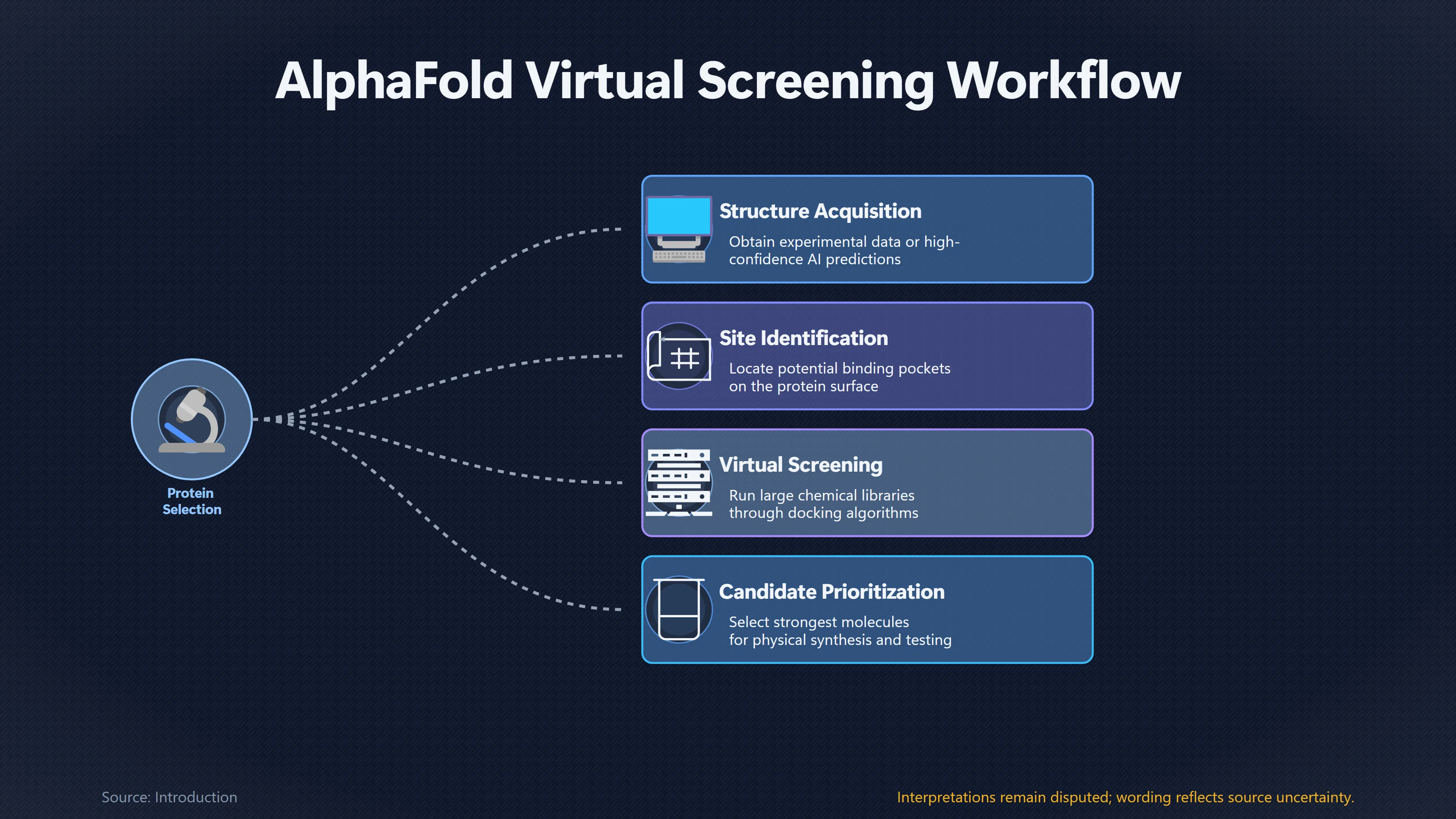
The workflow typically looks like this:
- Select a disease-associated protein.
- Obtain an experimental structure if available, or a high-confidence AlphaFold prediction.
- Identify possible binding sites.
- Virtually screen very large chemical libraries.
- Prioritise only the strongest candidates for synthesis and laboratory testing.
- Refine the best compounds using experimental feedback.
This does not guarantee that the highest-ranked molecules will succeed. Docking algorithms remain approximations, proteins move and change shape, and many biological factors cannot yet be predicted accurately. Nevertheless, reducing the number of compounds that require expensive synthesis and biochemical testing can substantially improve the efficiency of early-stage discovery.[nature.com]nature.comOpen source on nature.com.
For proteins that previously lacked structural information altogether, even an imperfect prediction may provide enough insight to begin rational screening rather than relying solely on broad empirical searches.
Better prioritisation rather than automatic discovery
One of the biggest changes is not scientific capability alone but research management.
Drug discovery programmes constantly face limited budgets, laboratory capacity and staff time. Every experiment performed means another cannot be. Predicted structures therefore act as a prioritisation tool.
Instead of treating every possible target equally, teams can rank opportunities according to factors such as:
- structural confidence;
- presence of druggable binding pockets;
- compatibility with known classes of compounds;
- biological importance;
- availability of complementary experimental evidence.
The result is often a smaller set of experiments with higher expected value.
This shift matters because early drug discovery contains enormous uncertainty. Many projects fail long before clinical trials. Improving the quality of early decisions—even modestly—can save considerable resources across large research portfolios.
In this sense, AlphaFold changes the economics of experimentation more than the chemistry itself. It helps researchers spend laboratory effort where it is most informative.

Choosing when experimental structure solving is still essential
A common misunderstanding is that predicted structures eliminate the need for experimental structural biology. In reality, the opposite is often true: AI predictions help laboratories decide where experimental work will have the greatest scientific payoff.
Experimental techniques remain essential when researchers need to know:
- the precise geometry of a drug-binding site;
- how proteins change shape during activity;
- how proteins interact with other proteins, DNA, RNA or membranes;
- the influence of ligands, metal ions or chemical modifications;
- whether a prediction is accurate in a biologically relevant environment.
Proteins are dynamic rather than rigid objects. Many adopt several conformations, and those conformations can determine whether a drug binds successfully. AlphaFold frequently predicts one highly probable structure, but biological function often depends on movement between multiple states.[nature.com]nature.comOpen source on nature.com.
Consequently, crystallography, cryo-electron microscopy, nuclear magnetic resonance spectroscopy and other experimental approaches continue to provide information that prediction models cannot yet replace.
Real examples of AI narrowing experimental search
Early case studies suggest that predicted structures can reduce the number of compounds requiring laboratory synthesis.
For example, researchers have reported using AlphaFold-derived models during hit discovery for previously poorly characterised targets such as CDK20. In that work, AI-supported target analysis, generative chemistry and experimental validation produced candidate inhibitors after synthesising relatively few compounds compared with traditional exploratory programmes. Although this represents an early proof of concept rather than a mature industry standard, it illustrates how predicted structures can help concentrate laboratory effort on more promising hypotheses.[arXiv]arxiv.orgAlphaFold Accelerates Artificial Intelligence Powered Drug Discovery: Efficient Discovery of a Novel Cyclin-dependent Kinase 20 (CDK…
Across industry more broadly, pharmaceutical companies increasingly combine AlphaFold predictions with molecular docking, molecular dynamics simulations, medicinal chemistry and biological assays rather than relying on any single AI model. The prediction becomes one component of an iterative design-test-learn cycle.
Where the approach still reaches its limits
Several important limitations prevent predicted structures from becoming automatic drug-design tools.
First, structural confidence varies across proteins and even within different regions of the same protein. Flexible loops and intrinsically disordered regions are often predicted with lower reliability.[AlphaFold]alphafold.ebi.ac.ukOpen source on ebi.ac.uk.
Second, drug binding frequently depends on subtle conformational changes. A protein may adopt several biologically relevant shapes, while AlphaFold commonly predicts only one dominant arrangement. Researchers increasingly combine AlphaFold with molecular dynamics simulations and additional modelling methods to explore these alternative states.[arXiv]arxiv.orgEmpowering AlphaFold2 for protein conformation selective drug discovery with AlphaFold2-RAVEApril 10, 2024…
Third, many successful medicines depend on interactions involving protein complexes, membranes, metabolites or post-translational modifications that remain challenging to model completely.
Finally, successful virtual screening does not guarantee biological success. Molecules that appear promising computationally may prove unstable, toxic or ineffective once tested in cells, animals or humans.
For these reasons, AI predictions are best understood as tools for prioritising hypotheses, not validating them.

Why faster prioritisation matters for AI-enabled scientific acceleration
Within the broader AI Bloom perspective, the significance of predicted protein structures lies less in replacing scientists than in increasing the productivity of scientific research itself.
Drug discovery is often constrained by the number of experiments laboratories can realistically perform. If AI consistently helps researchers discard weaker ideas earlier, identify stronger targets sooner and focus expensive laboratory resources where they are most informative, the cumulative effect could be substantial. Individual projects may save weeks or months, while entire research portfolios become more efficient over years.
That does not guarantee dramatically faster medical breakthroughs. Clinical trials, manufacturing, regulation and the complexity of human biology remain major bottlenecks. Yet AlphaFold demonstrates a broader pattern that may become increasingly important: AI can compress the search space of science, allowing human researchers to spend less time looking for promising experiments and more time performing the ones most likely to advance knowledge.[ebi.ac.uk]ebi.ac.ukEMBL-EBIValidation and impact | Alpha FoldEMBL-EBIValidation and impact | Alpha Fold
Amazon book picks
Further Reading
Books and field guides related to How Alpha Fold Changes Which Experiments Get Done. Use these as the next step if you want deeper reading beyond the article.
Protein Structure and Function
Each title in the 'Primers in Biology' series is constructed on a modular principle that is intended to make them easy to teach from, to...
The Drug Hunters
The surprising, behind-the-scenes story of how our medicines are discovered, told by a veteran drug hunter. The search to find medicines...

Drug Discovery
First published 1985. Subjects: Drugs, Science, Nonfiction, Chemistry, Pharmaceutical Preparations.

The eighth day of creation
First published 1969. Subjects: DNA, Molecular biology, Histoire, Biología molecular, Historia.
eBay marketplace picks
Marketplace Samples
Live-tested eBay searches with available results related to this page.
Selected fromscience poster oneBay.co.uk.


Endnotes
1.
Source: ebi.ac.uk
Title: EMBL-EBIAlpha Fold | EMBL-EBI Training
Link:https://www.ebi.ac.uk/training/online/courses/alphafold
2.
Source: nature.com
Link:https://www.nature.com/articles/s41592-023-02087-4
3.
Source: arxiv.org
Title: arXiv Recent Developments in Structure-Based Virtual Screening Approaches
Link:https://arxiv.org/abs/2211.03208
4.
Source: ebi.ac.uk
Title: EMBL-EBIHow to assess the quality of [Alpha Fold]({{ ‘alpha-fold/’ | relative_url }}) 3 predictions | Alpha Fold
Link:https://www.ebi.ac.uk/training/online/courses/alphafold/alphafold-3-and-alphafold-server/how-to-assess-the-quality-of-alphafold-3-predictions/
5.
Source: arxiv.org
Link:https://arxiv.org/abs/2201.09647
Source snippet
AlphaFold Accelerates Artificial Intelligence Powered Drug Discovery: Efficient Discovery of a Novel Cyclin-dependent Kinase 20 (CDK...
6.
Source: arxiv.org
Link:https://arxiv.org/abs/2404.07102
Source snippet
Empowering AlphaFold2 for protein conformation selective drug discovery with AlphaFold2-RAVEApril 10, 2024...
Published: April 10, 2024
7.
Source: ebi.ac.uk
Title: EMBL-EBIValidation and impact | Alpha Fold
Link:https://www.ebi.ac.uk/training/online/courses/alphafold/validation-and-impact/
8.
Source: reuters.com
Link:https://www.reuters.com/technology/google-deepmind-unveils-next-generation-drug-discovery-ai-model-2024-05-08/
Source snippet
Building on its 2020 breakthrough in predicting protein behaviors, the new AlphaFold can now map behaviors for all molecules in life, inc...
9.
Source: nature.com
Title: Assessing accuracy of Alpha Fold2 | Nature Reviews Drug Discovery
Link:https://www.nature.com/articles/d41573-024-00090-8
10.
Source: nature.com
Link:https://www.nature.com/articles/s41592-022-01685-y
11.
Source: nature.com
Title: What does Alpha Fold mean for drug discovery? | Nature Reviews Drug Discovery
Link:https://www.nature.com/articles/d41573-021-00161-0
12.
Source: nature.com
Title: Highly accurate protein structure prediction for the human proteome | Nature
Link:https://www.nature.com/articles/s41586-021-03828-1
13.
Source: embl.org
Title: thornton alphafold
Link:https://www.embl.org/news/science/thornton-alphafold/
14.
Source: nature.com
Title: Highly accurate protein structure prediction with Alpha Fold | Nature
Link:https://www.nature.com/articles/s41586-021-03819-2
15.
Source: embl.org
Title: alphafold protein structure
Link:https://www.embl.org/news/science/alphafold-protein-structure/
16.
Source: youtube.com
Title: Alpha Fold: The 50-year grand challenge cracked by AI
Link:https://www.youtube.com/watch?v=r4-hXO7MLVU
Source snippet
AI as a tool for science - EMBL-EBI and AlphaFold - Google DeepMind...
17.
Source: youtube.com
Link:https://www.youtube.com/watch?v=JLXkkHaFxGw
Source snippet
AlphaFold - The Most Useful Thing AI Has Ever Done...
18.
Source: youtube.com
Title: Alpha Fold
Link:https://www.youtube.com/watch?v=P_fHJIYENdI
19.
Source: alphafold.ebi.ac.uk
Link:https://www.alphafold.ebi.ac.uk/faq
21.
Source: biorxiv.org
Link:https://www.biorxiv.org/content/10.1101/2025.04.07.647682v1
22.
Source: ebi.ac.uk
Link:https://www.ebi.ac.uk/training/online/courses/alphafold/inputs-and-outputs/evaluating-alphafolds-predicted-structures-using-[confidence-scores
23.
Source: ebi.ac.uk
Link:https://www.ebi.ac.uk/training/online/courses/alphafold/inputs-and-outputs/evaluating-alphafolds-predicted-structures-using-confidence-scores/
25.
Source: ebi.ac.uk
Link:https://www.ebi.ac.uk/training/online/courses/alphafold/validation-and-impact/how-accurate-are-alphafold-structure-predictions/
26.
Source: sciencedirect.com
Title: Alpha Fold, allosteric, and orthosteric drug discovery: Ways forward
Link:https://www.sciencedirect.com/science/article/pii/S1359644623000673
Additional References
27.
Source: youtube.com
Title: The Quest to ‘Solve All Diseases’ with AI: Isomorphic Labs’ Max Jaderberg
Link:https://www.youtube.com/watch?v=LrMKsBtx5Bc
Source snippet
Artificial intelligence tool AlphaFold revolutionizes the search for new medicines...
28.
Source: youtube.com
Title: AI as a tool for science
Link:https://www.youtube.com/watch?v=70E7Q_g-eiU
Source snippet
The Quest to 'Solve All Diseases' with AI: Isomorphic Labs' Max Jaderberg...
29.
Source: pubs.acs.org
Link:https://pubs.acs.org/doi/10.1021/acs.jcim.6c01038
Source snippet
of Alphafold Protein Models for Small-Molecule Ligand Docking versus Co-Folding | Journal of Chemical Information and Modeling | ACS Publ...
30.
Source: sciencedirect.com
Link:https://www.sciencedirect.com/science/article/pii/S2667318526000152
31.
Source: neuro-psycho-group.github.io
Link:https://neuro-psycho-group.github.io/AlphaFold/pages/5-confidence.html
32.
Source: biorxiv.org
Link:https://www.biorxiv.org/content/10.64898/2026.01.04.697577v1
33.
Source: sciencedirect.com
Title: How good are Alpha Fold models for docking-based virtual screening?
Link:https://www.sciencedirect.com/science/article/pii/S2589004222021939
34.
Source: spj.science.org
Link:https://spj.science.org/doi/10.1016/j.csbr.2025.100057
35.
Source: pubmed.ncbi.nlm.nih.gov
Link:https://pubmed.ncbi.nlm.nih.gov/36621153/
36.
Source: pubmed.ncbi.nlm.nih.gov
Link:https://pubmed.ncbi.nlm.nih.gov/38036854/