Within Research Take off
Can AI Coding Speed Up Discovery?
AI coding assistants are becoming part of AI development, providing early evidence about whether automation can increase research productivity.
On this page
- How AI coding tools enter research
- Evidence from machine learning engineering tasks
- Limits of current productivity gains
Page outline Jump by section
Introduction
AI coding systems are among the clearest early tests of whether AI can accelerate the work of creating better AI. The optimistic case for an AI-enabled research boom does not depend only on models becoming more capable; it depends on whether AI can help researchers and engineers move faster. Coding assistants and software-engineering agents provide a measurable way to examine that possibility because modern AI research is heavily dependent on writing code, running experiments, managing data pipelines, and improving complex systems.
The evidence so far points to a meaningful but incomplete acceleration. AI coding tools can reduce time spent on routine programming, help researchers explore more ideas, and increasingly perform parts of machine-learning engineering. However, current systems remain unreliable on difficult, open-ended research tasks, and the strongest gains often come from human experts directing AI rather than from fully autonomous AI scientists.[microsoft.com]microsoft.comThe Impact of AI on Developer Productivity: Evidence from Git Hub CopilotThe Impact of AI on Developer Productivity: Evidence from GitHub Copilot - Microsoft Research…
For the long-term AI bloom vision, the important question is therefore not whether AI can write code. It is whether coding assistance becomes a pathway towards faster scientific discovery: more experiments attempted, more researchers empowered, and shorter cycles between ideas and working systems.
How AI coding tools enter research
Machine learning research is unusually dependent on software. A new model idea often requires implementing architectures, preparing datasets, writing training pipelines, running experiments, analysing results, and debugging failures. This creates many opportunities where AI coding systems could reduce friction.
Traditional coding assistants mainly helped with autocomplete, small functions, documentation, and debugging. Newer “coding agents” go further: they can read a repository, create files, run tests, execute commands, revise their own output, and complete multi-step programming tasks with less direct instruction. The difference matters because research acceleration depends less on producing isolated lines of code and more on handling entire workflows.
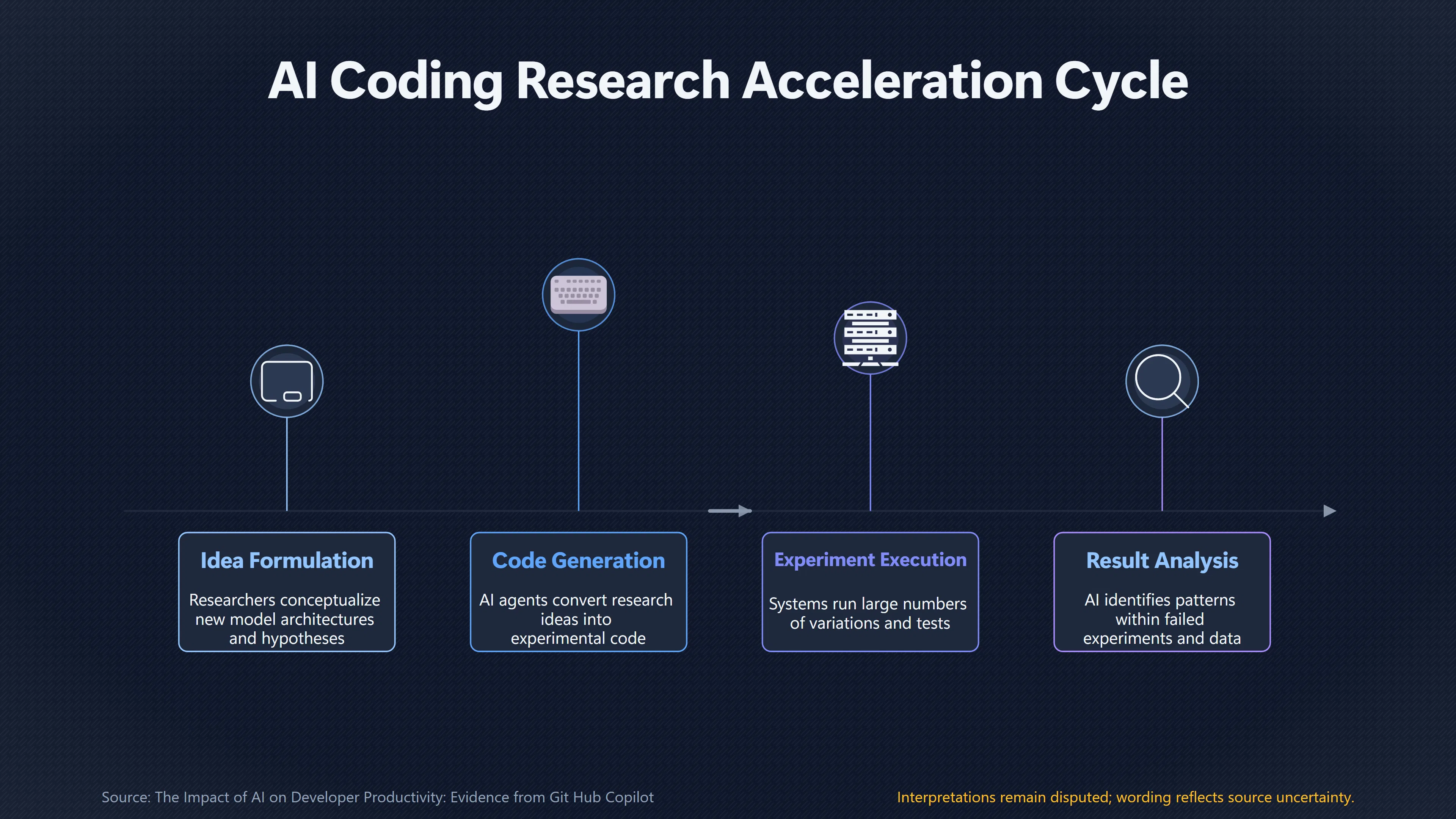
A useful way to think about the potential is as a shift from AI as a typing assistant to AI as a junior research engineer. Such a system could help with tasks such as:
- converting a research idea into experimental code;
- reproducing results from published papers;
- modifying existing machine-learning systems;
- searching through failed experiments for patterns;
- running large numbers of variations faster than a human team could manage.
This is the mechanism that connects coding systems to the wider question of AI-driven scientific acceleration. If AI can shorten the “idea → experiment → result” cycle, researchers may be able to test more possibilities and discover better methods more quickly.
Early evidence suggests that this process has begun, but it is not yet equivalent to autonomous research. Benchmarks and real-world studies show progress in software engineering and machine-learning tasks, while also revealing significant limits on reliability and independent problem solving.[OpenAI]OpenAIMLE-bench: Evaluating Machine Learning Agents on Machine Learning Engineering | OpenAI…
What productivity studies show about AI-assisted coding
The strongest evidence for near-term impact comes from controlled studies of human developers using AI coding assistants.
A Microsoft Research study examining GitHub Copilot tested developers completing a JavaScript programming task. Developers with access to Copilot completed the task substantially faster than those without it, with the study reporting a 55.8% reduction in completion time. The researchers also found variation between users, suggesting that AI assistance does not simply add the same amount of value for everyone.[microsoft.com]microsoft.comThe Impact of AI on Developer Productivity: Evidence from Git Hub CopilotThe Impact of AI on Developer Productivity: Evidence from GitHub Copilot - Microsoft Research…
A separate enterprise-focused randomised trial involving Google software engineers found that AI assistance reduced time spent on a complex software task, estimating an effect of around 21%, although the authors cautioned that results from one environment should not automatically be generalised to all software work.[arXiv]arxiv.orgHow much does AI impact development speed? An enterprise-based randomized controlled trialOctober 16, 2024…
These findings support a cautious conclusion: AI coding tools can increase individual productivity, especially for tasks involving implementation, exploration, and repetitive work. They do not yet demonstrate that entire engineering organisations can simply move twice as fast.
This distinction matters for research acceleration. A scientist who saves time writing experiment code may not automatically produce breakthroughs. The bottleneck may move elsewhere: choosing promising ideas, interpreting results, obtaining computing resources, or designing experiments that genuinely test new hypotheses.
Machine-learning engineering benchmarks reveal the next step
The more important evidence for AI take-off speed comes from systems that attempt machine-learning engineering itself.
OpenAI’s MLE-bench was designed specifically to measure whether AI agents could perform realistic machine-learning engineering tasks. The benchmark collected 75 Kaggle competitions involving activities such as dataset preparation, model training, and experimental optimisation. The strongest tested setup achieved at least a Kaggle bronze-medal level in 16.9% of competitions, showing that AI agents could solve a meaningful minority of practical ML engineering challenges, but were far from replacing expert researchers.[OpenAI]OpenAIMLE-bench: Evaluating Machine Learning Agents on Machine Learning Engineering | OpenAI…
Another benchmark, MLAgentBench, tested AI agents on machine-learning experimentation tasks, including improving model performance and carrying out research-style workflows. Results showed that agents could perform useful actions such as editing code, running experiments, and inspecting outputs, but success varied considerably depending on the difficulty and structure of the task.[Proceedings of Machine Learning Research]proceedings.mlr.pressOpen source on mlr.press.
These results are important because they move the discussion beyond simple coding speed. The relevant question is not “Can AI generate code?” but “Can AI reliably conduct the iterative engineering process that produces better science?”
Current evidence suggests partial capability:
- Strongest today: writing routine code, adapting existing examples, debugging common problems, creating experiment scaffolding.
- Promising but unreliable: modifying research code, optimising models, exploring experimental variations.
- Still difficult: deciding which research direction is valuable, creating genuinely new methods, and independently managing complex research programmes.
The gap between coding help and autonomous discovery
The most significant limitation is that research is not just programming. Scientific progress requires judgement about what questions matter and why a result is meaningful.
Recent evaluations of research-extension ability highlight this gap. RExBench tested whether AI coding agents could extend existing machine-learning papers by implementing new research ideas in existing codebases. The benchmark found that current agents failed on most tasks without substantial human guidance, with the best systems achieving success rates well below what would be required for independent research engineering.[ACL Anthology]aclanthology.orgACL AnthologyRExBench: Can coding agents autonomously implement AI research extensions? - ACL Anthology…
This suggests that present-day coding agents are better understood as force multipliers than autonomous scientists. They can amplify researchers who already understand the problem, but they do not yet consistently replace the creative and strategic parts of research.
The distinction is central to the intelligence explosion debate. A rapid acceleration scenario would require AI systems to contribute increasingly to the entire improvement cycle: identifying opportunities, designing experiments, implementing changes, evaluating results, and repeating the process. Coding ability is an important piece of that cycle, but not the whole chain.
Where the evidence points for AI research acceleration
The strongest evidence supports a gradual acceleration pathway rather than an immediate runaway feedback loop.
AI coding systems could contribute to faster scientific progress in several ways:
More experiments per researcher.
If researchers spend less time implementing ideas, they can test more hypotheses. Even modest improvements could compound across thousands of research teams.
Lower barriers to participation.
Researchers who are strong in biology, mathematics, medicine, or other fields but weaker in programming may be able to use AI coding tools to build computational experiments themselves. This could broaden who can participate in AI-assisted discovery.
Faster iteration inside AI labs.
Because AI development itself depends heavily on software engineering, better coding assistance could shorten development cycles for future systems.
More reproducible research.[github.blog]github.blogResearch: How Git Hub Copilot helps improve developer productivityResearch: How Git Hub Copilot helps improve developer productivity
AI agents that can reproduce papers, run experiments, and check implementations could improve scientific reliability as well as speed.
However, these benefits depend on surrounding systems. More generated code does not automatically mean more discoveries. Research organisations still need good evaluation methods, computing access, expert judgement, and incentives that reward genuine progress rather than simply producing more outputs.
The evidence gap: acceleration is real, but its scale remains uncertain
AI coding systems provide some of the clearest early evidence that AI can increase knowledge-work productivity. They show that parts of research engineering can be automated and that humans working with AI can sometimes complete tasks substantially faster.
But the evidence does not yet show a self-sustaining intelligence explosion. Current systems struggle with long-horizon tasks, make errors that require expert correction, and often depend on humans providing direction, context, and evaluation. More demanding software benchmarks continue to expose these weaknesses, especially when tasks require many coordinated steps across complex codebases.[arXiv]arxiv.orgSWE-Bench Pro: Can AI Agents Solve Long-Horizon Software Engineering Tasks?September 21, 2025…
For the AI bloom possibility, coding systems should therefore be viewed as an early indicator rather than proof of a coming transformation. They demonstrate a plausible mechanism: AI helping humans build faster, which could help civilisation discover and create more quickly. The unresolved question is how far that mechanism can scale — from assistance with individual tasks to genuine automation of large parts of scientific progress.
Amazon book picks
Further Reading
Books and field guides related to Can AI Coding Speed Up Discovery?. Use these as the next step if you want deeper reading beyond the article.
Co-Intelligence: Living and Working with AI
**A New York Times Bestseller** 'Co-Intelligence is the very best book I know about the ins, outs, and ethics of generative AI. Drop ever...
Artificial Intelligence: A Modern Approach
Rating: 4.5/5 from 10 Google Books ratings
Artificial intelligence: A Modern Approach, 3e,is ideal for one or two-semester, undergraduate or graduate-level courses in Artificial In...
The Coming Wave: Technology, Power, and the Twenty-first Cent...
"We are approaching a critical threshold in the history of our species. Everything is about to change. Soon you will live surrounded by A...
Deep Learning
Rating: 3.5/5 from 6 Google Books ratings
An introduction to a broad range of topics in deep learning, covering mathematical and conceptual background, deep learning techniques us...
eBay marketplace picks
Marketplace Samples
Live-tested eBay searches with available results related to this page.
Selected fromcomputer science poster oneBay.co.uk.




Endnotes
1.
Source: microsoft.com
Title: The Impact of AI on Developer Productivity: Evidence from Git Hub Copilot
Link:https://www.microsoft.com/en-us/research/publication/the-impact-of-ai-on-developer-productivity-evidence-from-github-copilot/
Source snippet
The Impact of AI on Developer Productivity: Evidence from GitHub Copilot - Microsoft Research...
2.
Source: OpenAI
Link:https://openai.com/index/mle-bench/
Source snippet
MLE-bench: Evaluating Machine Learning Agents on Machine Learning Engineering | OpenAI...
3.
Source: arxiv.org
Link:https://arxiv.org/abs/2410.12944
Source snippet
How much does AI impact development speed? An enterprise-based randomized controlled trialOctober 16, 2024...
Published: October 16, 2024
4.
Source: arxiv.org
Link:https://arxiv.org/abs/2509.16941
Source snippet
SWE-Bench Pro: Can AI Agents Solve Long-Horizon Software Engineering Tasks?September 21, 2025...
Published: September 21, 2025
5.
Source: scale.com
Title: swe atlas complete
Link:https://scale.com/blog/swe-atlas-complete
6.
Source: github.blog
Title: Does Git Hub Copilot improve code quality? Here’s what the data says
Link:https://github.blog/news-insights/research/does-github-copilot-improve-code-quality-heres-what-the-data-says/
7.
Source: OpenAI
Title: introducing swe bench verified
Link:https://openai.com/index/introducing-swe-bench-verified/
8.
Source: github.blog
Title: Research: Quantifying Git Hub Copilot’s impact in the enterprise with Accenture
Link:https://github.blog/news-insights/research/research-quantifying-github-copilots-impact-in-the-enterprise-with-accenture/
9.
Source: github.blog
Link:https://github.blog/news-insights/research/the-economic-impact-of-the-ai-powered-developer-lifecycle-and-lessons-from-github-copilot/
10.
Source: github.blog
Link:https://github.blog/news-insights/research/research-quantifying-github-copilots-impact-on-developer-productivity-and-happiness/
11.
Source: github.blog
Title: Research: How Git Hub Copilot helps improve developer productivity
Link:https://github.blog/news-insights/research/research-how-github-copilot-helps-improve-developer-productivity/
12.
Source: rexbench.com
Link:https://rexbench.com/
13.
Source: github.com
Title: Git Hub
Link:https://github.com/openai/mle-bench/
15.
Source: github.com
Title: Git Hub
Link:https://github.com/benettia/github-copilot-survey
16.
Source: github.com
Title: Git Hub
Link:https://github.com/swe-bench/SWE-bench
17.
Source: swe-agent-bench.github.io
Link:https://swe-agent-bench.github.io/original.html
18.
Source: microsoft.com
Link:https://www.microsoft.com/en-us/research/?p=894132
19.
Source: proceedings.mlr.press
Link:https://proceedings.mlr.press/v235/huang24y.html
20.
Source: aclanthology.org
Link:https://aclanthology.org/2026.acl-long.745/
Source snippet
ACL AnthologyRExBench: Can coding agents autonomously implement AI research extensions? - ACL Anthology...
21.
Source: arxiv.deeppaper.ai
Link:https://arxiv.deeppaper.ai/papers/2507.03156v1
22.
Source: doi.org
Link:https://doi.org/10.48550/ARXIV.2410.07095
23.
Source: proceedings.mlr.press
Title: press Infi Agent-DABench: Evaluating Agents on Data Analysis Tasks
Link:https://proceedings.mlr.press/v235/hu24s.html
Additional References
24.
Source: emergentmind.com
Title: MLAgent Bench: Benchmark for ML Experimentation Agents
Link:https://www.emergentmind.com/topics/mlagentbench
Source snippet
MLAgentBench: Benchmark for ML Experimentation AgentsJuly 4, 2026 — MLAGENTBENCH: BENCHMARK FOR ML EXPERIMENTATION AGENTS Updated 4 July...
Published: July 4, 2026
25.
Source: anthropic.com
Title: How Claude Code is used in practice \ Anthropic
Link:https://www.anthropic.com/research/claude-code-expertise?level=0
Source snippet
June 16, 2026 — AGENTIC CODING AND PERSISTENT RETURNS TO EXPERTISE Jun 16, 2026 Read in PDF Image: Agentic coding and persistent returns...
Published: June 16, 2026
26.
Source: youtube.com
Title: Measuring the impact of AI on software engineering – with Laura Tacho
Link:https://www.youtube.com/watch?v=xHHlhoRC8W4
Source snippet
Has This Report EXPOSED THE TRUTH About AI Assisted Software Development?...
27.
Source: youtube.com
Title: Developer productivity on Git Hub Copilot (w/ Eirini Kalliamvakou)
Link:https://www.youtube.com/watch?v=dZ11xA4sUFQ
Source snippet
Measuring the impact of AI on software engineering – with Laura Tacho...
28.
Source: youtube.com
Title: Has This Report EXPOSED THE TRUTH About AI Assisted Software Development?
Link:https://www.youtube.com/watch?v=CoGO6s7bS3A
Source snippet
How to Make the Best of AI Programming Assistants...
29.
Source: nature.com
Title: An AI system to help scientists write expert-level empirical software | Nature
Link:https://www.nature.com/articles/s41586-026-10658-6
30.
Source: nature.com
Title: Are Chat GPT and Alpha Code going to replace programmers? | Nature
Link:https://www.nature.com/articles/d41586-022-04383-z
31.
Source: researchgate.net
Link:https://www.researchgate.net/publication/381504160_Significant_Productivity_Gains_through_Programming_with_Large_Language_Models
32.
Source: researchgate.net
Link:https://www.researchgate.net/publication/381609417_The_impact_of_GitHub_Copilot_on_developer_productivity_from_a_software_engineering_body_of_knowledge_perspective
33.
Source: alphaxiv.org
Link:https://www.alphaxiv.org/abs/2606.11456