Within Alpha Fold
Why a Predicted Protein Shape Is Not Proof
AlphaFold usually predicts one likely shape, but real proteins move, bind partners and change state in ways that still require experiments.
On this page
- The missing dynamics of moving proteins
- Complexes, binding effects and cellular conditions
- Why structural accuracy does not validate a drug target
Page outline Jump by section
Introduction
AlphaFold has transformed structural biology by predicting the three-dimensional shapes of millions of proteins with remarkable accuracy. That achievement has accelerated early-stage drug discovery and made structural information available to researchers who might otherwise have waited years for experimental data. Yet one of the most common misunderstandings is that an accurate prediction has made laboratory structural biology unnecessary.
It has not. A predicted protein structure is a sophisticated scientific hypothesis, not proof of how a protein behaves inside a living cell. Real proteins move, change shape, bind to other molecules, undergo chemical modifications and respond to their environment. Experimental techniques such as X-ray crystallography, cryo-electron microscopy (cryo-EM) and nuclear magnetic resonance (NMR) spectroscopy remain essential because they reveal which structural states actually exist, how often they occur, and whether those structures are biologically relevant. This distinction matters not only for today’s drug discovery but also for the broader vision of AI accelerating science: faster hypotheses only become medical advances when experiments confirm them.[EMBL-EBI]ebi.ac.ukEMBL-EBIStrengths and limitations of Alpha Fold 2 | Alpha FoldEMBL-EBIStrengths and limitations of Alpha Fold 2 | Alpha Fold
A predicted structure is a model, not a measurement
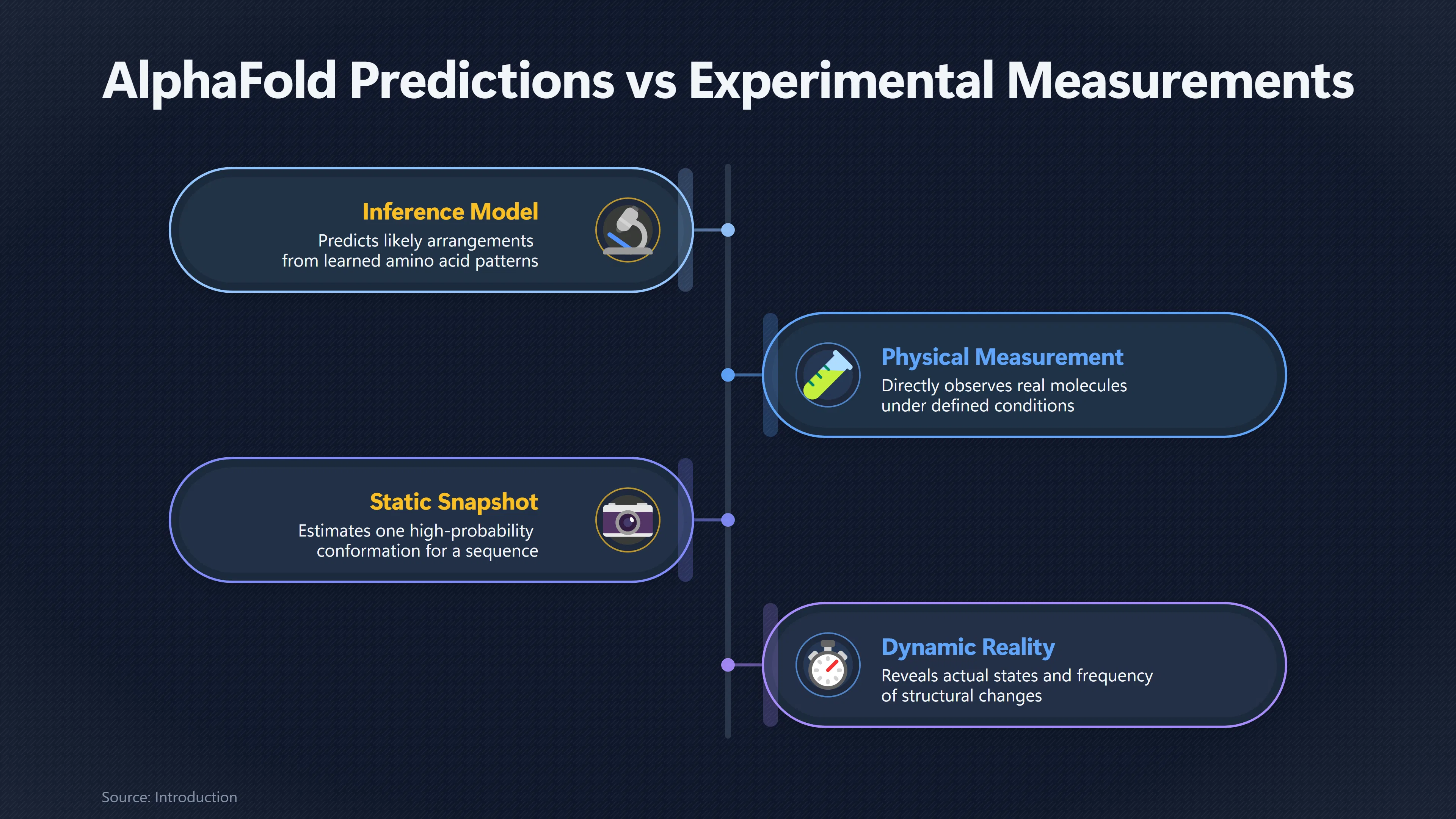
Experimental structural biology directly measures physical molecules. X-ray crystallography analyses diffraction from protein crystals, cryo-EM reconstructs structures from images of frozen particles, and NMR examines proteins in solution through magnetic interactions. Each technique observes real molecules under defined conditions.
AlphaFold takes a fundamentally different approach. It predicts the most likely three-dimensional arrangement of a protein from its amino acid sequence by recognising patterns learned from known structures. The result is often extraordinarily accurate, but it is still an inference rather than a direct observation.[EMBL-EBI]ebi.ac.ukOpen source on ebi.ac.uk.
This distinction affects how scientists interpret results:
- An experimental structure demonstrates that a particular conformation was observed.
- An AlphaFold prediction estimates what one likely conformation could be.
- Experimental data include measurable evidence that can be independently verified.
- AlphaFold provides confidence scores indicating where the prediction is likely to be reliable and where uncertainty is higher, rather than proving that every region is correct.[EMBL-EBI]ebi.ac.ukEMBL-EBIStrengths and limitations of Alpha Fold 2 | Alpha FoldEMBL-EBIStrengths and limitations of Alpha Fold 2 | Alpha Fold
For researchers, this difference means predicted structures are excellent starting points for designing experiments, not replacements for them.
The missing dynamics of moving proteins
Perhaps the biggest limitation of AlphaFold is that proteins are not rigid objects.
Many proteins constantly switch between multiple shapes as they carry out their biological functions. Enzymes open and close around substrates. Ion channels alternate between open and closed states. Receptors change conformation after binding hormones or drugs. Molecular motors cycle through several structural arrangements during movement.
AlphaFold generally predicts a single high-probability structure for a given sequence. That snapshot may correspond to one biologically relevant state, but it does not capture the entire functional landscape.[EMBL-EBI]ebi.ac.ukEMBL-EBIStrengths and limitations of Alpha Fold 2 | Alpha FoldEMBL-EBIStrengths and limitations of Alpha Fold 2 | Alpha Fold
This matters because medicines often work by stabilising one particular conformation rather than another. A drug may bind only to the active state, only to the inactive state, or only to a transient intermediate that exists briefly during a protein’s activity.
Experimental techniques remain the primary way to determine:
- which conformations actually occur;
- how frequently they occur;
- how rapidly proteins switch between them;
- how those changes influence biological function.
Without this information, researchers may understand a protein’s overall shape but still misunderstand how it performs its job.
Complexes, binding effects and cellular conditions
Proteins rarely act alone. Inside cells they interact continuously with other proteins, DNA, RNA, metal ions, lipids, sugars and countless small molecules.
These interactions frequently alter protein structure. Binding partners may stabilise one conformation, expose hidden binding sites or trigger large structural rearrangements.
Classic examples include:
- enzymes that close around their substrates;
- receptors that activate after ligand binding;
- signalling proteins assembled into large molecular complexes;
- membrane proteins whose orientation depends on the surrounding lipid membrane.
Standard AlphaFold models were originally trained primarily on individual protein chains and therefore do not directly account for much of this biological context. Although AlphaFold-Multimer and AlphaFold 3 have expanded the kinds of interactions that can be modelled, important limitations remain, especially for dynamic assemblies and context-dependent conformational changes.[EMBL-EBI]ebi.ac.ukEMBL-EBIStrengths and limitations of Alpha Fold 2 | Alpha FoldEMBL-EBIStrengths and limitations of Alpha Fold 2 | Alpha Fold
Experimental methods reveal these interactions directly by observing proteins in complexes, under different chemical conditions or alongside their natural binding partners.
Biology adds layers that sequence alone cannot predict
Protein sequence is only part of the biological story.
Cells chemically modify proteins after they are produced through processes known as post-translational modifications. These include phosphorylation, glycosylation, acetylation and many others that influence activity, stability and cellular location.
Likewise, proteins exist in environments that vary in:
- acidity (pH);
- salt concentration;
- temperature;
- oxidation state;
- molecular crowding;
- membrane composition.
Each of these factors can alter structure or function.
Standard AlphaFold predictions generally do not model these context-specific influences directly. Consequently, an apparently accurate predicted structure may differ from the form that predominates inside a living cell.[EMBL-EBI]ebi.ac.ukEMBL-EBIStrengths and limitations of Alpha Fold 2 | Alpha FoldEMBL-EBIStrengths and limitations of Alpha Fold 2 | Alpha Fold

Why structural accuracy does not validate a drug target
One of the easiest mistakes is assuming that an accurate structure automatically makes a protein a good drug target.
Drug discovery asks several separate questions:
- Does the protein contribute to disease?
- Will changing its activity benefit patients?
- Can a medicine bind safely and selectively?
- Does altering the protein improve clinical outcomes?
AlphaFold addresses only a small part of this chain by helping researchers understand structural possibilities.
Even a perfectly predicted structure cannot establish:
- whether the protein causes disease rather than merely being associated with it;
- whether inhibiting or activating it is therapeutically beneficial;
- whether the target is accessible inside the body;
- whether interfering with it produces unacceptable side effects.
Those questions require genetics, cell biology, animal studies and ultimately carefully controlled human clinical trials.
This is why structural prediction accelerates drug discovery but cannot replace the experimental pipeline that determines whether a treatment actually works.

Experimental structures uncover unexpected biology
Laboratory methods frequently reveal surprises that prediction alone cannot anticipate.
Researchers may discover:
- previously unknown binding partners;
- unexpected protein assemblies;
- alternative conformations;
- flexible regions that become ordered only after binding;
- structural changes caused by mutations;
- rare but biologically important states.
Some proteins also contain intrinsically disordered regions that do not adopt one stable structure at all. Rather than representing a failure, AlphaFold often signals these regions with low confidence, alerting researchers that flexibility itself may be biologically important. Experimental work is then needed to determine how those regions behave in living systems.[EMBL-EBI]ebi.ac.ukEMBL-EBIStrengths and limitations of Alpha Fold 2 | Alpha FoldEMBL-EBIStrengths and limitations of Alpha Fold 2 | Alpha Fold
These discoveries often lead to new biological insights that would have been difficult to infer from a single predicted structure.
The complementary future of AI and structural biology
Rather than replacing experimental structural biology, AlphaFold has changed where experiments are most valuable.
Instead of spending months solving structures that can now be predicted with high confidence, researchers can focus expensive laboratory techniques on the hardest and most informative problems:
- proteins with multiple functional states;
- large molecular complexes;
- flexible and disordered proteins;
- membrane proteins;
- disease-associated mutations;
- drug-bound structures;
- unusual or poorly characterised proteins.
This shifts experimental effort from routine structure determination towards understanding biological mechanism.
That pattern illustrates a broader lesson for AI-enabled scientific acceleration. Systems like AlphaFold make discovery faster by generating strong hypotheses at unprecedented scale. Human researchers then test those hypotheses against reality, refine them and determine which ideas withstand experimental scrutiny. The scientific bottleneck moves from generating candidate explanations to validating them rigorously.
For medicine, that partnership is far more powerful than either approach alone. AI reduces the time needed to identify promising directions, while experiments provide the evidence needed to transform structural predictions into reliable biology and, eventually, safe and effective treatments.[embl.org]embl.orgthornton alphafoldAccessible 3D protein models to accelerate scientific discovery | EMBLJuly 22, 2021…
Amazon book picks
Further Reading
Books and field guides related to Why a Predicted Protein Shape Is Not Proof. Use these as the next step if you want deeper reading beyond the article.
The Drug Hunters: The Improbable Quest to Discover New Medicines
The surprising, behind-the-scenes story of how our medicines are discovered, told by a veteran drug hunter. The search to find medicines...
The Structure of Scientific Revolutions
A good book may have the power to change the way we see the world, but a great book actually becomes part of our daily consciousness, per...
The Gene: An Intimate History
Prologue: Families -- "The missing science of heredity" 1865-1935 -- "In the sum of the parts, there are only the parts" 1930-1970 -- "Th...

Deep Medicine: How Artificial Intelligence Can Make Healthcar...
First published 2019. Subjects: Artificial intelligence, Medical informatics, Medical applications, Diagnosis, Data processing.
eBay marketplace picks
Marketplace Samples
Live-tested eBay searches with available results related to this page.
Selected frommolecular model oneBay.co.uk.

Current eBay listing
Molecular Models Set XMM-066 Model Kit Science Teaching Tool 240 PCs
Current eBay listing
Molecular Models Set XMM-066 Model Kit Science Teaching Tool 240 PCs
Endnotes
1.
Source: ebi.ac.uk
Title: EMBL-EBIStrengths and limitations of [Alpha Fold]({{ ‘alpha-fold/’ | relative_url }}) 2 | Alpha Fold
Link:https://www.ebi.ac.uk/training/online/courses/alphafold/an-introductory-guide-to-its-strengths-and-limitations/strengths-and-limitations-of-alphafold/
2.
Source: ebi.ac.uk
Title: EMBL-EBIAlpha Fold | EMBL-EBI Training
Link:https://www.ebi.ac.uk/training/online/courses/alphafold/
3.
Source: ebi.ac.uk
Link:https://www.ebi.ac.uk/training/online/courses/alphafold/an-introductory-guide-to-its-strengths-and-limitations/
4.
Source: ebi.ac.uk
Title: EMBL-EBIWhat Alpha Fold 3 struggles with | Alpha Fold
Link:https://www.ebi.ac.uk/training/online/courses/alphafold/alphafold-3-and-alphafold-server/introducing-alphafold-3/what-alphafold-3-struggles-with/
5.
Source: ebi.ac.uk
Title: EMBL-EBIGreat expectations – the potential impacts of Alpha Fold DB | EMBL-EBI
Link:https://www.ebi.ac.uk/about/news/perspectives/alphafold-potential-impacts/
6.
Source: embl.org
Title: thornton alphafold
Link:https://www.embl.org/news/science/thornton-alphafold/
Source snippet
Accessible 3D protein models to accelerate scientific discovery | EMBLJuly 22, 2021...
Published: July 22, 2021
7.
Source: embl.org
Title: sameer velankar alphafold training
Link:https://www.embl.org/news/people-perspectives/sameer-velankar-alphafold-training/
8.
Source: embl.org
Title: alphafold community applications
Link:https://www.embl.org/news/science/alphafold-community-applications/
10.
Source: ebi.ac.uk
Link:https://www.ebi.ac.uk/training/online/courses/alphafold/future-directions-and-summary/key-takeaways-about-alphafold/
Additional References
11.
Source: frontiersin.org
Link:https://www.frontiersin.org/journals/artificial-intelligence/articles/10.3389/frai.2026.1739303/full
Source snippet
However, it continues to pose obstacles in the field of structural biology research. These challen...
12.
Source: wired.com
Title: deepmind protein folding database
Link:https://www.wired.com/story/deepmind-protein-folding-database
Source snippet
The company has released over 350,000 protein structures, including most of the human proteome. This massive database, freely available t...
13.
Source: youtube.com
Title: Biochemistry Unfolded (e. 17): Confidently Wrong
Link:https://www.youtube.com/watch?v=qY6TeSfdABM
Source snippet
Biochemistry Focus webinar series – AlphaFold 2 structure modelling: access, uses and limitations...
14.
Source: pmc.ncbi.nlm.nih.gov
Link:https://pmc.ncbi.nlm.nih.gov/articles/PMC12956938/
Source snippet
2025 Dec 1;45(1):22–38. doi: 10.1007/s10930-025-10310-8 ADVANTAGES AND LIMITATIONS OF ALPHAFOLD IN STRUCTURAL BIOLOGY: INSIGHTS FROM RECE...
15.
Source: nature.com
Link:https://www.nature.com/articles/s41592-023-02087-4
16.
Source: youtube.com
Title: How to interpret Alpha Fold structures
Link:https://www.youtube.com/watch?v=UqeQfRDA8Yk
Source snippet
Coffee with EMBL #16: DeepMind and the Future of AI in Life Sciences (Part 1)...
17.
Source: youtube.com
Link:https://www.youtube.com/watch?v=T4Rl8OK_S-0
Source snippet
Scope and vision of AlphaFold...
18.
Source: scienceopen.com
Link:https://www.scienceopen.com/document?vid=334c5861-cbf8-457b-be27-f70b941c8ef9
19.
Source: alphafold.ebi.ac.uk
Link:https://alphafold.ebi.ac.uk/
20.
Source: youtube.com
Title: Coffee with EMBL #16: Deep Mind and the Future of AI in Life Sciences (Part 1)
Link:https://www.youtube.com/watch?v=ac5jGEmDu6I