Within Superintelligence
What evidence supports an intelligence explosion?
The intelligence explosion debate depends on evidence about AI capabilities, bottlenecks and whether current progress can continue at much faster rates.
On this page
- Current signals of accelerating capability
- Limits in measuring future progress
- Competing views on rapid take off
Page outline Jump by section
Introduction
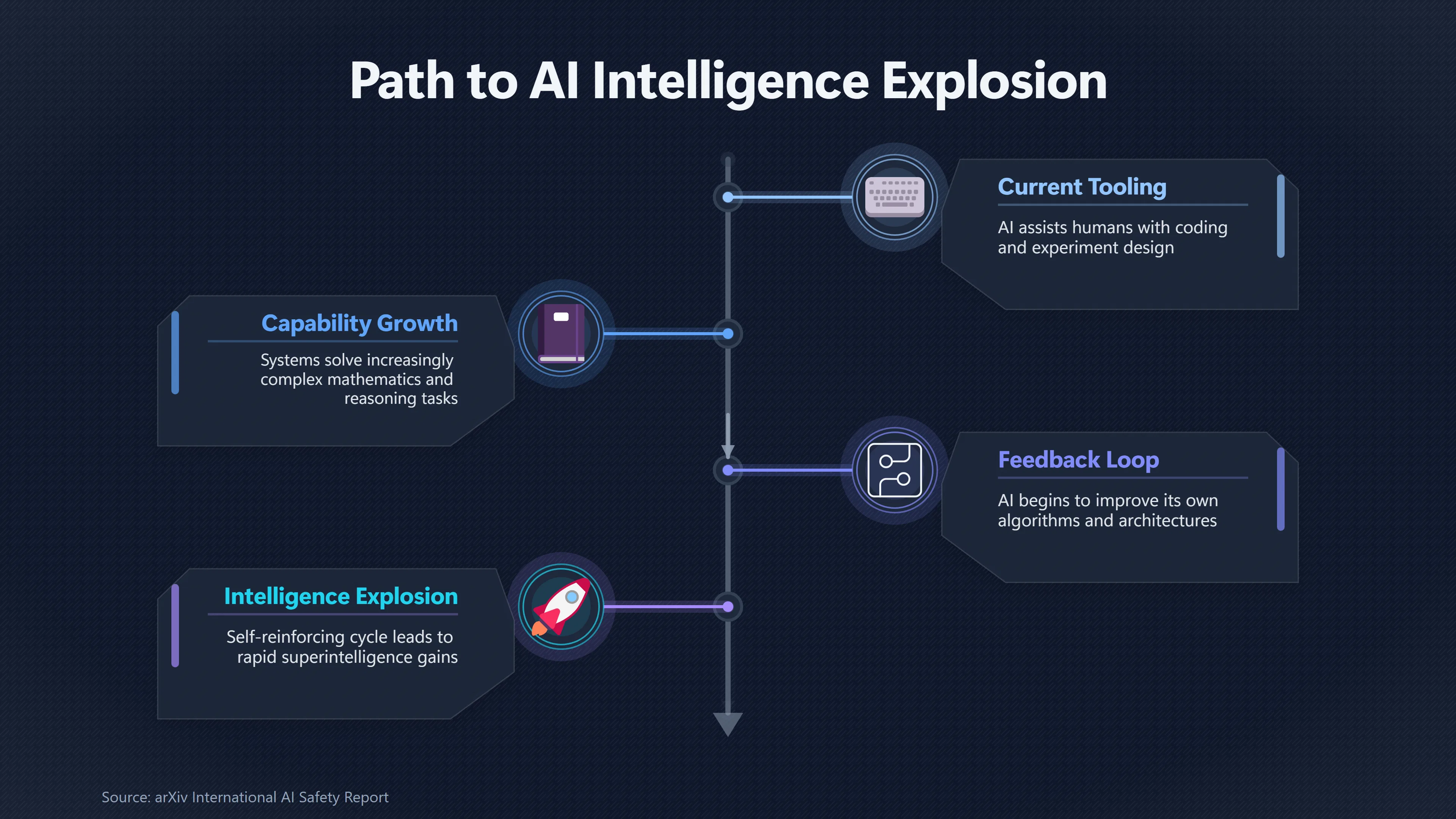
An intelligence explosion is a possibility, not an established outcome. The evidence supporting it comes from several trends: AI systems have improved rapidly across language, coding, mathematics and scientific tasks; the cost of achieving certain levels of performance has fallen; and newer AI agents are becoming better at completing longer, multi-step tasks. These developments suggest that AI may become a powerful accelerator of research and invention. However, they do not yet prove that AI can enter a self-reinforcing cycle of rapid improvement leading to superintelligence. The key uncertainty is whether today’s progress trends can continue when systems face harder problems, physical constraints, reliability challenges and the difficulty of building AI systems that can reliably improve themselves.[International AI Safety Report]internationalaisafetyreport.orginternational ai safety report 2025International AI Safety ReportInternational AI Safety Report 2025 | International AI Safety ReportJanuary 29, 2025…
The intelligence explosion debate is therefore less about whether AI is advancing and more about how far those advances can compound. Evidence exists for faster capability growth, but the crucial transition—from powerful tools that assist humans to systems that substantially accelerate AI development itself—remains unconfirmed.
Current signals of accelerating capability
AI systems are improving across increasingly complex tasks
One important reason some researchers consider an intelligence explosion plausible is that AI progress has moved beyond narrow pattern recognition into broader problem-solving abilities. Modern general-purpose AI systems have shown strong improvements in areas such as software development, mathematics, scientific assistance and reasoning tasks. The International AI Safety Report notes that recent systems have achieved major gains on expert-level benchmarks, including advanced mathematics and coding evaluations, while also emphasising that reliability remains uneven and benchmark success does not always translate into dependable real-world performance.[International AI Safety Report]internationalaisafetyreport.orgInternational AI Safety ReportFirst Key Update: Capabilities and Risk Implications | International AI Safety ReportOctober 15, 2025…
A particularly relevant development is the rise of AI agents: systems designed not only to answer questions but to complete sequences of actions. The Measurement and Evaluation of Task-Completion for AI (METR) has attempted to measure this by estimating the length of software and research tasks that AI agents can complete with a given probability of success. Its evaluations suggest that the duration of tasks frontier models can handle has increased rapidly over recent years, although the organisation stresses that these measurements have limits and should not be treated as a direct forecast of superintelligence.[Metr]metr.orgTask-Completion Time Horizons of Frontier AI ModelsTask-Completion Time Horizons of Frontier AI Models - METRMay 8, 2026…
This matters for the intelligence explosion debate because a system that can complete longer and more complex research tasks could potentially contribute more to AI development itself. An AI that helps write code, analyse experiments, improve algorithms or manage research workflows could increase the speed of future AI progress. The unresolved question is whether these gains will create a strong feedback loop or simply provide better assistance to human researchers.
Efficiency gains suggest progress is not only about bigger computers
Another signal supporting rapid progress is improvement in algorithmic efficiency. AI advances have not come only from adding more computing power. Researchers studying algorithmic progress in language models have found substantial reductions in the amount of computation needed to reach particular performance levels, with estimated efficiency improvements occurring much faster than traditional hardware improvements alone would suggest.[arXiv]arxiv.orgarXiv Algorithmic progress in language modelsAlgorithmic progress in language modelsMarch 9, 2024…
This supports the idea that future progress may come from unexpected breakthroughs in methods, not just larger training runs. Better algorithms, improved reasoning techniques, specialised systems and more effective use of computing resources could all extend the capabilities of AI systems.
However, efficiency improvements are difficult to extrapolate. Past gains may not continue indefinitely, and some breakthroughs may produce temporary jumps rather than a continuous acceleration. A history of rapid progress does not automatically establish a permanent upward curve.
Limits in measuring future progress
Benchmarks reveal progress but do not fully measure intelligence
A major challenge in assessing an intelligence explosion is that “intelligence” is difficult to measure. AI benchmarks often test specific abilities: answering questions, writing code, solving mathematical problems or completing structured tasks. These measures provide useful evidence, but they may not capture the broader qualities required for autonomous scientific discovery or recursive self-improvement.
The International AI Safety Report highlights this measurement problem: current AI systems can outperform humans on some evaluations while still showing weaknesses in areas requiring robust understanding, reliability and flexible adaptation. Researchers continue to debate how well benchmark improvements represent genuine general capability gains.[International AI Safety Report]internationalaisafetyreport.orginternational ai safety report 2025International AI Safety ReportInternational AI Safety Report 2025 | International AI Safety ReportJanuary 29, 2025…
For the intelligence explosion hypothesis, this distinction is crucial. A system that achieves impressive scores on tests may still struggle to conduct open-ended research, identify important questions, manage long projects or make consistently reliable decisions.
Capability growth may slow as problems become harder
Rapid progress in recent years does not guarantee equally rapid progress in the future. Early advances in AI benefited from scaling—training larger models with more data and computing resources—but future systems may face harder bottlenecks.
Possible constraints include:
- Limited high-quality data: Many AI systems are trained on large collections of human-generated information, but useful new data is not unlimited.
- Computing and energy requirements: Larger and more capable systems require substantial infrastructure, including advanced chips and electricity.
- Engineering complexity: Building reliable AI agents that can operate over long periods may be much harder than improving performance on short tasks.
- Scientific uncertainty: Researchers may not yet know which methods are needed for major leaps beyond current approaches.
These limits do not rule out an intelligence explosion, but they weaken simple arguments based only on past growth rates. A trend line from recent years cannot by itself prove that future progress will accelerate indefinitely.

Why recursive improvement is the key uncertainty
The strongest evidence for an intelligence explosion would not simply be better AI models. It would be evidence that AI systems can significantly speed up the process of creating better AI systems.
Today, AI already assists with programming, research summaries, experiment design and technical problem-solving. The possible future transition is from AI as a productivity tool to AI as a major contributor to AI research itself.
A gradual version of this process is already visible: researchers use AI tools to write code, analyse results and explore ideas faster. The more dramatic intelligence explosion scenario requires something stronger—a feedback loop where AI systems meaningfully improve algorithms, architectures, training methods or research processes faster than humans could alone.
The evidence for this stronger claim remains limited. Current AI systems can help with parts of research, but they are not yet clearly autonomous AI scientists capable of directing their own improvement. The gap between “AI helps researchers” and “AI drives a rapid technological acceleration” is the central empirical question.
Competing views on rapid take-off
The case for a faster intelligence explosion
Supporters of the intelligence explosion hypothesis argue that several trends could combine:
- AI capabilities are improving faster than many earlier expectations.
- Software-based improvements can spread quickly once discovered.
- AI systems can potentially be copied, deployed and improved at a scale unavailable to biological intelligence.
- Research itself may become faster if AI systems become capable assistants.
From this perspective, even a modest increase in AI’s ability to contribute to research could have large effects. Scientific discovery, engineering design and software development are information-processing activities, so improving the speed of those activities could accelerate progress across many fields.
This argument is especially relevant to the wider AI bloom vision: if AI can accelerate discovery, it could help address major human challenges such as disease, clean energy, material shortages and scientific bottlenecks. But achieving these benefits depends on whether capability growth is matched by safety, governance and broad access.
The case for slower or limited take-off
Sceptics argue that intelligence is not simply a quantity that can be increased without limit. Human researchers rely on physical experiments, institutions, judgement, social coordination and accumulated knowledge. AI systems may encounter similar constraints.
They also point to current weaknesses. Advanced models can produce incorrect answers, fail unexpectedly, struggle with long-term planning and require significant human oversight. The International AI Safety Report notes that current systems have uneven capabilities and that safety evaluations remain incomplete, making it difficult to predict how future systems will behave.[International AI Safety Report]internationalaisafetyreport.orginternational ai safety report 2025International AI Safety ReportInternational AI Safety Report 2025 | International AI Safety ReportJanuary 29, 2025…
Another concern is that improvements may become harder over time. Early AI advances may have exploited relatively accessible gains, while future progress could require deeper scientific breakthroughs. Under this view, AI may continue to transform society without producing a sudden intelligence explosion.
What evidence would change the debate?
The intelligence explosion debate will likely be shaped by evidence about several specific capabilities:
- Autonomous AI research: Can AI systems independently produce useful advances in AI algorithms, training methods or architectures?
- Long-horizon reliability: Can AI agents complete complex projects lasting days, weeks or months with limited supervision?
- Scientific discovery: Can AI systems generate and validate genuinely new scientific knowledge?
- Self-improvement feedback loops: Do AI-assisted improvements meaningfully accelerate the creation of more capable AI systems?
- Economic impact: Do improvements translate into large increases in real-world productivity and innovation?
Current evidence points in a mixed direction. AI progress is substantial and accelerating in some areas, but the decisive evidence for an intelligence explosion has not appeared. The most responsible assessment is neither that rapid take-off is inevitable nor that it is impossible. Instead, the evidence suggests a future with significant uncertainty, where continued advances could either produce a powerful acceleration of human capability or encounter substantial technical and practical limits.
For the AI bloom question, this uncertainty is central. A flourishing future depends not only on whether AI becomes more capable, but on whether humanity can guide those capabilities towards broad scientific progress, abundance, resilience and improved human wellbeing.
Amazon book picks
Further Reading
Books and field guides related to What evidence supports an intelligence explosion?. Use these as the next step if you want deeper reading beyond the article.
The Coming Wave: Technology, Power, and the Twenty-first Cent...
"We are approaching a critical threshold in the history of our species. Everything is about to change. Soon you will live surrounded by A...
Superintelligence: Paths, Dangers, Strategies
This profoundly ambitious and original book picks its way carefully through a vast tract of forbiddingly difficult intellectual terrain.
Life 3.0: Being Human in the Age of Artificial Intelligence
'This is the most important conversation of our time, and Tegmark's thought-provoking book will help you join it' Stephen Hawking THE INT...
The AI Revolution in Medicine: GPT-4 and Beyond
AI is about to transform medicine. Here's what you need to know right now. ''The development of AI is as fundamental as the creation of t...
eBay marketplace picks
Marketplace Samples
Live-tested eBay searches with available results related to this page.
Selected fromfuturistic art print oneBay.co.uk.




Endnotes
1.
Source: arxiv.org
Title: arXiv International AI Safety Report
Link:https://arxiv.org/abs/2501.17805
2.
Source: metr.org
Title: Task-Completion Time Horizons of Frontier AI Models
Link:https://metr.org/time-horizons/
Source snippet
Task-Completion Time Horizons of Frontier AI Models - METRMay 8, 2026...
Published: May 8, 2026
3.
Source: metr.org
Link:https://metr.org/research/
Source snippet
Research - METR...
4.
Source: arxiv.org
Title: arXiv Algorithmic progress in language models
Link:https://arxiv.org/abs/2403.05812
Source snippet
Algorithmic progress in language modelsMarch 9, 2024...
Published: March 9, 2024
5.
Source: metr.org
Title: Time Horizon 1.1
Link:https://metr.org/blog/2026-1-29-time-horizon-1-1/?%3F%3F%3Futm_source=content
6.
Source: techgov.intelligence.org
Title: catch up algorithmic progress might actually be 60x per year
Link:https://techgov.intelligence.org/blog/catch-up-algorithmic-progress-might-actually-be-60x-per-year
7.
Source: metr.org
Link:https://metr.org/index.html
8.
Source: metr.org
Link:https://metr.org/?source=4dayweek.io
9.
Source: metr.org
Link:https://metr.org/?trk=public_post_main-feed-card-text
10.
Source: internationalaisafetyreport.org
Title: international ai safety report 2025
Link:https://internationalaisafetyreport.org/publication/international-ai-safety-report-2025
Source snippet
International AI Safety ReportInternational AI Safety Report 2025 | International AI Safety ReportJanuary 29, 2025...
Published: January 29, 2025
11.
Source: internationalaisafetyreport.org
Link:https://internationalaisafetyreport.org/publication/first-key-update-capabilities-and-risk-implications
Source snippet
International AI Safety ReportFirst Key Update: Capabilities and Risk Implications | International AI Safety ReportOctober 15, 2025...
Published: October 15, 2025
12.
Source: internationalaisafetyreport.org
Title: Publications | International AI Safety Report
Link:https://internationalaisafetyreport.org/publications
13.
Source: internationalaisafetyreport.org
Title: International AI Safety Report
Link:https://internationalaisafetyreport.org/
14.
Source: internationalaisafetyreport.org
Title: international ai safety report 2026
Link:https://internationalaisafetyreport.org/publication/international-ai-safety-report-2026
15.
Source: internationalaisafetyreport.org
Link:https://internationalaisafetyreport.org/publication/second-key-update-technical-safeguards-and-risk-management
16.
Source: GOV.UK
Title: international ai safety report 2025
Link:https://www.gov.uk/government/publications/international-ai-safety-report-2025/international-ai-safety-report-2025
17.
Source: futuretech.mit.edu
Title: algorithmic progress in language models
Link:https://futuretech.mit.edu/publication/algorithmic-progress-in-language-models
18.
Source: internationalaisafetyreport.org
Link:https://internationalaisafetyreport.org/about
Additional References
19.
Source: aiwiki.ai
Title: Chinchilla scaling laws | AI Wiki
Link:https://aiwiki.ai/wiki/chinchilla_scaling
Source snippet
July 23, 2026 — Chinchilla scaling laws CHINCHILLA SCALING LAWS AI ResearchDeep LearningLarge Language ModelsMachine Learning 25 min read...
Published: July 23, 2026
20.
Source: youtube.com
Link:https://www.youtube.com/watch?v=5MnnuHX7Yd4
Source snippet
AI's “Intelligence Explosion” Is Coming. Here's What That Means...
21.
Source: aiwiki.ai
Title: Scaling Laws | AI Wiki
Link:https://aiwiki.ai/wiki/scaling_laws
Source snippet
July 23, 2026 — THE CHINCHILLA SCALING LAWS (2022) In March 2022, Jordan Hoffmann, Sebastian Borgeaud, Arthur Mensch, Elena Buchatskaya...
Published: July 23, 2026
22.
Source: un.org
Title: preliminary report
Link:https://www.un.org/independent-international-scientific-panel-ai/en/preliminary-report
Source snippet
Independent International Scientific Panel on AIJuly 1, 2026 — PRELIMINARY REPORT Image: Mockup of the Preliminary Report of the Independ...
Published: July 1, 2026
23.
Source: youtube.com
Title: The RSI Ignition How AI Starts Improving Itself
Link:https://www.youtube.com/watch?v=T9QAf6eM_3M
Source snippet
Recursive Self-Improvement (RSI) Concepts, Tech Trends, Commercialization Ecosystem, Security Risks...
24.
Source: youtube.com
Title: AI’s “Intelligence Explosion” Is Coming. Here’s What That Means
Link:https://www.youtube.com/watch?v=C1kuCIr_6MI
Source snippet
Who Controls the Intelligence Explosion?...
25.
Source: deepnlp.org
Link:https://www.deepnlp.org/content/articles/an-empirical-analysis-of-compute-optimal-large-language-model-training
26.
Source: datafield.dev
Link:https://datafield.dev/aibook/part-04/chapter-22/
27.
Source: amazon.science
Link:https://www.amazon.science/blog/making-llms-faster-without-sacrificing-accuracy?tag=searcht-20
28.
Source: zeroentropy.dev
Link:https://zeroentropy.dev/concepts/scaling-laws/