Within Health
Can AI Bring Specialist Screening to the Clinic?
Autonomous retinal screening can raise completion rates by moving diagnosis into routine diabetes visits instead of relying on specialist referrals.
On this page
- How autonomous retinal screening works
- Why same visit testing changes patient follow through
- Accuracy, referral capacity and equitable access
Page outline Jump by section
Introduction
Artificial intelligence is unlikely to replace ophthalmologists, but it can help ensure that many more people actually receive the eye examinations they already need. Autonomous retinal screening systems are designed to detect diabetic eye disease during an ordinary diabetes appointment, without waiting for a specialist to review every image. This matters because diabetic retinopathy is one of the leading causes of preventable blindness, yet large numbers of people never complete their recommended annual screening. The biggest barrier is often not the accuracy of diagnosis but the difficulty of getting patients from a primary care clinic to an eye specialist.
Within the wider vision of AI-enabled healthy longevity, this is an important example of how medical AI can extend specialist expertise beyond specialist clinics. Rather than creating a new treatment, autonomous eye examinations improve access to an existing preventive service. Earlier detection means more people can receive laser treatment, medication or closer monitoring before permanent vision loss develops, while ophthalmologists can focus their time on patients who genuinely need specialist care.[Diabetes Journals]diabetesjournals.orgDiabetes JournalsClinical Implementation of Autonomous Artificial Intelligence Systems for Diabetic Eye Exams: Considerations for Success…
Can AI bring specialist screening to the clinic?
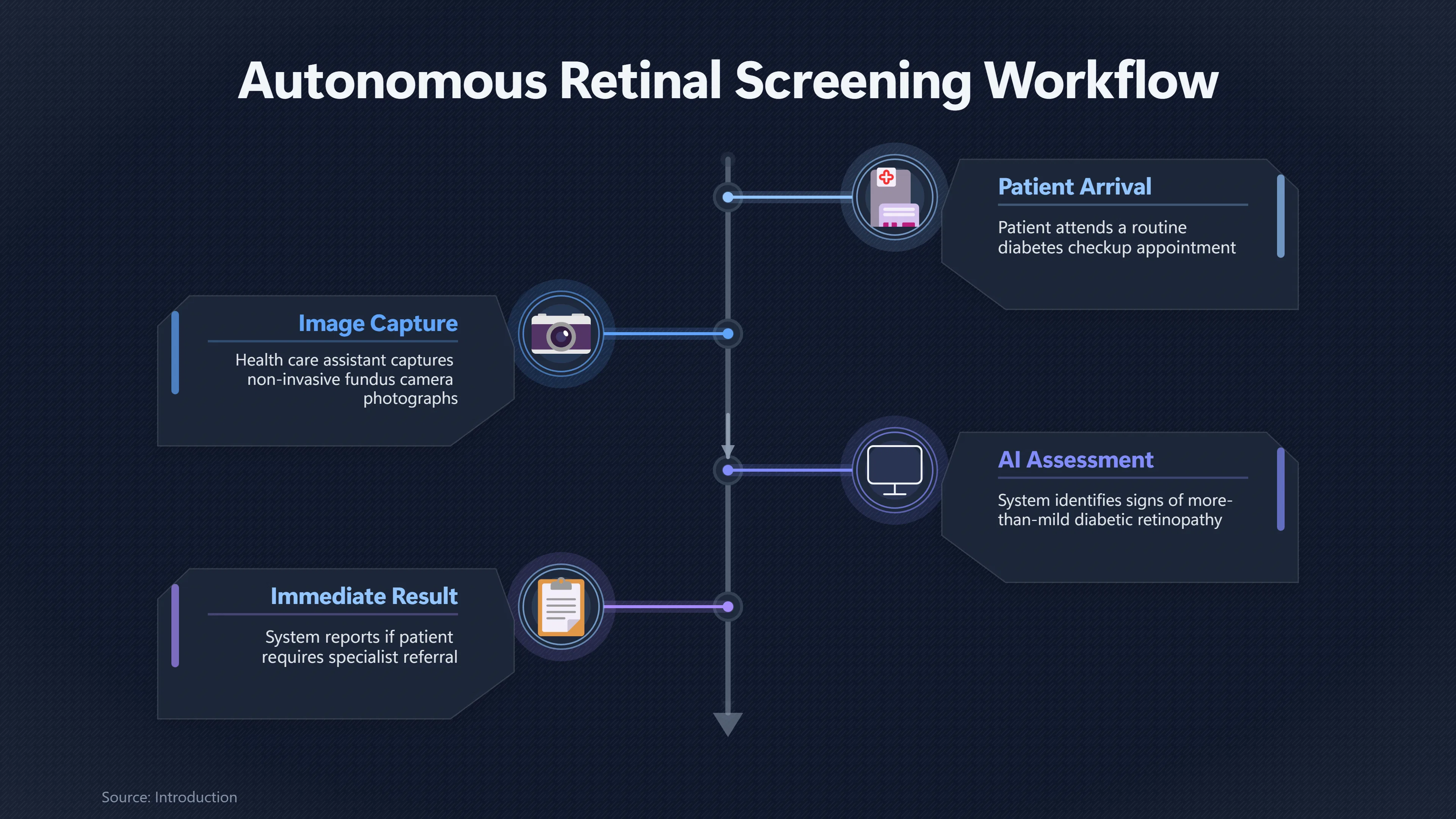
Autonomous retinal screening combines a retinal camera with an AI system that has been independently validated and authorised to make a clinical screening decision without requiring a specialist to examine every image. During a routine diabetes visit, a healthcare assistant or nurse captures photographs of the retina using a non-invasive fundus camera. The AI assesses whether there are signs of more-than-mild diabetic retinopathy or whether the images are of insufficient quality, and immediately reports whether the patient should be referred to an eye specialist.
This differs from earlier computer-aided systems that merely assisted clinicians. An autonomous system produces the screening result itself within an approved clinical workflow, allowing primary care practices, diabetes clinics and community health centres to offer eye screening without having an ophthalmologist on site. The specialist remains essential for confirming diagnoses, managing treatment and caring for patients with positive findings, but no longer needs to review every normal examination.[Diabetes Journals]diabetesjournals.orgDiabetes JournalsClinical Implementation of Autonomous Artificial Intelligence Systems for Diabetic Eye Exams: Considerations for Success…
The practical consequence is that retinal screening can become another routine element of diabetes care, much like measuring blood pressure or checking blood glucose, instead of a separate appointment that patients must arrange elsewhere.
Why same-visit testing changes patient follow-through
The greatest benefit of autonomous eye examinations comes from changing the patient’s journey rather than simply changing the diagnostic technology.
Traditional diabetic retinopathy screening often involves several steps:[youtube.com]youtube.comAI-Driven Diabetic Retinopathy Screening…
- a diabetes appointment;
- referral to an optometrist or ophthalmologist;
- booking another appointment;
- travelling to a different clinic;
- attending screening weeks or months later.
Every additional step creates opportunities for patients to delay or abandon screening. Time off work, transport difficulties, childcare, cost, anxiety and simple forgetfulness all reduce attendance.
Same-visit AI screening removes many of these barriers. The examination happens while the patient is already present for diabetes care. If the result is normal, reassurance is immediate. If the AI identifies disease, clinicians can explain the finding immediately and arrange referral before the patient leaves the clinic.
A randomised controlled trial involving young people with diabetes illustrates the size of this behavioural effect. Participants offered autonomous AI eye examinations during their diabetes appointment achieved a 100% screening completion rate, compared with only 22% among those receiving conventional referral and education alone. Patients with abnormal findings were also substantially more likely to complete follow-up with an eye specialist. The improvement came largely from eliminating missed referrals rather than from changing the underlying disease.[PubMed]pubmed.ncbi.nlm.nih.govAutonomous artificial intelligence increases screening and follow-up for diabetic retinopathy in youth: the ACCESS randomized contr…
Implementation studies have reached similar conclusions in adult practice. Clinics introducing autonomous screening into routine diabetes visits have reported marked increases in completed annual eye examinations because patients no longer need to organise a separate screening visit.[Diabetes Journals]diabetesjournals.orgQualified Health Center | Diabetes | American Diabetes AssociationJune 21, 2024…
Improving access where specialists are scarce
Many countries face a mismatch between the growing number of people living with diabetes and the limited supply of ophthalmologists and retinal specialists.
Autonomous screening changes how this limited workforce is used.
Instead of asking specialists to inspect every retinal photograph, AI filters the large proportion of patients whose examinations show no evidence of referable disease. Specialist attention can then be concentrated on patients most likely to require treatment.
This shift has several practical advantages:
- Greater screening capacity. Primary care clinics can examine more patients without expanding ophthalmology services at the same rate.
- Faster identification of disease. Patients needing urgent assessment can be referred immediately instead of waiting for delayed image review.
- Reduced unnecessary referrals. Patients with negative examinations avoid specialist appointments that add little value.
- More efficient use of expertise. Ophthalmologists spend more time treating disease and less time reviewing thousands of normal screening images.
One implementation study at a Federally Qualified Health Center in the United States illustrates these effects. After autonomous AI was introduced into routine diabetes care, annual diabetic eye examination completion increased from 16% to 35% over two years. Hundreds of patients received immediate screening in primary care, while only those with positive findings required referral to eye specialists.[Diabetes Journals]diabetesjournals.orgQualified Health Center | Diabetes | American Diabetes AssociationJune 21, 2024…

Accuracy is necessary, but implementation determines success
Most published evaluations show that modern autonomous diabetic retinopathy systems achieve high sensitivity for detecting referable disease while maintaining clinically useful specificity. However, implementation studies consistently argue that diagnostic accuracy alone does not determine success.
Several operational factors matter just as much:
- obtaining retinal photographs of sufficient quality;
- training nurses and clinic staff to capture images correctly;
- integrating AI results into electronic health records;
- creating clear referral pathways for positive findings;
- ensuring patients actually attend specialist follow-up.
Studies describing large-scale deployment emphasise that introducing autonomous AI into routine clinical practice often requires months of workflow redesign, staff education and coordination between primary care and ophthalmology services. AI is therefore best understood as one component of a redesigned screening pathway rather than a stand-alone technology.[Diabetes Journals]diabetesjournals.orgDiabetes JournalsClinical Implementation of Autonomous Artificial Intelligence Systems for Diabetic Eye Exams: Considerations for Success…
Importantly, autonomous systems generally identify patients who require further assessment—they do not replace comprehensive ophthalmic examination or treatment.
Can autonomous screening reduce health inequalities?
Screening programmes often fail to reach precisely those populations at greatest risk of vision loss. Rural communities, low-income populations, minority groups and people with limited access to specialist services are disproportionately likely to miss annual diabetic eye examinations.
Bringing AI screening into primary care clinics can narrow some of these gaps because the technology travels to patients instead of requiring patients to travel to specialists.
Emerging evidence suggests this can improve equity as well as overall screening rates. Studies involving diverse paediatric populations have found that point-of-care autonomous screening virtually eliminated differences in examination completion once the test became part of routine diabetes visits. More recent real-world analyses also suggest increased attendance at specialist follow-up among African American patients after implementation of autonomous AI-assisted screening in primary care, although further evaluation across different health systems is still needed.[Diabetes Journals]diabetesjournals.orgAmerican Diabetes AssociationJune 20, 2023…
These gains should not be overstated. AI cannot overcome every barrier to healthcare. Insurance coverage, transport, digital infrastructure, treatment availability and socioeconomic inequality continue to influence whether patients ultimately receive care.
What this means for healthy longevity
Autonomous retinal screening illustrates an important principle for AI medicine: increasing access to existing preventive care may produce larger population health gains than creating entirely new diagnostic technologies.
Diabetic retinopathy is often treatable if detected early but can cause irreversible blindness when diagnosis comes too late. The value of autonomous AI therefore lies less in outperforming ophthalmologists than in ensuring that many more people reach the point where specialist treatment is still effective.
Within the broader idea of AI supporting healthier and longer lives, this is a realistic near-term pathway. AI extends scarce clinical expertise into ordinary healthcare settings, shortens delays between risk detection and referral, and helps health systems cope with growing chronic disease burdens without requiring a proportional increase in specialist workforce.
It also illustrates a wider lesson for AI-enabled medicine. Progress is not measured only by algorithmic accuracy. The larger opportunity comes from redesigning healthcare pathways so that expert knowledge becomes available where patients already receive care. When implemented carefully, autonomous eye examinations demonstrate how AI can expand access to preventive medicine, preserve vision for more people and provide an early example of how intelligent systems might help make high-quality healthcare more widely available rather than simply more technologically sophisticated.

Amazon book picks
Further Reading
Books and field guides related to Can AI Bring Specialist Screening to the Clinic?. Use these as the next step if you want deeper reading beyond the article.

Deep Medicine: How Artificial Intelligence Can Make Healthcar...
First published 2019. Subjects: Artificial intelligence, Medical informatics, Medical applications, Diagnosis, Data processing.
The Digital Doctor: Hope, Hype, and Harm at the Dawn of Medic...
The New York Times Science Bestseller from Robert Wachter, Modern Healthcare’s #1 Most Influential Physician-Executive in the US While mo...
The Patient Will See You Now: The Future of Medicine Is in Yo...
A revolutionary argument for how putting patients in charge will make healthcare better for everyone
Complications: A Surgeon's Notes
In gripping accounts of true cases, surgeon Atul Gawande explores the power and the limits of medicine, offering an unflinching view from...
eBay marketplace picks
Marketplace Samples
Live-tested eBay searches with available results related to this page.
Selected frommedical poster oneBay.co.uk.


Endnotes
1.
Source: diabetesjournals.org
Link:https://diabetesjournals.org/clinical/article/42/1/142/153640/Clinical-Implementation-of-Autonomous-Artificial
Source snippet
Diabetes JournalsClinical Implementation of Autonomous Artificial Intelligence Systems for Diabetic Eye Exams: Considerations for Success...
2.
Source: pubmed.ncbi.nlm.nih.gov
Link:https://pubmed.ncbi.nlm.nih.gov/38212308/
Source snippet
Autonomous artificial intelligence increases screening and follow-up for diabetic retinopathy in youth: the ACCESS randomized contr...
3.
Source: pubmed.ncbi.nlm.nih.gov
Link:https://pubmed.ncbi.nlm.nih.gov/41140908/
Source snippet
Autonomous Artificial Intelligence in Diabetic Retinopathy Testing-Lessons Learned on Successful Health System Adoption - PubMed...
4.
Source: diabetesjournals.org
Link:https://diabetesjournals.org/diabetes/article/73/Supplement_1/57-OR/156635/57-OR-Enhancing-Diabetic-Eye-Disease-Detection
Source snippet
Qualified Health Center | Diabetes | American Diabetes AssociationJune 21, 2024...
Published: June 21, 2024
5.
Source: diabetesjournals.org
Link:https://diabetesjournals.org/diabetes/article/72/Supplement_1/110-OR/149364/110-OR-Autonomous-Artificial-Intelligence-Diabetic
Source snippet
American Diabetes AssociationJune 20, 2023...
Published: June 20, 2023
6.
Source: pmc.ncbi.nlm.nih.gov
Link:https://pmc.ncbi.nlm.nih.gov/articles/PMC13077085/
Source snippet
PubMed Central (PMC)Autonomous AI-assisted diabetic retinopathy screening at primary care is associated with increased presentation to ey...
7.
Source: pmc.ncbi.nlm.nih.gov
Link:https://pmc.ncbi.nlm.nih.gov/articles/PMC13212912/
Source snippet
2026 May 15;9:400. doi: 10.1038/s41746-026-02627-0 CLINICAL SETTING-DEPENDENT DIAGNOSTIC ACCURACY OF ARTIFICIAL INTELLIGENCE AND STORE-AN...
8.
Source: pubmed.ncbi.nlm.nih.gov
Link:https://pubmed.ncbi.nlm.nih.gov/42141103/
Source snippet
2026 May 15;9(1):400. doi: 10.1038/s41746-026-02627-0. CLINICAL SETTING-DEPENDENT DIAGNOSTIC ACCURACY OF ARTIFICIAL INTELLIGENCE AND STOR...
9.
Source: pubmed.ncbi.nlm.nih.gov
Title: We performed a Preferr
Link:https://pubmed.ncbi.nlm.nih.gov/42141103/?fc=20240423223220&ff=20260526105851&v=2.20.0
Source snippet
setting-dependent diagnostic accuracy of artificial intelligence and store-and-forward diabetic retinopathy screening: a systematic revie...
10.
Source: nationalscreening.blog.gov.uk
Link:https://nationalscreening.blog.gov.uk/2026/05/11/uk-nsc-consults-on-use-of-artificial-intelligence-in-the-diabetic-eye-screening-programme/
11.
Source: pubmed.ncbi.nlm.nih.gov
Link:https://pubmed.ncbi.nlm.nih.gov/41781569/
12.
Source: pmc.ncbi.nlm.nih.gov
Link:https://pmc.ncbi.nlm.nih.gov/articles/PMC12092458/
13.
Source: pmc.ncbi.nlm.nih.gov
Link:https://pmc.ncbi.nlm.nih.gov/articles/PMC12012971/
14.
Source: GOV.UK
Link:https://www.gov.uk/government/publications/diabetic-eye-screening-programme-standards/nhs-diabetic-eye-screening-pathway-standards-from-1st-october-2024-public-facing-guidance-information
Published: october 2024
15.
Source: diabetesjournals.org
Link:https://diabetesjournals.org/diabetes/article/73/Supplement_1/14-OR/156090/14-OR-Autonomous-Artificial-Intelligence-Diabetic
16.
Source: pubmed.ncbi.nlm.nih.gov
Link:https://pubmed.ncbi.nlm.nih.gov/38438095/
17.
Source: pmc.ncbi.nlm.nih.gov
Link:https://pmc.ncbi.nlm.nih.gov/articles/PMC10784572/
18.
Source: pmc.ncbi.nlm.nih.gov
Link:https://pmc.ncbi.nlm.nih.gov/articles/PMC10788651/
19.
Source: view-health-screening-recommendations.service.gov.uk
Title: Diabetic retinopathy
Link:https://view-health-screening-recommendations.service.gov.uk/diabetic-retinopathy/
Additional References
20.
Source: youtube.com
Link:https://www.youtube.com/watch?v=_ANdpTkAiA4
Source snippet
Dr. Alvin Liu, Johns Hopkins Medicine| Scaling Autonomous AI for Diabetic Retinopathy...
21.
Source: youtube.com
Link:https://www.youtube.com/watch?v=2jLYQGaBMSc
Source snippet
LumineticsCore™ Engineered by Digital Diagnostics: [Early Detection]({{ 'early-detection/' | relative_url }}) of Diabetic Retinopathy Using AI...
22.
Source: youtube.com
Link:https://www.youtube.com/watch?v=NzxXX0jZPDQ
Source snippet
AI-Driven Diabetic Retinopathy Screening...
23.
Source: nature.com
Link:https://www.nature.com/articles/s41433-020-01240-z
24.
Source: nature.com
Link:https://www.nature.com/articles/s41746-026-02460-5
25.
Source: nature.com
Link:https://www.nature.com/articles/s41746-024-01197-3
26.
Source: nature.com
Link:https://www.nature.com/articles/s41467-023-44676-z
27.
Source: nature.com
Link:https://www.nature.com/articles/s41746-024-01389-x
28.
Source: nature.com
Link:https://www.nature.com/articles/s41746-026-02616-3
29.
Source: youtube.com
Title: Autonomous AI for Diabetic Retinopathy Screening
Link:https://www.youtube.com/watch?v=AUlv_GmR-KU
Source snippet
Michael Abramoff, EURETINA 2019 - AI-based diabetic retinopathy screening...