Within Labour Share
When AI Tasks Shift Income Away
AI can move valuable tasks from workers to machines, changing who receives the income created by rising productivity.
On this page
- How task based automation changes production
- Why profits can grow faster than wages
- Where human work remains valuable
Page outline Jump by section
Introduction
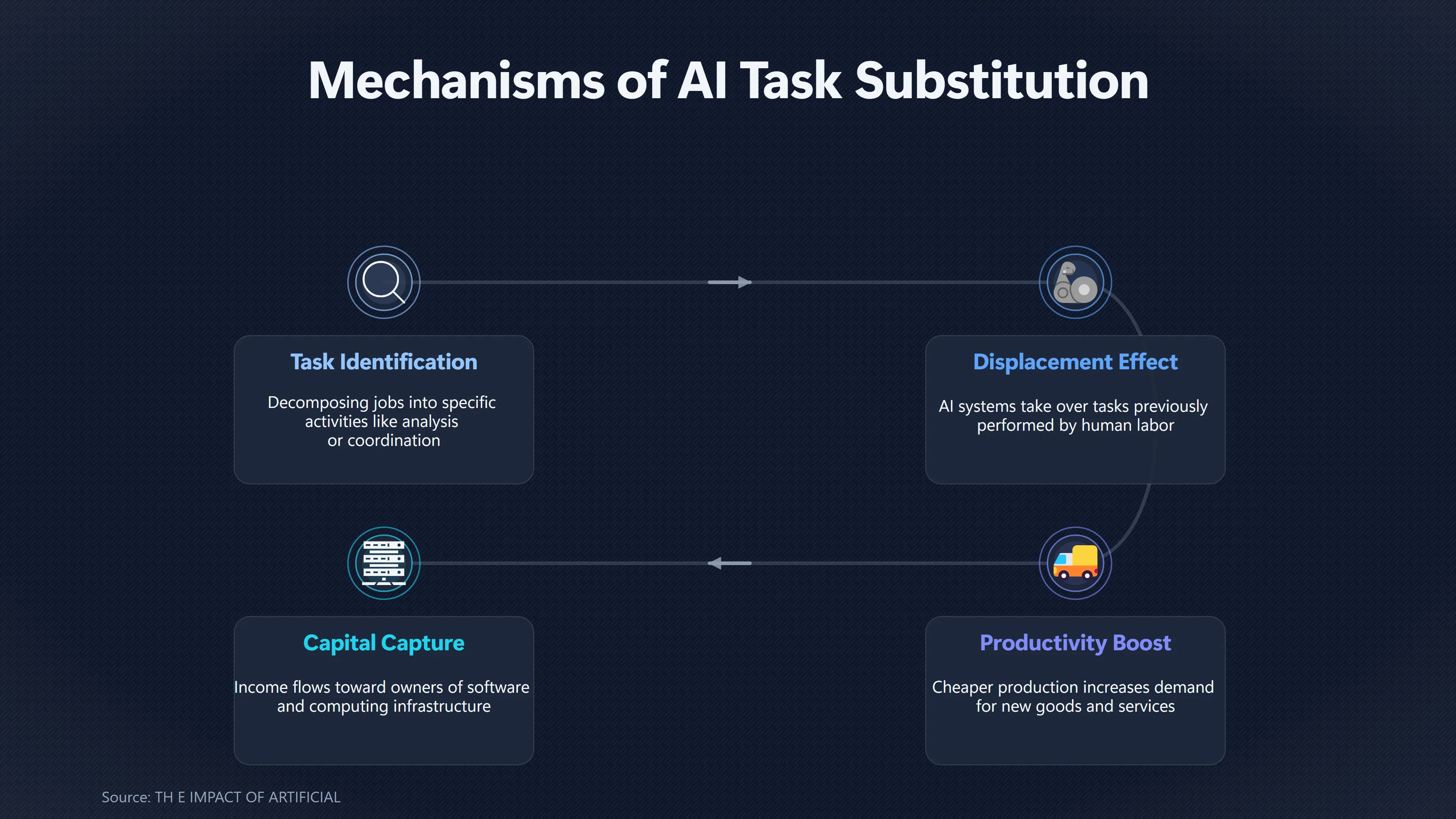
AI could make economies far more productive, but the way that productivity gains are divided will shape whether an AI-driven future becomes broadly shared prosperity or a period of growing economic concentration. The key mechanism is task substitution: when AI systems can perform valuable tasks that were previously done by workers, firms may produce more with fewer hours of human labour. The additional income created by this efficiency can then flow increasingly towards owners of AI systems, computing infrastructure, data, software and capital rather than towards wages.[National Bureau of Economic Research]nber.orgOpen source on nber.org.
This does not mean that AI must cause mass unemployment. A more likely near-term pathway is a gradual shift in bargaining power: some workers may become more productive with AI tools, while others may see slower wage growth, fewer entry-level opportunities or reduced demand for particular skills. Whether AI contributes to human flourishing therefore depends not only on how capable the technology becomes, but also on who owns it, who can use it, and how the gains from abundance are distributed.[International Labour Organization]ilo.orgInternational Labour OrganizationThe impact of GenAI on jobs, productivity and work organization: a review of the empirical evidence | In…
How task-based automation changes production
Traditional discussions often ask whether AI will replace entire jobs. Economists increasingly focus instead on tasks: the individual activities that make up a job. An accountant, designer, doctor or programmer does not perform one single activity; each role combines analysis, communication, judgement, coordination, creativity and routine processes. AI may replace some tasks while increasing the value of others.[National Bureau of Economic Research]nber.orgNational Bureau of Economic ResearchTasks At Work: Comparative Advantage, Technology and Labor Demand | NBERAugust 21, 2024…
The task-based view developed by economists such as Daron Acemoglu and Pascual Restrepo separates two forces. The first is the displacement effect: machines or AI systems take over tasks previously performed by workers, reducing demand for labour in those areas. The second is the productivity and new-task effect: cheaper production can increase demand for goods and services, while new activities emerge where humans remain valuable.[National Bureau of Economic Research]nber.orgOpen source on nber.org.
The income shift occurs when the first force becomes stronger than the second. If AI can perform an expanding share of economically important tasks, companies may need fewer employees for the same output. The value generated by those automated tasks is then recorded as returns to capital: higher profits, software revenues, licensing income or returns to shareholders.
A simple example shows the difference:
- A company employs 1,000 workers to provide a service.
- AI systems allow the same service to be delivered with 600 workers.
- Total output rises because costs fall and demand expands.
- Remaining workers may become more productive, but a larger share of the company’s income may now come from ownership of AI systems rather than from wages.
The economy can become richer while labour receives a smaller proportion of that wealth.
Why profits can grow faster than wages
A falling labour share does not necessarily mean wages fall in absolute terms. Workers can earn more money while receiving a smaller percentage of total economic output.
Suppose an economy produces £100 of value, with £70 going to wages and £30 going to profits. Labour receives 70% of income. After major productivity gains, the economy produces £200, but wages rise only to £100 while profits rise to £100. Workers are better off in cash terms, yet labour’s share has fallen from 70% to 50%.
This distinction matters because ownership of capital is unevenly distributed. Most households rely primarily on employment income, while ownership of businesses, shares, intellectual property and advanced computing infrastructure is concentrated among a smaller group. If AI increases the importance of capital ownership, economic gains may accumulate disproportionately unless ownership and access broaden.
Previous technological changes already show this pattern. The OECD has documented declines in labour income shares across many advanced economies, linking part of the shift to technological change, lower investment costs and the rise of highly productive firms with relatively low labour costs.[oecd.org]oecd.orgOECD Employment Outlook 2018 | OECDJuly 4, 2018…
AI may intensify this mechanism because it targets cognitive tasks that were historically difficult to automate. Earlier automation often replaced physical or routine activities; advanced AI systems increasingly affect writing, coding, analysis, customer support and administrative work.[Stanford Graduate School of Business]gsb.stanford.eduGraduate School of Business Generative AI at Work: Journal ArticleStanford Graduate School of BusinessGenerative AI at Work: Journal Article…
The first signs of AI changing bargaining power
Current evidence does not show a complete labour-market transformation, but it does show early signs of changing how work is organised.
Research on generative AI in customer support found that AI assistance increased productivity by around 15% on average among more than 5,000 customer-support agents. The largest improvements came among less experienced workers, suggesting that AI can spread expertise and raise productivity rather than simply remove workers.[Stanford Graduate School of Business]gsb.stanford.eduGraduate School of Business Generative AI at Work: Journal ArticleStanford Graduate School of BusinessGenerative AI at Work: Journal Article…
However, productivity gains do not automatically translate into higher wages. The question is who captures the benefit.
A firm using AI may respond to productivity improvements in several ways:
- It may increase wages because workers become more valuable.
- It may expand production and hire more workers.
- It may lower prices and increase consumer demand.
- It may keep more of the gains as profits.
The final outcome depends on competition, worker bargaining power, labour shortages, regulation and ownership structures.
Recent analyses of AI exposure increasingly highlight wage effects as a key concern. One recent study using occupational exposure measures and wage data reported slower real wage growth in highly AI-exposed occupations after the arrival of generative AI, while finding limited evidence of large employment effects so far. These findings remain early and are debated, but they illustrate why income distribution may change before widespread job losses appear.[Axios]axios.comUsing U.S. Labor Department wage data and Anthropic’s Economic Index, the study found that after the 2023 debut of ChatGPT, real wage gro…
Where human work remains valuable
The risk of labour losing income share does not come from all human work becoming worthless. Many valuable activities remain difficult to automate because they depend on trust, responsibility, physical presence, social relationships or complex judgement.
Human work may remain especially valuable where people:
- define goals rather than simply execute instructions;
- make decisions under uncertainty;
- build relationships and provide care;
- take legal, ethical or social responsibility;
- create new ideas and directions rather than only producing outputs.
Even highly capable AI systems may change the role of workers from performing every step of a task to supervising, directing and combining machine capabilities. In that scenario, the challenge is not simply replacing workers but determining whether humans retain meaningful economic roles and whether those roles provide sufficient income and security.
The balance between substitution and complementarity is therefore crucial. AI designed as a tool that expands human capability can increase the value of workers. AI designed mainly to remove labour costs can push more income towards capital owners.[oecd.org]oecd.orgartificial intelligence job quality and inclusiveness a713d0adartificial intelligence job quality and inclusiveness a713d0ad
Why ownership may matter as much as employment
In a future of highly advanced AI, the central economic question may shift from “Will people have jobs?” to “Who owns the systems that create value?”
If AI becomes a general-purpose technology capable of performing large portions of knowledge work, ownership of models, computing resources, robotics and data could become a major source of economic power. A small number of firms or investors controlling these assets could capture a large share of the gains from AI abundance.
This is why discussions about an AI-enabled human bloom cannot focus only on technical progress. Scientific acceleration, cheaper production and abundance are only socially transformative if their benefits reach beyond those who control the productive systems.
Possible approaches include broader access to AI tools, worker ownership models, public investment in AI infrastructure, stronger competition policy and mechanisms that allow societies to share in productivity gains. The objective is not to slow beneficial automation, but to ensure that automation increases human freedom rather than creating a divide between those who own intelligence systems and those who depend on selling labour.
The unresolved question: substitution or shared abundance?
AI task substitution contains two possible futures.
In one future, AI removes dangerous and repetitive work, lowers the cost of essential goods, accelerates science and allows people to spend more time on creativity, relationships and discovery. Workers share in the gains because institutions adapt alongside technology.
In another, AI creates extraordinary wealth but concentrates ownership. Productivity rises, companies become more profitable, and society becomes richer overall, yet many people experience weaker bargaining power because their labour captures a smaller share of economic value.
The technology itself does not determine which outcome occurs. The decisive choices involve economic structures around AI: who owns productive assets, how workers transition into new roles, how markets remain competitive, and whether the gains from machine intelligence are treated as a private windfall or a foundation for wider human flourishing.
Amazon book picks
Further Reading
Books and field guides related to When AI Tasks Shift Income Away. Use these as the next step if you want deeper reading beyond the article.
Race Against the Machine
Examines how information technologies are affecting jobs, skills, wages, and the economy.
Power and Progress
A bold reinterpretation of economics and history revealing why technology does not inevitably lead to shared prosperity, and how we must...
The Second Machine Age
A New York Times Bestseller. A “fascinating” (Thomas L. Friedman, New York Times) look at how digital technology is transforming our work...
A World Without Work
NOMINATED FOR THE FT & McKINSEY BUSINESS BOOK OF THE YEAR AWARDS 2020 'A path-breaking, thought-provoking and in-depth study of how new t...
eBay marketplace picks
Marketplace Samples
Live-tested eBay searches with available results related to this page.
Selected fromrobot model oneBay.co.uk.



Endnotes
1.
Source: oecd.org
Title: TH E IMPACT OF ARTIFICIAL
Link:https://www.oecd.org/content/dam/oecd/en/publications/reports/2024/04/the-impact-of-artificial-intelligence-on-productivity-distribution-and-growth_d54e2842/8d900037-en.pdf
2.
Source: oecd.org
Link:https://www.oecd.org/en/publications/oecd-employment-outlook-2018_empl_outlook-2018-en/full-report/component-6.html
Source snippet
OECD Employment Outlook 2018 | OECDJuly 4, 2018...
Published: July 4, 2018
3.
Source: gsb.stanford.edu
Title: Graduate School of Business Generative AI at Work: Journal Article
Link:https://www.gsb.stanford.edu/faculty-research/publications/generative-ai-work
Source snippet
Stanford Graduate School of BusinessGenerative AI at Work: Journal Article...
4.
Source: axios.com
Link:https://www.axios.com/2026/07/31/ai-jobs-pay-apollo
Source snippet
Using U.S. Labor Department wage data and Anthropic’s Economic Index, the study found that after the 2023 debut of ChatGPT, real wage gro...
5.
Source: oecd.org
Title: artificial intelligence job quality and inclusiveness a713d0ad
Link:https://www.oecd.org/en/publications/oecd-employment-outlook-2023_08785bba-en/full-report/artificial-intelligence-job-quality-and-inclusiveness_a713d0ad.html
6.
Source: digitaleconomy.stanford.edu
Link:https://digitaleconomy.stanford.edu/project/indicators/
7.
Source: oecd.org
Title: how do structural trends affect labour market shortages and mismatch acfb5c31 en
Link:https://www.oecd.org/en/publications/how-do-structural-trends-affect-labour-market-shortages-and-mismatch_acfb5c31-en.html
8.
Source: news.stanford.edu
Title: what workers really want from ai
Link:https://news.stanford.edu/stories/2025/07/what-workers-really-want-from-ai
9.
Source: hai.stanford.edu
Title: ai index 2025 state of ai in 10 charts
Link:https://hai.stanford.edu/news/ai-index-2025-state-of-ai-in-10-charts
10.
Source: oecd.org
Title: artificial intelligence and jobs no signs of slowing labour demand yet 5aebe670
Link:https://www.oecd.org/en/publications/oecd-employment-outlook-2023_08785bba-en/full-report/artificial-intelligence-and-jobs-no-signs-of-slowing-labour-demand-yet_5aebe670.html
11.
Source: oecd.org
Title: artificial intelligence job quality and inclusiveness a713d0ad
Link:https://www.oecd.org/en/publications/2023/07/oecd-employment-outlook-2023_904bcef3/full-report/artificial-intelligence-job-quality-and-inclusiveness_a713d0ad.html
12.
Source: oecd.org
Link:https://www.oecd.org/en/publications/2018/07/oecd-employment-outlook-2018_g1g8f61d/full-report/component-6.html
13.
Source: hai.stanford.edu
Title: 2025 ai index report
Link:https://hai.stanford.edu/ai-index/2025-ai-index-report?sf223786129=1
14.
Source: hai.stanford.edu
Link:https://hai.stanford.edu/ai-index/2026-ai-index-report/economy
15.
Source: hai.stanford.edu
Title: 2026 ai index report
Link:https://hai.stanford.edu/ai-index/2026-ai-index-report
16.
Source: hai.stanford.edu
Title: 2025 ai index report
Link:https://hai.stanford.edu/ai-index/2025-ai-index-report?authuser=0
17.
Source: hai.stanford.edu
Title: 2025 ai index report
Link:https://hai.stanford.edu/ai-index/2025-ai-index-report?b=wsj-events&source-key=wsj.com
18.
Source: siepr.stanford.edu
Title: generative ai boost can boost productivity without replacing workers
Link:https://siepr.stanford.edu/news/generative-ai-boost-can-boost-productivity-without-replacing-workers
19.
Source: hai.stanford.edu
Link:https://hai.stanford.edu/ai-index/2025-ai-index-report/economy?cq_cmp=422077331&cq_con=1162185632505575&cq_med=&cq_net=s&cq_plac=&cq_plt=gp&cq_pos=&cq_src=BingAds_Paid&cq_term=2+step+authentication&creative=&device=m&keyword=2+step+authentication&matchtype=p&network=s&wtime=%7Bseek_to_second_number%7D
20.
Source: digitaleconomy.stanford.edu
Title: augmenting intelligence the effects of ai on productivity and work practices
Link:https://digitaleconomy.stanford.edu/project/augmenting-intelligence-the-effects-of-ai-on-productivity-and-work-practices/
21.
Source: oecd.org
Link:https://www.oecd.org/en/topics/sub-issues/ai-and-work.html
22.
Source: oecd.org
Link:https://www.oecd.org/en/topics/ai-and-work.html
23.
Source: nber.org
Link:https://www.nber.org/books-and-chapters/economics-artificial-intelligence-agenda/artificial-intelligence-automation-and-work
24.
Source: nber.org
Link:https://www.nber.org/papers/w25684
25.
Source: ilo.org
Link:https://www.ilo.org/publications/impact-genai-jobs-productivity-and-work-organization-review-empirical
Source snippet
International Labour OrganizationThe impact of GenAI on jobs, productivity and work organization: a review of the empirical evidence | In...
26.
Source: nber.org
Link:https://www.nber.org/papers/w32872
Source snippet
National Bureau of Economic ResearchTasks At Work: Comparative Advantage, Technology and Labor Demand | NBERAugust 21, 2024...
Published: August 21, 2024
27.
Source: ilo.org
Link:https://www.ilo.org/publications/aggregation-paradox-ai-why-do-micro-economic-productivity-gains-ai
28.
Source: ilo.org
Title: Disruption without dividend?
Link:https://www.ilo.org/publications/disruption-without-dividend-how-digital-divide-and-task-differences-split
29.
Source: ilo.org
Link:https://www.ilo.org/publications/artificial-intelligence-adoption-and-its-impact-jobs
30.
Source: nber.org
Link:https://www.nber.org/papers/w33777
31.
Source: nber.org
Link:https://www.nber.org/papers/w31910
32.
Source: ilo.org
Link:https://www.ilo.org/publications/economics-artificial-intelligence-implications-future-work
33.
Source: nber.org
Link:https://www.nber.org/papers/w24196
34.
Source: nber.org
Link:https://www.nber.org/papers/w24119
35.
Source: nber.org
Link:https://www.nber.org/papers/w28920
36.
Source: nber.org
Link:https://www.nber.org/papers/w24321
Additional References
37.
Source: pubs.aeaweb.org
Link:https://pubs.aeaweb.org/doi/10.1257/jep.33.2.3
Source snippet
American Economic Association JournalsAutomation and New Tasks: How Technology Displaces and Reinstates Labor - American Economic Associa...
38.
Source: youtube.com
Title: Will AI Replace Jobs? The Real Future of Work Explained with Research
Link:https://www.youtube.com/watch?v=z7F5dI5FHGg
Source snippet
AI & Inequality | Daron Acemoglu: Big Tech poses risks as AI reshapes society...
39.
Source: youtube.com
Title: The Great Displacement: Will AI Take Your Job? w/ Daron Acemoglu
Link:https://www.youtube.com/watch?v=Slt3qJ2pm-0
Source snippet
Will AI Replace Jobs? The Real Future of Work Explained with Research...
40.
Source: arxiv.org
Link:https://arxiv.org/abs/2503.04761
41.
Source: businessinsider.com
Link:https://www.businessinsider.com/ai-could-lower-workers-pay-job-market-impact
42.
Source: tandfonline.com
Link:https://www.tandfonline.com/doi/abs/10.1080/13504851.2025.2513973
43.
Source: imf.org
Link:https://www.imf.org/en/publications/wp/issues/2024/03/22/the-economic-impacts-and-the-regulation-of-ai-a-review-of-the-academic-literature-and-546645
44.
Source: cnb.cz
Link:https://www.cnb.cz/en/economic-research/research-publications/cnb-working-paper-series/The-Rise-of-Generative-AI-Modelling-Exposure-Substitution-and-Inequality-Effects-on-the-US-Labour-Market-00001
45.
Source: sciencedirect.com
Link:https://www.sciencedirect.com/science/article/pii/S0313592626001797
46.
Source: read.oecd-ilibrary.org
Link:https://read.oecd-ilibrary.org/en/publications/oecd-employment-outlook-2026_7e710f54-en/full-report/places-and-people-the-impact-of-structural-change-on-local-labour-markets_a0874d97.html