Within Alignment
Can AI Benefits Reach Everyone Fairly?
AI systems can reproduce unfair patterns from data and institutions, making equal access and accountability central to human flourishing.
On this page
- How bias enters AI systems
- Unequal impacts across communities
- Fairer paths for aligned AI
Page outline Jump by section
Introduction
AI could help create a future of greater abundance, better healthcare, faster scientific progress and wider access to opportunity. But those benefits will not automatically reach everyone. Evidence from facial recognition, healthcare, hiring and other high-impact systems shows that AI can reproduce existing inequalities when its data, objectives or deployment conditions reflect unequal societies. The central lesson is not that AI is inherently unfair, but that powerful systems can scale both human strengths and human blind spots.[Proceedings of Machine Learning Research]proceedings.mlr.pressProceedings of Machine Learning ResearchGender Shades: Intersectional Accuracy Disparities in Commercial Gender ClassificationFebruary 23…
For an AI-enabled human bloom, fairness is therefore not a side issue. If advanced AI systems help decide who receives medical attention, employment opportunities, education, credit or public services, unequal outcomes can determine who shares in the benefits of technological progress. The challenge is ensuring that AI expands human potential broadly rather than concentrating advantages among groups already best positioned to benefit.
How bias enters AI systems
AI systems learn patterns from data, but data is not a neutral record of the world. It contains the outcomes of past decisions, social structures, measurement choices and institutional priorities. When an AI system learns from those patterns, it may discover useful signals — but it may also inherit unfair relationships that were present in the original information.
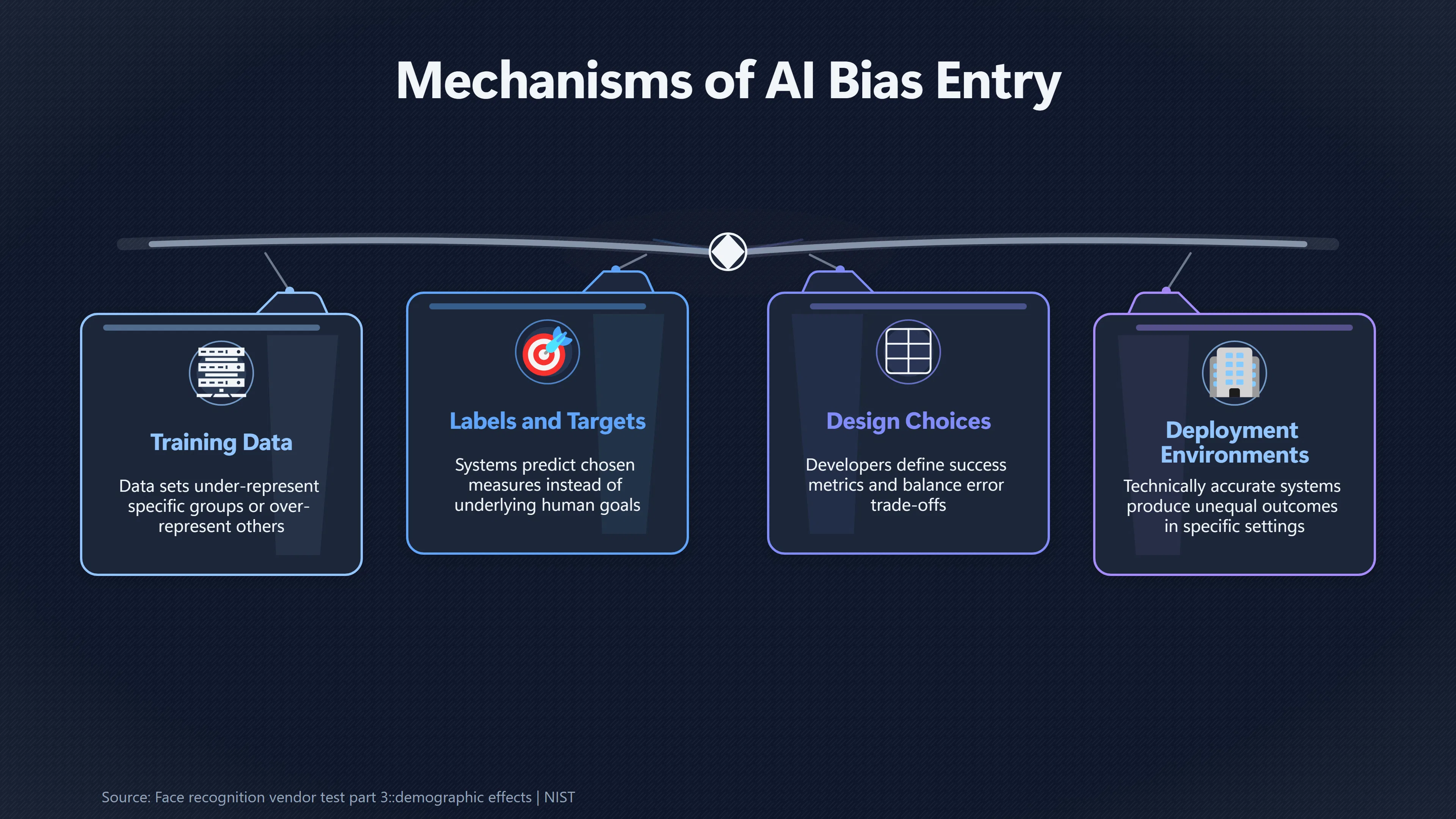
Bias can enter at several points:
- Training data: A dataset may under-represent some groups or over-represent others. A medical imaging system trained mostly on one population may perform worse for patients who differ from that population.
- Labels and targets: AI systems often learn to predict a chosen measure rather than the underlying human goal. If the measure is a poor substitute, the system can reproduce the wrong priorities.
- Design choices: Developers decide what counts as success, which errors matter most and how trade-offs are balanced.
- Deployment environments: Even a technically accurate system can produce unequal outcomes if it is used in settings where some groups face different barriers or risks.
This distinction matters because reducing bias is not simply a matter of removing sensitive information such as race or gender from a dataset. A system can still produce unequal outcomes through indirect signals, sometimes called proxies. For example, location, spending patterns, language or previous institutional decisions may carry information about social disadvantage even when protected characteristics are absent.
The healthcare case studied by Ziad Obermeyer and colleagues illustrates this problem clearly. A widely used US healthcare algorithm did not directly use race, but it used healthcare spending as a measure of health need. Because less money had historically been spent on Black patients with similar levels of illness, the system underestimated their needs and identified fewer Black patients for extra support. Changing the target from cost to actual health needs substantially reduced the disparity.[DOI]doi.orgDissecting racial bias in an algorithm used to manage the health of populations | Science…
The lesson for advanced AI is important: alignment with human flourishing requires aligning systems with the outcomes people actually value, not merely with convenient measurements.
Unequal impacts across communities
Facial recognition revealed measurable accuracy gaps
One of the most influential demonstrations of AI bias came from facial analysis research. In the 2018 “Gender Shades” study, Joy Buolamwini and Timnit Gebru evaluated commercial gender classification systems across different demographic groups. They found major differences in error rates: darker-skinned women were misclassified far more often than lighter-skinned men, with the highest error rate for darker-skinned females reaching 34.7% in the systems tested, compared with 0.8% for lighter-skinned males.[Proceedings of Machine Learning Research]proceedings.mlr.pressProceedings of Machine Learning ResearchGender Shades: Intersectional Accuracy Disparities in Commercial Gender ClassificationFebruary 23…
The significance was not only that some systems performed poorly. It was that performance failures were distributed unevenly across populations. A small overall accuracy improvement could hide serious failures affecting particular communities.
Subsequent evaluations by the US National Institute of Standards and Technology (NIST) also examined demographic differences in face recognition performance, including variations in false matches and failures to recognise people correctly. NIST found that demographic factors can affect error rates and that evaluation needs to account for population diversity rather than relying on overall averages alone.[NIST Pages]pages.nist.govNIST PagesFace Recognition Technology Evaluation: Demographic Effects in Face RecognitionMarch 5, 2025…
For a flourishing future, this matters because AI systems may increasingly mediate access to identity verification, security, employment and public services. A system that works well for the majority but fails for minorities can create barriers precisely where technology is supposed to expand opportunity.

Healthcare algorithms can amplify unequal access to care
Healthcare is one of the clearest examples of why AI fairness is connected to human flourishing. AI has enormous potential to improve diagnosis, personalise treatment and accelerate medical discovery, but unequal systems could widen existing health gaps.
The Obermeyer study found that correcting the healthcare algorithm’s target would have increased the proportion of Black patients receiving additional help from 17.7% to 46.5% in the studied population. The problem was not a simple programming error; it came from using a historical pattern of healthcare spending as a stand-in for medical need.[ScienceOpen]scienceopen.comOpen source on scienceopen.com.
This example shows why advanced AI requires careful choices about what is being optimised. A system can be statistically effective at predicting the wrong thing. In a future where AI helps allocate scarce medical resources, assist clinicians or accelerate drug development, fairness will depend on whether systems measure genuine human needs rather than existing patterns of advantage.
A 2023 review by the US Agency for Healthcare Research and Quality examined evidence on healthcare algorithms and racial and ethnic disparities, highlighting both the risk that algorithms can worsen inequities and the need for stronger methods to evaluate and reduce these effects.[NCBI]ncbi.nlm.nih.govNCBI BookshelfDecember 1, 2023…
Hiring systems showed how past inequality can become automated
Employment systems provide another example of how AI can reproduce historical patterns. In 2018, reporting revealed that Amazon had abandoned an experimental recruitment tool after discovering that it disadvantaged women applying for technical roles. The system had learned from previous hiring patterns, where men were more heavily represented, and those patterns influenced its recommendations.[The Guardian]theguardian.comThe GuardianAmazon ditched AI recruiting tool that favored men for technical jobs | Amazon | The GuardianOctober 10, 2018…
The broader lesson is that prediction systems often answer a question shaped by history: “Who has succeeded before?” That can be useful when past conditions were fair, but harmful when previous outcomes reflected unequal access or discrimination.
If advanced AI becomes a major gateway to jobs, education or entrepreneurship, fairness will require more than matching people to historical patterns. Systems may need to recognise potential, account for structural barriers and support wider participation.
Fairer paths for aligned AI
Reducing unequal outcomes does not mean removing all human judgement from AI systems. Instead, it requires better evidence, stronger accountability and clearer goals.
Several approaches are becoming central:
- Representative evaluation: Systems should be tested across the populations who will use or be affected by them, rather than judged only by average performance.
- Better targets: Developers should ensure that the outcome being predicted genuinely matches the human goal. The healthcare example shows how changing the target can transform fairness.
- Independent auditing: External testing can reveal problems that internal evaluations miss, especially when systems affect rights or access to important services.
- Transparency and accountability: Organisations deploying AI need ways to explain decisions, monitor outcomes and correct failures.
- Human oversight: High-impact decisions should retain meaningful human responsibility rather than treating AI outputs as unquestionable answers.
However, fairness itself involves difficult choices. Different definitions of fairness can conflict. A system may achieve equal accuracy across groups while producing unequal access, or it may improve outcomes for disadvantaged groups while creating different error rates between populations. There is no single mathematical definition that resolves every social question.
This is why AI alignment with human flourishing is partly a technical challenge and partly a governance challenge. A superintelligent or highly capable AI system could potentially help overcome major human limitations, but only if the benefits are directed towards people broadly rather than reinforcing existing inequalities.
The strongest evidence from current AI systems suggests a balanced conclusion: bias is real, measurable and consequential, but it is not inevitable. The same tools that reveal unfair patterns can also help identify and reduce them. The future impact of AI will depend on whether societies build systems that treat fairness as a core requirement of intelligence rather than an afterthought.
Amazon book picks
Further Reading
Books and field guides related to Can AI Benefits Reach Everyone Fairly?. Use these as the next step if you want deeper reading beyond the article.
The Alignment Problem
Finalist for the Los Angeles Times Book Prize A jaw-dropping exploration of everything that goes wrong when we build AI systems and the m...
Weapons of Math Destruction
'A manual for the 21st-century citizen... accessible, refreshingly critical, relevant and urgent' - Financial Times 'Fascinating and deep...
Algorithms of Oppression
Acknowledgments -- Introduction: the power of algorithms -- A society, searching -- Searching for Black girls -- Searching for people and...
Automating Inequality
WINNER: The 2019 Lillian Smith Book Award, 2018 McGannon Center Book Prize, and shortlisted for the Goddard Riverside Stephan Russo Book...
eBay marketplace picks
Marketplace Samples
Live-tested eBay searches with available results related to this page.
Selected fromai technology poster oneBay.co.uk.



Endnotes
1.
Source: doi.org
Link:https://doi.org/10.1126/science.aax2342
Source snippet
Dissecting racial bias in an algorithm used to manage the health of populations | Science...
2.
Source: scienceopen.com
Link:https://www.scienceopen.com/document?vid=34b5b9f0-d108-4873-b244-c0f785b635a8
3.
Source: pages.nist.gov
Link:https://pages.nist.gov/frvt/html/frvt_demographics.html
Source snippet
NIST PagesFace Recognition Technology Evaluation: Demographic Effects in Face RecognitionMarch 5, 2025...
Published: March 5, 2025
4.
Source: nist.gov
Title: Face recognition vendor test part 3::demographic effects | NIST
Link:https://www.nist.gov/publications/face-recognition-vendor-test-part-3demographic-effects
5.
Source: ncbi.nlm.nih.gov
Link:https://www.ncbi.nlm.nih.gov/books/NBK598802/
Source snippet
NCBI BookshelfDecember 1, 2023...
Published: December 1, 2023
6.
Source: pages.nist.gov
Link:https://pages.nist.gov/frvt/html/frvt11.html
7.
Source: nist.gov
Title: face projects
Link:https://www.nist.gov/programs-projects/face-projects
8.
Source: nist.gov
Title: face recognition vendor test frvt
Link:https://www.nist.gov/programs-projects/face-recognition-vendor-test-frvt
9.
Source: pages.nist.gov
Title: enface 002
Link:https://pages.nist.gov/frvt/reportcards/11/enface_002.html
10.
Source: nist.gov
Title: launches studies masks effect face recognition software
Link:https://www.nist.gov/news-events/news/2020/07/nist-launches-studies-masks-effect-face-recognition-software
11.
Source: doi.org
Link:https://doi.org/10.1145/3392866
12.
Source: nist.gov
Title: facial recognition technology part iii ensuring commercial transparency accuracy
Link:https://www.nist.gov/speech-testimony/facial-recognition-technology-part-iii-ensuring-commercial-transparency-accuracy
13.
Source: doi.org
Title: Millions of black people affected by racial bias in health-care algorithms
Link:https://doi.org/10.1038%2Fd41586-019-03228-6
14.
Source: nist.gov
Title: demographic effects estimates automatic face recognition performance 0
Link:https://www.nist.gov/publications/demographic-effects-estimates-automatic-face-recognition-performance-0
15.
Source: nist.gov
Title: demographic effects estimates automatic face recognition performance 1
Link:https://www.nist.gov/publications/demographic-effects-estimates-automatic-face-recognition-performance-1
16.
Source: nist.gov
Title: demographic effects estimates automatic face recognition performance 2
Link:https://www.nist.gov/publications/demographic-effects-estimates-automatic-face-recognition-performance-2
17.
Source: youtube.com
Title: The Bias Problem AI Companies Don’t Want You to Know About
Link:https://www.youtube.com/watch?v=hqN8_rU-bnU
18.
Source: youtube.com
Title: AI Bias
Link:https://www.youtube.com/watch?v=N9RSkmhWS1o
Source snippet
How Does Algorithmic Bias Affect AI Fairness? - AI and Machine Learning Explained...
19.
Source: proceedings.mlr.press
Link:https://proceedings.mlr.press/v81/buolamwini18a
Source snippet
Proceedings of Machine Learning ResearchGender Shades: Intersectional Accuracy Disparities in Commercial Gender ClassificationFebruary 23...
20.
Source: pubmed.ncbi.nlm.nih.gov
Link:https://pubmed.ncbi.nlm.nih.gov/38467001/
Source snippet
The Impact of Health Care Algorithms on Racial and Ethnic Disparities: A Systematic Review - PubMed...
21.
Source: theguardian.com
Link:https://www.theguardian.com/technology/2018/oct/10/amazon-hiring-ai-gender-bias-recruiting-engine
Source snippet
The GuardianAmazon ditched AI recruiting tool that favored men for technical jobs | Amazon | The GuardianOctober 10, 2018...
Published: October 10, 2018
22.
Source: pubmed.ncbi.nlm.nih.gov
Link:https://pubmed.ncbi.nlm.nih.gov/39626231/
23.
Source: pmc.ncbi.nlm.nih.gov
Link:https://pmc.ncbi.nlm.nih.gov/articles/PMC12934203/
24.
Source: pubmed.ncbi.nlm.nih.gov
Link:https://pubmed.ncbi.nlm.nih.gov/39488857/
25.
Source: pubmed.ncbi.nlm.nih.gov
Link:https://pubmed.ncbi.nlm.nih.gov/31649194/
26.
Source: ncbi.nlm.nih.gov
Link:https://www.ncbi.nlm.nih.gov/books/NBK598794/
27.
Source: ncbi.nlm.nih.gov
Link:https://www.ncbi.nlm.nih.gov/books/NBK598808/
28.
Source: genderedinnovations.stanford.edu
Link:https://genderedinnovations.stanford.edu/case-studies/facial.html
Additional References
29.
Source: digital-strategy.ec.europa.eu
Title: eu Navigating the AI Act | Shaping Europe’s digital future
Link:https://digital-strategy.ec.europa.eu/en/faqs/navigating-ai-act
Source snippet
the AI Act | Shaping Europe’s digital futureJuly 27, 2026 — NAVIGATING THE AI ACT These questions and answers detail the AI Act’s goals...
Published: July 27, 2026
30.
Source: nature.com
Link:https://www.nature.com/articles/s41746-026-02723-1
31.
Source: youtube.com
Title: How AI Bias Impacts Healthcare | Invisible Inputs Lesson (K–12)
Link:https://www.youtube.com/watch?v=QiYdqvKIcsE
Source snippet
The Bias Problem AI Companies Don't Want You to Know About...
32.
Source: youtube.com
Title: AI Bias vs Human Bias | ICIMS Fireside Chat
Link:https://www.youtube.com/watch?v=hG1iRNf-luA
Source snippet
How AI Bias Impacts Healthcare | Invisible Inputs Lesson (K–12)...
33.
Source: theinformation.com
Link:https://www.theinformation.com/briefings/faab8f
34.
Source: escholarship.org
Link:https://escholarship.org/uc/item/6h92v832
35.
Source: researchgate.net
Link:https://www.researchgate.net/publication/336791156_Dissecting_racial_bias_in_an_algorithm_used_to_manage_the_health_of_populations
36.
Source: tandfonline.com
Link:https://www.tandfonline.com/doi/abs/10.1080/13557858.2024.2422848
37.
Source: dblp.org
Link:https://dblp.org/rec/conf/fat/BuolamwiniG18
38.
Source: ellphacitizen.org
Link:https://www.ellphacitizen.org/academic-research/2018/2/12/gender-shades-intersectional-accuracy-disparities-in-commercial-gender-classification