Within AI Governance
Who Controls Access to Powerful AI?
Advanced AI access policies will shape whether transformative capabilities become widely shared or remain controlled by a small group of actors.
On this page
- Why advanced AI power may concentrate
- Policies for broader AI access
- Trade offs between openness and safety
Page outline Jump by section
Introduction
The benefits of advanced AI may depend not only on how capable these systems become, but on who can use them. If increasingly powerful AI helps accelerate science, improve healthcare, expand education and reduce scarcity, access policies will influence whether those gains become a shared foundation for human flourishing or a source of concentrated advantage.

The central governance challenge is that frontier AI is becoming expensive and strategically important. Building and operating the most capable systems requires specialised talent, enormous computing resources, advanced chips, energy infrastructure and large-scale data access. These conditions can naturally favour a small number of companies and governments. At the same time, restricting access too aggressively could slow beneficial innovation, reduce independent research and leave developing regions permanently dependent on a few technology providers.[OECD AI]oecd.aiAIA blueprint for building national compute capacity for artificial intelligenceA blueprint for building national compute capacity for artificial intelligence - OECD.AI…
The key question for an AI bloom future is therefore not simply whether powerful AI exists, but whether society can design institutions that make transformative capabilities widely useful while maintaining safety. Access, openness and accountability must be balanced so that AI becomes a shared tool for expanding human possibility rather than a new concentration of power.
Why advanced AI power may concentrate
Frontier AI differs from many earlier technologies because the leading edge depends on a small number of difficult-to-replicate inputs. Training highly capable models requires large clusters of advanced processors, extensive engineering expertise, specialised research teams and substantial financial resources. The OECD has highlighted the importance of AI compute — the hardware and infrastructure needed to train and run AI systems — and noted that countries face challenges in measuring and planning their own capacity.[OECD AI]oecd.aiAIA blueprint for building national compute capacity for artificial intelligenceA blueprint for building national compute capacity for artificial intelligence - OECD.AI…
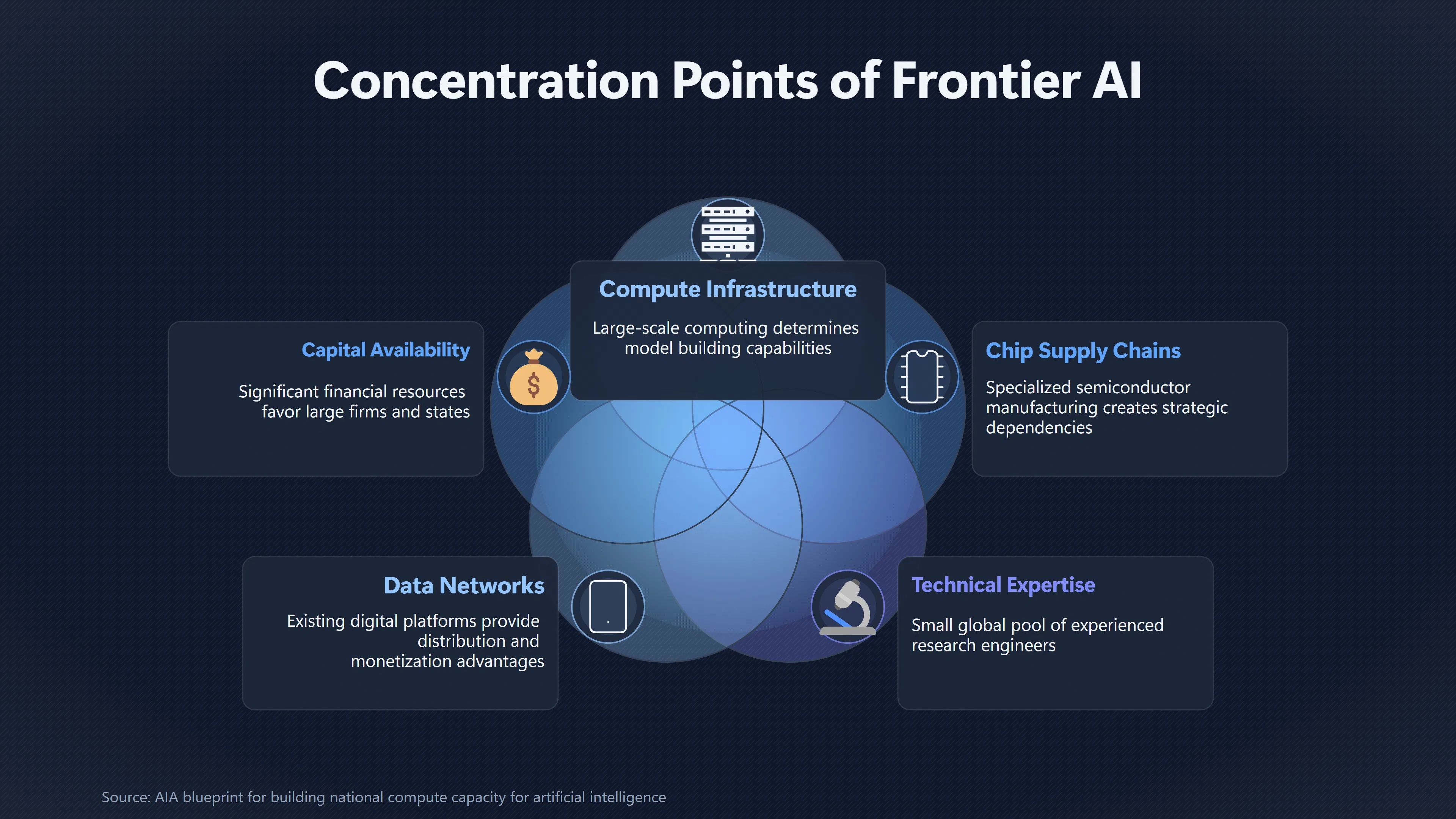
This creates several possible concentration points:
- Compute infrastructure: The ability to access large-scale computing can determine who is able to build frontier models and who must rely on existing providers.
- Chip supply chains: Advanced AI depends on specialised semiconductor manufacturing and access to high-performance processors, creating strategic dependencies.
- Technical expertise: Frontier research requires a relatively small global pool of highly experienced researchers and engineers.
- Data and deployment networks: Organisations that already operate large digital platforms may have advantages in improving, distributing and monetising AI systems.
- Capital availability: The cost of training and deploying advanced systems may favour firms and states with significant financial resources.
The concern is not simply that successful companies become valuable. Many important technologies began with concentrated development before becoming widely available. The deeper concern is that advanced AI could become a persistent source of influence if only a few actors control the systems that generate scientific discoveries, economic decisions, security capabilities and access to knowledge.
The United Nations’ Advisory Body on Artificial Intelligence has argued that governance arrangements should help ensure AI’s benefits are shared globally, warning that current institutions may not yet match the speed and scale of AI development.[Digital Library]digitallibrary.un.orgDigital Library Governing AI for humanityDigital Library Governing AI for humanity
How concentration could affect human flourishing
The AI bloom vision depends on AI capabilities reaching far beyond existing technology markets. A future of abundant intelligence could involve AI-assisted scientific research, personalised education, better medical discovery, improved public services and faster solutions to global problems.
However, unequal access could change the distribution of these benefits.
A small number of organisations controlling the strongest systems could influence:
- Scientific progress: If advanced AI research assistants, automated laboratories or discovery systems are available only to wealthy institutions, scientific acceleration may become uneven between countries and communities.
- Healthcare innovation: AI-designed medicines, diagnostic systems and personalised treatments could widen existing health inequalities if access depends heavily on geography or wealth.
- Education: AI tutors could provide high-quality learning support globally, but only if affordable and available across different languages and regions.
- Economic opportunity: Small businesses, researchers and individuals may need access to powerful AI tools to participate in an AI-driven economy rather than simply consume services created by dominant providers.
This does not mean concentration inevitably produces harmful outcomes. Large organisations may also have advantages in safety research, reliability testing and infrastructure investment. The governance challenge is finding ways to preserve these benefits while preventing excessive control over a technology that could shape civilisation’s long-term trajectory.
Policies for broader AI access
There is no single policy that guarantees fair access. A range of approaches aim to make AI capabilities more widely available while reducing serious risks.
Public and shared AI infrastructure
One approach is treating AI compute as strategic infrastructure. Governments and research institutions can invest in shared computing resources that allow universities, startups and public-interest researchers to access capabilities that would otherwise be unavailable.
The OECD has argued that countries need clearer strategies for AI compute capacity, including questions of availability, access, resilience and sustainability. Without such planning, countries may struggle to capture AI’s economic and scientific benefits.[OECD AI]oecd.aiAIA blueprint for building national compute capacity for artificial intelligenceA blueprint for building national compute capacity for artificial intelligence - OECD.AI…
Public infrastructure could support areas where commercial incentives are weaker, such as:
- medical research for neglected diseases;
- climate modelling;
- scientific discovery;
- educational tools for underserved communities;
- language technologies for smaller populations.

Open and transparent AI models
Another policy debate concerns whether powerful AI models should be openly released or kept under controlled access.
Open models can increase competition, allow independent research and enable organisations without enormous resources to adapt AI systems for their own needs. They may help prevent a future where only a few companies determine how advanced AI is used.
However, openness also raises safety questions. Highly capable models may be easier to misuse if barriers to access are low. The challenge is that “open versus closed” is not a simple safety divide: openness can improve accountability and innovation, while restrictions can improve control but may increase dependence on a small group of providers.
The European Union’s AI Act reflects this balancing approach. It includes transparency and documentation requirements for general-purpose AI providers while creating some different treatment for genuinely open-source models, with stronger obligations for models considered to pose systemic risks.[AI Act Service Desk]ai-act-service-desk.ec.europa.euAI Act Service DeskArticle 53: Obligations for providers of general-purpose AI models | AI Act Service DeskJune 13, 2024…
Access rules based on capability and risk
A middle path is to avoid treating all AI systems the same. Less capable systems may be broadly available, while the most powerful systems could require stronger safeguards.
Possible mechanisms include:
- independent safety evaluations before release;
- transparency about model capabilities and limitations;
- monitoring of high-risk deployments;
- controlled access for especially powerful systems;
- international agreements on responsible development.
This approach attempts to avoid two extremes: unrestricted release of potentially dangerous capabilities and excessive concentration where only a handful of institutions can access transformative tools.
The openness versus safety dilemma
The debate over AI access often centres on a difficult trade-off: making AI widely available may increase innovation and reduce inequality, but unrestricted availability may also increase misuse risks.
Supporters of greater openness argue that concentration itself creates dangers. If only a few companies control frontier AI, those organisations gain enormous influence over research priorities, economic systems and public knowledge. Independent researchers and smaller countries may lose the ability to understand or challenge powerful systems.
Supporters of tighter controls argue that some AI capabilities may be too consequential to distribute without safeguards. Advanced models could potentially assist with cyberattacks, biological research risks or large-scale manipulation if poorly governed.
The important point is that safety and access are not always opposites. Better governance may involve expanding beneficial access while restricting specific harmful uses. For example, a medical researcher might need powerful AI assistance for drug discovery, while access to certain dangerous capabilities could require additional oversight.
Avoiding a permanent AI divide
A major concern for the long-term future is that early AI advantages could compound. Countries or organisations with better infrastructure may use AI to accelerate research, improve productivity and build even stronger technological capacity, creating a widening gap.
This possibility makes international access a central governance issue. The United Nations has called for more inclusive global AI governance arrangements, emphasising that AI development should support human rights and shared benefits rather than deepen existing inequalities.[Digital Library]digitallibrary.un.orgDigital Library Governing AI for humanityDigital Library Governing AI for humanity
A more inclusive AI ecosystem could involve:
- international research partnerships;
- shared scientific resources;
- support for AI capacity-building in developing countries;
- access to reliable AI tools in education and healthcare;
- standards that allow different regions to participate safely.
Without such measures, an AI bloom could become uneven: highly beneficial for those with access to advanced systems while leaving others behind.
What governance choices could shape the AI bloom?
The future of AI access will likely be determined by choices about infrastructure, regulation and institutional design.
A flourishing outcome would require several conditions:
- Broad capability access: People and organisations should be able to benefit from advanced AI without needing to belong to a small technological elite.
- Safety protections: Powerful systems should be governed according to their real-world impact and risks.
- Competition and diversity: Multiple developers and research communities should be able to contribute to AI progress.
- Public accountability: Decisions affecting society should not be controlled entirely by private actors without oversight.
- Global inclusion: The benefits of AI should not depend solely on where someone lives or which institutions they can access.
The question of AI access is therefore central to whether advanced AI becomes a force for human flourishing. A future of abundance requires more than creating extraordinary intelligence; it requires building social systems that allow that intelligence to improve lives broadly, safely and sustainably.
Amazon book picks
Further Reading
Books and field guides related to Who Controls Access to Powerful AI?. Use these as the next step if you want deeper reading beyond the article.
AI Superpowers: China, Silicon Valley, and the New World Order
AI Superpowers is Kai-Fu Lee's New York Times and USA Today bestseller about the American-Chinese competition over the future of artifici...
The Coming Wave: Technology, Power, and the Twenty-first Cent...
"We are approaching a critical threshold in the history of our species. Everything is about to change. Soon you will live surrounded by A...
Weapons of Math Destruction
'A manual for the 21st-century citizen... accessible, refreshingly critical, relevant and urgent' - Financial Times 'Fascinating and deep...
The Age of A.I.: And Our Human Future
Traditional Chinese edition of The Age of A.I.: And Our Human Future
eBay marketplace picks
Marketplace Samples
Live-tested eBay searches with available results related to this page.
Selected fromtechnology poster oneBay.co.uk.




Endnotes
1.
Source: oecd.ai
Title: AIA blueprint for building national compute capacity for artificial intelligence
Link:https://oecd.ai/en/compute-report
Source snippet
A blueprint for building national compute capacity for artificial intelligence - OECD.AI...
2.
Source: oecd.ai
Title: Can mid-sized economies come together to build frontier AI?
Link:https://oecd.ai/en/wonk/can-mid-sized-economies-come-together-to-build-frontier-ai
3.
Source: oecd.ai
Title: Public AI: Policies for democratic and sustainable AI infrastructures
Link:https://oecd.ai/en/wonk/public-ai-policies-for-democratic-and-sustainable-ai-infrastructures
4.
Source: oecd.org
Title: component 5
Link:https://www.oecd.org/en/publications/competition-in-artificial-intelligence-infrastructure_623d1874-en/full-report/component-5.html
5.
Source: oecd.org
Title: component 6
Link:https://www.oecd.org/en/publications/competition-in-artificial-intelligence-infrastructure_623d1874-en/full-report/component-6.html
6.
Source: oecd.org
Link:https://www.oecd.org/en/publications/competition-in-artificial-intelligence-infrastructure_623d1874-en/full-report/component-3.html
7.
Source: governance.ai
Link:https://www.governance.ai/research-paper/voice-and-access-in-ai-global-ai-majority-participation-in-artificial-intelligence-development-and-governance
8.
Source: oecd.ai
Title: A blueprint for building national compute capacity for artificial intelligence
Link:https://oecd.ai/en/ai-publications/national-compute-blueprint
9.
Source: en.ai-act.io
Link:https://en.ai-act.io/article/general-purpose-ai-models/obligations-for-providers-of-general-purpose-ai-models/obligations-for-providers-of-general-purpose-ai-models
10.
Source: oecd.ai
Title: The OECD Artificial Intelligence Policy Observatory
Link:https://oecd.ai/en/
11.
Source: survey.oecd.org
Link:https://survey.oecd.org/index.php?lang=en&newtest=Y&r=survey%2Findex&sid=679658
12.
Source: digitallibrary.un.org
Title: Digital Library Governing AI for humanity
Link:https://digitallibrary.un.org/record/4062495
13.
Source: ai-act-service-desk.ec.europa.eu
Link:https://ai-act-service-desk.ec.europa.eu/en/ai-act/article-53
Source snippet
AI Act Service DeskArticle 53: Obligations for providers of general-purpose AI models | AI Act Service DeskJune 13, 2024...
Published: June 13, 2024
14.
Source: digital-strategy.ec.europa.eu
Link:https://digital-strategy.ec.europa.eu/en/factpages/general-purpose-ai-obligations-under-ai-act
15.
Source: digital-strategy.ec.europa.eu
Link:https://digital-strategy.ec.europa.eu/en/faqs/questions-and-answers-code-practice-general-purpose-ai
Source snippet
and answers on the code of practice for General-Purpose AI | Shaping Europe’s digital futureJuly 20, 2026 — QUESTIONS AND ANSWERS ON THE...
Published: July 20, 2026
16.
Source: un.org
Title: preliminary report
Link:https://www.un.org/independent-international-scientific-panel-ai/en/preliminary-report
17.
Source: digital-strategy.ec.europa.eu
Link:https://digital-strategy.ec.europa.eu/en/policies/guidelines-gpai-providers
18.
Source: digital-strategy.ec.europa.eu
Link:https://digital-strategy.ec.europa.eu/en/faqs/guidelines-obligations-general-purpose-ai-providers
19.
Source: digital-strategy.ec.europa.eu
Link:https://digital-strategy.ec.europa.eu/en/faqs/general-purpose-ai-models-ai-act-questions-answers
20.
Source: digital-strategy.ec.europa.eu
Title: eu The General-Purpose AI Code of Practice | Shaping Europe’s digital future
Link:https://digital-strategy.ec.europa.eu/en/policies/contents-code-gpai
21.
Source: digitallibrary.un.org
Link:https://digitallibrary.un.org/record/4062495?v=pdf
22.
Source: digitallibrary.un.org
Link:https://digitallibrary.un.org/record/4062495?ln=fr&v=%5B%27pdf%27%5D
23.
Source: ai-act-service-desk.ec.europa.eu
Title: eu Recital 102 | AI Act Service Desk
Link:https://ai-act-service-desk.ec.europa.eu/en/ai-act/recital-102
24.
Source: ai-act-service-desk.ec.europa.eu
Title: eu Recital 104 | AI Act Service Desk
Link:https://ai-act-service-desk.ec.europa.eu/en/ai-act/recital-104
25.
Source: digitallibrary.un.org
Link:https://digitallibrary.un.org/record/4062495?v=%5B%27pdf%27%5D
26.
Source: un.org
Title: A I Advisory Body | United Nations AI
Link:https://www.un.org/en/node/210865
27.
Source: digitallibrary.un.org
Link:https://digitallibrary.un.org/record/4062495?ln=ru
28.
Source: ai-act-service-desk.ec.europa.eu
Link:https://ai-act-service-desk.ec.europa.eu/en/ai-act/faq/which-ai-models-does-ai-act-apply
29.
Source: ai-act-service-desk.ec.europa.eu
Link:https://ai-act-service-desk.ec.europa.eu/en/faq?faq_category_id=69
30.
Source: read.oecd-ilibrary.org
Title: ai compute
Link:https://read.oecd-ilibrary.org/en/topics/ai-compute.html
Additional References
31.
Source: epoch.ai
Link:https://epoch.ai/publications/chips-topic-overview
Source snippet
AI Chips: why they cost as much as a car, and why companies can't get enough | Epoch AIJuly 14, 2026 — HOW MANY AI CHIPS EXIST, AND WHO L...
Published: July 14, 2026
32.
Source: read.oecd-ilibrary.org
Title: artificial intelligence markets d531d73f en
Link:https://read.oecd-ilibrary.org/en/publications/artificial-intelligence-markets_d531d73f-en.html
Source snippet
Intelligence markets | OECDJuly 10, 2026 — ARTIFICIAL INTELLIGENCE MARKETS Recent developments and competition issues Policy brief More i...
Published: July 10, 2026
33.
Source: youtube.com
Title: A One In A Lifetime Crash Is Coming (3 Warning Signs)
Link:https://www.youtube.com/watch?v=te3W5UHierw
Source snippet
How the Public can Steer the Future of AI | Sol Erdman SCaLE 23x...
34.
Source: oecd-ilibrary.org
Title: full report
Link:https://www.oecd-ilibrary.org/en/publications/artificial-intelligence-markets_d531d73f-en/full-report.html
Source snippet
Artificial Intelligence markets | OECDJuly 10, 2026 — ARTIFICIAL INTELLIGENCE MARKETS Recent developments and competition issues Policy b...
Published: July 10, 2026
35.
Source: arxiv.org
Title: arXiv Computing Power and the Governance of Artificial Intelligence
Link:https://arxiv.org/abs/2402.08797
36.
Source: aistackmap.org
Link:https://aistackmap.org/
37.
Source: oecd-ilibrary.org
Link:https://www.oecd-ilibrary.org/en/topics/ai-compute.html
38.
Source: aisi.gov.uk
Link:https://www.aisi.gov.uk/frontier-ai-trends-report
39.
Source: theinformation.com
Link:https://www.theinformation.com/newsletters/ai-infrastructure/nvidias-share-ai-inference-chip-market-appears-rising/
40.
Source: aisi.gov.uk
Link:https://www.aisi.gov.uk/research/open-technical-problems-in-open-weight-ai-model-risk-management