Within AI Bloom
Can AI Abundance Outrun Physical Resource Limits?
AI may improve grids, materials and energy systems, but computation itself still depends on electricity, minerals, land and resilient infrastructure.
On this page
- AI for grids, energy discovery and efficiency
- Compute demand, minerals and infrastructure
- Selective abundance within ecological boundaries
Page outline Jump by section
Introduction
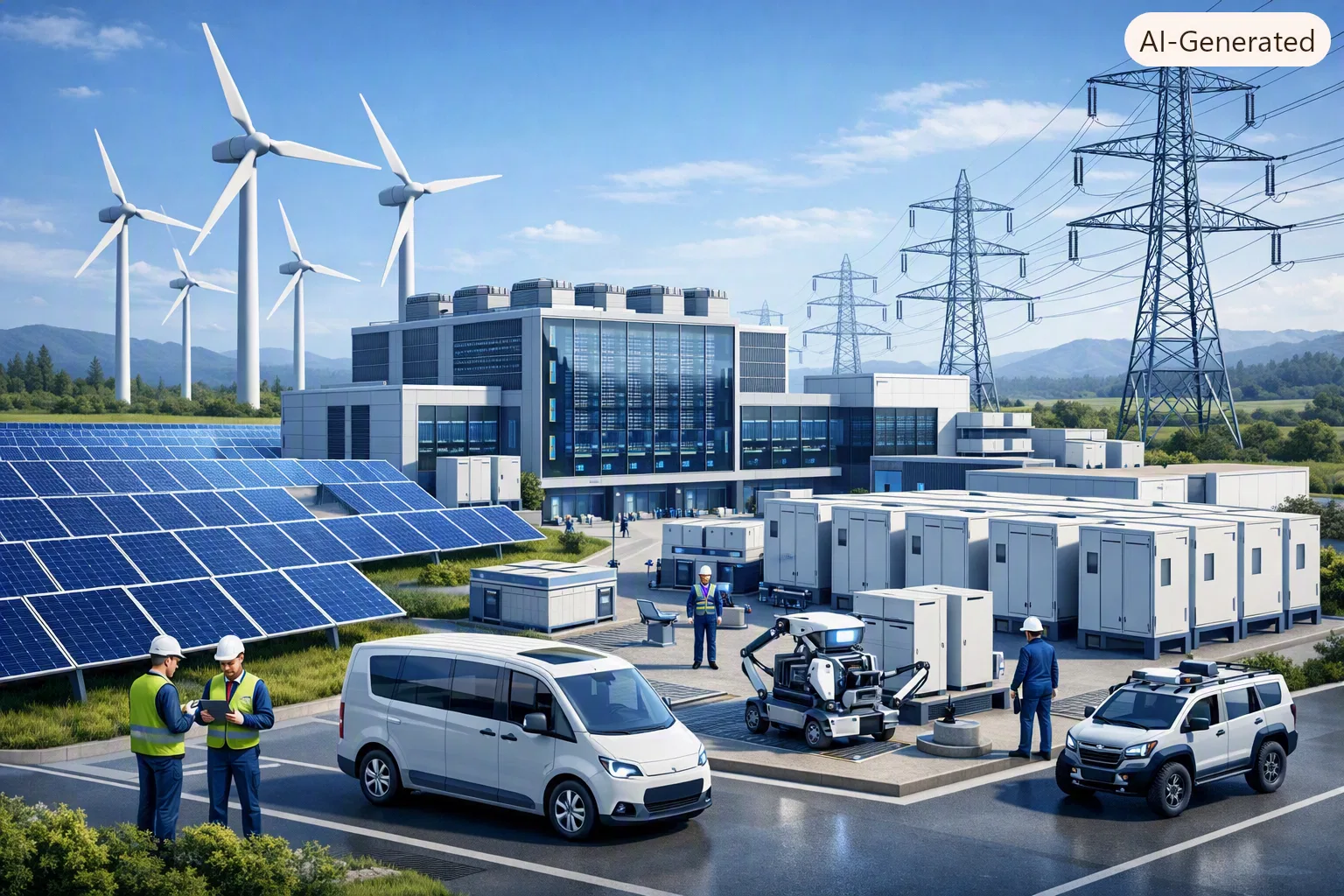
AI could help create cleaner, cheaper and more reliable energy systems, but it cannot abolish physics. Advanced systems may improve electricity-grid planning, discover better batteries and catalysts, reduce industrial waste and coordinate millions of flexible devices. These gains could support a form of selective abundance in which energy services, transport, heating and manufactured goods become far more accessible without a matching rise in pollution.
The difficulty is that AI is also a physical industry. Data centres require electricity, chips, cooling equipment, water, land, transmission lines and minerals. Clean-energy expansion likewise depends on mines, factories, permits and infrastructure that often take years to build. The International Energy Agency expects global data-cententre electricity consumption to more than double from about 415 terawatt-hours in 2024 to roughly 945 terawatt-hours in 2030, with AI the largest driver of the increase. The central question is therefore not whether AI can optimise resource use, but whether those improvements can arrive faster—and be governed better—than the new demand AI helps create.[IEA Blob Storage]iea.blob.core.windows.netIEA Blob StorageEnergy and AIa new global model and comprehensive dataset of data centre electricity demand, its analysis was also enrich…
Can AI make a clean grid work better?
Electricity systems are becoming harder to manage. Solar and wind output varies with the weather; electric vehicles, heat pumps and batteries create new patterns of demand; and power may need to travel long distances from renewable-rich regions to cities and industrial centres. Grid operators must constantly match supply and demand while keeping voltages, frequencies and equipment within safe limits.
AI can help at several points in this system. Machine-learning tools can improve forecasts of wind generation, solar output and electricity demand; identify equipment likely to fail; detect anomalies; optimise battery charging; and help operators decide when to shift flexible loads. The US Department of Energy has identified practical applications across grid planning, siting and permitting, real-time operations, reliability and resilience. It also highlights uses beyond the grid, including electric-vehicle charging, virtual power plants and the design of lower-carbon industrial materials.[energy.gov]energy.govPriority use cases have been identified in fAI for Energy Opportunities for a Modern Grid and Clean Energy Economyto the Executive Order (E.O.) on the Safe, Secure, and Trustworthy…
A particularly important opportunity is to make better use of infrastructure that already exists. Grid-enhancing technologies can estimate the actual carrying capacity of transmission lines under current weather conditions rather than relying only on conservative fixed limits. AI-assisted control can coordinate home batteries, electric vehicles, industrial equipment and smart buildings so that they reduce consumption during periods of system stress. Better forecasting can lower the amount of backup generation needed to handle uncertainty.
Data centres themselves could become flexible participants rather than inflexible blocks of demand. In a 2025 field demonstration involving a 256-GPU cluster in Phoenix, researchers reduced the cluster’s power use by 25 per cent for three hours during peak grid conditions while maintaining promised computing performance. The trial was limited in scale, but it shows that some AI workloads can be delayed, redistributed or slowed briefly without halting useful work.[arXiv]arxiv.orgTurning AI Data Centers into Grid-Interactive Assets: Results from a Field Demonstration in Phoenix, ArizonaJuly 1, 2025…
These improvements matter because grid capacity is already constraining the energy transition. The IEA reported that at least 3,000 gigawatts of renewable projects were waiting in connection queues worldwide, including 1,500 gigawatts at advanced stages. Meeting announced climate and energy goals could require adding or refurbishing more than 80 million kilometres of grid by 2040—roughly the length of the entire existing global network. Better software can extract more value from that network, but it cannot substitute indefinitely for new substations, transformers, cables and transmission corridors.[IEA Blob Storage]iea.blob.core.windows.netWe find that delayed action mea…
AI may also speed up grid development before construction begins. It can compare possible transmission routes, model future demand, process environmental information and help identify projects with the greatest system value. Yet permitting disputes are rarely mere data problems. New lines cross communities and habitats, create visible local costs and distribute benefits unevenly. An algorithm can clarify the trade-offs, but legitimate consent, compensation and political judgement remain human tasks.
Can faster discovery loosen material constraints?
Much of the clean-energy transition depends on materials whose properties remain imperfect. Better batteries could store more energy with less weight and fewer scarce minerals. Improved catalysts could make hydrogen, synthetic fuels or industrial chemicals with lower energy losses. Stronger conductors could reduce electricity wasted in transmission, while cheaper solar absorbers might raise output or simplify manufacturing.
AI can search this design space much faster than traditional trial and error. Google DeepMind’s Graph Networks for Materials Exploration, or GNoME, predicted 2.2 million candidate crystal structures, including about 380,000 judged sufficiently stable to merit further investigation. The published work included hundreds of possible lithium-ion conductors, illustrating how machine learning can narrow an enormous theoretical search to a more manageable list of candidates.[nature.com]nature.comScaling deep learning for materials discoveryNovember 27, 2023…
Automated laboratories may shorten the next stage. Berkeley Lab’s A-Lab combined machine-learning guidance, robotics and automated analysis to select recipes and synthesise inorganic compounds. In its initial reported campaign, the system produced 41 previously unrealised materials. This is an important proof of principle: AI can connect prediction to physical experimentation rather than merely generating a database of hypothetical substances.[nature.com]nature.comAn autonomous laboratory for the accelerated synthesis of inorganic materialsAn autonomous laboratory for the accelerated synthesis of inorganic materials
However, discovering a stable crystal is not the same as producing a commercially useful technology. A battery material must also charge rapidly, last through many cycles, remain safe, tolerate manufacturing defects and compete on cost. A catalyst may require elements that are too rare or toxic for mass use. A promising substance may be difficult to synthesise outside a laboratory or impossible to manufacture reliably at industrial scale.
Even material-stability prediction remains an imperfect screening process. Comparative research has found that apparently strong models can produce substantial numbers of false positives close to the stability threshold, and that performance depends heavily on choosing benchmarks that match the actual discovery task. AI can dramatically improve where scientists look, but laboratories must still confirm composition, structure, performance and durability.[arXiv]arxiv.orgOpen source on arxiv.org.
The largest long-term benefit may therefore come from an integrated discovery loop: AI proposes candidates, simulations reject weak ones, robotic laboratories test the survivors, and the resulting measurements improve the next model. More capable AI could run many such loops across batteries, solar cells, cement, steel, cooling systems and carbon removal. That would not make minerals irrelevant, but it could reduce the quantity, cost or environmental burden required for each unit of useful energy.
Compute is becoming an energy system of its own
The optimistic case for AI-enabled abundance contains an immediate tension: the systems expected to solve energy constraints are increasing electricity demand themselves. Data centres accounted for about 1.5 per cent of global electricity use in 2024. The IEA projects consumption of roughly 945 terawatt-hours by 2030, slightly more than Japan uses today, although outcomes vary widely depending on hardware efficiency, model design and deployment rates.[IEA Blob Storage]iea.blob.core.windows.netIEA Blob StorageEnergy and AIa new global model and comprehensive dataset of data centre electricity demand, its analysis was also enrich…
Global percentages can obscure local effects. AI facilities are geographically concentrated and can demand power on the scale of energy-intensive factories. The IEA estimates that nearly half of US data-centre capacity is located in five regional clusters. In such places, a single group of projects can dominate expected load growth, require new generation and transmission, or compete with housing and industry for scarce grid connections.[IEA Blob Storage]iea.blob.core.windows.netIEA Blob StorageEnergy and AIa new global model and comprehensive dataset of data centre electricity demand, its analysis was also enrich…
US projections illustrate the uncertainty. Lawrence Berkeley National Laboratory estimated that data centres could consume between 6.7 and 12 per cent of US electricity in 2028, depending partly on the pace and efficiency of AI deployment. The range is large because future systems may use more efficient chips and algorithms, but they may also train larger models, serve many more users and expand into energy-intensive forms of scientific computing.[LBL ETA Publications]eta-publications.lbl.govSmith, Alex Hubbard, Alex Newkirk, Nuoa Lei, Md Abu Bakar SiSource details in endnotes.
Efficiency therefore does not automatically reduce total consumption. A cheaper, more efficient AI service may be used in far more places, much as improvements in engines, lighting and computing have often stimulated new demand. This rebound effect does not mean efficiency is futile: without it, the same services would consume even more. It does mean that efficiency targets must be paired with attention to absolute electricity use, generation sources and local system capacity.
The emissions outcome depends strongly on where and when computation runs. A data centre supplied by additional low-carbon electricity has a very different climate effect from one that prolongs coal generation or triggers new gas capacity. Annual renewable-energy contracts may not show whether a facility is consuming electricity during hours when the local grid is fossil-heavy. More meaningful assessment therefore requires location-specific and time-sensitive accounting, alongside evidence that clean generation is genuinely additional.
AI infrastructure also creates water and construction demands. Cooling methods differ substantially: some consume water directly to reduce electricity use, while air cooling may save water at the cost of higher power demand. The environmental trade-off depends on climate, water scarcity and the electricity mix, so there is no universally superior design. Transparent facility-level reporting is necessary because national totals can hide serious pressure on a particular watershed or municipality.[LBL ETA Publications]eta-publications.lbl.govSmith, Alex Hubbard, Alex Newkirk, Nuoa Lei, Md Abu Bakar SiSource details in endnotes.
Minerals shift scarcity rather than ending it
Clean-energy systems generally consume no fuel while operating, but building them requires large quantities of copper, lithium, graphite, nickel, rare earth elements, steel, aluminium and other materials. AI hardware adds further demand for semiconductor-grade materials, advanced cooling equipment, backup power systems and electrical infrastructure.
The constraint is not simply whether minerals exist in the Earth’s crust. New mines and processing facilities require exploration, finance, permits, skilled labour, water, energy and community acceptance. Lead times can stretch over a decade, while demand forecasts and commodity prices can change far faster. Low prices may benefit manufacturers today but discourage the investment needed to avoid shortages later.
Copper is a particularly consequential bottleneck because it is used across grids, motors, generators, buildings and data centres. The IEA’s 2025 critical-minerals outlook found that announced projects could leave primary copper supply about 30 per cent below projected requirements in 2035 under current-policy demand, owing to declining ore quality, rising capital costs, limited discoveries and long development periods. Lithium supply appears more expandable, but strong battery demand could still create deficits during the 2030s.[IEA Blob Storage]iea.blob.core.windows.netOpen source on windows.net.
Supply chains are also highly concentrated. Between 2020 and 2024, the average share held by the three largest refining countries across key energy minerals rose from about 82 to 86 per cent. Roughly 90 per cent of the growth in refined supply came from the single leading supplier for each material—Indonesia in nickel and China in cobalt, graphite and rare earth elements. Concentration can reduce costs through scale, but it also increases exposure to trade disputes, export controls, political instability and local disruptions.[IEA Blob Storage]iea.blob.core.windows.netOpen source on windows.net.
AI may ease these problems through better geological modelling, ore sorting, process control, maintenance and recycling. It could identify deposits with fewer exploratory drill holes, separate useful material from waste more precisely and optimise refineries to consume less energy and water. Materials discovery might also replace a scarce input with a more common one. But greater mining efficiency can expand extraction as easily as it can reduce damage. Whether the net result is beneficial depends on regulation, prices, demand and enforcement.
Recycling will become increasingly important, particularly as the first large generations of electric-vehicle batteries, wind turbines and solar panels reach the end of their lives. Yet recycling cannot fully supply a rapidly growing system because most of the required material is still being installed rather than discarded. It is most powerful when combined with longer product lifetimes, repairable designs, standardisation and systems for collecting used equipment.
Abundance must fit within ecological boundaries
Physical abundance and human flourishing are not identical. Material extraction and processing already account for a large share of greenhouse-gas emissions, air-pollution damage, habitat disruption and biodiversity loss. The UN Environment Programme warns that, under present trends, global resource extraction could increase by about 60 per cent between 2020 and 2060. High-income countries use far more resources per person than low-income countries, so a strategy based only on producing more risks widening environmental and distributive inequalities.[UNEP - UN Environment Programme]unep.orgGlobal Resource Outlook 2024Global Resource Outlook 2024
A credible AI-bloom scenario therefore cannot mean unlimited consumption of every physical good. It would need to distinguish between outcomes that directly support flourishing and forms of throughput that add little welfare. Reliable electricity, comfortable homes, mobility, nutrition, medicine and digital access can often be delivered in several materially different ways. Compact cities, durable products, shared infrastructure and efficient buildings may provide high living standards with less land, energy and extraction than car-dependent development, planned obsolescence and disposable goods.
This is selective abundance within ecological boundaries. Some constraints can be loosened dramatically:
- Knowledge and design can become far more abundant because digital information can be copied at low marginal cost.
- Energy services can become cheaper as clean generation, storage and grid coordination improve, even though power plants and networks remain physical.
- Material services can expand through durability, recycling, lightweight design and substitution rather than proportionate growth in extraction.
- Scarce natural assets—stable climates, freshwater ecosystems, fertile soils, biodiversity and desirable land—remain limited and require explicit protection.
AI could help identify these trade-offs, model supply chains and design systems that deliver more welfare from fewer resources. It could also be used to maximise extraction, advertising, consumption or short-term profit. Intelligence supplies options; institutions determine which objectives are pursued.
What would responsible AI-enabled abundance require?
The energy and material limits of abundance are not arguments against advanced AI. They are reasons to treat compute, electricity and industrial policy as one connected system.
First, large data-cententre projects should face transparent assessment of electricity, water, land and infrastructure requirements. Developers should bear an appropriate share of the cost of new generation and network upgrades rather than shifting it to existing consumers. Flexible connection agreements could reward facilities that pause non-urgent workloads when grids are strained.
Second, clean-power claims should reflect real system effects. Hourly, location-based carbon accounting is more informative than matching annual electricity use with renewable certificates from another region or season. New demand should ideally bring forward additional low-carbon generation, storage and transmission rather than compete for an unchanged supply.
Third, governments need to invest in the unglamorous infrastructure that both AI and decarbonisation require: transmission lines, transformers, substations, skilled workforces, ports, recycling plants and faster but legitimate permitting. AI can improve planning, but deployment capacity remains a political and industrial achievement.
Fourth, materials policy should pursue diversification, substitution, circular design and stronger environmental and labour standards together. Simply relocating mining from one country to another does not guarantee a fairer system. Communities need meaningful participation, enforceable protections and a share in the benefits created from their land and resources.
Finally, the value of computation should matter. In a genuinely flourishing future, scarce clean electricity would not be allocated solely to whoever can pay most for advertising, financial speculation or ever-larger models. Public policy may need to favour applications with broad social value, especially where grid capacity, water or public investment is limited.
The realistic ceiling is not post-physics
AI could make civilisation much better at converting energy and materials into health, comfort, knowledge and freedom. It may uncover cleaner industrial processes, accelerate energy research and operate complex grids beyond unaided human capacity. Over decades, those gains could help billions of people reach high living standards while reducing climate damage.
But abundance will remain uneven across different kinds of goods. Software, expertise and scientific exploration may approach extraordinary abundance. Electricity could become plentiful in many regions. Physical products could become cheaper and more circular. Land, minerals, ecological capacity and resilient infrastructure will still impose limits, delays and choices.
The strongest version of the AI-bloom case is therefore not that superintelligence makes resources infinite. It is that greater intelligence could help humanity use finite resources far more wisely—discovering better technologies, coordinating complicated systems and directing material growth towards what genuinely improves life. Whether that happens depends as much on energy planning, environmental boundaries and political distribution as on the intelligence of the machines themselves.
Amazon book picks
Further Reading
Books and field guides related to Can AI Abundance Outrun Physical Resource Limits?. Use these as the next step if you want deeper reading beyond the article.
Energy and Civilization: A History
A comprehensive account of how energy has shaped society throughout history, from pre-agricultural foraging societies through today's fos...
How the World Really Works
INSTANT NEW YORK TIMES BESTSELLER “A new masterpiece from one of my favorite authors… [How The World Really Works] is a compelling and hi...
Material World
THE NEW YORK TIMES BOOK REVIEW EDITORS' CHOICE • AN ECONOMIST BEST BOOK OF THE YEAR • Finalist for the Financial Times and Schroders Busi...
The Grid
One of Bill Gates's Favorite Books of 2016 A revelatory look at our national power grid--how it developed, its current flaws, and how it...
eBay marketplace picks
Marketplace Samples
Live-tested eBay searches with available results related to this page.
Selected fromscience wall art oneBay.co.uk.




Endnotes
1.
Source: eta-publications.lbl.gov
Title: Smith, Alex Hubbard, Alex Newkirk, Nuoa Lei, Md Abu Bakar Si
Link:https://eta-publications.lbl.gov/sites/default/files/2024-12/lbnl-2024-united-states-data-center-energy-usage-report.pdf?cfplatform=android&webview=1
Source snippet
"LBL ETA Publications[https://eta-publications.lbl.gov/sites/default/files/2024-12/lbnl-2024-united-states-data-center-energy-usage-report..."](https://eta-publications.lbl.gov/sites/default/files/2024-12/lbnl-2024-united-states-data-cen...
2.
Source: energy.gov
Title: Priority use cases have been identified in f
Link:https://www.energy.gov/sites/default/files/2024-04/AI%20EO%20Report%20Section%205.2g%28i%29_043024.pdf?curius=1296
Source snippet
AI for Energy Opportunities for a Modern Grid and Clean Energy Economyto the Executive Order (E.O.) on the Safe, Secure, and Trustworthy...
3.
Source: arxiv.org
Link:https://arxiv.org/abs/2507.00909
Source snippet
Turning AI Data Centers into Grid-Interactive Assets: Results from a Field Demonstration in Phoenix, ArizonaJuly 1, 2025...
Published: July 1, 2025
4.
Source: nature.com
Title: Scaling deep learning for materials discovery
Link:https://www.nature.com/articles/s41586-023-06735-9.pdf
Source snippet
November 27, 2023...
Published: November 27, 2023
5.
Source: deepmind.google
Link:https://deepmind.google/blog/millions-of-new-materials-discovered-with-deep-learning/
6.
Source: nature.com
Title: An autonomous laboratory for the accelerated synthesis of inorganic materials
Link:https://www.nature.com/articles/s41586-023-06734-w.pdf
7.
Source: nature.com
Link:https://www.nature.com/articles/s41586-023-06734-w
8.
Source: arxiv.org
Link:https://arxiv.org/abs/2308.14920
9.
Source: nature.com
Title: Artificial intelligence-driven approaches for materials design and discovery
Link:https://www.nature.com/articles/s41563-025-02403-7.pdf
10.
Source: arxiv.org
Link:https://arxiv.org/abs/2604.06198
11.
Source: arxiv.org
Link:https://arxiv.org/abs/2607.22604
12.
Source: unep.org
Title: Global Resource Outlook 2024
Link:https://www.unep.org/resources/Global-Resource-Outlook-2024
13.
Source: iea.org
Link:https://www.iea.org/news/data-centre-electricity-use-surged-in-2025-even-with-tightening-bottlenecks-driving-a-scramble-for-solutions
14.
Source: nature.com
Link:https://www.nature.com/articles/s41578-026-00912-8
15.
Source: iea.org
Title: Key Questions on Energy and AI – Analysis
Link:https://www.iea.org/reports/key-questions-on-energy-and-ai
16.
Source: iea.org
Link:https://www.iea.org/commentaries/with-new-export-controls-on-critical-minerals-supply-concentration-risks-become-reality?stream=top
17.
Source: arxiv.org
Link:https://arxiv.org/pdf/2501.16548v2
18.
Source: iea.org
Title: Copper – Analysis
Link:https://www.iea.org/reports/copper-2
19.
Source: iea.org
Title: Energy and AI – Analysis
Link:https://www.iea.org/reports/energy-and-ai/
20.
Source: arxiv.org
Link:https://arxiv.org/abs/2501.16548
21.
Source: energyanalysis.lbl.gov
Title: 2024 lbnl data center energy usage report
Link:https://energyanalysis.lbl.gov/publications/2024-lbnl-data-center-energy-usage-report
22.
Source: eta-publications.lbl.gov
Title: 2024 lbnl data center energy usage report
Link:https://eta-publications.lbl.gov/publications/2024-lbnl-data-center-energy-usage-report
23.
Source: nature.com
Link:https://www.nature.com/nenergy/articles?type=review-article&year=2024
24.
Source: nature.com
Link:https://www.nature.com/articles/s44172-024-00273-6
25.
Source: nature.com
Link:https://www.nature.com/articles/s41578-024-00708-8
26.
Source: nature.com
Link:https://www.nature.com/articles/s44287-024-00083-0
27.
Source: iea.org
Link:https://www.iea.org/news/sharp-declines-in-critical-mineral-prices-mask-risks-of-future-supply-strains-as-energy-transitions-advance
28.
Source: iea.org
Title: Electricity Grids and Secure Energy Transitions – Analysis
Link:https://www.iea.org/reports/electricity-grids-and-secure-energy-transitions?linkId=100000224167411
29.
Source: nature.com
Title: Scaling deep learning for materials discovery | Nature
Link:https://www.nature.com/articles/s41586-023-06735-9
30.
Source: nature.com
Title: Google AI and robots join forces to build new materials | Nature
Link:https://www.nature.com/articles/d41586-023-03745-5
31.
Source: newscenter.lbl.gov
Title: google deepmind new compounds materials project
Link:https://newscenter.lbl.gov/2023/11/29/google-deepmind-new-compounds-materials-project/
32.
Source: ceder.berkeley.edu
Title: [a lab]({{ ‘a-lab/’ | relative_url }}) paper published in nature featured in news story
Link:https://ceder.berkeley.edu/news/a-lab-paper-published-in-nature-featured-in-news-story/
33.
Source: iea.org
Link:https://www.iea.org/news/lack-of-ambition-and-attention-risks-making-electricity-grids-the-weak-link-in-clean-energy-transitions
34.
Source: newscenter.lbl.gov
Title: meet the autonomous lab of the future
Link:https://newscenter.lbl.gov/2023/04/17/meet-the-autonomous-lab-of-the-future/
35.
Source: nature.com
Link:https://www.nature.com/articles/s41560-025-01703-1.pdf
36.
Source: nature.com
Title: Synergizing physics and machine learning for advanced battery management
Link:https://www.nature.com/articles/s44172-024-00273-6.pdf
37.
Source: nature.com
Link:https://www.nature.com/articles/s43588-026-00996-w.pdf
38.
Source: nature.com
Title: 1.5 million materials narratives generated by chatbots
Link:https://www.nature.com/articles/s41597-024-03886-w.pdf
39.
Source: nature.com
Title: Structure prediction and materials design with generative neural networks
Link:https://www.nature.com/articles/s43588-023-00471-w.pdf
40.
Source: nature.com
Title: Embracing data science in catalysis research
Link:https://www.nature.com/articles/s41929-024-01150-3.pdf
41.
Source: nature.com
Link:https://www.nature.com/articles/s41524-025-01918-6.pdf
42.
Source: nature.com
Title: Digital Jevons paradox in urban data center energy systems
Link:https://www.nature.com/articles/s44284-025-00289-9.pdf
43.
Source: iea.org
Title: global critical minerals outlook 2024
Link:https://www.iea.org/reports/global-critical-minerals-outlook-2024
44.
Source: iea.org
Title: outlook for key minerals
Link:https://www.iea.org/reports/global-critical-minerals-outlook-2024/outlook-for-key-minerals?_hsmi=358901176
45.
Source: iea.org
Link:https://www.iea.org/reports/energy-and-ai/executive-summary%C2%A0
46.
Source: iea.org
Link:https://www.iea.org/reports/the-role-of-critical-minerals-in-clean-energy-transitions/mineral-requirements-for-clean-energy-transitions?_hsenc=p2ANqtz-8TRgRSH0_qDuaZ7Uh5nsrP-JFDFALAjsSAx9Cj9qH0FOIFPw6TNsDiZiFleArI2N6c9fZM
47.
Source: iea.org
Title: Energy supply for AI – Energy and AI – Analysis
Link:https://www.iea.org/reports/energy-and-ai/energy-supply-for-ai
48.
Source: iea.org
Title: electricity 2025
Link:https://www.iea.org/reports/electricity-2025
49.
Source: iea.org
Title: Lithium – Analysis
Link:https://www.iea.org/reports/lithium?_bhlid=8385045f74e6c83723601ec3f07296d85dfd8b76
50.
Source: iea.org
Title: global energy review 2025
Link:https://www.iea.org/reports/global-energy-review-2025
51.
Source: iea.org
Link:https://www.iea.org/reports/the-role-of-critical-minerals-in-clean-energy-transitions/executive-summary%20
52.
Source: iea.org
Link:https://www.iea.org/reports/electricity-grids-and-secure-energy-transitions/executive-summary
53.
Source: iea.org
Link:https://www.iea.org/reports/building-the-future-transmission-grid/executive-summary
54.
Source: iea.org
Title: global critical minerals outlook 2025
Link:https://www.iea.org/reports/global-critical-minerals-outlook-2025
55.
Source: iea.org
Title: global critical minerals outlook 2025
Link:https://www.iea.org/reports/global-critical-minerals-outlook-2025?stream=top
56.
Source: iea.org
Title: overview of outlook for key minerals
Link:https://www.iea.org/reports/global-critical-minerals-outlook-2025/overview-of-outlook-for-key-minerals
57.
Source: iea.org
Link:https://www.iea.org/reports/global-critical-minerals-outlook-2025/executive-summary
58.
Source: iea.org
Title: broader view on energy related strategic minerals what risks to anticipate
Link:https://www.iea.org/reports/global-critical-minerals-outlook-2025/broader-view-on-energy-related-strategic-minerals-what-risks-to-anticipate
59.
Source: energy.gov
Link:https://www.energy.gov/sites/default/files/2024-04/AI%20EO%20Report%20Section%205.2g%28i%29_043024.pdf
60.
Source: energy.gov
Link:https://www.energy.gov/cet/articles/ai-energy
61.
Source: energy.gov
Link:https://www.energy.gov/sites/default/files/2024-12/SEAB%20AI%20for%20Clean%20Energy%20Deployment%20Recommendations%20December%202024.pdf
62.
Source: energy.gov
Title: DOE OE Strategic Plan 2026 05 21
Link:https://www.energy.gov/sites/default/files/2026-05/DOE-OE-Strategic-Plan-2026-05-21.pdf
63.
Source: energy.gov
Title: DOE OE Strategic Plan 2026 03 25
Link:https://www.energy.gov/sites/default/files/2026-03/DOE-OE-Strategic-Plan%20-2026-03-25.pdf
64.
Source: energy.gov
Link:https://www.energy.gov/sites/default/files/2024-04/DOE%20CESER_EO14110-AI%20Report%20Summary_4-26-24.pdf
65.
Source: eta-publications.lbl.gov
Title: us data center energy usage report lbnl 2001637 0
Link:https://eta-publications.lbl.gov/sites/default/files/2024-12/us_data_center_energy_usage_report_lbnl-2001637_0.pdf
66.
Source: eta-publications.lbl.gov
Title: lbnl 2024 united states data center energy usage report
Link:https://eta-publications.lbl.gov/sites/default/files/2024-12/lbnl-2024-united-states-data-center-energy-usage-report.pdf?stream=top
67.
Source: eta-publications.lbl.gov
Title: lbnl 2024 united states data center energy usage report 1
Link:https://eta-publications.lbl.gov/sites/default/files/2024-12/lbnl-2024-united-states-data-center-energy-usage-report_1.pdf?_bhlid=6e3cafbceb951012707f7cea7d3bd8f1bfdde416
68.
Source: eta-publications.lbl.gov
Title: lbnl 2024 united states data center energy usage report
Link:https://eta-publications.lbl.gov/sites/default/files/2024-12/lbnl-2024-united-states-data-center-energy-usage-report.pdf?ct=t%28EMAIL_CAMPAIGN_2025-JANUARY-10-119%29
69.
Source: eta-publications.lbl.gov
Title: lbnl 2024 united states data center energy usage report 1
Link:https://eta-publications.lbl.gov/sites/default/files/2024-12/lbnl-2024-united-states-data-center-energy-usage-report_1.pdf
70.
Source: eta-publications.lbl.gov
Title: lbnl 2024 united states data center energy usage report 0
Link:https://eta-publications.lbl.gov/sites/default/files/2024-12/lbnl-2024-united-states-data-center-energy-usage-report_0.pdf
71.
Source: arxiv.org
Link:https://arxiv.org/pdf/2501.16548v1
72.
Source: ceder.berkeley.edu
Title: autonomous experimentation for accelerated materials discovery
Link:https://ceder.berkeley.edu/research-areas/autonomous-experimentation-for-accelerated-materials-discovery/
73.
Source: law.berkeley.edu
Link:https://www.law.berkeley.edu/wp-content/uploads/2024/02/Google-AI-and-robots-join-forces-to-build-new-materials.pdf
74.
Source: unep.org
Title: Global Resource Outlook 2024
Link:https://www.unep.org/fr/resources/Global-Resource-Outlook-2024
75.
Source: iea.blob.core.windows.net
Link:https://iea.blob.core.windows.net/assets/40a4db21-2225-42f0-8a07-addcc2ea86b3/EnergyandAI.pdf
Source snippet
IEA Blob StorageEnergy and AIa new global model and comprehensive dataset of data centre electricity demand, its analysis was also enrich...
76.
Source: iea.blob.core.windows.net
Link:https://iea.blob.core.windows.net/assets/ea2ff609-8180-4312-8de9-494bcf21696d/ElectricityGridsandSecureEnergyTransitions.pdf
Source snippet
We find that delayed action mea...
77.
Source: iea.blob.core.windows.net
Link:https://iea.blob.core.windows.net/assets/afebed83-db6b-4e38-8fe7-4ed4f506a742/ElectricityGridsandSecureEnergyTransitions.pdf
Source snippet
IEA Blob StorageElectricity Grids and Secure Energy Transitionsof growth as the world deploys more electric vehicles, installs more elect...
78.
Source: iea.blob.core.windows.net
Link:https://iea.blob.core.windows.net/assets/ef5e9b70-3374-4caa-ba9d-19c72253bfc4/GlobalCriticalMineralsOutlook2025.pdf
79.
Source: preview-nature.com
Link:https://preview-www.nature.com/articles/s41586-023-06734-w.pdf
80.
Source: preview-nature.com
Link:https://preview-www.nature.com/articles/s41563-025-02403-7.pdf
81.
Source: iea.blob.core.windows.net
Link:https://iea.blob.core.windows.net/assets/ee01701d-1d5c-4ba8-9df6-abeeac9de99a/GlobalCriticalMineralsOutlook2024.pdf?v=081708
82.
Source: iea.blob.core.windows.net
Link:https://iea.blob.core.windows.net/assets/dd7c2387-2f60-4b60-8c5f-6563b6aa1e4c/EnergyandAI.pdf
83.
Source: iea.blob.core.windows.net
Link:https://iea.blob.core.windows.net/assets/ee01701d-1d5c-4ba8-9df6-abeeac9de99a/GlobalCriticalMineralsOutlook2024.pdf?v=112607
84.
Source: iea.blob.core.windows.net
Link:https://iea.blob.core.windows.net/assets/34eac603-ecf1-464f-b813-2ecceb8f81c2/EnergyandAI.pdf
85.
Source: iea.blob.core.windows.net
Link:https://iea.blob.core.windows.net/assets/ee01701d-1d5c-4ba8-9df6-abeeac9de99a/GlobalCriticalMineralsOutlook2024.pdf?v=112302
86.
Source: iea.blob.core.windows.net
Link:https://iea.blob.core.windows.net/assets/7c671ef6-2947-4e87-beea-af0e1288e1d7/Electricity2025.pdf
87.
Source: iea.blob.core.windows.net
Title: IEA GCMO2024 Final webinar
Link:https://iea.blob.core.windows.net/assets/28b6df14-0293-4245-afbc-ec9548944e9f/IEA_GCMO2024_Final_webinar.pdf
88.
Source: iea.blob.core.windows.net
Link:https://iea.blob.core.windows.net/assets/0f028d5f-26b1-47ca-ad2a-5ca3103d070a/Electricity2025.pdf
89.
Source: iea.blob.core.windows.net
Link:https://iea.blob.core.windows.net/assets/24d5dfbb-a77a-4647-abcc-667867207f74/TheRoleofCriticalMineralsinCleanEnergyTransitions.pdf?fs=e&s=cl
90.
Source: iea.blob.core.windows.net
Link:https://iea.blob.core.windows.net/assets/70f2de45-6d84-4e07-bfd0-93833e205c81/ElectricityGridsandSecureEnergyTransitions.pdf
91.
Source: iea.blob.core.windows.net
Link:https://iea.blob.core.windows.net/assets/6fbf940a-d4e8-4156-b8e0-07c2f793c094/BuildingtheFutureTransmissionGrid.pdf
92.
Source: iea.blob.core.windows.net
Title: 230516 GridWorkshop V41
Link:https://iea.blob.core.windows.net/assets/08642462-8e97-4c7c-8f84-efe698a3770e/230516_GridWorkshop_V41.pdf
93.
Source: iea.blob.core.windows.net
Link:https://iea.blob.core.windows.net/assets/021af929-17f5-40c1-83f5-0cd0d306bcb0/ElectricityGridsandSecureEnergyTransitions_Chinese.pdf
94.
Source: iea.blob.core.windows.net
Link:https://iea.blob.core.windows.net/assets/a33abe2e-f799-4787-b09b-2484a6f5a8e4/GlobalCriticalMineralsOutlook2025.pdf
95.
Source: uncclearn.org
Title: Global Resource Outlook 2024
Link:https://www.uncclearn.org/wp-content/uploads/library/Global-Resource-Outlook_2024.pdf
96.
Source: uepal.fr
Title: Global Resource Outlook 2024
Link:https://www.uepal.fr/wp-content/uploads/2024/11/Global-Resource-Outlook_2024.pdf
97.
Source: climate.mit.edu
Title: lbnl 2024 united states data center energy usage report
Link:https://climate.mit.edu/sites/default/files/2025-02/lbnl-2024-united-states-data-center-energy-usage-report.pdf
98.
Source: securesustain.org
Title: Global Resource Outlook 2024
Link:https://securesustain.org/wp-content/uploads/2024/09/Global-Resource-Outlook_2024.pdf
99.
Source: cdurable.info
Title: Global Resource Outlook 2024
Link:https://cdurable.info/wp-content/uploads/2024/03/Global-Resource-Outlook_2024.pdf
100.
Source: revistacloud.com
Title: lbnl 2024 united states data center energy usage report
Link:https://revistacloud.com/wp-content/uploads/2024/12/lbnl-2024-united-states-data-center-energy-usage-report.pdf
Additional References
101.
Source: osti.gov
Link:https://www.osti.gov/biblio/2281696
102.
Source: osti.gov
Title: Advanced Research Directions on AI for Energy (Technical Report) | OSTI.GO V
Link:https://www.osti.gov/biblio/2340139
103.
Source: youtube.com
Title: How energy will shape the future of AI (and vice versa)
Link:https://www.youtube.com/watch?v=CiWtXUKqpYU
Source snippet
The World Needs AI, But There's a Problem...
104.
Source: ipcc.ch
Link:https://www.ipcc.ch/report/ar6/wg3/downloads/report/IPCC_AR6_WGIII_Chapter09_SM.pdf
105.
Source: ipcc.ch
Link:https://www.ipcc.ch/site/assets/uploads/2026/04/ipcc_wg3_ar5_final-draft_fgd_chapter9.pdf
106.
Source: ipcc.ch
Link:https://www.ipcc.ch/site/assets/uploads/2026/04/ipcc_wg3_ar5_final-draft_fgd_chapter10.pdf
107.
Source: ipcc.ch
Link:https://www.ipcc.ch/site/assets/uploads/2026/04/ipcc_wg3_ar5_final-draft_fgd_annex-iii.pdf
108.
Source: apnews.com
Link:https://apnews.com/article/3dbee35f17823656b75939305bbd0512
109.
Source: colab.ws
Link:https://colab.ws/articles/10.1038%2Fs41586-023-06734-w
110.
Source: ipcc.ch
Link:https://www.ipcc.ch/report/ar6/wg3/downloads/report/IPCC_AR6_WGIII_SOD_Chapter11.pdf