Within Energy Limits
How Much More Can Existing Grids Carry?
Better forecasts and dynamic line ratings could unlock more renewable power from existing grids, although they cannot replace physical expansion forever.
On this page
- Why fixed grid limits leave capacity unused
- How AI improves forecasting and dynamic line ratings
- Where software ends and new infrastructure begins
Page outline Jump by section
Introduction
Artificial intelligence cannot make an electricity grid ignore the laws of physics, but it can help operators use far more of the capacity they already have. Many transmission networks are run using deliberately conservative assumptions about weather, equipment limits and uncertainty. That protects reliability, yet it also means valuable capacity often sits unused on cool or windy days when power lines could safely carry more electricity.

This matters because renewable energy projects around the world are increasingly delayed not by a lack of wind or sunshine, but by grid constraints. Better forecasting, dynamic line ratings and AI-assisted control systems can reveal some of this hidden capacity, allowing more renewable electricity to flow through existing infrastructure while reducing congestion and curtailment. These technologies are not a substitute for building new transmission lines, substations and transformers, but they can buy valuable time, lower costs and make the clean-energy transition move faster.
Why Fixed Grid Limits Leave Capacity Unused
Transmission lines have thermal limits. As electricity flows through a conductor it heats up, causing the metal to expand and sag. Excessive sag can reduce safety clearances or damage equipment, so operators set limits on how much current each line may carry.
Traditionally these limits are based on static line ratings. Instead of constantly recalculating conditions, utilities assume conservative combinations of high temperatures, low wind and strong sunlight that represent unfavourable operating conditions. This approach is simple and reliable, but it means many lines spend much of the year operating well below their true capability.[Federal Energy Regulatory Commission]ferc.govFederal Energy Regulatory CommissionFERC Rule to Improve Transmission Line Ratings Will Help Lower Transmission Costs | Federal Energy Re…
The mismatch becomes especially important in renewable-heavy systems. Wind farms often produce their most electricity during cool, breezy weather—the same conditions that naturally cool transmission lines and increase their safe carrying capacity. Static ratings ignore much of this coincidence.
As renewable generation expands, these conservative assumptions become increasingly expensive. Grid congestion forces operators to curtail renewable generation, rely on more expensive alternatives or delay connecting new projects even when physical infrastructure might safely accommodate additional power for much of the year. The International Energy Agency identifies grid-enhancing technologies as an important way to improve utilisation of existing networks while larger transmission expansion proceeds.[IEA]iea.orgGrids – Electricity 2026 – Analysis - IEA…
How AI Improves Forecasting and Dynamic Line Ratings
The hidden capacity of existing grids is unlocked by combining sensors, weather prediction and machine-learning models.
Better forecasts reduce uncertainty
Grid operators constantly forecast several uncertain quantities at once:
- electricity demand
- wind generation
- solar generation
- equipment temperatures
- transmission loading
- reserve requirements
Forecasting errors force operators to maintain safety margins. If wind output is uncertain, more backup generation must remain available. If demand is difficult to predict, transmission capacity must be reserved for unexpected conditions.
Modern AI forecasting systems can process enormous quantities of historical weather observations, satellite imagery, local sensor data and electricity market information to improve these predictions. Even modest reductions in forecasting error can allow operators to schedule generation more efficiently and reduce unnecessary reserve margins.
The value comes less from making dramatic predictions than from shrinking uncertainty. Smaller uncertainty means less capacity must be held back “just in case.”
Dynamic line ratings
Dynamic line rating (DLR) extends this principle directly to transmission lines.
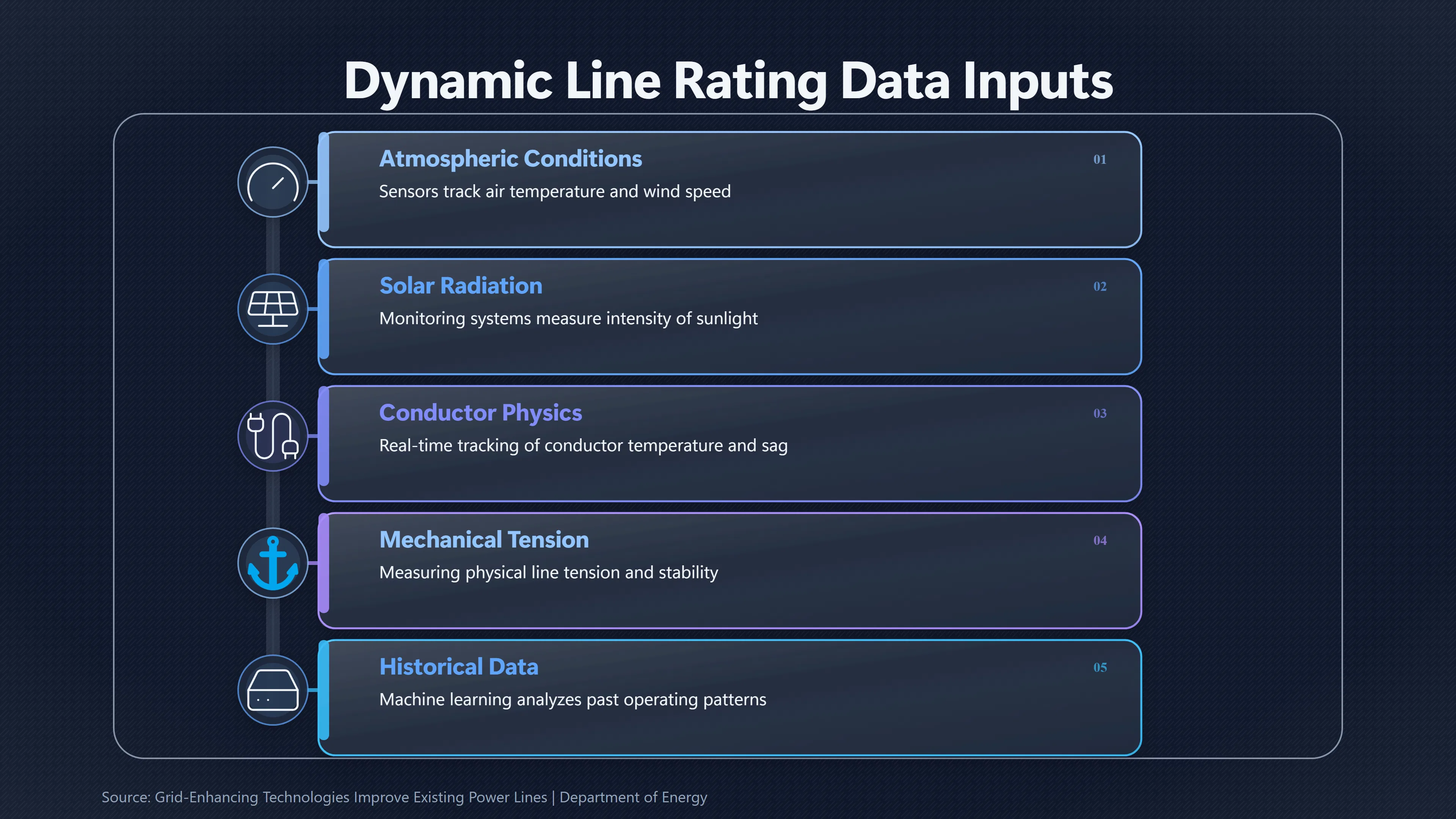
Instead of assigning a fixed seasonal limit, DLR continually estimates how much power a specific line can safely carry under current or forecast weather conditions.
Typical inputs include:
- air temperature
- wind speed
- wind direction
- solar radiation
- conductor temperature
- conductor sag
- line tension
- historical operating data
AI is not replacing the underlying physics. Rather, machine-learning systems help combine large streams of environmental data, improve short-term forecasts and identify patterns that traditional models may not capture efficiently. The final ratings still respect engineering safety constraints.
The result is that transmission capacity becomes a variable rather than a fixed number.
On cool, windy days many lines can safely carry substantially more electricity than their conservative static ratings imply. Conversely, DLR can also identify unusually poor conditions when flows should be reduced to protect equipment.[Federal Energy Regulatory Commission]ferc.govFederal Energy Regulatory CommissionFERC Opens Inquiry on Use of Dynamic Line Ratings to Promote Grid Efficiency | Federal Energy Regulat…
Hidden Capacity Is Real—but It Is Not Unlimited
The attraction of dynamic ratings is that they can often be deployed much faster than constructing entirely new transmission corridors.
The US Department of Energy notes that grid-enhancing technologies such as dynamic line ratings, advanced monitoring and power-flow control can improve utilisation of existing infrastructure at far lower cost than major new construction. It also notes that under favourable conditions transmission lines may safely carry roughly 50% more power than their labelled static limits. Those gains vary widely by location and weather rather than representing a guaranteed increase.[energy.gov]energy.govGrid-Enhancing Technologies Improve Existing Power Lines | Department of EnergyGrid-Enhancing Technologies Improve Existing Power Lines | Department of Energy
Academic studies reach similar conclusions while highlighting the limits.
Research using realistic power-system models has found that dynamic line ratings can reduce renewable curtailment, lower operating costs and reduce emissions compared with static ratings. German modelling suggests nationwide deployment could reduce overall power-system costs in high-renewable scenarios by improving use of existing transmission and reducing some storage and generation requirements. Studies on ERCOT likewise suggest that fully dynamic ratings can outperform simpler ambient-adjusted ratings, although benefits depend heavily on local weather patterns and network design.[arXiv]arxiv.orgarXiv Leveraging the Existing German Transmission Grid with Dynamic Line RatingLeveraging the Existing German Transmission Grid with Dynamic Line RatingMarch 6, 2023…
The important point is that the grid often contains operational slack, not unlimited spare capacity.

Why AI Forecasting Matters More as Renewables Grow
Older electricity systems were dominated by large coal, gas or nuclear stations whose output could be scheduled relatively predictably.
Modern electricity systems increasingly depend on weather-sensitive generation spread across thousands of locations. That changes the optimisation problem dramatically.
Instead of predicting the output of a few hundred generators, operators increasingly forecast:
- millions of rooftop solar systems
- thousands of wind turbines
- distributed batteries
- electric vehicle charging
- industrial demand response
- changing weather over large geographic areas
AI excels at recognising patterns in exactly these kinds of large, noisy datasets.
Better forecasts help operators:
- reduce renewable curtailment[energy.gov]energy.govDOE Study Shows Maximizing Capabilities of Existing Transmission Lines through Grid-Enhancing Technologies (GETs) Can Reduce Transmission…
- schedule batteries more effectively
- anticipate congestion earlier
- coordinate flexible demand
- reduce balancing costs
- improve market efficiency
The gains accumulate across thousands of operational decisions each day rather than coming from one dramatic technological breakthrough.
AI Is Only One Part of a Smarter Grid
Dynamic line ratings are usually discussed alongside other grid-enhancing technologies, because they complement one another.
Power-flow control devices can redirect electricity away from congested corridors. Topology optimisation software searches for better network configurations using existing switches and breakers. Advanced monitoring systems provide higher-quality real-time information about equipment conditions.
AI increasingly helps coordinate these tools simultaneously.
Rather than treating each transmission line independently, optimisation systems can evaluate entire networks, identifying where additional capacity actually creates the greatest overall benefit. This becomes increasingly valuable as millions of distributed energy resources—home batteries, electric vehicles and flexible industrial loads—begin participating in electricity markets.
The International Energy Agency expects these grid-enhancing technologies to play an increasingly important role alongside more conventional upgrades such as reconductoring existing lines and increasing transmission voltages.[IEA]iea.orgGrids – Electricity 2026 – Analysis - IEA…
Where Software Ends and New Infrastructure Begins
The optimistic case for AI-enabled electricity abundance sometimes risks overstating what software alone can achieve.
Dynamic ratings cannot remove every bottleneck.
Many transmission constraints arise from equipment that has fixed physical limits:
- transformers
- substations
- circuit breakers
- underground cables
- protection systems
A transmission corridor may contain dozens of components, with the weakest element determining overall capacity. Increasing the rating of one overhead line accomplishes little if a transformer further downstream remains saturated.
Nor can better forecasting solve the basic geographical challenge that renewable resources are often located far from major cities and industrial centres. Long-distance transmission still has to be built.
Planning, permitting and construction therefore remain essential. Grid-enhancing technologies should be viewed as ways to extract more value from today’s infrastructure while society undertakes the slower work of expanding tomorrow’s network.
This distinction matters for the broader AI abundance debate. AI may reduce some forms of scarcity by revealing underused capacity, but it does not eliminate the need for steel, copper, transformers, substations, skilled engineers or public acceptance of new infrastructure.
What This Means for an AI-Enabled Future
The idea of “hidden capacity” illustrates a broader theme in discussions of AI and human flourishing.
Many modern systems contain unused potential because humans simplify complex decisions using conservative assumptions and limited information. AI can sometimes recover part of that lost efficiency by making faster, better-informed predictions.
Electricity grids are a particularly valuable example because energy underpins almost every other sector of the economy. If AI helps existing networks connect renewable generation more quickly, reduce congestion and postpone expensive upgrades, it can accelerate progress towards cleaner, more abundant electricity without waiting for every kilometre of new transmission to be built.
The gains are likely to be significant but bounded. Better forecasting and dynamic line ratings can unlock meaningful additional capacity, reduce renewable waste and improve system reliability. They cannot eliminate the need for major investment in physical infrastructure as electricity demand grows from electrification, industry and AI itself.
In that sense, smarter grids demonstrate both the promise and the limits of AI-enabled abundance: intelligence can reveal opportunities that were previously invisible, but lasting prosperity still depends on combining better software with continued investment in the physical foundations of civilisation.
Amazon book picks
Further Reading
Books and field guides related to How Much More Can Existing Grids Carry?. Use these as the next step if you want deeper reading beyond the article.
The Grid
One of Bill Gates's Favorite Books of 2016 A revelatory look at our national power grid--how it developed, its current flaws, and how it...
How the World Really Works
INSTANT NEW YORK TIMES BESTSELLER “A new masterpiece from one of my favorite authors… [How The World Really Works] is a compelling and hi...
Superpower
In the ever more urgent quest for sources of renewable energy, meet the man boldly harnessing the natural forces that could power America...
Power Hungry
The promise of "green jobs" and a "clean energy future" has roused the masses. But as Robert Bryce makes clear in this provocative book,...
eBay marketplace picks
Marketplace Samples
Live-tested eBay searches with available results related to this page.
Selected frompower grid model oneBay.co.uk.

Endnotes
1.
Source: iea.org
Link:https://www.iea.org/reports/electricity-2026/grids
Source snippet
Grids – Electricity 2026 – Analysis - IEA...
2.
Source: energy.gov
Title: Grid-Enhancing Technologies Improve Existing Power Lines | Department of Energy
Link:https://www.energy.gov/oe/grid-enhancing-technologies-improve-existing-power-lines
3.
Source: energy.gov
Link:https://www.energy.gov/oe/articles/doe-study-shows-maximizing-capabilities-existing-transmission-lines-through-grid
Source snippet
DOE Study Shows Maximizing Capabilities of Existing Transmission Lines through Grid-Enhancing Technologies (GETs) Can Reduce Transmission...
4.
Source: arxiv.org
Title: arXiv Leveraging the Existing German Transmission Grid with Dynamic Line Rating
Link:https://arxiv.org/abs/2303.02987
Source snippet
Leveraging the Existing German Transmission Grid with Dynamic Line RatingMarch 6, 2023...
Published: March 6, 2023
5.
Source: arxiv.org
Title: arXiv Impacts of Dynamic Line Ratings on the ERCOT Transmission System
Link:https://arxiv.org/abs/2207.11309
6.
Source: ferc.gov
Link:https://www.ferc.gov/news-events/news/ferc-rule-improve-transmission-line-ratings-will-help-lower-transmission-costs
Source snippet
Federal Energy Regulatory CommissionFERC Rule to Improve Transmission Line Ratings Will Help Lower Transmission Costs | Federal Energy Re...
7.
Source: ferc.gov
Link:https://www.ferc.gov/news-events/news/ferc-opens-inquiry-use-dynamic-line-ratings-promote-grid-efficiency
Source snippet
Federal Energy Regulatory CommissionFERC Opens Inquiry on Use of Dynamic Line Ratings to Promote Grid Efficiency | Federal Energy Regulat...
Additional References
8.
Source: youtube.com
Title: Artificial Intelligence for Power Grid Optimization | Load Forecasting & Control
Link:https://www.youtube.com/watch?v=jdXZbFU1sAA
Source snippet
How AI is Revolutionizing the Grid: Efficiency, Reliability, and Resilience...
9.
Source: youtube.com
Title: AI Energy Forecasting: How Machine Learning is Transforming the Grid?
Link:https://www.youtube.com/watch?v=7P8CiTDVVng
Source snippet
Artificial Intelligence for Power Grid Optimization | Load Forecasting & Control...
10.
Source: youtube.com
Title: More Power, Same Lines: The AI Revolution in Transmission Infrastructure
Link:https://www.youtube.com/watch?v=2k4OKwW-J7M
Source snippet
AI Energy Forecasting: How Machine Learning is Transforming the Grid?...
11.
Source: youtube.com
Title: How AI is Revolutionizing the Grid: Efficiency, Reliability, and Resilience
Link:https://www.youtube.com/watch?v=5iGn3Fg8M9A
Source snippet
Grid's Hidden Potential Dynamic Line Rating...
12.
Source: youtube.com
Title: Grid’s Hidden Potential Dynamic Line Rating
Link:https://www.youtube.com/watch?v=jzAHUYIXo5U