Within Farm Robots
Why Safe Farm Robots Still Fail Outdoors
Mud, dust, rain and uneven ground can turn a safety tool into an unreliable machine during narrow planting and harvest windows.
On this page
- How weather and terrain disrupt sensors and navigation
- Why seasonal timing makes breakdowns unusually costly
- What robust deployment requires from design and support
Page outline Jump by section
Introduction
The biggest obstacle facing safety robots in agriculture is not usually artificial intelligence. It is the physical environment. Robots that work reliably in laboratories, warehouses or even on paved roads must operate in fields where mud clogs wheels, dust coats sensors, rain changes traction, crops grow unpredictably, sunlight varies by the minute and hidden obstacles appear without warning. A robot that performs well in ideal demonstrations may become unreliable during the narrow planting or harvest periods when farmers depend on it most. This matters because one of the strongest near-term arguments for agricultural AI is that it can reduce human exposure to pesticides, extreme heat and hazardous machinery. If robots cannot be trusted to work safely under real field conditions, they cannot consistently deliver those safety benefits or serve as convincing evidence for the broader vision that AI could eliminate more dangerous forms of work.
Why outdoor farms remain one of robotics’ hardest environments
Factories succeed with industrial robots because almost everything important is controlled. Floors are flat, lighting is consistent, objects arrive in predictable positions and unexpected obstacles are rare.
Agriculture presents almost the opposite challenge. Every part of the operating environment changes over time. Soil dries or becomes waterlogged, crops increase in height, leaves obscure cameras, animals enter fields, irrigation creates reflective surfaces and weather alters visibility. Modern reviews of agricultural navigation consistently identify this combination of changing terrain, unreliable localisation and degraded perception as the central obstacle to dependable autonomy rather than a lack of machine-learning capability.[sciencedirect.com]sciencedirect.comScienceDirect…
Researchers commonly describe farms as ranging from “semi-structured” to “unstructured” environments. Even fields planted in straight rows gradually become less predictable as vegetation grows unevenly, weeds appear, machinery creates ruts and seasonal changes alter visual landmarks that navigation systems depend upon.[sciencedirect.com]sciencedirect.comScienceDirect…
The result is that robots must continually answer questions that factories rarely ask:
- Is this obstacle a person, a branch or tall weeds?
- Has rain turned firm soil into ground that will trap the machine?
- Is the crop row still visible beneath overlapping leaves?
- Has vibration shifted sensor calibration?
- Has dust reduced camera performance enough that operations should stop?
Each uncertainty increases the chance that a robot will slow down, request human intervention or halt completely.
How weather and terrain disrupt sensors and navigation
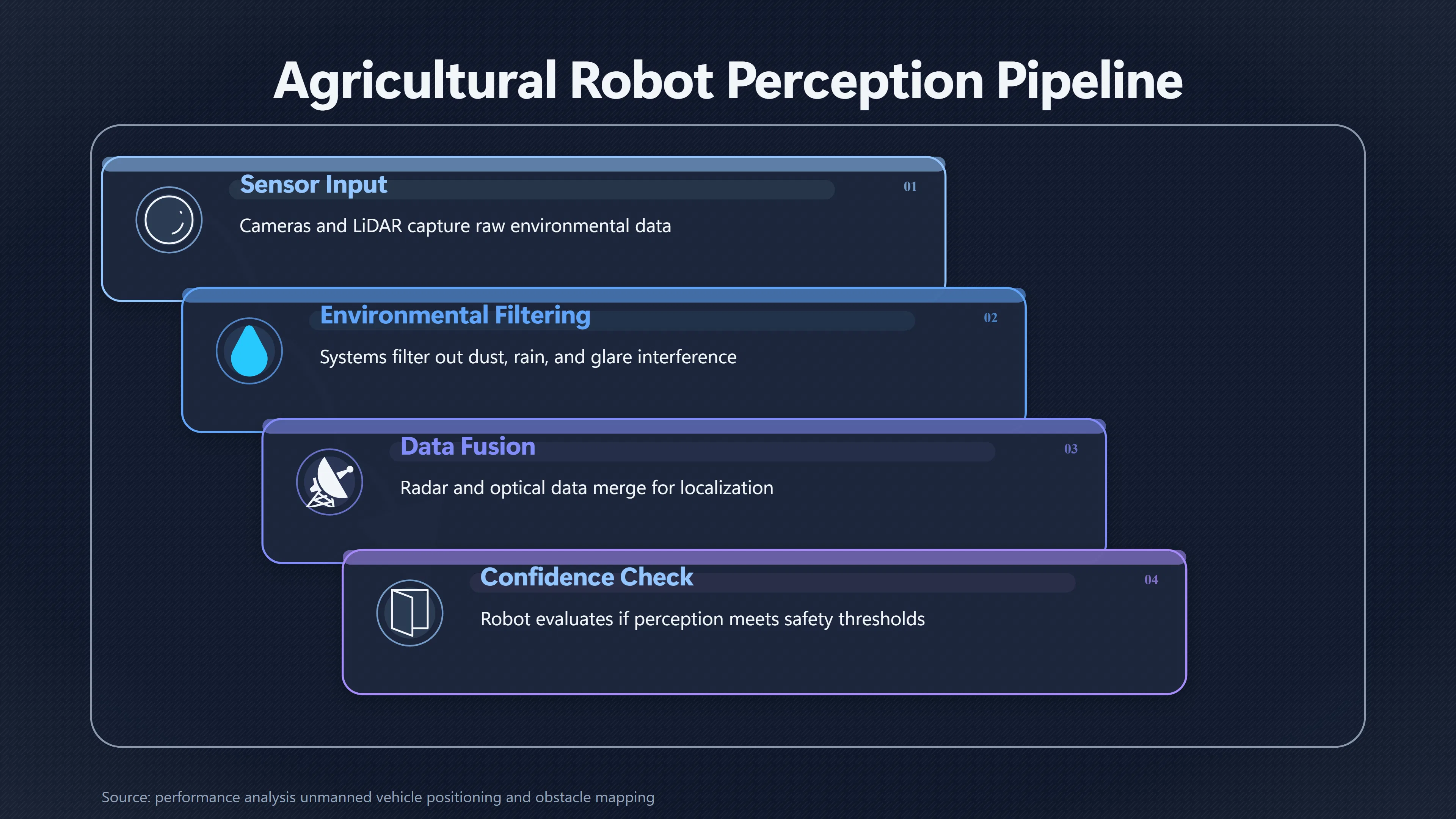
Safe agricultural robots rely on perception systems that combine cameras, satellite positioning, inertial sensors, radar, laser scanners (LiDAR) and other measurements. No single sensor performs well under every agricultural condition.
Dust, rain and sunlight confuse perception
Optical cameras perform well in clear conditions but struggle with glare, shadows, fog, heavy dust and rapidly changing illumination. Laser scanners can produce false returns or reduced detection distances in dust or rainfall. Radar is generally more resistant to adverse weather but provides less detailed environmental information, making precise localisation more difficult. Because every sensing technology has different weaknesses, agricultural robotics increasingly depends on sensor fusion rather than a single “best” sensor.[wiley.com]onlinelibrary.wiley.comWiley Online LibraryPerformance of laser and radar ranging devices in adverse environmental conditions - Ryde - 2009 - Journal of Field R…
Research on autonomous perception more broadly reaches similar conclusions. Studies examining adverse weather show that reduced lighting, occlusion and combinations of poor weather with partially hidden objects substantially increase uncertainty in AI perception systems, making conservative behaviour essential for safety.[NIST Computer Security Resource Center]csrc.nist.govNIST Computer Security Resource CenterOn the Assessment of Sensitivity of Autonomous Vehicle Perception | CSRCJanuary 30, 2026…
Terrain constantly changes beneath the robot
Unlike paved roads, agricultural surfaces are continually reshaped by machinery, rainfall and cultivation.
Robots must cope with:
- soft soil that changes wheel grip
- deep ruts left by tractors
- slopes and uneven ground
- standing water after rainfall
- loose stones and crop residue
- vibration that affects sensors and mechanical components.
Navigation controllers have improved considerably, but maintaining accurate steering and stable motion across these changing conditions remains a major engineering challenge, especially when robots must simultaneously avoid workers, equipment and livestock.[Wiley Online Library]onlinelibrary.wiley.comWiley Online LibraryControl System for the Navigation of the Agricultural Robots: A Review - Polanía - Journal of Field Robotics - Wiley…

Crops hide the world
Unlike warehouse shelves, crops grow.
As plants mature they block GPS signals beneath dense canopies, hide rocks and irrigation equipment, obscure row markings and make it harder for cameras to distinguish between crop plants and weeds. Orchard environments add branches, changing shadows and irregular fruit positions, creating further perception problems.
Recent reviews continue to identify canopy occlusion, moving machinery and dense vegetation as key barriers to reliable autonomous navigation in real farms.[sciencedirect.com]sciencedirect.comScienceDirect…
Why seasonal timing makes breakdowns unusually costly
Field reliability matters more in farming than in many industries because agricultural work is governed by biology rather than production schedules.
Missing a factory shift may reduce output. Missing a narrow planting window can reduce yields for an entire season. Delayed harvesting may expose crops to storms, disease or over-ripening. Many safety applications—such as pesticide spraying or heat-avoiding field work—must also occur during specific weather conditions.
This means downtime has unusually high economic consequences. Farmers often judge automation not by average performance but by whether it works during the few weeks each year when failure is unacceptable.
Long-term validation therefore matters as much as headline accuracy figures. Recent reviews argue that agricultural robotics research has relied too heavily on short experimental demonstrations instead of measuring reliability across complete growing seasons, where sensor contamination, changing vegetation, varying soil moisture and equipment wear gradually reduce performance. They recommend evaluating systems using measures such as mean time between human interventions and recovery rates during severe weather rather than navigation accuracy alone.[mdpi.com]mdpi.comDecember 27, 2025…
For safety robots, this distinction is crucial. A machine that succeeds in controlled field trials but requires frequent operator rescue during harvest may provide little practical reduction in dangerous human work.
Reliability is as much an engineering problem as an AI problem
It is tempting to imagine that more powerful AI models alone will solve agricultural autonomy. In reality, robust deployment depends on the interaction between software, hardware and operational support.
Reliable field systems increasingly require:
- Multiple complementary sensors, allowing one system to compensate when another degrades.
- Continuous self-monitoring, enabling robots to recognise when perception confidence has become too low for safe operation.
- Graceful failure modes, where machines slow down, stop or request human assistance rather than making uncertain decisions.
- Mechanical robustness, including sealed electronics, vibration-resistant mounting and protection against dust, moisture and corrosion.
- Maintainable designs, allowing damaged components to be cleaned or replaced quickly during busy seasons.
- Remote diagnostics and software updates, reducing repair delays in isolated farming regions.
Researchers are also moving towards adaptive systems that estimate the trustworthiness of individual sensors in real time, adjusting navigation strategies when cameras, LiDAR or GPS become unreliable because of environmental conditions.[sciencedirect.com]sciencedirect.comSeptember 15, 2026…
What these limits mean for AI-enabled human flourishing
Within the broader vision of AI supporting human flourishing, agricultural robots illustrate an important lesson: reducing dangerous labour depends on dependable physical systems, not just increasingly capable AI.
If robots can reliably undertake pesticide application, repetitive weeding or field inspection during extreme heat, they could substantially reduce human exposure to chemicals, heat stress and hazardous machinery. Those gains would strengthen the case that AI can remove people from dangerous work while improving agricultural productivity.
Yet harsh outdoor conditions remain one of the strongest reminders that intelligence alone is not enough. Progress depends on building machines that continue operating safely after weeks of dust, vibration, rain and changing crops—not merely demonstrating impressive autonomy on ideal test days.
Rather than disproving the long-term promise of AI-enabled abundance, these challenges clarify where the remaining work lies. The next advances are likely to come from combining stronger AI with more resilient sensors, better mechanical engineering, long-duration field testing and support systems designed around the realities of farming rather than laboratory performance. Only when robots prove dependable through complete growing seasons will their potential to protect workers and expand the practical benefits of agricultural automation be fully realised.
Amazon book picks
Further Reading
Books and field guides related to Why Safe Farm Robots Still Fail Outdoors. Use these as the next step if you want deeper reading beyond the article.
Introduction to Autonomous Mobile Robots
The second edition of a comprehensive introduction to all aspects of mobile robotics, from algorithms to mechanisms. Mobile robots range...
Robotics: Modelling, Planning and Control
Based on the successful Modelling and Control of Robot Manipulators by Sciavicco and Siciliano (Springer, 2000), Robotics provides the ba...
The Second Machine Age
A New York Times Bestseller A revolution is under way. In recent years, Google’s autonomous cars have logged thousands of miles on Americ...
The Future Is Faster Than You Think
From the New York Times bestselling authors of Abundance and Bold comes a practical playbook for technological convergence in our modern...
eBay marketplace picks
Marketplace Samples
Live-tested eBay searches with available results related to this page.
Selected fromfarm robot model oneBay.co.uk.

Endnotes
1.
Source: sciencedirect.com
Link:https://www.sciencedirect.com/science/article/pii/S2772375526003394
Source snippet
ScienceDirect...
2.
Source: mdpi.com
Link:https://www.mdpi.com/2218-6581/14/11/159
3.
Source: onlinelibrary.wiley.com
Link:https://onlinelibrary.wiley.com/doi/full/10.1002/rob.70199
Source snippet
Wiley Online LibraryControl System for the Navigation of the Agricultural Robots: A Review - Polanía - Journal of Field Robotics - Wiley...
4.
Source: onlinelibrary.wiley.com
Link:https://onlinelibrary.wiley.com/doi/pdf/10.1002/rob.20310
Source snippet
Wiley Online LibraryPerformance of laser and radar ranging devices in adverse environmental conditions - Ryde - 2009 - Journal of Field R...
5.
Source: csrc.nist.gov
Link:https://csrc.nist.gov/pubs/other/2026/01/30/on-the-assessment-of-sensitivity-of-autonomous-veh/final
Source snippet
NIST Computer Security Resource CenterOn the Assessment of Sensitivity of Autonomous Vehicle Perception | CSRCJanuary 30, 2026...
Published: January 30, 2026
6.
Source: mdpi.com
Link:https://www.mdpi.com/2075-1702/12/4/218/html
7.
Source: mdpi.com
Link:https://www.mdpi.com/2077-0472/16/1/64
Source snippet
December 27, 2025...
Published: December 27, 2025
8.
Source: sciencedirect.com
Link:https://www.sciencedirect.com/science/article/pii/S0168169926007374
Source snippet
September 15, 2026...
Published: September 15, 2026
9.
Source: sciencedirect.com
Link:https://www.sciencedirect.com/science/article/pii/S0168169926003492
Source snippet
July 1, 2026 — Review article Get rights and content Review article A review of visual navigation for agricultural robots in...
Published: July 1, 2026
10.
Source: onlinelibrary.wiley.com
Link:https://onlinelibrary.wiley.com/doi/abs/10.1002/rob.20310
11.
Source: nist.gov
Title: performance analysis unmanned vehicle positioning and obstacle mapping
Link:https://www.nist.gov/publications/performance-analysis-unmanned-vehicle-positioning-and-obstacle-mapping
12.
Source: nist.gov
Title: new visual invariants terrain navigation without 3 d reconstruction
Link:https://www.nist.gov/publications/new-visual-invariants-terrain-navigation-without-3-d-reconstruction
13.
Source: doi.org
Link:https://doi.org/10.2139/ssrn.6771197
Additional References
14.
Source: youtube.com
Link:https://www.youtube.com/watch?v=bUJHog40KNw
Source snippet
K.U.L.T. InRow eActuator, K.U.L.T.iScan & K.U.L.T.aiLaser by K.U.L.T...
15.
Source: youtube.com
Title: K.U.L.T. In Row e Actuator, K.U.L.T.i Scan & K.U.L.T.ai Laser by K.U.L.T
Link:https://www.youtube.com/watch?v=xAxJHP3TS1E
Source snippet
[IPPS2022 Keynote] Cyrill Stachniss - Robotics & Mobile Sensing Towards Sustainable Crop Production...
16.
Source: youtube.com
Link:https://www.youtube.com/watch?v=J8H_UEDDT6s
Source snippet
Stanford Seminar - Where are the Field Robots?...
17.
Source: youtube.com
Title: [Development]({{ ‘build-rights/’ | relative_url }}) and autonomous navigation of a field robot
Link:https://www.youtube.com/watch?v=tzSqEQOgS4M
Source snippet
Lymow One Review: Tank Track Robot Mower That Actually Works Under Trees (GPS Dead Zone Test)...
18.
Source: eurekamag.com
Link:https://eurekamag.com/research/108/261/108261350.php
19.
Source: research.tudelft.nl
Link:https://research.tudelft.nl/en/publications/keypoint-semantic-integration-for-improved-feature-matching-in-ou/
20.
Source: arxiv.org
Title: arXiv Ambient awareness for agricultural robotic vehicles
Link:https://arxiv.org/abs/2104.05270
21.
Source: rchelec.com
Title: Weather resistant agricultural robot processing parts for smart farming
Link:https://rchelec.com/en/agricultural-robot-processing-parts/
22.
Source: eureka.patsnap.com
Title: report quantify weather resilience of precision agriculture robotics
Link:https://eureka.patsnap.com/report-quantify-weather-resilience-of-precision-agriculture-robotics
23.
Source: eureka.patsnap.com
Title: report material durability in precision agriculture robots evaluate
Link:https://eureka.patsnap.com/report-material-durability-in-precision-agriculture-robots-evaluate