Within Health
Does AI Breast Screening Save More Lives?
AI-supported mammography may reduce missed cancers, but its value depends on limiting false alarms, overdiagnosis and unnecessary treatment.
On this page
- What the Swedish randomised trial found
- The difference between detection and better outcomes
- False alarms, overdiagnosis and long term follow up
Page outline Jump by section
Introduction
Artificial intelligence has become one of the strongest real-world tests of whether medical AI can genuinely improve health rather than simply recognise patterns in images. Breast cancer screening is especially important because mammography is already widely used, the disease is common, and every improvement or mistake affects large numbers of healthy people.
The most encouraging evidence so far comes from large randomised studies in Sweden showing that AI-assisted mammography can detect more clinically important cancers while reducing radiologists’ workload. But these results also highlight an equally important lesson: finding more abnormalities is not automatically the same as saving more lives. If AI mainly increases detection of slow-growing cancers that would never have caused harm, or triggers unnecessary biopsies and treatment, then higher detection rates could create more harm than benefit. The central question is therefore not whether AI finds more suspicious areas, but whether it improves long-term health outcomes enough to justify the additional interventions.
What the Swedish randomised trial found
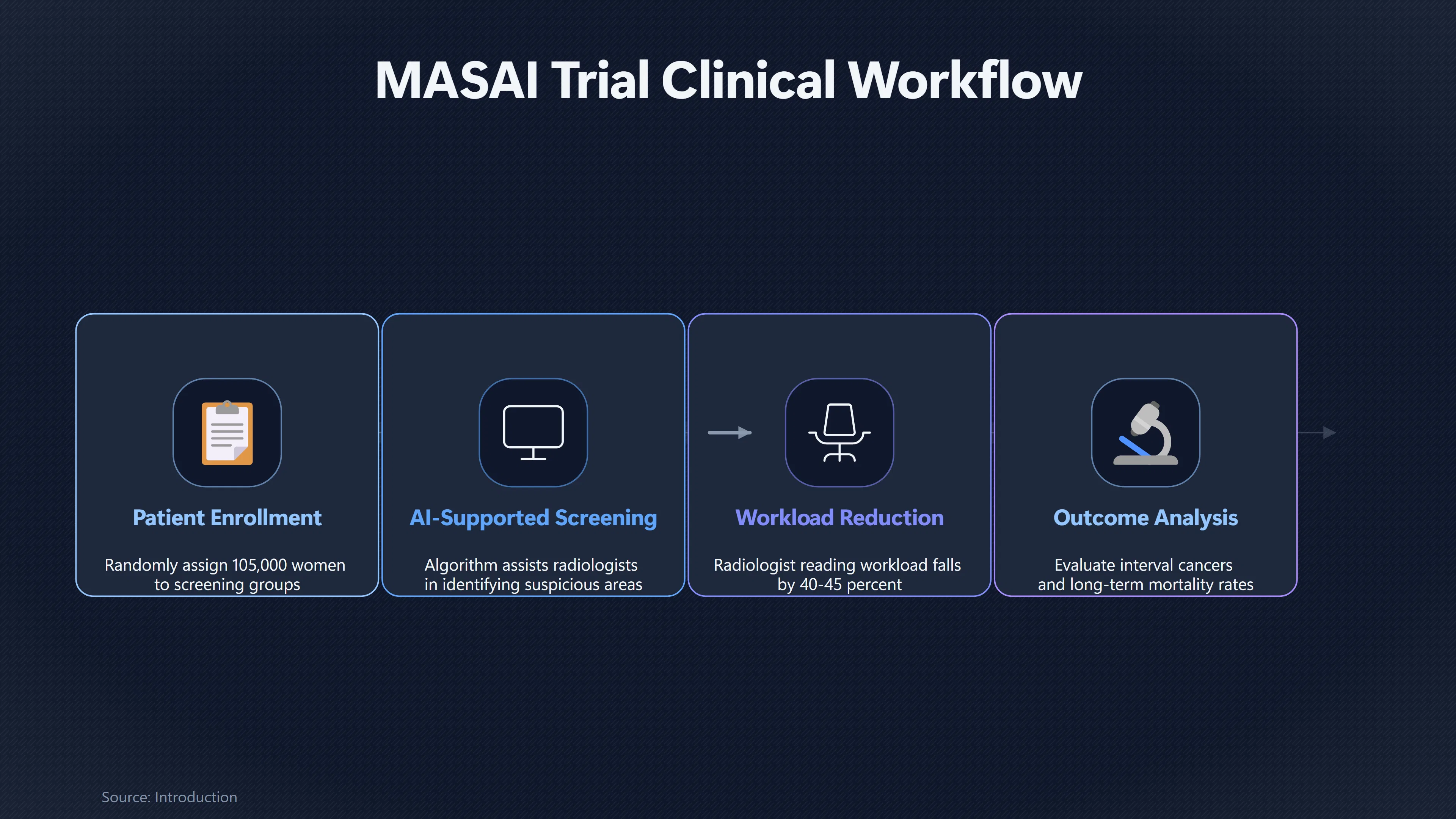
The Mammography Screening with Artificial Intelligence (MASAI) trial is among the strongest pieces of evidence yet available because it was conducted within Sweden’s national screening programme and randomly assigned more than 105,000 women to either conventional double reading by radiologists or AI-supported screening. Unlike many earlier retrospective studies, this design measures how AI performs under everyday clinical conditions rather than on carefully selected image collections.[PubMed]pubmed.ncbi.nlm.nih.govScreening performance and characteristics of breast cancer detected in the Mammography Screening with Artificial Intelligence trial…
Early analyses showed several encouraging findings:
- AI-supported screening detected more breast cancers overall.
- More invasive cancers were found rather than simply more very early abnormalities.
- Radiologists’ reading workload fell by roughly 40–45%, an important consideration given workforce shortages.
- Recall rates and false-positive rates did not increase significantly despite the higher detection rate.[PubMed]pubmed.ncbi.nlm.nih.govScreening performance and characteristics of breast cancer detected in the Mammography Screening with Artificial Intelligence trial…
The most important follow-up analysis, published after sufficient time had passed to observe interval cancers—cancers diagnosed between scheduled screening rounds—provided a stronger test than simply counting cancers found during screening.
Women screened with AI experienced a statistically non-inferior interval cancer rate compared with standard double reading (1.55 versus 1.76 cancers per 1,000 participants). AI-supported screening also achieved higher overall sensitivity while maintaining essentially identical specificity. In other words, the system detected a greater proportion of existing cancers without increasing the proportion of healthy women incorrectly classified as having cancer.[PubMed]pubmed.ncbi.nlm.nih.govInterval cancer, sensitivity, and specificity comparing AI-supported mammography screening with standard double reading without AI…
These findings suggest that AI was not merely identifying more harmless abnormalities. It appeared to detect additional clinically relevant cancers that conventional screening would otherwise have missed.
Detection is not the same as better outcomes
Even these promising results do not settle the most important question.
Cancer screening has always faced a distinction between finding more disease and improving people’s lives. A screening programme can increase diagnoses while producing only modest improvements—or even no improvement—in mortality or quality of life.
Several mechanisms explain why.
Lead-time bias occurs when a cancer is diagnosed earlier but the patient’s eventual lifespan remains unchanged. Survival after diagnosis appears longer simply because the clock started sooner.
Length bias arises because screening preferentially detects slower-growing tumours that remain visible for longer. Aggressive cancers may still develop rapidly between screening rounds.
Overdiagnosis occurs when screening identifies cancers that would never have become clinically significant during a person’s lifetime. Those patients may nevertheless undergo surgery, radiotherapy or hormone treatment despite receiving little or no health benefit.
For this reason, screening programmes ultimately judge success by outcomes such as:
- fewer interval cancers;
- fewer advanced cancers;
- lower breast cancer mortality;[doi.org]doi.orgScreening performance and characteristics of breast cancer detected in the Mammography Screening with Artificial Intelligence trial (M…
- reduced unnecessary treatment;
- acceptable rates of false positives and biopsies.
Simply reporting that AI detects more abnormalities does not answer these questions.

Why false alarms still matter
Every abnormal mammogram creates consequences even when cancer is ultimately excluded.
A false-positive screening result commonly leads to additional imaging, further clinic appointments and sometimes biopsy. Many women experience substantial anxiety during the investigation period, while health systems incur extra costs and workload.
Historically, breast screening has accepted some false positives because earlier detection saves lives overall. AI changes the balance only if it improves detection without substantially increasing unnecessary investigations.
The MASAI trial provides encouraging evidence on this point because specificity remained effectively unchanged despite higher sensitivity. This means AI found more genuine cancers without noticeably increasing the proportion of healthy women recalled for further assessment.[PubMed]pubmed.ncbi.nlm.nih.govInterval cancer, sensitivity, and specificity comparing AI-supported mammography screening with standard double reading without AI…
That does not mean false positives disappear. Rather, it suggests that a carefully validated AI system can shift the balance towards finding more true cancers without paying the usual price of substantially more unnecessary recalls.
The overdiagnosis question remains unresolved
Overdiagnosis is probably the hardest problem in cancer screening because it cannot usually be recognised in an individual patient.
Once a suspicious lesion is identified, neither clinicians nor patients can know with certainty whether that cancer would eventually have caused illness if left undiscovered. Consequently, treatment often proceeds.
This issue becomes particularly important when AI increases detection of very early or non-invasive lesions such as ductal carcinoma in situ (DCIS). Some DCIS lesions progress to invasive cancer, while others may never become dangerous.
Earlier MASAI analyses observed a relative increase in detection of in situ cancers alongside larger increases in invasive cancers. Researchers themselves cautioned that long-term follow-up would be needed to determine whether the additional in situ diagnoses represent beneficial earlier detection or an increase in overdiagnosis.[DOI]doi.orgScreening performance and characteristics of breast cancer detected in the Mammography Screening with Artificial Intelligence trial (M…
This illustrates a broader lesson for medical AI.
An algorithm can demonstrate excellent image recognition while still leaving unanswered whether the extra abnormalities it identifies ultimately improve patients’ lives.
Why long-term follow-up matters more than early headlines
The Swedish trial has attracted attention because it goes beyond simple image-classification accuracy. Nevertheless, even this study cannot yet answer every clinically important question.
Researchers still need longer observation to determine whether AI-supported screening ultimately produces:
- lower breast cancer mortality;[doi.org]doi.orgScreening performance and characteristics of breast cancer detected in the Mammography Screening with Artificial Intelligence trial (M…
- fewer advanced cancers requiring intensive treatment;
- lower rates of unnecessary surgery and radiotherapy;
- acceptable lifetime rates of overdiagnosis;
- favourable cost-effectiveness across national screening programmes.
Health systems considering widespread deployment—including large NHS evaluations—are therefore interested not only in detection rates but also in these longer-term clinical outcomes.[theguardian.com]theguardian.comMore breast cancer cases found when AI used in screenings, study findsResearchers analyzed data from 461,818 women screened between July 2021 and February 2023, discovering that the cancer detection rate was…
This distinction is essential for understanding medical AI more broadly. Short-term diagnostic accuracy is an encouraging intermediate result, but durable improvements in health are the true objective.
What this means for AI and healthy longevity
Within the broader question of whether AI can contribute to healthier, longer lives, mammography provides an unusually demanding test.
Unlike laboratory demonstrations, breast screening affects millions of healthy people. Small improvements in accuracy can prevent deaths, while small increases in unnecessary treatment can also affect many lives. The technology therefore has to improve the overall balance of benefit and harm rather than merely producing more detections.
The Swedish evidence is encouraging because AI appears capable of increasing sensitivity while maintaining specificity and reducing radiologists’ workload. That combination suggests genuine clinical value rather than simple technological novelty.[PubMed]pubmed.ncbi.nlm.nih.govInterval cancer, sensitivity, and specificity comparing AI-supported mammography screening with standard double reading without AI…
At the same time, the trial reinforces an important principle for evaluating every medical AI system. Better pattern recognition is only the first step. The ultimate measure of success is whether patients experience fewer advanced cancers, less unnecessary treatment, better quality of life and longer healthy lives. AI mammography appears to be moving in that direction, but only continued long-term follow-up can determine how much of today’s increased detection translates into tomorrow’s improved health.
Amazon book picks
Further Reading
Books and field guides related to Does AI Breast Screening Save More Lives?. Use these as the next step if you want deeper reading beyond the article.
Deep Medicine: How Artificial Intelligence Can Make Healthcar...
One of America's top doctors reveals how AI will empower physicians and revolutionize patient care Medicine has become inhuman, to disast...
The Emperor of All Maladies: A Biography of Cancer
A historical assessment of cancer addresses both the courageous battles against the complex disease and the misperceptions and hubris tha...
The Gene: An Intimate History
Prologue: Families -- "The missing science of heredity" 1865-1935 -- "In the sum of the parts, there are only the parts" 1930-1970 -- "Th...
The Digital Doctor: Hope, Hype, and Harm at the Dawn of Medic...
The New York Times Science Bestseller from Robert Wachter, Modern Healthcare’s #1 Most Influential Physician-Executive in the US While mo...
eBay marketplace picks
Marketplace Samples
Live-tested eBay searches with available results related to this page.
Selected frommedical poster oneBay.co.uk.

Endnotes
1.
Source: doi.org
Link:https://doi.org/10.1016/s2589-7500%2824%2900267-x
Source snippet
Screening performance and characteristics of breast cancer detected in the Mammography Screening with Artificial Intelligence trial (M...
2.
Source: theguardian.com
Title: More breast cancer cases found when AI used in screenings, study finds
Link:https://www.theguardian.com/society/2025/jan/07/more-breast-cancer-cases-found-when-ai-used-in-screenings-study-finds
Source snippet
Researchers analyzed data from 461,818 women screened between July 2021 and February 2023, discovering that the cancer detection rate was...
Published: July 2021
3.
Source: pubmed.ncbi.nlm.nih.gov
Link:https://pubmed.ncbi.nlm.nih.gov/39904652/
Source snippet
Screening performance and characteristics of breast cancer detected in the Mammography Screening with Artificial Intelligence trial...
4.
Source: pubmed.ncbi.nlm.nih.gov
Link:https://pubmed.ncbi.nlm.nih.gov/41620232/
Source snippet
Interval cancer, sensitivity, and specificity comparing AI-supported mammography screening with standard double reading without AI...
5.
Source: pmc.ncbi.nlm.nih.gov
Link:https://pmc.ncbi.nlm.nih.gov/articles/PMC13036691/
Source snippet
2026 Mar 27;8(2):e269007. doi: 10.1148/rycan.269007 AI AND BREAST CANCER SCREENING AT A CROSSROADS: INSIGHTS FROM THE MASAI TRIAL Andrea...
6.
Source: pmc.ncbi.nlm.nih.gov
Link:https://pmc.ncbi.nlm.nih.gov/articles/PMC10623302/
Additional References
7.
Source: associationofbreastsurgery.org.uk
Link:https://associationofbreastsurgery.org.uk/professionals/information-hub/publications/2026/interval-cancer-sensitivity-and-specificity-comparing-ai-supported-mammography-screening-with-standard-double-reading-without-ai-in-the-masai-study-a-randomised-controlled-non-inferiority-single-blinded-population-based-screening-accuracy-t
Source snippet
Interval cancer, sensitivity, and specificity comparing AI-supported mammography screening with standard double reading without AI in the...
8.
Source: sciencedirect.com
Title: Some of these are rapidly [progressive]({{ ‘progressive-hints/’ | relative_url }}) and can appear as interval
Link:https://www.sciencedirect.com/science/article/abs/pii/S014067362502464X
Source snippet
Interval cancer, sensitivity, and specificity comparing AI-supported mammography screening with standard double reading without AI in the...
9.
Source: youtube.com
Title: AI could help find breast cancer, study suggests
Link:https://www.youtube.com/watch?v=Suc2bLXbIFs
Source snippet
AI breast cancer screening overdiagnosis Doctors using AI mammogram readings to predict breast cancer risk CBS News...
10.
Source: nature.com
Link:https://www.nature.com/nature-index/article/10.1016/s0140-6736%2825%2902464-x
11.
Source: youtube.com
Title: Positive results for AI-assisted breast cancer detection, says Swedish trial
Link:https://www.youtube.com/watch?v=CbNn4X90hB4
Source snippet
Paper of the week MASAI Trial – Full videocast...
12.
Source: youtube.com
Title: Onco Daily Dialogues #10
Link:https://www.youtube.com/watch?v=WEqNeAEkVWI
Source snippet
Top Breast Cancer Surgeon Reveals: We're Overdiagnosing...
13.
Source: youtube.com
Title: Paper of the week MASAI Trial – Full videocast
Link:https://www.youtube.com/watch?v=3GvyGJLYk24
Source snippet
OncoDaily Dialogues #10 - Krissa Smith / Hosted by Roupen Odabashian...
14.
Source: youtube.com
Title: Top Breast Cancer Surgeon Reveals: We’re Overdiagnosing!
Link:https://www.youtube.com/watch?v=_Kuz6alispo
Source snippet
AI could help find breast cancer, study suggests...
15.
Source: sciencedirect.com
Link:https://www.sciencedirect.com/science/article/pii/S258975002300153X
16.
Source: sciencedirect.com
Link:https://www.sciencedirect.com/science/article/abs/pii/S147020452300298X