Within Scarce Essentials
Who Owns The Gains From AI?
Cheap AI services may not create broad security if ownership of productive AI systems and infrastructure remains concentrated.
On this page
- The difference between using AI and owning AI assets
- How concentrated ownership affects economic outcomes
- Possible routes to wider participation in AI wealth
Page outline Jump by section
Introduction
Cheap AI services could make expert-level assistance widely available, but access to AI tools is not the same as ownership of the systems that generate AI-driven wealth. The difference matters because the long-term economic impact of AI may depend not only on how powerful the technology becomes, but on who owns the models, computing infrastructure, data assets, and businesses built around them.
If advanced AI creates a new era of abundance, the benefits could spread broadly through cheaper services, better healthcare, faster scientific discovery, and higher productivity. But if ownership of the most valuable AI assets remains concentrated among a small number of firms and investors, society could experience a paradox: abundant intelligence for users, but concentrated wealth and decision-making power for owners. The central policy question is therefore not only whether AI becomes cheap, but whether the gains from AI become widely shared.[arXiv]arxiv.orgAI and the Opportunity for Shared Prosperity: Lessons from the History of Technology and the EconomyJanuary 18, 2024…
The difference between using AI and owning AI assets
Using AI is becoming increasingly accessible. A student can use an AI tutor, a small company can access automated analysis, and individuals can use AI assistants without owning the underlying systems. This resembles many earlier technologies: people could use electricity without owning power stations, or use the internet without owning data centres.
However, ownership determines who captures the largest share of economic returns. The owners of productive assets — factories, land, patents, networks, or financial infrastructure — often receive a disproportionate share of the value created by those assets. AI introduces a similar question because the most powerful systems depend on valuable inputs that are not evenly distributed.
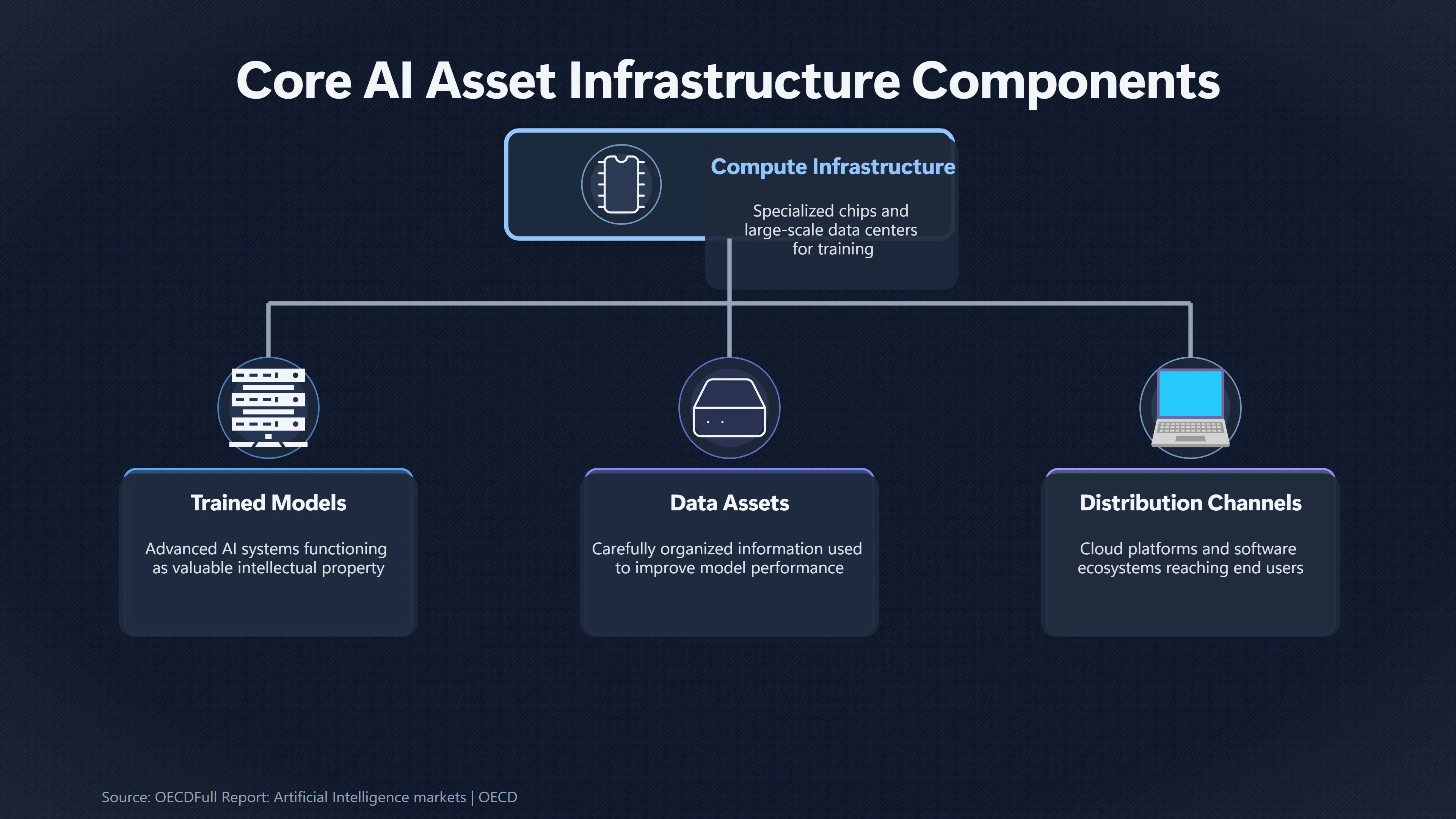
The core AI assets include:
- Compute infrastructure: the specialised chips and data centres needed to train and run advanced models.
- Models: the trained AI systems themselves, which can become valuable intellectual property.
- Data assets: carefully collected and organised information that improves AI performance.
- Distribution channels: cloud platforms, software ecosystems, and consumer or business relationships through which AI reaches users.
These assets are becoming strategically important because frontier AI requires enormous amounts of computing power. The OECD has highlighted that AI infrastructure markets face concentration risks because chip production, cloud computing, and large-scale data centres involve high fixed costs, economies of scale, and significant barriers to entry.[OECD]oecd-ilibrary.orgOECDFull Report: Artificial Intelligence markets | OECDOECDFull Report: Artificial Intelligence markets | OECD
This creates a distinction between two futures. In one, AI behaves like a widely available public capability: many people and organisations can build on it, compete with it, and share in the productivity gains. In another, AI behaves more like a privately controlled industrial resource: most people can access it, but a small group controls the assets that produce the largest economic rewards.
The difference could shape whether AI becomes a foundation for broad human flourishing or a source of deeper economic concentration.
How concentrated ownership affects economic outcomes
Compute becomes a strategic asset
The modern AI economy is not built only on algorithms. It depends on physical infrastructure that is expensive and difficult to replicate. Advanced chips, energy supplies, specialised data centres, and cloud computing capacity all influence who can participate.
Research on AI governance has identified compute — the computing power used to train and operate AI systems — as a particularly important point of control because it is measurable, limited, and concentrated in supply chains.[arXiv]arxiv.orgarXiv Computing Power and the Governance of Artificial IntelligenceComputing Power and the Governance of Artificial IntelligenceFebruary 13, 2024… The World Bank has similarly described compute as a foundational input for AI participation, while noting that access remains uneven between countries and organisations.[World Bank]worldbank.orgWorld Bank ReportWorld Bank Report
This matters because a small number of organisations controlling essential infrastructure can influence:
- who can develop advanced AI systems;
- which industries gain access first;
- what prices users pay;
- which applications receive investment;
- where AI research capacity grows.
The concentration of cloud infrastructure illustrates the challenge. The OECD has reported that the largest cloud providers hold significant shares of global cloud markets, with advantages created by scale, existing infrastructure, and integration with wider technology ecosystems.[oecd.org]oecd.org623d1874 enCOMPETITION INApril 21, 2026…
A world where only a few companies can afford frontier-scale AI development may still deliver many benefits to consumers, but it could limit competition and reduce the number of people able to shape the technology’s direction.
Productivity gains do not automatically become shared prosperity
Technology has often increased total wealth without guaranteeing equal distribution of that wealth. The industrial revolution, computing revolution, and internet revolution all created enormous new capabilities, but their benefits were shaped by institutions, labour markets, ownership structures, and public policy.
AI could follow the same pattern. Higher productivity may increase the size of the economic “pie”, but ownership rules influence who receives the additional income. Research on AI and shared prosperity argues that the distribution of benefits will depend on choices made by developers, businesses, governments, infrastructure providers, and workers rather than technology alone.[arXiv]arxiv.orgAI and the Opportunity for Shared Prosperity: Lessons from the History of Technology and the EconomyJanuary 18, 2024…
The concern is particularly important because AI may affect both labour and capital. If AI mainly complements workers, it could raise human capability and create new opportunities. If it primarily substitutes for human labour while increasing returns to AI infrastructure owners, income and wealth could become more concentrated.
The challenge is not simply that some people may lose jobs. A deeper issue is whether ordinary people retain a meaningful stake in a more productive economy.

Possible routes to wider participation in AI wealth
No single policy guarantees that AI benefits will be broadly shared. Different approaches address different parts of the ownership problem.
Wider access to AI infrastructure
One approach is reducing barriers to participation. Public research computing, shared AI infrastructure, open models, and affordable access programmes could allow universities, smaller businesses, and developing regions to experiment with advanced AI.
The aim is not necessarily to make every organisation own a frontier model. That may be economically unrealistic. Instead, the goal is to prevent AI capability from becoming available only through a handful of gatekeepers.
Open technologies can play a role by allowing more researchers and developers to build on AI advances. However, openness has trade-offs: large models still require substantial resources, and poorly governed access can create safety and security challenges.
The policy challenge is finding ways to widen participation without ignoring the costs of developing and operating powerful systems.
Employee ownership and profit sharing
A second route is ensuring that workers share in the value created by AI adoption.
If AI increases productivity inside companies, businesses could distribute some gains through employee ownership, profit-sharing schemes, or broader forms of shared capital ownership. Evidence from previous technology transitions suggests that ownership structures can influence whether productivity improvements translate into wider economic benefits.
Research on employee ownership has found associations between employee share ownership and higher workplace productivity, while studies of shared capitalism have linked these arrangements with outcomes such as higher employee involvement and job satisfaction.[CLEO]cleo.rutgers.eduCLEOEmployee Share Ownership, Management Practices, and Labor ProductivityCLEOEmployee Share Ownership, Management Practices, and Labor Productivity
Applied to AI, the idea is straightforward: if workers help create value in AI-enabled organisations, they should not only provide labour but potentially hold a stake in the systems increasing productivity.
This does not remove the need for skills training, labour protections, or competitive markets, but it addresses the ownership question directly.
Public-interest AI assets
A third possibility is treating some AI infrastructure as a strategic public resource.
Governments already invest in infrastructure that supports broad economic activity, including research networks, education systems, transport, and energy grids. Some policymakers argue that AI compute, datasets of public value, or scientific AI systems could require similar public-interest approaches.
Examples might include:
- publicly funded research computing facilities;
- national AI infrastructure accessible to universities and startups;
- public-interest datasets managed with clear governance rules;
- funding models that ensure publicly supported AI research produces widely accessible benefits.
The challenge is avoiding inefficient state control while ensuring that critical infrastructure does not become a permanent bottleneck controlled by a small number of private actors.
The ownership question is ultimately a governance question
The AI bloom vision depends on more than creating powerful systems. It depends on whether those systems expand human capability across society.
If advanced AI helps cure diseases, accelerate science, automate dangerous work, and create abundance, ownership will influence how quickly and widely those benefits spread. A society where millions of people can use AI but only a few institutions own the productive foundations of AI may achieve impressive technological progress while leaving many people economically insecure.
The opposite outcome is possible. Broad participation, competitive markets, shared ownership models, public investment, and thoughtful governance could allow AI-generated wealth to become a foundation for wider prosperity.
The key question is therefore not simply “Will AI become powerful?” It is also “Who will have a stake in that power?” The answer may determine whether AI becomes another source of concentrated advantage or a genuine tool for shared human flourishing.
Amazon book picks
Further Reading
Books and field guides related to Who Owns The Gains From AI?. Use these as the next step if you want deeper reading beyond the article.
Power and Progress: Our Thousand-Year Struggle Over Technolog...
A bold reinterpretation of economics and history revealing why technology does not inevitably lead to shared prosperity, and how we must...
Capital and Ideology
The epic successor to one of the most important books of the century: at once a retelling of global history, a scathing critique of conte...
Radical Markets: Uprooting Capitalism and Democracy for a Jus...
Revolutionary ideas on how to use markets to bring about fairness and prosperity for all Many blame today's economic inequality, stagnati...
The Age of Surveillance Capitalism: The Fight for a Human Fut...
An exposé of the unprecedented form of power called “surveillance capitalism,” and the quest by powerful corporations to predict and cont...
eBay marketplace picks
Marketplace Samples
Live-tested eBay searches with available results related to this page.
Selected fromtechnology poster oneBay.co.uk.




Endnotes
1.
Source: arxiv.org
Link:https://arxiv.org/abs/2401.09718
Source snippet
AI and the Opportunity for Shared Prosperity: Lessons from the History of Technology and the EconomyJanuary 18, 2024...
Published: January 18, 2024
2.
Source: oecd-ilibrary.org
Title: OECDFull Report: Artificial Intelligence markets | OECD
Link:https://www.oecd-ilibrary.org/en/publications/artificial-intelligence-markets_d531d73f-en/full-report.html
3.
Source: arxiv.org
Title: arXiv Computing Power and the Governance of Artificial Intelligence
Link:https://arxiv.org/abs/2402.08797
Source snippet
Computing Power and the Governance of Artificial IntelligenceFebruary 13, 2024...
Published: February 13, 2024
4.
Source: oecd.org
Title: 623d1874 en
Link:https://www.oecd.org/content/dam/oecd/en/publications/reports/2025/11/competition-in-artificial-intelligence-infrastructure_69319aee/623d1874-en.pdf
Source snippet
COMPETITION INApril 21, 2026...
Published: April 21, 2026
5.
Source: cleo.rutgers.edu
Title: CLEOEmployee Share Ownership, Management Practices, and Labor Productivity
Link:https://cleo.rutgers.edu/articles/employee-share-ownership-management-practices-and-labor-productivity/
6.
Source: oecd.ai
Title: The geography of AI compute: Mapping what is available and where
Link:https://oecd.ai/en/wonk/the-geopgraphy-of-ai-compute-mapping-what-is-available-and-where
7.
Source: oecd.org
Title: governing with artificial intelligence 398fa287
Link:https://www.oecd.org/en/publications/2025/06/governing-with-artificial-intelligence_398fa287.html
8.
Source: oecd.ai
Link:https://oecd.ai/en/ai-publications/developments-in-artificial-intelligence-markets-new-indicators-based-on-model-characteristics-prices-and-providers
9.
Source: oecd.org
Link:https://www.oecd.org/en/publications/a-blueprint-for-building-national-compute-capacity-for-artificial-intelligence_876367e3-en.html
10.
Source: oecd.ai
Link:https://oecd.ai/en/wonk/ai-compute-capacity/
11.
Source: oecd.org
Title: component 9
Link:https://www.oecd.org/en/publications/artificial-intelligence-in-society_eedfee77-en/full-report/component-9.html
12.
Source: oecd.ai
Title: A blueprint for building national compute capacity for artificial intelligence
Link:https://oecd.ai/en/compute-report
13.
Source: oecd.ai
Title: A I compute from OECD and Oxford University
Link:https://oecd.ai/en/ai-compute
14.
Source: oecd.ai
Title: Compute Climate Overview
Link:https://oecd.ai/en/site/compute-climate/
15.
Source: oecd.org
Link:https://www.oecd.org/en/topics/data-flows-and-governance.html
16.
Source: worldbank.org
Title: World Bank Report
Link:https://www.worldbank.org/en/publication/dptr2025-ai-foundations/report
17.
Source: oecd-ilibrary.org
Link:https://www.oecd-ilibrary.org/en/publications/competition-in-the-age-of-ai_6f88a1ea-en.html
Source snippet
re info MORE INFO Close DOI [https://doi.org/10.1787/6f88a1ea-en](https://doi.org/10.1787/6f88a1ea-en) Authors OECD Pages 75 Tags * Sci...
18.
Source: read.oecd-ilibrary.org
Title: artificial intelligence markets d531d73f en
Link:https://read.oecd-ilibrary.org/en/publications/artificial-intelligence-markets_d531d73f-en.html
Source snippet
Intelligence markets | OECDJuly 10, 2026 — ARTIFICIAL INTELLIGENCE MARKETS Recent developments and competition issues Policy brief More i...
Published: July 10, 2026
19.
Source: oecd-ilibrary.org
Title: artificial intelligence markets d531d73f en
Link:https://www.oecd-ilibrary.org/en/publications/artificial-intelligence-markets_d531d73f-en.html
Source snippet
Artificial Intelligence markets | OECDJuly 10, 2026 — ARTIFICIAL INTELLIGENCE MARKETS Recent developments and competition issues Policy b...
Published: July 10, 2026
20.
Source: oecd-ilibrary.org
Link:https://www.oecd-ilibrary.org/en/publications/measuring-domestic-public-cloud-compute-availability-for-artificial-intelligence_8602a322-en.html
21.
Source: oecd-ilibrary.org
Title: Competition in the Provision of Cloud Computing Services
Link:https://www.oecd-ilibrary.org/en/events/2025/06/competition-in-the-provision-of-cloud-computing-services.html
Additional References
22.
Source: nber.org
Link:https://www.nber.org/papers/w14233
Source snippet
National Bureau of Economic ResearchDo Workers Gain by Sharing? Employee Outcomes under Employee Ownership, Profit Sharing, and Broad-bas...
23.
Source: youtube.com
Title: Money as a Democratic Medium | History and Theory
Link:https://www.youtube.com/watch?v=vVD4XZSoRL4
Source snippet
This If AI Replaces Workers, What Happens to Capitalism? video explores how economic concentration and ownership determine whether artifi...
24.
Source: youtube.com
Link:https://www.youtube.com/watch?v=QcL196n6v1k
Source snippet
AI Isn't Creating the Future… It's Rebuilding the Middle Ages...
25.
Source: ftc.gov
Link:https://www.ftc.gov/news-events/news/press-releases/2025/01/ftc-issues-staff-report-ai-partnerships-investments-study
26.
Source: youtube.com
Title: AI Isn’t Creating the Future… It’s Rebuilding the Middle Ages
Link:https://www.youtube.com/watch?v=tr_5PQDarBA
Source snippet
If Billionaires Own Everything, What Comes Next?...
27.
Source: sciencedirect.com
Link:https://www.sciencedirect.com/science/article/pii/S1059056025000681
28.
Source: nber.org
Link:https://www.nber.org/papers/w34984
29.
Source: sciencedirect.com
Link:https://www.sciencedirect.com/science/article/pii/S1544612325020926
30.
Source: dacs.org.uk
Link:https://www.dacs.org.uk/news-events/considering-creatives-copyright-and-ai
31.
Source: brookings.edu
Link:https://www.brookings.edu/articles/from-open-internet-to-open-intelligence-why-ais-market-structure-matters-more-than-ever/