Within AI Principles
When Medical AI Values Collide
Medical AI reveals how competing goals like privacy, research progress, transparency and efficiency must be balanced in practice.
On this page
- Privacy versus research benefits
- Transparency and human oversight needs
- Resolving conflicts in healthcare AI
Page outline Jump by section
Introduction
Medical AI sits at one of the clearest fault lines in the debate over how advanced AI should serve human flourishing. The same health data that could help AI discover new treatments, detect disease earlier and accelerate medical breakthroughs is also among the most private information a person possesses. The central challenge is therefore not simply whether AI can improve healthcare, but how societies should balance individual privacy with collective gains in health, knowledge and longevity.
A successful AI-enabled medical future would require more than accurate algorithms. It would require trustworthy systems in which people understand how their information is used, clinicians remain accountable for decisions, and the benefits of medical discovery are not limited to those who control the data. The World Health Organization (WHO) has argued that AI for health should be designed around human rights, accountability and public benefit because the technology creates both major opportunities and significant ethical risks.[World Health Organization]who.intOpen source on who.int.
Medical data creates a unique privacy dilemma
Medical AI depends on learning from large amounts of information: scans, genetic data, electronic health records, laboratory results, treatment histories and patterns across populations. Unlike many other forms of data, health information can reveal intimate facts about a person’s body, future risks, family relationships and identity.
This creates a fundamental trade-off. Restricting access to medical data can protect individuals from misuse, discrimination or unwanted exposure. However, limiting data too heavily can slow research that could benefit future patients. A model trained on diverse clinical information may detect patterns that are invisible to individual doctors, helping identify disease earlier or discover new approaches to treatment.
The difficulty is that traditional ideas of “anonymous” data are becoming more complicated. AI systems can find connections across large datasets, and researchers have raised concerns that even de-identified clinical data may carry renewed risks of re-identification when combined with other information. This has become a major issue for modern medical research because open data sharing can accelerate discovery while also increasing privacy challenges.[arXiv]arxiv.orgOpen Data Sharing in Clinical Research and Participants Privacy: Challenges and Opportunities in the Era of Artificial IntelligenceA…
The wider AI bloom question appears here in a practical form: should society allow more data sharing today to create a healthier future tomorrow, and if so, under what rules?
Privacy versus research benefits
The strongest argument for broader medical AI data access is that health improvements are often collective achievements. A patient’s information may contribute to knowledge that helps thousands of future patients. This logic has supported large-scale medical research databases and international collaborations.
AI could amplify this effect. Instead of researchers manually examining limited samples, machine-learning systems can analyse enormous datasets to identify subtle relationships between symptoms, biology and treatment outcomes. This could support faster drug discovery, more personalised medicine and earlier detection of serious conditions.
However, collective benefit does not automatically override individual rights. Medical information is not simply a resource; it is tied to personal dignity and trust. If people believe their records may be used in ways they did not expect, they may avoid sharing information with healthcare providers or research programmes, damaging the very systems that AI depends on.
The controversy around the NHS data-sharing partnership with DeepMind illustrates this tension. The project aimed to use patient information from the Royal Free Hospital in London to develop a tool for detecting acute kidney injury. Critics questioned whether patients had been adequately informed about how their data would be used and whether the scope of access was appropriate. The debate became an example of a wider principle: even a potentially beneficial medical AI project can lose public trust if governance and consent are unclear.[wired.com]wired.comDeep Mind hits back at criticism of its NHS data-sharing dealThe deal with the Royal Free Hospital Trust involves sharing information on over 1.6 million patients annually through an app called Stre…
The lesson is not that medical AI requires zero data sharing. Rather, it suggests that the social contract around health data must evolve. People are more likely to support research when they can see clear public benefit, meaningful safeguards and transparent rules about who receives access.
Transparency and human oversight needs
Privacy is only one part of trustworthy medical AI. Another challenge is deciding how much explanation and human control are necessary when AI influences medical decisions.
Many healthcare AI systems are designed to assist rather than replace clinicians. An algorithm may flag a possible cancer finding on a scan, identify patients at higher risk of deterioration or suggest possible treatment options. But medical decisions involve context that may not be captured in data alone.
This creates a second value conflict: efficiency versus human judgement. A highly automated system may process information quickly and consistently, but excessive reliance on AI could cause clinicians to overlook errors. On the other hand, requiring extensive human review of every AI recommendation may reduce the speed and scale of potential benefits.
Regulators have increasingly focused on transparency and human-AI teamwork. The US Food and Drug Administration (FDA), Health Canada and the UK Medicines and Healthcare products Regulatory Agency (MHRA) have developed principles for transparency in machine-learning medical devices, emphasising clear information about intended use, performance, limitations and the role of human users.[fda.gov]fda.govOpen source on fda.gov.
Explainability — the ability to provide understandable reasons for an AI output — is often presented as part of the solution. Yet evidence suggests explanations alone do not automatically create trust. A 2024 systematic review of explainable AI in healthcare found that explanations could improve clinician trust in some cases, but unclear or overly complex explanations could also reduce confidence. The goal is not maximum trust in AI, but appropriate trust: enough confidence to use useful systems without blindly accepting incorrect recommendations.[PubMed]pubmed.ncbi.nlm.nih.govHow Explainable Artificial Intelligence Can Increase or Decrease Clinicians' Trust in AI Applications in Health Care: Systematic Re…
Resolving conflicts in healthcare AI
The challenge for medical AI governance is not choosing privacy over progress or innovation over caution. It is designing systems that allow these values to coexist.
Several approaches are emerging:
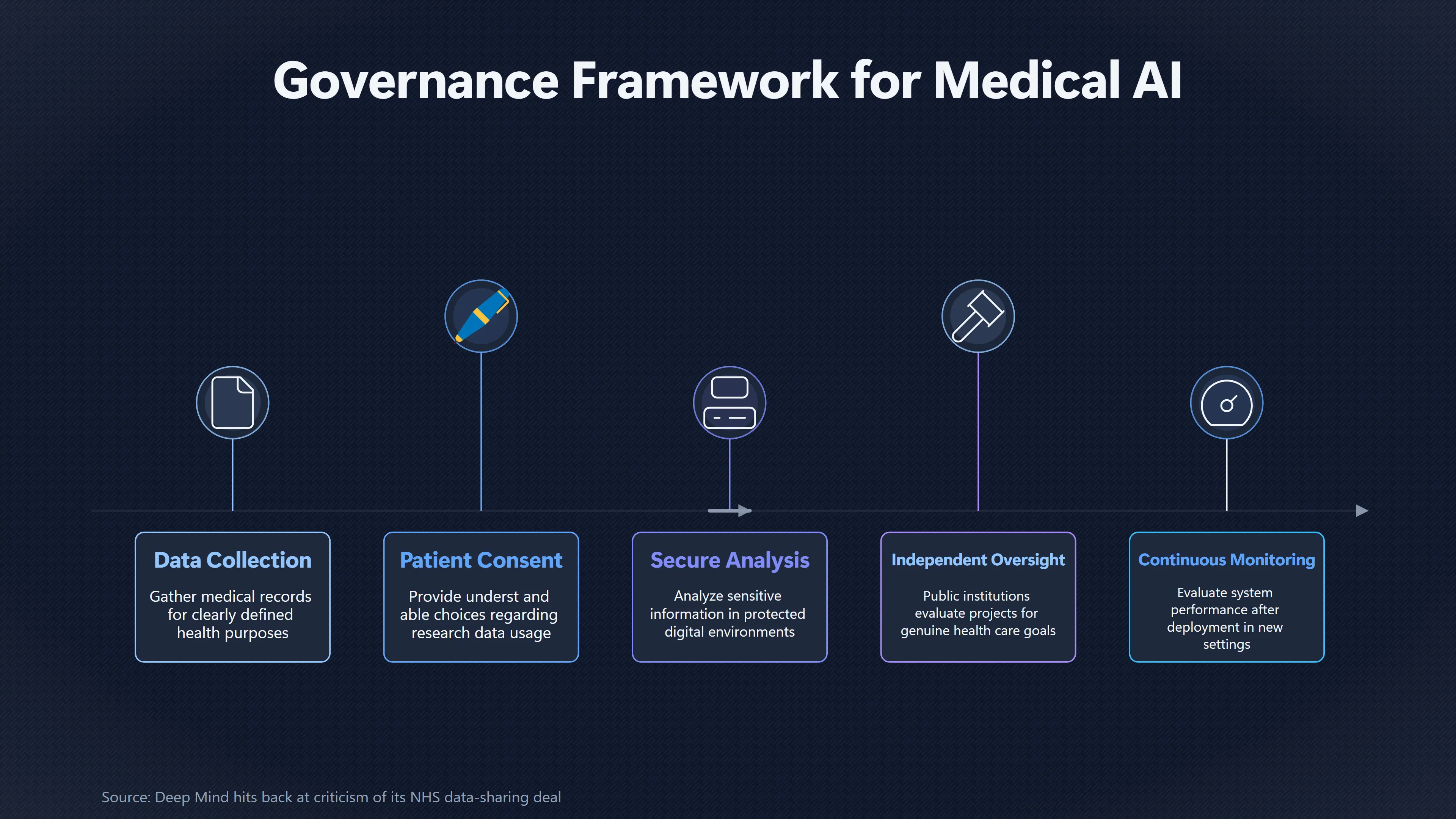
- Purpose limitation: Medical data should be collected and used for clearly defined health purposes rather than unrestricted secondary uses.
- Meaningful consent and control: Patients need understandable choices about how their information contributes to research and AI development.
- Secure data environments: Researchers can increasingly analyse sensitive information without creating unnecessary copies of raw patient records.
- Independent oversight: Public institutions, clinicians and patient representatives can help decide whether AI projects serve genuine healthcare goals.
- Continuous monitoring: AI systems need evaluation after deployment because performance can change when used with new populations or settings.
These approaches reflect a broader constitutional principle for AI: values must be built into implementation, not added after problems appear. In healthcare, this means privacy, fairness, safety and transparency are not obstacles to medical progress; they are conditions for making progress durable.

The path from medical AI today to a healthier long future
Medical AI is often discussed as a route towards faster diagnosis or cheaper healthcare, but its deeper significance lies in whether it can expand humanity’s ability to protect and extend healthy life. In an optimistic AI future, advanced systems could accelerate biomedical discovery, help prevent disease earlier and contribute to longer, healthier lives.
Yet the benefits of such a future depend on trust. A society that sees medical AI as a tool for collective flourishing may share the information needed for discovery. A society that sees it as a system for extracting private data may resist it, even when the technology could help.
The central governance question is therefore not whether medical AI should pursue greater capability. It is whether capability can be combined with principles that respect individuals while enabling humanity as a whole to learn, heal and progress. The balance between privacy and research benefit is one of the practical tests of whether advanced AI will genuinely support human flourishing.
Amazon book picks
Further Reading
Books and field guides related to When Medical AI Values Collide. Use these as the next step if you want deeper reading beyond the article.
Deep Medicine
One of America's top doctors reveals how AI will empower physicians and revolutionize patient care Medicine has become inhuman, to disast...
The AI Revolution in Medicine
AI is about to transform medicine. Here's what you need to know right now. ''The development of AI is as fundamental as the creation of t...
The Creative Destruction of Medicine
A professor of medicine reveals how technology like wireless internet, individual data, and personal genomics can be used to save lives.
The Patient Will See You Now
"In The Patient Will See You Now, Eric Topol, one of the nation's top physicians, examines what he calls medicine's Gutenberg moment--muc...
eBay marketplace picks
Marketplace Samples
Live-tested eBay searches with available results related to this page.
Selected fromhealthcare model oneBay.co.uk.




Endnotes
1.
Source: who.int
Link:https://www.who.int/publications/b/58847
2.
Source: who.int
Link:https://www.who.int/publications/i/item/9789240029200
3.
Source: arxiv.org
Link:https://arxiv.org/abs/2508.01140
Source snippet
Open Data Sharing in Clinical Research and Participants Privacy: Challenges and Opportunities in the Era of Artificial IntelligenceA...
4.
Source: wired.com
Title: Deep Mind hits back at criticism of its NHS data-sharing deal
Link:https://www.wired.com/story/deepmind-nhs-data-sharing-streams-app-privacy
Source snippet
The deal with the Royal Free Hospital Trust involves sharing information on over 1.6 million patients annually through an app called Stre...
5.
Source: fda.gov
Link:https://www.fda.gov/medical-devices/software-medical-device-samd/transparency-machine-learning-enabled-medical-devices-guiding-principles
6.
Source: GOV.UK
Title: Transparency for machine learning-enabled medical devices: guiding principles
Link:https://www.gov.uk/government/publications/machine-learning-medical-devices-transparency-principles/transparency-for-machine-learning-enabled-medical-devices-guiding-principles
7.
Source: fda.gov
Link:https://www.fda.gov/news-events/press-announcements/fda-issues-comprehensive-draft-guidance-developers-artificial-intelligence-enabled-medical-devices
8.
Source: fda.gov
Link:https://www.fda.gov/medical-devices/medical-devices-news-and-events/cdrh-issues-guiding-principles-transparency-machine-learning-enabled-medical-devices
9.
Source: GOV.UK
Title: www.gov.uk Machine learning medical devices: transparency principles
Link:https://www.gov.uk/government/publications/machine-learning-medical-devices-transparency-principles
10.
Source: GOV.UK
Title: www.gov.uk Medical devices: software and artificial intelligence (AI)
Link:https://www.gov.uk/government/publications/software-and-artificial-intelligence-ai-as-a-medical-device
11.
Source: who.int
Link:https://www.who.int/publications-detail-redirect/9789240037403
12.
Source: who.int
Title: Health Ethics & Governance
Link:https://www.who.int/teams/health-ethics-governance/emerging-technologies/big-data-and-artificial-intelligence
13.
Source: who.int
Link:https://www.who.int/news/item/28-06-2021-who-issues-first-global-report-on-ai-in-health-and-six-guiding-principles-for-its-design-and-use
14.
Source: who.int
Link:https://www.who.int/publications/i/item/9789240012752
15.
Source: fda.gov
Title: releases artificial intelligencemachine learning action plan
Link:https://www.fda.gov/news-events/press-announcements/fda-releases-artificial-intelligencemachine-learning-action-plan
16.
Source: GOV.UK
Title: www.gov.uk Addressing trust in public sector data use
Link:https://www.gov.uk/government/publications/cdei-publishes-its-first-report-on-public-sector-data-sharing/addressing-trust-in-public-sector-data-use
17.
Source: royalfree.nhs.uk
Title: Your privacy
Link:https://www.royalfree.nhs.uk/patients-and-visitors/your-privacy
18.
Source: deepmind.google
Link:https://deepmind.google/blog/royal-free-london-publishes-findings-of-legal-audit-in-use-of-streams/
19.
Source: royalfree.nhs.uk
Title: Royal Free London publishes audit into Streams app
Link:https://www.royalfree.nhs.uk/news/royal-free-london-publishes-audit-streams-app
20.
Source: wired.com
Title: deepmind nhs data sharing privacy concerns
Link:https://www.wired.com/story/deepmind-nhs-data-sharing-privacy-concerns/
22.
Source: who.int
Link:https://www.who.int/teams/health-ethics-governance/emerging-technologies
23.
Source: fda.gov
Link:https://www.fda.gov/medical-devices/software-medical-device-samd/artificial-intelligence-enabled-medical-devices
24.
Source: fda.gov
Link:https://www.fda.gov/science-research/science-and-research-special-topics/artificial-intelligence-and-medical-products
25.
Source: royalfree.nhs.uk
Title: Your privacy
Link:https://www.royalfree.nhs.uk/patients-and-visitors/your-privacy?q=%2Fpatients-visitors%2Fhow-we-use-patient-information%2Four-work-with-deepmind%2F
26.
Source: researchportal.ukhsa.gov.uk
Title: ukhsa.gov.uk Balancing Risks and Opportunities: Data-Empowered-Health Ecosystems
Link:https://researchportal.ukhsa.gov.uk/en/publications/balancing-risks-and-opportunities-data-empowered-health-ecosystem/
27.
Source: pubmed.ncbi.nlm.nih.gov
Link:https://pubmed.ncbi.nlm.nih.gov/39476365/
Source snippet
How Explainable Artificial Intelligence Can Increase or Decrease Clinicians' Trust in AI Applications in Health Care: Systematic Re...
28.
Source: pubmed.ncbi.nlm.nih.gov
Link:https://pubmed.ncbi.nlm.nih.gov/42343130/
29.
Source: pubmed.ncbi.nlm.nih.gov
Link:https://pubmed.ncbi.nlm.nih.gov/42066251/
30.
Source: pubmed.ncbi.nlm.nih.gov
Link:https://pubmed.ncbi.nlm.nih.gov/41784960/
31.
Source: pmc.ncbi.nlm.nih.gov
Link:https://pmc.ncbi.nlm.nih.gov/articles/PMC12995956/
32.
Source: pubmed.ncbi.nlm.nih.gov
Link:https://pubmed.ncbi.nlm.nih.gov/41484344/
33.
Source: pubmed.ncbi.nlm.nih.gov
Link:https://pubmed.ncbi.nlm.nih.gov/41542222/?fc=20240423222946&ff=20260122161712&v=2.18.0.post22+67771e2
34.
Source: pubmed.ncbi.nlm.nih.gov
Link:https://pubmed.ncbi.nlm.nih.gov/41249460/
35.
Source: pmc.ncbi.nlm.nih.gov
Link:https://pmc.ncbi.nlm.nih.gov/articles/PMC12618665/
36.
Source: pubmed.ncbi.nlm.nih.gov
Link:https://pubmed.ncbi.nlm.nih.gov/41238825/
37.
Source: pubmed.ncbi.nlm.nih.gov
Link:https://pubmed.ncbi.nlm.nih.gov/40502277/
38.
Source: pubmed.ncbi.nlm.nih.gov
Link:https://pubmed.ncbi.nlm.nih.gov/40978336/
39.
Source: pubmed.ncbi.nlm.nih.gov
Link:https://pubmed.ncbi.nlm.nih.gov/38273098/
40.
Source: pubmed.ncbi.nlm.nih.gov
Link:https://pubmed.ncbi.nlm.nih.gov/37044052/
41.
Source: pmc.ncbi.nlm.nih.gov
Link:https://pmc.ncbi.nlm.nih.gov/articles/PMC9234328/
Additional References
42.
Source: natureasia.com
Link:https://www.natureasia.com/en/info/press-releases/detail/9369
Source snippet
June 25, 2026 — Press release HEALTH SCIENCES: PRIVACY RISKS FROM MEDICAL AI MODELS (NATURE) 25 June 2026 Individuals whose data are used...
Published: June 25, 2026
43.
Source: youtube.com
Link:https://www.youtube.com/watch?v=cgpDQ6xi5Hg
Source snippet
The Ethical Risks of Using AI in Breast Cancer Care – Dr. Frederick Howard...
44.
Source: youtube.com
Title: The Ethical Risks of Using AI in Breast Cancer Care – Dr. Frederick Howard
Link:https://www.youtube.com/watch?v=n7V22asPbFc
Source snippet
The Ethics of AI in Healthcare: Beyond the Stochastic Parrot | Dr Jessica Morley...
45.
Source: youtube.com
Title: The Ethics of AI in Healthcare: Beyond the Stochastic Parrot | Dr Jessica Morley
Link:https://www.youtube.com/watch?v=oKhEIZ9CM_s
Source snippet
Thinking Critically about AI in Healthcare L4...
46.
Source: nature.com
Link:https://www.nature.com/articles/s41746-025-02280-z
47.
Source: nature.com
Link:https://www.nature.com/articles/s41746-025-01945-z
48.
Source: nature.com
Link:https://www.nature.com/articles/s41746-025-02023-0
49.
Source: youtube.com
Title: BTPT Framework
Link:https://www.youtube.com/watch?v=UTBbkOswXXg
Source snippet
Healthcare AI Governance: How CHAI Certification Solves the 250-Regulation Problem...
50.
Source: nature.com
Title: A question of trust for AI research in medicine | Nature Machine Intelligence
Link:https://www.nature.com/articles/s42256-024-00880-0
51.
Source: doi.org
Title: JMIR AI
Link:https://doi.org/10.2196%2F53207
Source snippet
JMIR AI - How Explainable Artificial Intelligence Can Increase or Decrease Clinicians’ Trust in AI Applications in Health Care: System...