Within AI Tutoring
Can AI Turn Novice Tutors Into Better Teachers?
AI coaching can help inexperienced tutors adopt stronger questioning and scaffolding methods, spreading expert teaching practices more widely.
On this page
- What novice tutors typically struggle to do
- How AI coaching changes questioning and feedback
- Why teacher amplification may scale better than replacement
Page outline Jump by section
Introduction
If AI makes tutoring cheaper, one of its greatest contributions may not be replacing human tutors but improving them. Many people who teach—whether classroom teachers, volunteer tutors, university teaching assistants or parents helping with homework—never receive sustained coaching on how to ask better questions, diagnose misunderstandings or adapt explanations. Expert instructional coaching is effective, but it is expensive and scarce.
AI changes that equation by making personalised coaching available far more often. Rather than observing one lesson every few months, an AI system can analyse transcripts, lesson recordings or tutoring conversations and provide immediate suggestions for improvement. If these systems prove reliable and are used with appropriate human oversight, they could spread expert teaching practices to millions of educators. Within the broader vision of AI-enabled abundance, this represents an important shift: instead of only scaling instruction to learners, AI may also scale expertise to the people who teach.
What novice tutors typically struggle to do
Most beginning tutors know their subject better than they know how people learn it. They often fall into predictable patterns that limit learning even when they are knowledgeable and well-intentioned.
Common difficulties include:
- Explaining too much instead of discovering what the learner already understands.
- Giving answers too quickly, preventing productive struggle.
- Missing misconceptions because they focus on correct answers rather than reasoning.
- Asking questions that check recall instead of encouraging explanation.
- Providing encouragement that is vague (“Good job”) rather than feedback linked to specific thinking.
- Moving through material at a pace chosen by the tutor rather than the learner.
Research on effective tutoring has consistently found that expert tutors spend much more time diagnosing understanding, asking probing questions and adapting their responses. These are professional skills developed through practice and feedback rather than subject knowledge alone. Expert coaching therefore matters because it changes how tutors interact with learners, not simply what they know.
How AI coaching changes questioning and feedback
The strongest case for AI coaching is not that it invents new teaching methods but that it helps more people use methods already supported by educational research.
Instead of replacing the tutor during the lesson, AI can analyse a completed tutoring session and highlight patterns such as:
- how often the tutor asked open questions;
- whether students were encouraged to explain their reasoning;
- where misconceptions first appeared;
- whether hints were given before complete solutions;
- how much of the conversation was dominated by tutor talk rather than student thinking.
This turns reflective practice—which often depends on an experienced mentor—into something available after every session.
A novice tutor might receive feedback such as:
- “The student answered correctly, but you revealed the procedure before asking how they were thinking.”
- “The learner expressed uncertainty three times before asking for the answer. Consider adding an intermediate question.”
- “You asked eight factual questions but only one explanation question.”
These observations are much more actionable than generic advice to “be more interactive.”
Research evaluating large language models as teacher coaches suggests that they can identify many useful instructional opportunities and generate relevant suggestions for improvement. However, they also tend to produce feedback that lacks originality or misses deeper pedagogical issues, meaning they currently function better as coaching assistants than replacements for expert instructional coaches.[ACL Anthology]aclanthology.orgACL AnthologyIs ChatGPT a Good Teacher Coach? Measuring Zero-Shot Performance For Scoring and Providing Actionable Insights on Classroom…
Coaching the teacher, not just the student
This changes the economics of educational expertise in an important way.
Traditionally, improving teaching required:
- An expert coach.
- Time for classroom observation.
- Written feedback.
- Follow-up discussion.
- Repeated observation.
Because each cycle is labour-intensive, many teachers receive only occasional coaching. Studies of instructional coaching have repeatedly found positive effects on teaching quality, but coaching remains expensive and difficult to provide consistently.[Data Science Center]edsi.umd.eduOpen source on umd.edu.
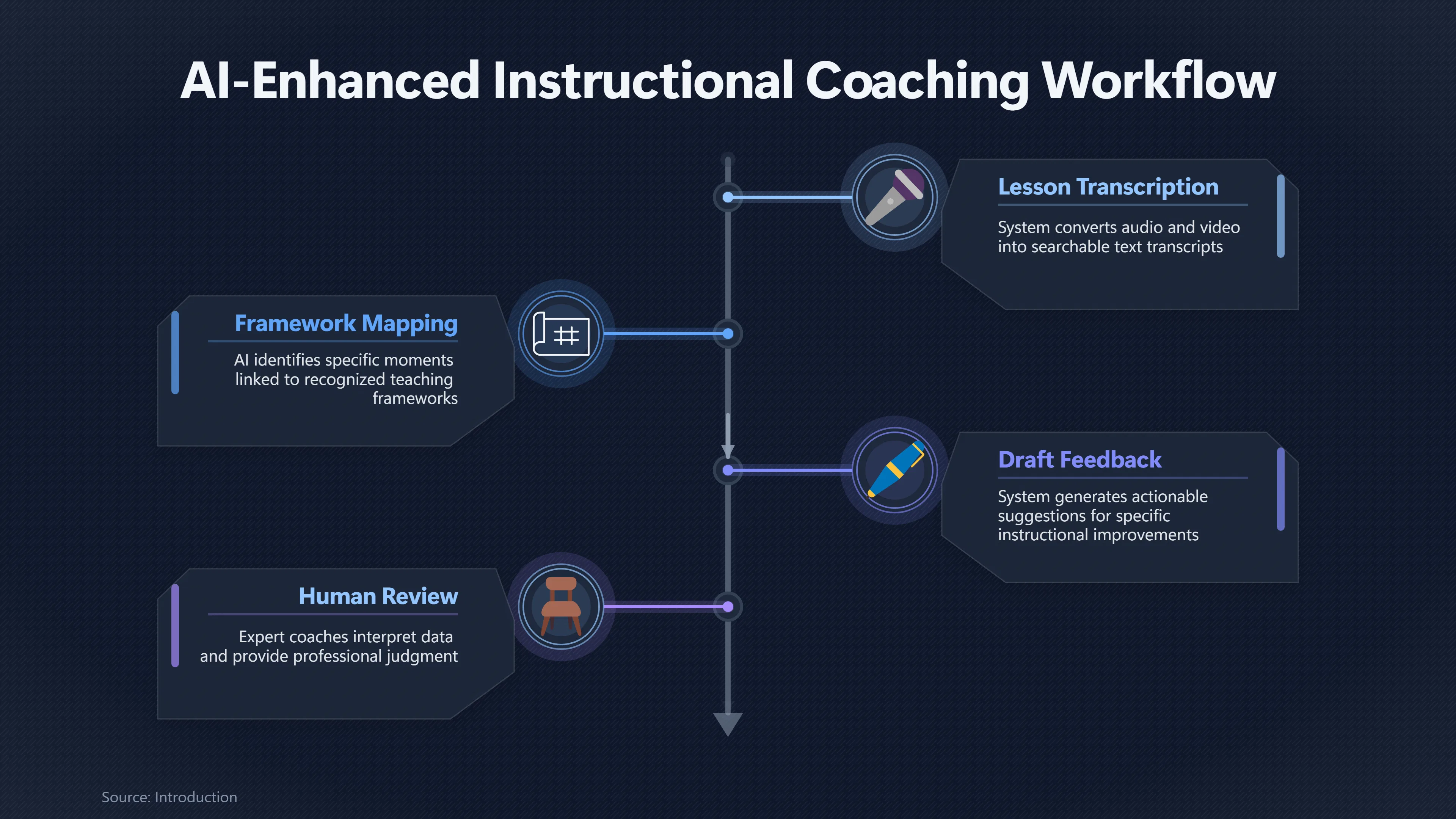
AI can automate parts of this process by:
- transcribing lessons;
- identifying moments linked to recognised teaching frameworks;
- generating draft feedback;
- summarising recurring strengths and weaknesses;
- tracking improvement across weeks or months.
Human coaches can then spend their limited time discussing the highest-value issues instead of preparing observation notes.
Rather than eliminating the coach, AI shifts the coach’s work towards interpretation, motivation and professional judgement.
Why better questions matter more than better explanations
One of the most consistent findings in learning science is that durable learning depends on retrieval, explanation and active reasoning rather than passive exposure.
Good tutors therefore spend surprisingly little time delivering polished explanations. Instead they encourage learners to think aloud, justify answers and confront misconceptions.
AI coaching can reinforce these habits by measuring behaviours that are difficult for tutors to notice themselves.
For example, it can estimate:
- the ratio of tutor talk to student talk;
- how often students explain their reasoning;
- whether hints become progressively more specific;
- whether errors are explored before correction.
These measures cannot capture every aspect of good teaching, but they provide concrete signals that tutors can improve over time.
Some early deployments have reported that AI-supported coaching increased tutors’ use of prompts encouraging students to explain and elaborate their thinking rather than simply producing answers. This is important because questioning style often distinguishes expert tutoring from straightforward explanation.[wired.com]wired.comA I Can't Replace Teaching, but It Can Make It BetterDeveloped by Satya Nitta, Origin integrates AI to help with summoning educational resources and answering student queries quickly and acc…
Why teacher amplification may scale better than replacement
The economic benefits of AI become much larger if every tutor becomes modestly better rather than if a small number of tutors are replaced entirely.
Suppose an AI coach improves the effectiveness of thousands of tutors by helping each adopt stronger questioning, clearer scaffolding and more consistent feedback. The cumulative improvement may exceed what could be achieved by deploying a limited number of fully autonomous AI tutors.
This amplification model has several advantages.
It preserves human relationships. Motivation, trust and emotional support remain centred on the human tutor.
It spreads scarce expertise. Excellent teaching practices become easier to learn even where expert mentors are unavailable.
It fits existing education systems. Schools, universities and tutoring organisations can improve current staff rather than redesign instruction around fully autonomous AI.
It supports continuous improvement. Tutors receive feedback after many sessions rather than waiting months for formal observations.
This aligns with a broader AI Bloom perspective. Intelligence becomes more abundant not only because machines answer more questions, but because they help humans develop more sophisticated cognitive skills and pass those skills on to others.
Evidence from emerging classroom systems
Several research groups are exploring AI-assisted instructional coaching rather than AI-only teaching.
Experimental work has shown that language models can score classroom interactions against recognised observation frameworks, identify moments where richer questioning could have been used and generate practical coaching suggestions, although their recommendations often remain less insightful than expert human feedback.[ACL Anthology]aclanthology.orgACL AnthologyIs ChatGPT a Good Teacher Coach? Measuring Zero-Shot Performance For Scoring and Providing Actionable Insights on Classroom…
Newer multimodal systems combine classroom video, audio and transcripts to produce richer observations. Early field studies suggest that teachers find these systems useful for reflection and appreciate faster feedback, while also raising important concerns about privacy, surveillance and preserving meaningful human judgement.[Scale]scale.stanford.eduOpen source on stanford.edu.
Researchers studying AI-enhanced coaching increasingly frame the technology as a way to reduce the cost and administrative burden of classroom observations rather than eliminate instructional coaches altogether. Because traditional coaching requires substantial time and financial investment, AI may allow expert coaches to support far more educators if routine observation and documentation become partially automated.[Data Science Center]edsi.umd.eduOpen source on umd.edu.
What AI coaching still cannot do well
Current systems also have important limitations.
First, teaching quality is not fully visible in transcripts. Tone, classroom relationships, cultural context and non-verbal interactions often matter as much as spoken words.
Second, educational judgement is frequently ambiguous. Two experienced coaches may disagree about whether a teaching decision was appropriate because it depends on lesson goals and student needs.
Third, language models can generate confident but superficial advice. Research has found that they sometimes recommend strategies the teacher is already using or overlook subtle pedagogical opportunities because they rely heavily on explicit textual cues.[ACL Anthology]aclanthology.orgACL AnthologyIs ChatGPT a Good Teacher Coach? Measuring Zero-Shot Performance For Scoring and Providing Actionable Insights on Classroom…
Finally, widespread classroom recording raises questions about consent, data security and whether teachers feel they are being supported or monitored. Systems designed for professional growth need governance that protects trust and avoids turning coaching into automated surveillance.
Why this matters for AI-enabled educational abundance
If AI simply answers students’ questions more cheaply, education becomes more accessible but not necessarily better. If AI also helps millions of ordinary tutors teach more like experienced experts, the gains become cumulative.
Each improved tutor influences hundreds or thousands of learners over a career. Better questioning, stronger scaffolding and more effective feedback spread through human relationships rather than replacing them. This makes educational expertise itself more scalable.
That possibility fits naturally within the wider argument that AI could contribute to long-term human flourishing. The largest educational impact may come not from removing teachers from the learning process, but from making high-quality teaching practice far less scarce.
Amazon book picks
Further Reading
Books and field guides related to Can AI Turn Novice Tutors Into Better Teachers?. Use these as the next step if you want deeper reading beyond the article.
Teach Like a Champion
Empower your students to succeed and create a culture of engaged learning in your classroom Teach Like a Champion 3.0 is the long-awaited...
Why Don't Students Like School?
Research-based insights and practical advice about effective learning strategies In this new edition of the highly regarded Why Don't Stu...
The Coaching Habit
Coaching is an essential skill for leaders. But for most busy, overworked managers, coaching employees is done badly, or not at all. They...

Introduction to Educational Administration
First published 2003. Subjects: School management and organization, Educational leadership, Interstate School Leaders Licensure Consortium.
eBay marketplace picks
Marketplace Samples
Live-tested eBay searches with available results related to this page.
Selected fromeducation kit oneBay.co.uk.


Endnotes
1.
Source: aclanthology.org
Link:https://aclanthology.org/2023.bea-1.53/
Source snippet
ACL AnthologyIs ChatGPT a Good Teacher Coach? Measuring Zero-Shot Performance For Scoring and Providing Actionable Insights on Classroom...
2.
Source: edsi.umd.edu
Link:https://edsi.umd.edu/publications/ai-enhanced-coaching-what-early-studies-show
3.
Source: wired.com
Title: A I Can’t Replace Teaching, but It Can Make It Better
Link:https://www.wired.com/story/what-aspects-of-teaching-should-remain-human
Source snippet
Developed by Satya Nitta, Origin integrates AI to help with summoning educational resources and answering student queries quickly and acc...
4.
Source: scale.stanford.edu
Link:https://scale.stanford.edu/ai/repository/classmind-scaling-classroom-observation-and-instructional-feedback-multimodal-ai
5.
Source: scale.stanford.edu
Title: chatgpt good teacher coach measuring zero shot performance scoring and providing
Link:https://scale.stanford.edu/ai/repository/chatgpt-good-teacher-coach-measuring-zero-shot-performance-scoring-and-providing
6.
Source: edsi.umd.edu
Link:https://edsi.umd.edu/publications/automated-feedback-improves-teachers-questioning-quality-brick-and-mortar-classrooms
Additional References
7.
Source: sciencedirect.com
Link:https://www.sciencedirect.com/science/article/pii/S2666920X26000743
Source snippet
Validating AI-generated classroom observations: Reliability, accuracy, and [limits]({{ 'limits/' | relative_url }}) of LLM-based pedagogical judgment - Scienc...
8.
Source: sciencedirect.com
Link:https://www.sciencedirect.com/science/article/pii/S1060374326000512
Source snippet
September 1, 2026 — JOURNAL OF SECOND LANGUAGE WRITING Volume 73, September 2026, 101331 QUESTION-ONLY AI SOCRATIC DIALOGUE...
Published: September 1, 2026
9.
Source: pubmed.ncbi.nlm.nih.gov
Link:https://pubmed.ncbi.nlm.nih.gov/36641220/
Source snippet
Instructional coaching actions that predict teacher classroom practices and student achievement - PubMed...
10.
Source: youtube.com
Title: AI+Education Summit: Envisioning AI Enriched Classrooms
Link:https://www.youtube.com/watch?v=5fWclPBzaRk
Source snippet
AI coaching human tutors teacher feedback Stanford education AI+Education Summit: Generative AI for Education Stanford HAI...
11.
Source: youtube.com
Title: Chatting about chatbots: How AI tools can support teachers | School’s In Podcast
Link:https://www.youtube.com/watch?v=IjcIJ324oWs
Source snippet
AI+Education Summit: Envisioning AI Enriched Classrooms...
12.
Source: youtube.com
Title: How can AI support teacher training? Featuring Professor Dora Demszky
Link:https://www.youtube.com/watch?v=ZS2jRxtojFI
Source snippet
How Instructional Coaches Can Use AI to Give Teachers Better Feedback...
13.
Source: youtube.com
Title: Instructional Coaching Towards Deeper Reflection With Teach FX
Link:https://www.youtube.com/watch?v=0B9LHsnFQ9M
Source snippet
Chatting about chatbots: How AI tools can support teachers | School's In Podcast...
14.
Source: youtube.com
Title: How Instructional Coaches Can Use AI to Give Teachers Better Feedback
Link:https://www.youtube.com/watch?v=DfCrkB_8alQ
Source snippet
Instructional Coaching Towards Deeper Reflection With TeachFX...
15.
Source: nature.com
Link:https://www.nature.com/articles/s41539-025-00320-7
16.
Source: tail.cc.gatech.edu
Title: reddig pele 2026
Link:https://tail.cc.gatech.edu/publications/reddig-pele-2026/
Source snippet
Comparing Interface Scaffolding Methods in an Intelligent Tutoring System | Teachable AI LabJuly 7, 2026 — STATIC, DYNAMIC, OR ADAPTIVE?...
Published: July 7, 2026