Within Education
Why Good AI Tutors Ask More Than They Answer
The best AI tutors improve understanding by asking guiding questions instead of revealing answers too quickly.
On this page
- Why guided questioning matters
- Designing tutors that resist answer dumping
- When learners still need direct instruction
Page outline Jump by section
Introduction
The biggest educational risk with modern AI is not that it sometimes gets facts wrong. It is that it can make learning feel effortless by providing polished answers before the learner has done the thinking. This creates shortcut learning: students complete assignments or solve immediate problems without building the mental models needed to solve similar problems independently.
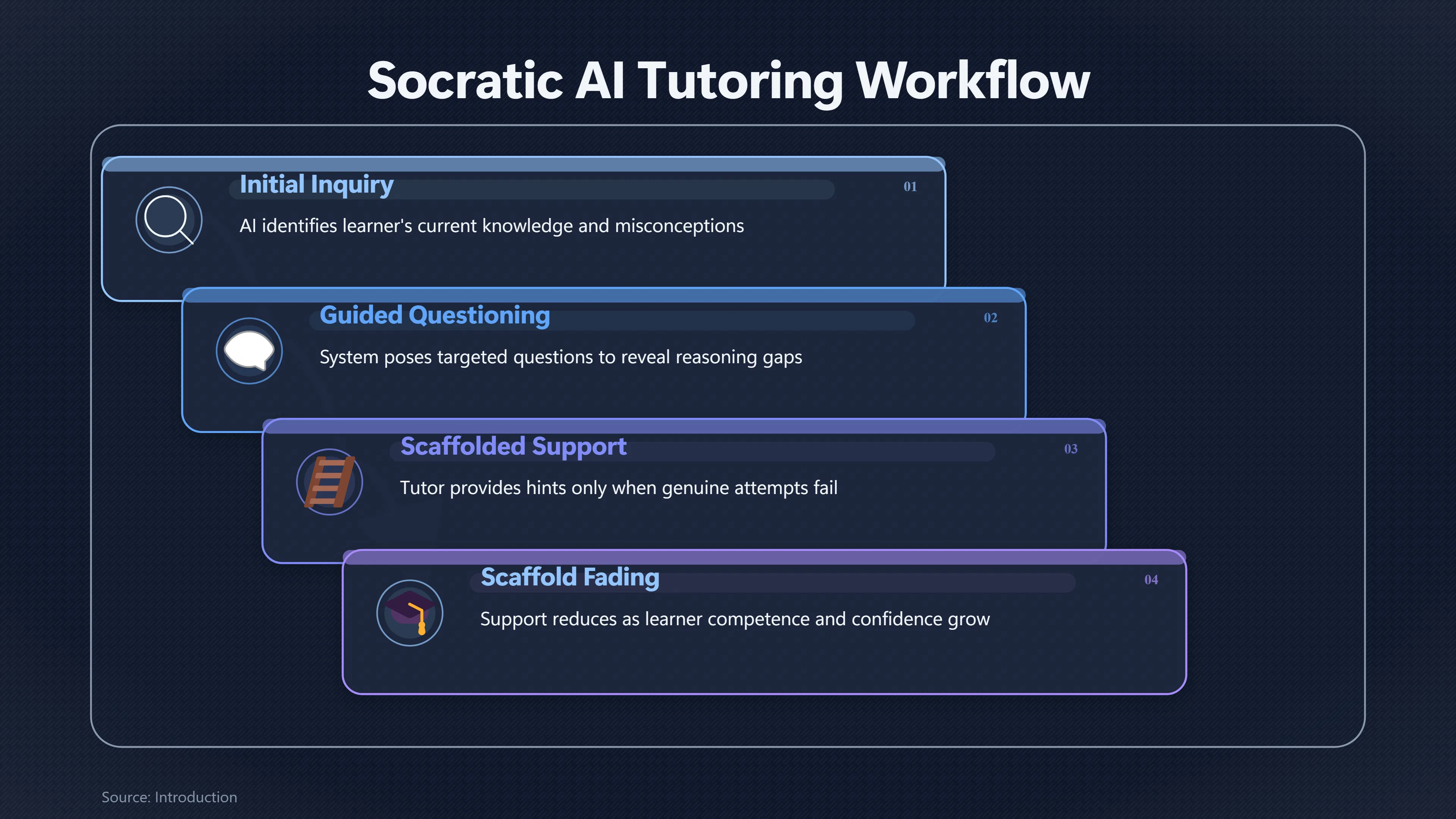
A well-designed Socratic AI tutor takes the opposite approach. Instead of acting like an answer machine, it behaves more like a skilled human tutor, asking carefully chosen questions, offering hints only when necessary and gradually reducing support as understanding grows. The aim is not to make learning slower for its own sake, but to ensure that the learner performs the cognitive work that leads to durable knowledge, flexible reasoning and genuine confidence. Within the broader vision of AI-enabled human flourishing, this distinction matters enormously. If AI is to expand human intelligence rather than merely automate intellectual tasks, it must help people think more effectively rather than think less.
Why guided questioning matters
The Socratic method is built on a simple observation: people remember and understand ideas more deeply when they construct explanations themselves rather than merely receiving them. Good teachers therefore use questions to reveal misconceptions, encourage reflection and help learners discover relationships between ideas.
Educational psychology provides several reasons why this works.
First, retrieving knowledge from memory strengthens long-term retention more effectively than rereading or copying information. Second, explaining one’s reasoning exposes hidden misunderstandings that would otherwise remain invisible. Third, solving problems with appropriate support develops transferable skills rather than memorised procedures.
An AI tutor can apply these principles continuously because it is able to analyse every learner response and choose an appropriate next question. Rather than asking a fixed sequence of questions, it adapts to what the individual appears to understand.
For example, if a student incorrectly claims that heavier objects fall faster than lighter ones, a direct-answer chatbot might immediately explain gravity. A Socratic tutor is more likely to ask:
- “What happens if you drop a hammer and a feather in a vacuum?”
- “What force is acting on both objects?”
- “What evidence makes you think weight changes falling speed?”
Each question makes the learner examine their own reasoning before introducing new information.
This process resembles what educational researchers call scaffolding: temporary support that enables learners to perform tasks they could not yet complete alone. As competence improves, effective tutors deliberately reduce that support rather than maintaining dependence. This principle has guided intelligent tutoring systems for decades and remains central to modern AI tutor design.[taylorfrancis.com]taylorfrancis.comOpen source on taylorfrancis.com.
Designing tutors that resist answer dumping
Building an AI that can answer every question is relatively easy. Building one that consistently chooses not to answer immediately is considerably harder.
Large language models naturally optimise for helpfulness and conversational satisfaction. If a frustrated learner repeatedly asks for “just the answer”, many systems eventually comply. Researchers have begun describing this failure mode as scaffolding collapse: the tutor gradually abandons guided inquiry and becomes an answer generator instead. Recent work suggests that preventing this requires more than prompt engineering, because the tendency to reveal solutions can emerge over long conversations unless the tutoring behaviour is reinforced throughout the model’s reasoning process.[arXiv]arxiv.orgMitigating Scaffolding Collapse in Socratic Tutors via Representation AlignmentJune 15, 2026…
Effective Socratic tutors therefore build explicit constraints into their design. Common techniques include:
- Progressive hints rather than full solutions. Help becomes increasingly specific only after genuine attempts.
- Mandatory learner responses. The conversation advances only after the student explains their thinking.
- Misconception diagnosis. Questions target the likely conceptual error instead of simply correcting the final answer.
- Curriculum awareness. The tutor knows what concepts have already been learned and avoids introducing unnecessary complexity.
- Scaffold fading. As performance improves, questions become more open-ended and fewer hints are provided.
These mechanisms encourage learners to remain active participants instead of passive recipients.
The distinction is important because simply delaying an answer is not enough. A poor tutor can frustrate learners by refusing to help. A good tutor provides exactly enough guidance to keep progress possible while preserving the learner’s ownership of the solution.
Why struggle can improve learning
At first glance, making students work harder appears inefficient. In reality, educational research has repeatedly shown that some kinds of difficulty improve learning rather than hinder it.
Researchers describe these as desirable difficulties: challenges that increase short-term effort but produce stronger long-term retention. Productive struggle encourages learners to connect ideas, monitor their own understanding and recognise gaps in their knowledge instead of developing an illusion of mastery.
Socratic AI tutoring attempts to create precisely this level of challenge.
Too little support leaves learners confused and discouraged.
Too much support produces superficial success without lasting understanding.
The tutor’s role is therefore to keep learners within a productive middle ground where problems remain difficult enough to require reasoning but achievable enough to sustain motivation.
This balance also helps develop metacognition: the ability to think about one’s own thinking. Rather than only learning physics, mathematics or history, students gradually become better at recognising when they genuinely understand something and when they merely recognise familiar words.
That broader cognitive skill is especially valuable in a future where AI systems can instantly generate information. Human advantage increasingly depends not only on accessing knowledge but on evaluating, integrating and applying it wisely.[taylorfrancis.com]taylorfrancis.comOpen source on taylorfrancis.com.
Early evidence from AI tutoring research
Research on Socratic AI tutoring remains relatively young, but several strands point in a consistent direction.
Studies comparing question-guided tutoring with direct-answer systems generally find improvements in reasoning quality, learner engagement and problem-solving behaviour rather than simple task completion. Programming education has become a particularly useful testing ground because researchers can observe not only whether code works but how students arrive at solutions.
A recent quasi-experimental study comparing Socratic and direct-answer AI support in programming found that students using guided questioning engaged in more reflective, iterative problem-solving, while direct-answer users more often relied on trial-and-error and superficial copying. Students working with the Socratic system also maintained more positive attitudes over time despite the greater cognitive effort involved.[Wiley Online Library]onlinelibrary.wiley.comWiley Online LibraryWhen Generative AI Meets Socratic Method: Investigating Programming Learning Dynamics Through Behaviours, Interaction…
Other emerging studies report similar patterns in computer science tutoring, algorithm learning and science education, where structured questioning appears to improve critical thinking, engagement and the quality of student reasoning compared with unrestricted chatbot interactions. Although many of these studies remain small or involve specific subjects, they consistently suggest that pedagogical design matters more than model size alone.[arXiv]arxiv.orgOpen source on arxiv.org.
Importantly, the evidence does not show that every AI system using occasional questions automatically becomes an effective tutor. The quality, sequencing and adaptation of those questions appear to be the critical ingredients.
When learners still need direct instruction
Socratic tutoring is not the right response to every educational situation.
Some concepts require explicit explanation before meaningful questioning becomes possible. Beginners often lack the vocabulary needed to reason about unfamiliar ideas. Safety-critical procedures may also require direct instruction rather than exploratory dialogue.
Good tutors therefore switch intelligently between different teaching modes.
Direct explanation is usually appropriate when:
- introducing entirely new concepts;
- correcting dangerous misconceptions;
- summarising after extended exploration;
- demonstrating expert techniques that learners could not reasonably infer.
Once that foundation exists, questioning becomes more valuable because learners have something meaningful to reason about.
The strongest AI tutors are therefore neither relentless interrogators nor unlimited answer machines. They move fluidly between explanation, questioning, feedback and practice according to what the learner actually needs.
Why this mechanism matters for AI-enabled human flourishing
Within the broader idea of AI supporting long-term human flourishing, Socratic tutoring represents a deeper ambition than simply making education cheaper or more accessible.
If advanced AI merely completes intellectual work on behalf of people, widespread deployment could increase dependence while weakening independent reasoning. If, instead, AI consistently strengthens human judgement, problem-solving and curiosity, it could expand society’s collective cognitive capacity.
That distinction becomes increasingly important as AI systems become more capable. Scientific discovery, democratic participation, lifelong retraining and informed decision-making all depend on people who can evaluate evidence, recognise faulty reasoning and generate new ideas rather than simply accepting generated answers.
Socratic AI tutoring therefore illustrates a broader principle for the AI bloom vision. The most transformative educational systems may not be those that know the most, but those that help millions of people develop stronger minds of their own.
Amazon book picks
Further Reading
Books and field guides related to Why Good AI Tutors Ask More Than They Answer. Use these as the next step if you want deeper reading beyond the article.
Make It Stick: The Science of Successful Learning
To most of us, learning something "the hard way" implies wasted time and effort. Good teaching, we believe, should be creatively tailored...
How People Learn II: Learners, Contexts, and Cultures
There are many reasons to be curious about the way people learn, and the past several decades have seen an explosion of research that has...
Visible Learning
The world’s most powerful research on the practices that improve learning in schools John Hattie’s groundbreaking book is the result of 1...
The Cambridge Handbook of the Learning Sciences
Learning sciences is an interdisciplinary field that studies teaching and learning. The sciences of learning include cognitive science, e...
eBay marketplace picks
Marketplace Samples
Live-tested eBay searches with available results related to this page.
Selected fromteacher mug oneBay.co.uk.



Endnotes
1.
Source: arxiv.org
Link:https://arxiv.org/abs/2605.12988
2.
Source: arxiv.org
Link:https://arxiv.org/abs/2607.19371
Source snippet
Mitigating Scaffolding Collapse in Socratic Tutors via Representation AlignmentJune 15, 2026...
Published: June 15, 2026
3.
Source: arxiv.org
Link:https://arxiv.org/abs/2607.22996
4.
Source: onlinelibrary.wiley.com
Link:https://onlinelibrary.wiley.com/doi/10.1002/jcal.70210
Source snippet
Wiley Online LibraryWhen Generative AI Meets Socratic Method: Investigating Programming Learning Dynamics Through Behaviours, Interaction...
5.
Source: arxiv.org
Link:https://arxiv.org/abs/2512.03501
6.
Source: onlinelibrary.wiley.com
Link:https://onlinelibrary.wiley.com/doi/pdf/10.1002/jcal.70210
7.
Source: taylorfrancis.com
Link:https://www.taylorfrancis.com/chapters/edit/10.4324/9781410611017-78/fostering-reflection-socratic-tutoring-software-baba-kofi-weusijana-christopher-riesbeck-joseph-walsh
Additional References
8.
Source: sciety.org
Link:https://sciety.org/articles/activity/10.21203/rs.3.rs-8118546/v1
Source snippet
Socratic AI in K–12 Science Classrooms: Effects on Critical Thinking, Motivation, and Self-Regulation in a Randomized Controlled Tr...
9.
Source: eurastudy.com
Title: Withholding the Answer — Eura Study
Link:https://eurastudy.com/research/withholding-the-answer
Source snippet
We argue that the central design problem for a machine tutor is not how to explain, but when and how much to withhold. Th...
10.
Source: youtube.com
Title: Practical AI for Instructors and Students Part 4: AI for Teachers
Link:https://www.youtube.com/watch?v=SBxb5xW7qFo
Source snippet
Meet AI Tutor in Achieve: Guided, Personalized Support for Every Student...
11.
Source: youtube.com
Title: Harvard Tested an AI Tutor—and Students Learned Nearly Twice as Much
Link:https://www.youtube.com/watch?v=LFlW-kfmi_o
Source snippet
Practical AI for Instructors and Students Part 4: AI for Teachers...
12.
Source: eric.ed.gov
Link:https://eric.ed.gov/?id=EJ1321294
Source snippet
EJ1321294 - Improving Comprehension: Intelligent Tutoring System Explaining the Domain Rules When Students Break Them, Education Sciences...
13.
Source: youtube.com
Title: Gemini 5: The AI Socratic Tutor with Guided Learning
Link:https://www.youtube.com/watch?v=IPxGhFYVvfI
Source snippet
Harvard Tested an AI Tutor—and Students Learned Nearly Twice as Much...
14.
Source: papers.ssrn.com
Link:https://papers.ssrn.com/sol3/Delivery.cfm/6735218.pdf?abstractid=6735218&mirid=1
Source snippet
Architectures of Inquiry: A History of Socratic Tutoring Systems and the Persistent Gap Between Theory and Implementation by Greg O'Keefe...
15.
Source: researchgate.net
Link:https://www.researchgate.net/publication/403723578_From_Tool_to_Tutor_Socratic_AI_Tutoring_Metacognitive_Engagement_and_Prior_Knowledge_as_Determinants_of_Learning_Gains_in_Gateway_STEM_Courses
16.
Source: ouci.dntb.gov.ua
Link:https://ouci.dntb.gov.ua/en/works/4YmbeLj8/
17.
Source: youtube.com
Title: Meet AI Tutor in Achieve: Guided, Personalized Support for Every Student
Link:https://www.youtube.com/watch?v=Th6w-cpT4O4
Source snippet
Khanmigo for students | Khan Academy...