Within Materials Scale Up
Which Predicted Materials Can Actually Be Made?
Practical screening must estimate whether a predicted crystal can be made reliably, not merely whether it appears stable in a computer model.
On this page
- Why thermodynamic stability does not guarantee synthesis
- How AI models estimate practical synthesisability
- What unusual chemical space means for experimental success
Page outline Jump by section
Introduction
Artificial intelligence can now propose millions of new crystals and materials in silico, but only a small fraction are likely to become real substances that can be manufactured in a laboratory. The key question is no longer simply whether an AI-designed material appears stable on a computer. It is whether chemists can actually make it, reproduce it, and scale its production using realistic experimental methods.
This distinction is becoming one of the most important bottlenecks in AI-driven materials discovery. Computational models can explore chemical space far faster than laboratories can test it, so researchers increasingly need AI systems that estimate synthesisability—the likelihood that a predicted material can be produced using current experimental techniques. Rather than replacing laboratory science, these models help prioritise which candidates deserve scarce experimental effort, increasing the chances that AI-assisted discovery leads to practical advances in batteries, catalysts, clean energy and other technologies relevant to long-term human flourishing.
Why thermodynamic stability does not guarantee synthesis
Many AI materials systems begin by predicting whether a crystal is thermodynamically stable. In simple terms, this asks whether the material should exist in a low-energy state instead of spontaneously decomposing into other compounds.
That is a necessary condition for many useful materials—but it is far from sufficient.
A material that appears perfectly stable in a density functional theory (DFT) calculation may still prove impossible, or extremely difficult, to manufacture because real chemistry involves many additional constraints beyond equilibrium thermodynamics. Researchers routinely encounter problems such as:
- reactions becoming trapped in intermediate phases
- precursor chemicals reacting in unexpected ways
- reaction rates being too slow
- extremely high temperatures or pressures being required
- impurities preventing formation of the desired crystal
- competing crystal structures forming instead.
In other words, nature does not automatically find the theoretically lowest-energy arrangement. Real synthesis follows complex reaction pathways, many of which are governed by kinetics—the speed and sequence of chemical transformations—rather than equilibrium alone. A material can therefore be stable “on paper” while remaining experimentally inaccessible using practical methods.[nature.com]nature.comApril 9, 2024…
This explains why AI-generated catalogues containing hundreds of thousands of apparently stable crystals should not be interpreted as hundreds of thousands of immediately useful materials. Stability narrows the search, but laboratory feasibility remains an independent challenge.[nature.com]nature.comOpen source on nature.com.
How AI models estimate practical synthesisability
Instead of asking only whether a material should be stable, newer AI systems attempt to answer a more practical question:
“If a chemist tried to make this today, how likely is that attempt to succeed?”
This is a much harder prediction because synthesisability depends on historical experimental knowledge as well as chemistry.
Rather than relying exclusively on physics calculations, many models learn from databases containing hundreds of thousands of previously synthesised compounds. They identify statistical patterns that distinguish compositions humans have successfully produced from those that have not.
For example, the SynthNN model treats synthesisability as a classification problem instead of relying solely on calculated formation energy. In published testing it achieved substantially higher precision than thermodynamic stability alone and even outperformed experienced materials scientists in selecting promising candidates for further investigation, while operating vastly faster. The authors argue that the model implicitly learns chemical principles such as charge balance and relationships between chemical families without being explicitly programmed with those rules.[nature.com]nature.comialsAugust 25, 2023…
Other recent approaches combine several complementary signals rather than trusting a single score, including:
- thermodynamic stability
- similarity to previously synthesised compounds
- precursor availability
- known reaction pathways
- predicted crystal structure
- synthesis recipes extracted automatically from published literature
- confidence estimates reflecting uncertainty.
Increasingly, researchers view synthesisability not as one property but as a probability that depends on both the material and the experimental capabilities available to produce it.
Learning from failed experiments
One important change in AI-assisted materials science is that failed syntheses are becoming valuable training data rather than discarded mistakes.
Historically, unsuccessful experiments were rarely published, creating a bias in the scientific literature. AI systems therefore learned primarily from successes while remaining relatively ignorant about conditions that consistently fail.
Autonomous laboratories help address this imbalance.
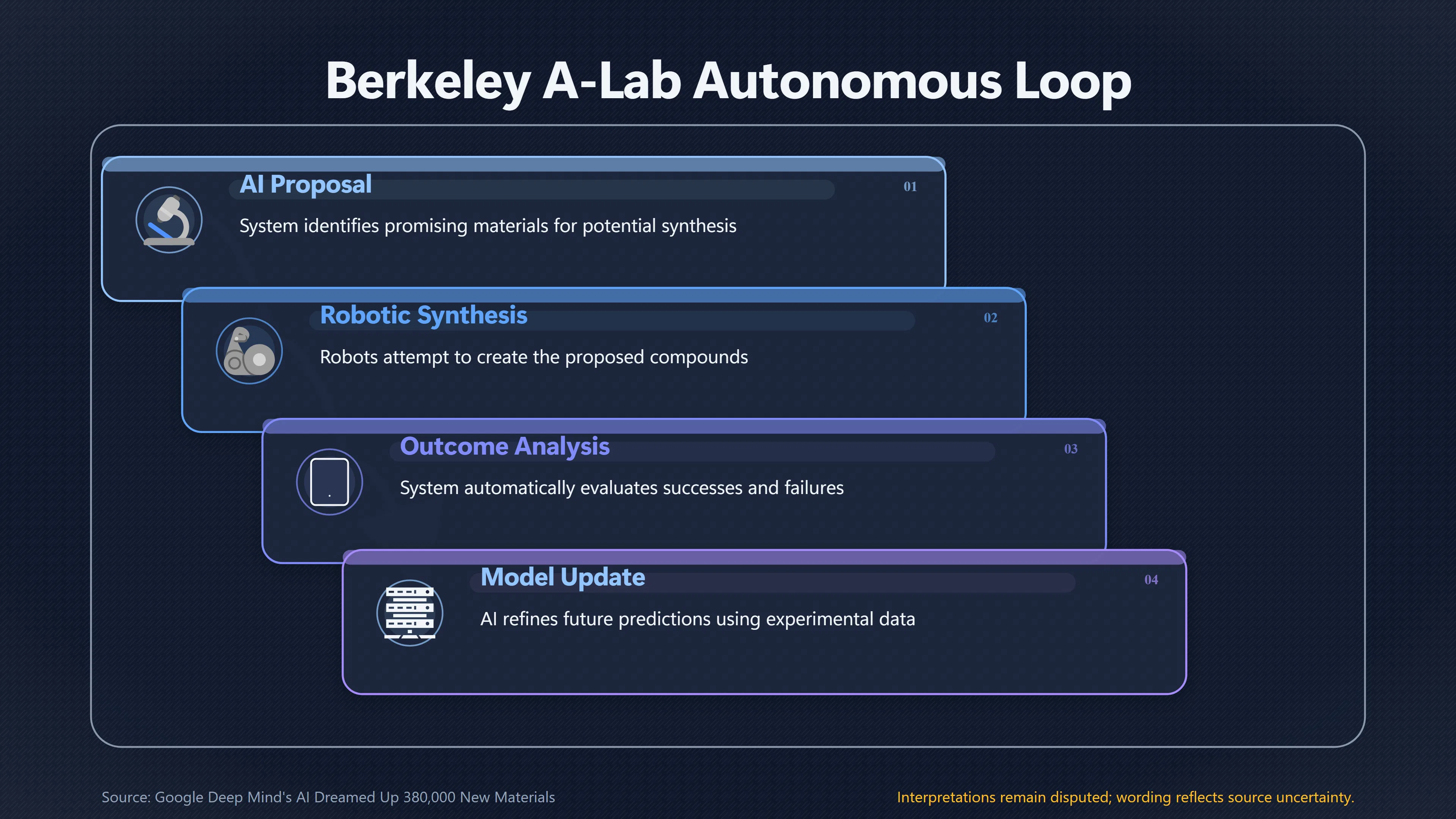
The Berkeley A-Lab combines robotics, machine learning, computational screening and active learning into a closed experimental loop. Rather than attempting each synthesis only once, the system analyses unsuccessful outcomes, modifies reaction conditions and plans improved experiments automatically. During one demonstration it operated continuously for 17 days, performing hundreds of experiments and successfully realising dozens of targeted inorganic compounds. The failures also revealed where computational predictions and synthesis planning remained inadequate, providing data for improving future models.[nature.com]nature.comOpen source on nature.com.
This creates an important feedback cycle:
- AI proposes promising materials.
- Robots attempt synthesis.
- Experimental outcomes are analysed automatically.
- AI updates future predictions using both successes and failures.
Over time, this should improve the reliability of synthesisability estimates in ways that purely computational screening cannot.

What unusual chemical space means for experimental success
AI is increasingly exploring regions of chemical space that contain few or no known materials.
This is scientifically exciting because genuinely novel compounds may possess valuable electrical, magnetic or catalytic properties. However, it also increases uncertainty.
When a proposed material lies close to well-studied chemical families, researchers already possess extensive knowledge about likely precursors, reaction temperatures and processing methods. AI can often interpolate from this experience.
Completely unfamiliar combinations of elements are different.
Researchers may have little idea:
- which precursors should be used
- which atmosphere is required
- whether multiple reaction steps are necessary
- whether competing phases dominate
- whether entirely new synthesis methods are needed.
Consequently, synthesis success generally falls as predictions move further away from experimentally explored chemistry. Many synthesisability models therefore estimate not only intrinsic stability but also how isolated a candidate is from existing knowledge.[The Meta Lab]geunho.kentech.ac.krThe Meta LabSynthesizability of materials stoichiometry using semi-supervised learning | The Meta LabJune 5, 2024…
This does not mean AI should avoid unusual chemistry. Some of the most important future materials may indeed lie in these unexplored regions. It does mean that researchers increasingly distinguish between scientific novelty and experimental accessibility, recognising that the two do not always coincide.
From crystal prediction to synthesis planning
Researchers are increasingly shifting AI effort from predicting materials to predicting how to make them.
This includes models that recommend:
- suitable precursor chemicals
- heating schedules
- reaction sequences
- processing conditions
- alternative synthetic routes if an initial plan fails.
Large language models trained on millions of published experimental procedures have shown encouraging performance in predicting inorganic synthesis conditions and precursor selection, sometimes approaching specialised machine-learning systems while being easier for experimental researchers to use.[PubMed]pubmed.ncbi.nlm.nih.govPub Med Large Language Models for Inorganic Synthesis PredictionsLarge Language Models for Inorganic Synthesis Predictions - PubMedJuly 24, 2024…
Other systems generate explicit synthesis pathways rather than merely proposing desirable molecules. Instead of producing compounds that exist only mathematically, they search regions of chemical space connected to feasible reaction sequences, improving the likelihood that laboratory validation can follow.[arXiv]arxiv.orgarXiv Projecting Molecules into Synthesizable Chemical SpacesProjecting Molecules into Synthesizable Chemical SpacesJune 7, 2024…
This represents an important conceptual shift. The objective is no longer simply to invent attractive materials but to invent materials together with realistic manufacturing routes.
Why synthesisability remains difficult to predict
Despite rapid progress, synthesisability prediction remains an unsolved scientific problem.
Several limitations continue to constrain current systems.
First, there is no comprehensive database of failed synthesis attempts. Machine-learning models therefore learn from an incomplete record of chemistry.
Second, laboratory capability changes over time. A compound that appeared impossible ten years ago may become practical once new equipment, precursor materials or processing methods become available.
Third, many predictions depend strongly on subtle experimental details that are difficult to encode numerically, including furnace geometry, contamination, mixing procedures or operator experience.
Finally, recent assessments suggest that some synthesisability models remain overly optimistic, predicting successful synthesis for compounds whose thermodynamic or reaction characteristics make experimental realisation unlikely. Researchers increasingly advocate combining machine-learning scores with more detailed thermodynamic and reaction modelling rather than treating either approach as sufficient on its own.[arXiv]arxiv.orgThermodynamic assessment of machine learning models for solid-state synthesis predictionFebruary 3, 2026…
The field has also seen healthy scientific debate over claims of successful AI-guided synthesis, reinforcing the need for independent experimental verification and careful characterisation rather than assuming every computational prediction represents a genuinely new or practically useful material.[wired.com]wired.comGoogle Deep Mind's AI Dreamed Up 380,000 New MaterialsThe Next Challenge Is Making ThemGoogle DeepMind developed an AI program, GNoME, which has predicted 380,000 new stable materials, expand…
Why this matters for AI-enabled scientific acceleration
Within the broader vision of AI accelerating scientific discovery, synthesisability prediction is a crucial bridge between computation and reality.
Generative AI can already propose candidate materials far faster than laboratories can evaluate them. Without effective prioritisation, the gap between prediction and experimentation simply widens.
Better synthesisability models help narrow that gap by directing expensive laboratory effort towards compounds with the highest probability of success. Combined with autonomous laboratories and continual learning from experimental outcomes, they can shorten the cycle between theoretical design and practical validation.
For ambitious applications such as next-generation batteries, cleaner industrial chemistry, improved catalysts and advanced semiconductors, this may prove more valuable than generating ever-larger catalogues of hypothetical materials. Progress depends not only on discovering what could exist, but on identifying which discoveries can become reliable physical technologies that support wider human prosperity and long-term scientific progress.
Amazon book picks
Further Reading
Books and field guides related to Which Predicted Materials Can Actually Be Made?. Use these as the next step if you want deeper reading beyond the article.
Callister's Materials Science and Engineering, Global Edition
Callister's Materials Science and Engineering: An Introduction, 10th Edition promotes student understanding of the three primary types of...
Stuff Matters: Exploring the Marvelous Materials That Shape O...
An eye-opening adventure deep inside the everyday materials that surround us, from concrete and steel to denim and chocolate, packed with...
The Innovators: How a Group of Hackers, Geniuses, and Geeks C...
A revelatory history of the people who created the computer and the Internet discusses the process through which innovation happens in th...
The Fourth Paradigm: Data-Intensive Scientific Discovery
Foreword. A transformed scientific method. Earth and environment. Health and wellbeing. Scientific infrastructure. Scholarly communication.
eBay marketplace picks
Marketplace Samples
Live-tested eBay searches with available results related to this page.
Selected fromchemistry poster oneBay.co.uk.
Endnotes
1.
Source: nature.com
Link:https://www.nature.com/articles/s44160-024-00502-y
Source snippet
April 9, 2024...
Published: April 9, 2024
2.
Source: nature.com
Link:https://www.nature.com/articles/s41586-023-06734-w
3.
Source: wired.com
Title: Google Deep Mind’s AI Dreamed Up 380,000 New Materials
Link:https://www.wired.com/story/an-ai-dreamed-up-380000-new-materials-the-next-challenge-is-making-them
Source snippet
The Next Challenge Is Making ThemGoogle DeepMind developed an AI program, GNoME, which has predicted 380,000 new stable materials, expand...
4.
Source: nature.com
Link:https://www.nature.com/articles/s41524-023-01114-4
Source snippet
ialsAugust 25, 2023...
Published: August 25, 2023
5.
Source: arxiv.org
Title: arXiv Projecting Molecules into Synthesizable Chemical Spaces
Link:https://arxiv.org/abs/2406.04628
Source snippet
Projecting Molecules into Synthesizable Chemical SpacesJune 7, 2024...
Published: June 7, 2024
6.
Source: arxiv.org
Link:https://arxiv.org/abs/2410.03494
7.
Source: arxiv.org
Link:https://arxiv.org/abs/2602.04075
Source snippet
Thermodynamic assessment of machine learning models for solid-state synthesis predictionFebruary 3, 2026...
Published: February 3, 2026
8.
Source: arxiv.org
Title: arXiv Predicting Novel Stable Materials for Experimental Synthesis
Link:https://arxiv.org/abs/2607.01713
9.
Source: nature.com
Link:https://www.nature.com/articles/s42256-026-01262-4
10.
Source: nature.com
Title: Collective intelligence for AI-assisted chemical synthesis | Nature
Link:https://www.nature.com/articles/s41586-026-10131-4
11.
Source: nature.com
Link:https://www.nature.com/articles/s43588-023-00536-w
12.
Source: geunho.kentech.ac.kr
Link:https://geunho.kentech.ac.kr/publication/34/
Source snippet
The Meta LabSynthesizability of materials stoichiometry using semi-supervised learning | The Meta LabJune 5, 2024...
Published: June 5, 2024
13.
Source: pubmed.ncbi.nlm.nih.gov
Title: Pub Med Large Language Models for Inorganic Synthesis Predictions
Link:https://pubmed.ncbi.nlm.nih.gov/38991051/
Source snippet
Large Language Models for Inorganic Synthesis Predictions - PubMedJuly 24, 2024...
Published: July 24, 2024
14.
Source: pubmed.ncbi.nlm.nih.gov
Link:https://pubmed.ncbi.nlm.nih.gov/39198655/
15.
Source: pubmed.ncbi.nlm.nih.gov
Link:https://pubmed.ncbi.nlm.nih.gov/38030721/
16.
Source: pmc.ncbi.nlm.nih.gov
Link:https://pmc.ncbi.nlm.nih.gov/articles/PMC10700133/
17.
Source: pubmed.ncbi.nlm.nih.gov
Link:https://pubmed.ncbi.nlm.nih.gov/38177590/
Additional References
18.
Source: youtube.com
Link:https://www.youtube.com/watch?v=Oepxd27_5JE
Source snippet
Accelerating Materials Discovery, Design, and [Development]({{ 'build-rights/' | relative_url }}) with Materials Informatics | James Saal...
19.
Source: youtube.com
Title: Can AI Create Materials That Never Existed?
Link:https://www.youtube.com/watch?v=QWjzHJHh_fw
Source snippet
This video provides an in-depth look at how artificial intelligence models predict novel crystals and structures, and why bridging the ga...
20.
Source: youtube.com
Link:https://www.youtube.com/watch?v=ajmSiHCZo1Q
Source snippet
Discovering New Materials With AI | Jonathan Godwin...
21.
Source: youtube.com
Link:https://www.youtube.com/watch?v=lVa7v8AbTM8
Source snippet
Can AI Create Materials That Never Existed?...
22.
Source: youtube.com
Title: Discovering New Materials With AI | Jonathan Godwin
Link:https://www.youtube.com/watch?v=P3uHQGGQiLs
Source snippet
Public Lecture | How scientists are building the AI-powered laboratory presented by Sean Gasiorowski...
23.
Source: openreview.net
Link:https://openreview.net/forum?id=hy39qxU6CQ
24.
Source: doi.org
Link:https://doi.org/10.1038/s42256-024-00832-8
25.
Source: sciencedirect.com
Title: Free energy predictions for crystal stability and synthesisability
Link:https://www.sciencedirect.com/org/science/article/pii/S2635098X23000529
26.
Source: snu.elsevierpure.com
Title: synthesizability of materials stoichiometry using semi supervised
Link:https://snu.elsevierpure.com/en/publications/synthesizability-of-materials-stoichiometry-using-semi-supervised/
27.
Source: nextwavesinsight.com
Title: ai materials discovery gnome mattergen 2026
Link:https://nextwavesinsight.com/ai-materials-discovery-gnome-mattergen-2026/