Within Farm Robots
Can Farm Robots Take the Hottest Shift?
Heat-tolerant robots could shift spraying, weeding and hauling away from the most dangerous parts of the working day.
On this page
- Which farm tasks create the greatest heat risk
- How supervised robots could reshape daily work schedules
- Limits from batteries, overheating and field reliability
Page outline Jump by section
Introduction
As agricultural work becomes more dangerous during prolonged heatwaves, one of the clearest near-term roles for AI-enabled farm robots is surprisingly simple: take over the hottest part of the working day. Rather than replacing farmers entirely, autonomous and remotely supervised machines can perform repetitive tasks such as weeding, spraying, mowing or hauling while human workers shift towards planning, maintenance and supervision during cooler hours. This approach could reduce heat-related illness, make working days more flexible and help farms maintain productivity as temperatures rise. It also illustrates a broader theme within AI-enabled human flourishing: using intelligent machines to remove people from avoidable physical danger rather than simply increasing output. The opportunity is real, but so are the engineering and economic constraints that determine where this approach is practical.[International Labour Organization]ilo.orgInternational Labour OrganizationMore workers than ever are losing the fight against heat stress | International Labour OrganizationJuly…
Which farm tasks create the greatest heat risk?
Agriculture is among the occupations most exposed to extreme heat because much of the work takes place outdoors, often involving heavy physical effort with limited access to shade or cooling. The International Labour Organization (ILO) warns that excessive heat is already causing growing numbers of occupational injuries and deaths, with agriculture among the sectors facing the greatest exposure. Heat affects workers not only during exceptional heatwaves but throughout increasingly hot growing seasons.[International Labour Organization]ilo.orgInternational Labour OrganizationMore workers than ever are losing the fight against heat stress | International Labour OrganizationJuly…
Not every farm task benefits equally from automation. The strongest candidates share three characteristics: they are repetitive, physically demanding and can often be completed without continuous human judgement.
Examples include:
- Mechanical weeding, where robots repeatedly move along crop rows removing weeds for many hours.
- Precision spraying, where machine vision identifies weeds or diseased plants and applies chemicals only where required.
- Transporting harvested produce, particularly repetitive shuttle movements between field and collection point.
- Grass cutting or orchard maintenance, where navigation is relatively predictable.
- Routine crop monitoring, using cameras and sensors instead of workers walking fields during the hottest periods.
These jobs frequently coincide with the middle of the day, when temperatures and solar radiation are highest and physical work becomes most hazardous.
How supervised robots could reshape daily work schedules
The most realistic vision is not a completely autonomous farm operating without people. Instead, AI changes who works during the hottest hours.
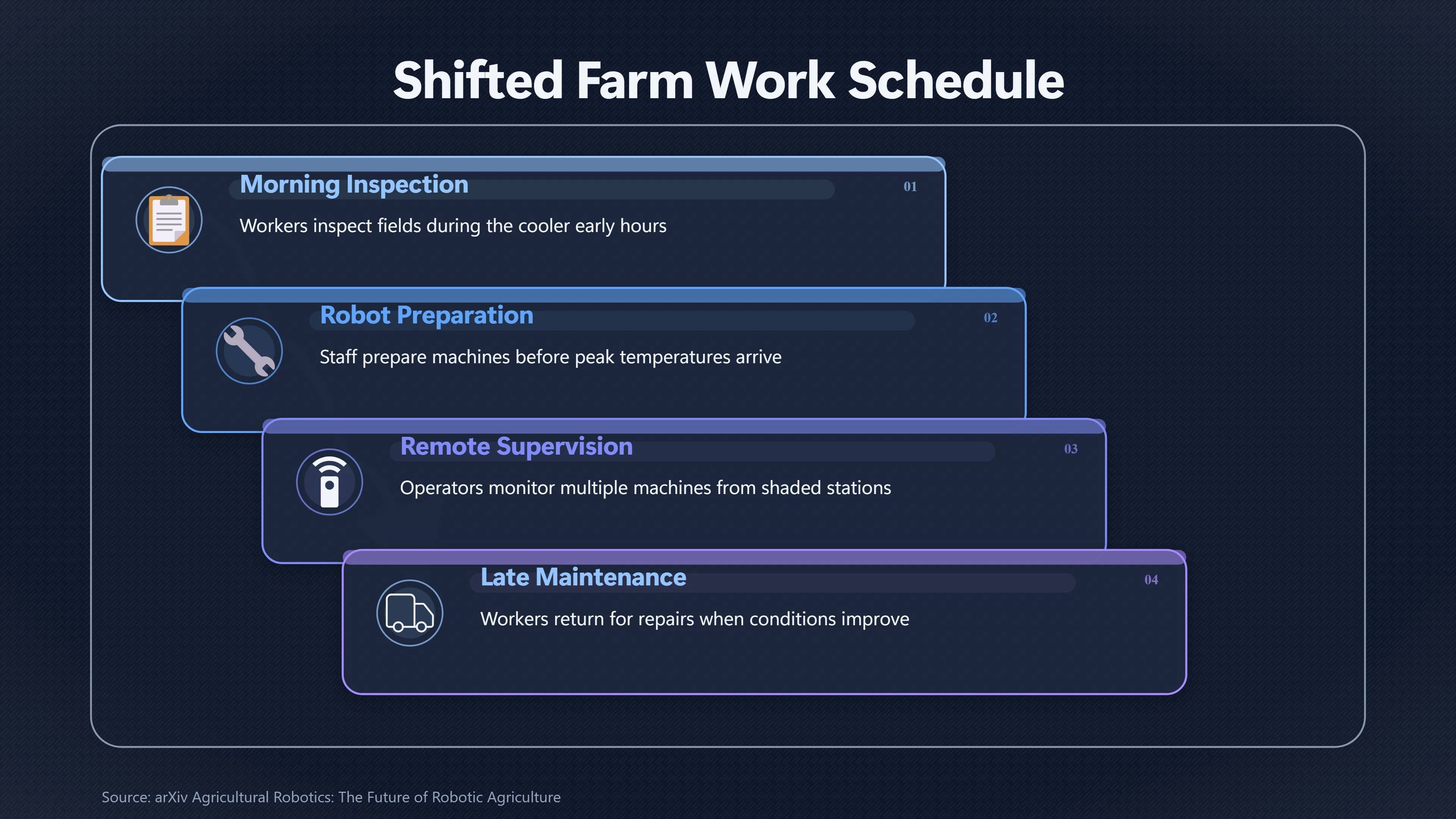
Rather than spending six or eight continuous hours outdoors, workers could:
- inspect fields early in the morning;
- prepare robots before temperatures peak;
- supervise several machines remotely from shaded vehicles, farm offices or sheltered control stations;
- return outdoors later for maintenance, refuelling, repairs or harvesting when conditions improve.
This changes the relationship between humans and machines. The robot absorbs prolonged exposure to heat, dust and repetitive movement, while people concentrate on judgement, exception handling and coordination.
In practice, this resembles the evolution already seen in other industries. Modern aircraft still have pilots, but automation performs much of the routine flying. Similarly, agricultural robots are increasingly intended to automate continuous physical work while leaving humans responsible for decisions that require flexibility.
This scheduling flexibility may become increasingly valuable as climate change narrows the safe working window in many farming regions. Earlier starts, evening operations and, where appropriate, overnight robotic work could allow farms to avoid the most dangerous afternoon conditions without sacrificing field productivity.[International Labour Organization]ilo.orgInternational Labour OrganizationMore workers than ever are losing the fight against heat stress | International Labour OrganizationJuly…
Why robots can sometimes work when people should not
Robots do not suffer heat exhaustion, dehydration or heatstroke. They can continue operating in temperatures that would require humans to slow down or stop, provided their own mechanical systems remain within operating limits.
Several features make this possible:
- Electric drivetrains generally generate less waste heat than combustion engines for comparable low-speed field tasks.
- Machine vision allows robots to continue identifying crop rows or weeds without fatigue.
- Remote supervision enables one operator to monitor multiple machines instead of physically accompanying each one.
- Continuous precision means spraying or cultivation quality does not decline simply because a machine has been working for several hours.
This does not eliminate human involvement. Workers still prepare equipment, refill tanks, replace batteries, perform repairs and intervene when unusual situations arise. The main advantage is reducing the amount of time humans spend undertaking strenuous outdoor work during dangerous heat.

The engineering limits: batteries, overheating and unreliable fields
Heat creates problems for robots as well as people.
High temperatures reduce battery efficiency and accelerate battery degradation over time. Electric motors, power electronics, cameras and onboard computers also generate heat that must be removed through cooling systems. Dust, crop debris and blocked air intakes can reduce cooling performance, while direct sunlight increases thermal load.
Field conditions introduce additional complications:
- soft soil increases energy consumption;
- mud raises rolling resistance;
- tall crops may obstruct sensors;
- dust affects cameras and cooling fans;
- uneven terrain demands constant steering corrections, using additional power.
These factors reduce operating time precisely when farms may want machines working longest.
Reliability is another challenge. A robot stopping unexpectedly in the middle of a field during extreme heat may require a worker to travel out for recovery, partly undermining the safety benefit. Agricultural robotics researchers therefore emphasise robustness, fault detection and graceful recovery as much as artificial intelligence itself. Reliable operation in changing outdoor environments remains one of the hardest technical problems in farm automation.[arXiv]arxiv.orgarXiv Agricultural Robotics: The Future of Robotic AgricultureAgricultural Robotics: The Future of Robotic AgricultureJune 18, 2018…

Economics matter as much as artificial intelligence
Whether robots actually replace the hottest field work depends less on technical possibility than on farm economics.
Large commercial farms with extensive repetitive operations can spread equipment costs over many hectares, making autonomous machines more attractive. Smaller farms may struggle to justify purchasing specialised robots that operate only during certain seasons.
Other practical questions also matter:
- Can one worker supervise several robots safely?
- How often do batteries require charging or replacement?
- Is wireless connectivity reliable across large fields?
- Does the machine save enough labour to justify maintenance costs?
- Can repairs be completed quickly during narrow planting or harvesting windows?
In some regions, labour shortages strengthen the economic case for automation. In others, abundant seasonal labour may delay adoption despite rising temperatures.
What this mechanism means for AI-enabled human flourishing
Within the broader AI Bloom perspective, robots working through the hottest farm hours are significant not because they promise fully automated agriculture, but because they demonstrate a practical pathway towards reducing dangerous labour.
If intelligent machines increasingly perform the most hazardous outdoor work, people may spend less of their working lives exposed to heat stress, dehydration and related health risks while remaining central to farm management and decision-making. Combined with precision agriculture, better weather forecasting and improved crop science, this could help agricultural systems adapt to a warming climate without assuming that human labour must simply endure ever harsher conditions.
The longer-term significance extends beyond farming. If AI-powered robotics can reliably remove people from the most physically dangerous parts of agricultural work, similar approaches may spread across construction, mining, disaster response and other sectors where environmental hazards increasingly limit safe human labour. That possibility supports one element of the broader vision of AI-enabled abundance: using intelligent machines not merely to produce more, but to reduce avoidable suffering and expand the range of work humans can perform safely and sustainably. At the same time, achieving those benefits depends on continued improvements in reliability, affordable deployment, fair access and labour transition, rather than assuming that technological capability alone guarantees widespread human flourishing.
Amazon book picks
Further Reading
Books and field guides related to Can Farm Robots Take the Hottest Shift?. Use these as the next step if you want deeper reading beyond the article.
Introduction to Autonomous Mobile Robots
The second edition of a comprehensive introduction to all aspects of mobile robotics, from algorithms to mechanisms. Mobile robots range...
Robotics: Modelling, Planning and Control
Based on the successful Modelling and Control of Robot Manipulators by Sciavicco and Siciliano (Springer, 2000), Robotics provides the ba...
The Second Machine Age
A New York Times Bestseller A revolution is under way. In recent years, Google’s autonomous cars have logged thousands of miles on Americ...
The Future of Work
Throughout the history of business employees had to adapt to managers and managers had to adapt to organizations. In the future this is r...
eBay marketplace picks
Marketplace Samples
Live-tested eBay searches with available results related to this page.
Selected fromfarm robot model oneBay.co.uk.



Endnotes
1.
Source: ilo.org
Link:https://www.ilo.org/resource/news/more-workers-ever-are-losing-fight-against-heat-stress
Source snippet
International Labour OrganizationMore workers than ever are losing the fight against heat stress | International Labour OrganizationJuly...
2.
Source: ilo.org
Link:https://www.ilo.org/publications/heat-work-implications-safety-and-health
3.
Source: ilo.org
Link:https://www.ilo.org/resource/news/increase-heat-stress-predicted-bring-productivity-loss-equivalent-80
Source snippet
International Labour OrganizationIncrease in heat stress predicted to bring productivity loss equivalent to 80 million jobs | Internation...
4.
Source: arxiv.org
Title: arXiv Agricultural Robotics: The Future of Robotic Agriculture
Link:https://arxiv.org/abs/1806.06762
Source snippet
Agricultural Robotics: The Future of Robotic AgricultureJune 18, 2018...
Published: June 18, 2018
5.
Source: who.int
Title: Climate change and workplace heat stress: technical report and guidance
Link:https://www.who.int/publications/i/item/9789240099814
Source snippet
August 22, 2025 — CLIMATE CHANGE AND WORKPLACE HEAT STRESS: TECHNICAL REPORT AND GUIDANCE 22 August 2025 | Publication Image: Climate cha...
Published: August 22, 2025
6.
Source: ilo.org
Title: 酷暑が働く人の命脅かす ILOが報告書 | International Labour Organization
Link:https://www.ilo.org/ja/resource/news/%E9%85%B7%E6%9A%91%E3%81%8C%E5%83%8D%E3%81%8F%E4%BA%BA%E3%81%AE%E5%91%BD%E8%84%85%E3%81%8B%E3%81%99%E3%80%80ilo%E3%81%8C%E5%A0%B1%E5%91%8A%E6%9B%B8
7.
Source: ilo.org
Link:https://www.ilo.org/es/resource/news/cada-vez-m%C3%A1s-trabajadores-pierden-la-batalla-contra-el-estr%C3%A9s-t%C3%A9rmico
8.
Source: ilo.org
Link:https://www.ilo.org/ja/publications/heat-work-implications-safety-and-health
9.
Source: ilo.org
Link:https://www.ilo.org/publications/ensuring-safety-and-health-work-changing-climate
10.
Source: webapps.ilo.org
Title: rep vi 1
Link:https://webapps.ilo.org/public/english/standards/relm/ilc/ilc88/rep-vi-1.htm
11.
Source: researchrepository.ilo.org
Title: Working on a warmer planet
Link:https://researchrepository.ilo.org/esploro/outputs/report/Working-on-a-warmer-planet/995219567102676
Additional References
12.
Source: fao.org
Title: Extreme heat is pushing agrifood systems to the brink worldwide
Link:https://www.fao.org/newsroom/detail/extreme-heat-is-pushing-agrifood-systems-to-the-brink-worldwide/en
Source snippet
April 22, 2026 — EXTREME HEAT IS PUSHING AGRIFOOD SYSTEMS TO THE BRINK WORLDWIDE New FAO-WMO report assesses risks and identifies adaptat...
Published: April 22, 2026
13.
Source: wmo.int
Title: Extreme heat pushes agrifood systems to the brink
Link:https://wmo.int/news/media-centre/extreme-heat-pushes-agrifood-systems-brink
Source snippet
April 22, 2026 — EXTREME HEAT PUSHES AGRIFOOD SYSTEMS TO THE BRINK Press Release 22 April 2026 Rome/Geneva (FAO/WMO) – Extreme heat event...
Published: April 22, 2026
14.
Source: youtube.com
Title: Pe K Agrobots: Slopehelper & Agilehelper – Maximum Efficiency in Agriculture
Link:https://www.youtube.com/watch?v=BirVQymwyZ8
Source snippet
Croplands Robot Ready Pinto launch | Autonomous Weed-It Sprayer FIRST LOOK...
15.
Source: youtube.com
Title: Croplands Robot Ready Pinto launch | Autonomous Weed-It Sprayer FIRST LOOK
Link:https://www.youtube.com/watch?v=muNj_RDwZTU
Source snippet
RIPPA The Farm Robot Exterminates Pests And Weeds...
16.
Source: youtube.com
Title: Lady Bird Solar Robot: Amazing Agriculture Robot
Link:https://www.youtube.com/watch?v=RKoPwGChTxw
Source snippet
PeK Agrobots: Slopehelper & Agilehelper – Maximum Efficiency in Agriculture...
17.
Source: youtube.com
Link:https://www.youtube.com/watch?v=pVOeqjoOX6E
Source snippet
This video is relevant because it shows how autonomous field robots handle heavy, repetitive agricultural tasks during peak hours to prot...
18.
Source: pubmed.ncbi.nlm.nih.gov
Link:https://pubmed.ncbi.nlm.nih.gov/32105559/
19.
Source: pubmed.ncbi.nlm.nih.gov
Link:https://pubmed.ncbi.nlm.nih.gov/37718073/
20.
Source: pubmed.ncbi.nlm.nih.gov
Link:https://pubmed.ncbi.nlm.nih.gov/40080010/
21.
Source: pubmed.ncbi.nlm.nih.gov
Link:https://pubmed.ncbi.nlm.nih.gov/40794928/