Within Lab Access
Who Owns the Results of Robot Science?
Control of experimental data and intellectual property may determine whether automated science benefits many institutions or entrenches a few leaders.
On this page
- Why failed experiments and machine readable records matter
- Private ownership versus open scientific access
- Licensing choices for high public benefit discoveries
Page outline Jump by section
Introduction
Self-driving laboratories promise to accelerate scientific discovery by combining AI, robotics and automated instruments into systems that can design, perform and analyse experiments with minimal human intervention. Yet an equally important question is who owns the resulting data, discoveries and intellectual property. The answer will help determine whether AI-driven science becomes a widely shared engine of human flourishing or primarily strengthens a small number of technology companies, elite universities and governments.
Ownership is not just about patents. Autonomous laboratories generate vast machine-readable records, including successful experiments, failed attempts, calibration logs, sensor readings and AI decision trails. These datasets can become valuable scientific assets in their own right, training future AI systems and making subsequent discoveries faster. Decisions about who controls these records, how they are licensed and whether others can reuse them may shape the future distribution of scientific power as much as the robots themselves.[oecd.org]oecd.orgResponsibility, ownership and stewardshipApril 2, 2025…
Why autonomous laboratory data is unusually valuable
Traditional scientific papers reveal only a small fraction of the research process. They usually describe successful methods and selected results, while unsuccessful experiments often remain unpublished.
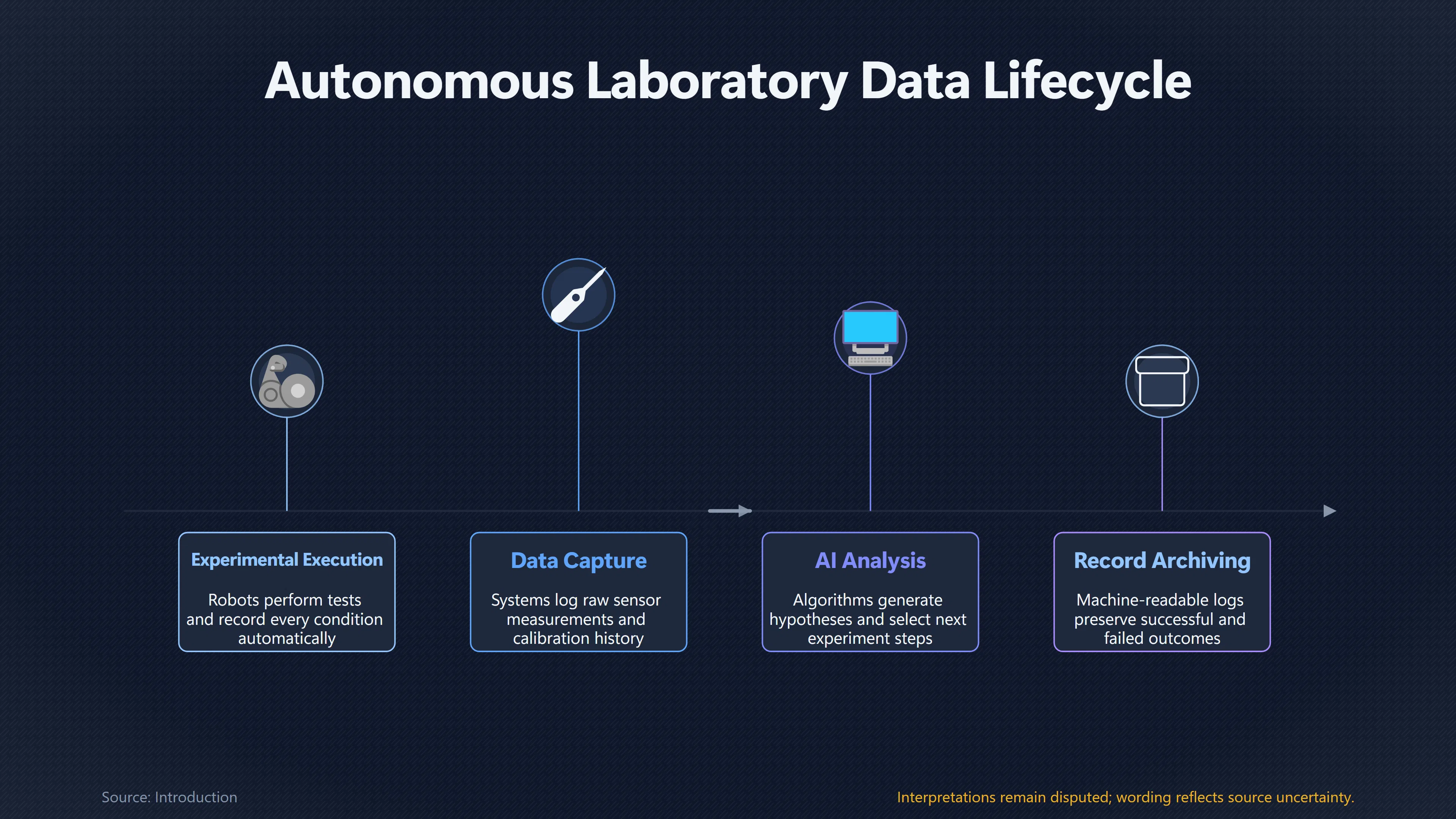
Autonomous laboratories change this pattern because they automatically record nearly every step of an experimental campaign. A single system may preserve:
- Every experimental condition that was tested.
- Instrument settings and calibration history.
- Raw sensor measurements.
- AI-generated hypotheses.
- Intermediate analyses.
- Failed experiments and unexpected outcomes.
- The reasoning used to select the next experiment.
These records allow researchers to reproduce experiments more accurately than conventional laboratory notebooks. They also provide rich training data for future AI systems that learn how scientific discovery unfolds rather than simply reading published conclusions. As autonomous laboratories become more sophisticated, comprehensive data records may become as strategically valuable as the physical equipment itself.[NIST]nist.govDevelopment of Standards to Support a Modular and Autonomous Laboratory Ecosystem | NIST…
Why failed experiments matter
Failure is often invisible in published science but highly valuable for machine learning.
If an autonomous laboratory tests 10,000 chemical formulations and only 30 succeed, the remaining 9,970 “negative” results still teach an AI which approaches are unlikely to work. Access to these records can prevent duplicated effort, improve predictive models and accelerate future research.
Historically, these failures were rarely documented in enough detail for others to use. Automated experimentation makes systematic recording practical, meaning that the ownership of failed experiments may become almost as important as ownership of successful discoveries.
Who actually owns robot-generated discoveries?
There is no universal rule. Ownership depends on contracts, employment law, funding conditions and intellectual property law rather than on the AI system itself.
In most jurisdictions today:
- Research institutions usually own discoveries created by employees during their work.
- Companies typically own inventions produced within commercial research programmes.
- Funding agreements may require publicly funded data to be shared or archived.
- Collaborative projects often divide ownership according to negotiated agreements before research begins.
Current patent systems generally do not recognise AI systems as inventors. Human researchers or their institutions remain responsible for patent applications, even when autonomous systems contribute substantially to experimental design or optimisation.
As autonomous laboratories become more capable, questions about inventorship may become more frequent, but ownership disputes are currently driven far more by institutional agreements than by the legal status of AI itself.[oecd.org]oecd.orgResponsibility, ownership and stewardshipApril 2, 2025…
Private ownership versus open scientific access
The central governance debate is not whether ownership exists but how exclusive it should be.
A private company investing hundreds of millions of pounds in autonomous laboratories has strong incentives to keep experimental data proprietary. Exclusive datasets can provide lasting competitive advantages because rivals cannot easily recreate years of automated experimentation.
Universities and publicly funded laboratories often face different expectations. Many governments increasingly encourage research data produced with public funding to be shared wherever possible, while recognising legitimate exceptions for privacy, security, commercial partnerships and sensitive technologies. OECD guidance summarises this principle as making research data “as open as possible and as closed as necessary”.[oecd.org]oecd.orgData governance for trustData governance for trust
The tension becomes particularly significant for AI-enabled scientific acceleration. If only a handful of organisations control the largest experimental datasets, they may continually improve their AI systems faster than everyone else, creating a feedback loop that widens scientific inequality.
Conversely, carefully managed open access could allow many institutions to build on one another’s work, increasing the overall pace of discovery.
Why machine-readable records matter
Scientific papers are written for humans. Autonomous laboratories increasingly produce records intended for both humans and machines.
Machine-readable datasets allow AI systems to:
- Search millions of previous experiments automatically.
- Compare results across laboratories.
- Detect hidden patterns.
- Design improved follow-up experiments.
- Reproduce earlier work more reliably.
For this to work across institutions, laboratories need common standards for recording experiments, metadata, instrument outputs and licensing information. Without shared formats, valuable data may remain trapped inside proprietary software ecosystems even when organisations are willing to collaborate. Developing common standards for data and knowledge management has therefore become a priority for autonomous laboratory initiatives.[NIST]nist.govDevelopment of Standards to Support a Modular and Autonomous Laboratory Ecosystem | NIST…
Licensing choices may matter more than ownership
Ownership alone does not determine public benefit. Licensing determines what others are allowed to do.
Several broad approaches are possible.
Fully proprietary licences allow owners to prevent reuse except under commercial agreements. These maximise exclusivity but may slow wider scientific progress.
Academic collaboration licences permit sharing among research institutions while restricting commercial exploitation.
Open licences allow broad reuse provided attribution or other conditions are met. These can encourage rapid scientific diffusion but may reduce commercial incentives for expensive research.
Tiered licensing attempts to combine both approaches by allowing open academic access while charging commercial users or reserving rights in selected markets.
OECD recommendations increasingly emphasise embedding clear licensing information within research metadata so future users understand exactly what can and cannot be reused.[oecd.org]oecd.orgResponsibility, ownership and stewardshipApril 2, 2025…
Publicly funded discoveries raise different expectations
The governance question becomes especially important when taxpayers finance autonomous laboratories.
Many policymakers argue that publicly funded experimental data should generally be accessible because the public has already paid for its creation. Open access may also produce larger economic returns by enabling follow-on innovation across universities, startups and established firms.
However, unrestricted release is not always appropriate. Legitimate reasons for limiting access include:
- National security.
- Biosecurity.
- Patient privacy.
- Commercial partnerships.
- Protection of confidential industrial information.
- Ethical restrictions on sensitive datasets.
Modern open-science policies therefore increasingly distinguish between openness as the default objective and carefully justified exceptions rather than treating every dataset identically.[oecd.org]oecd.orgData governance for trustData governance for trust

Reproducibility depends on data stewardship
Control over autonomous laboratory data also affects scientific reliability.
If only final conclusions are published while underlying experimental records remain inaccessible, independent researchers may struggle to verify results. Conversely, preserving detailed execution logs, provenance information and machine-readable workflows makes independent replication far easier.
Recent research on autonomous science argues that verification, reproducibility and trustworthy record-keeping are becoming limiting factors as AI systems generate hypotheses more rapidly than humans can validate them. Some proposed systems use semantic execution traces and digital twins to preserve complete experimental histories, allowing others to inspect exactly how robotic experiments were conducted rather than relying solely on written summaries.[arXiv]arxiv.orgarXiv Toward Trustworthy Autonomous Science: A Two-Year Community RoadmapToward Trustworthy Autonomous Science: A Two-Year Community RoadmapJuly 13, 2026…
The governance choices that could broaden the benefits
If autonomous laboratories become central to scientific discovery, several governance choices could help spread their benefits more widely.
These include:
- Requiring robust data management plans for publicly funded autonomous research.
- Recording ownership and licensing information alongside experimental metadata.
- Adopting interoperable standards so data can move between laboratory platforms.
- Preserving failed experiments as reusable scientific assets where appropriate.
- Using open licences for high-public-benefit datasets when commercial confidentiality is unnecessary.
- Creating trusted repositories that allow controlled access to sensitive data rather than simple publication or permanent secrecy.
- Encouraging public-private partnerships that balance commercial incentives with long-term scientific access.[oecd.org]oecd.orgResponsibility, ownership and stewardshipApril 2, 2025…
Why data ownership matters for AI bloom
Within the broader vision of AI-driven human flourishing, ownership of autonomous laboratory data is a foundational governance question rather than an administrative detail.
If experimental records become concentrated inside a few organisations, AI may accelerate science while simultaneously concentrating scientific capability, economic value and strategic influence. If interoperable standards, thoughtful licensing and open-science practices allow knowledge to circulate more widely, autonomous laboratories could instead become shared infrastructure that helps many institutions contribute to faster medical advances, cleaner energy technologies and broader scientific progress.
The technologies that automate discovery are only one part of the story. The rules governing who can learn from those discoveries may determine whether the long-term benefits of AI-enabled science are broadly distributed or captured by a relatively small number of actors.
Amazon book picks
Further Reading
Books and field guides related to Who Owns the Results of Robot Science?. Use these as the next step if you want deeper reading beyond the article.
Life 3.0: Being Human in the Age of Artificial Intelligence
'This is the most important conversation of our time, and Tegmark's thought-provoking book will help you join it' Stephen Hawking THE INT...
Weapons of Math Destruction
'A manual for the 21st-century citizen... accessible, refreshingly critical, relevant and urgent' - Financial Times 'Fascinating and deep...
The Entrepreneurial State
10TH ANNIVERSARY EDITION: UPDATED WITH A NEW PREFACE 'Superb ... At a time when government action of any kind is ideologically suspect, a...
The Age of A.I.: And Our Human Future
Traditional Chinese edition of The Age of A.I.: And Our Human Future
eBay marketplace picks
Marketplace Samples
Live-tested eBay searches with available results related to this page.
Selected fromscience model oneBay.co.uk.

Endnotes
1.
Source: oecd.org
Title: Responsibility, ownership and stewardship
Link:https://www.oecd.org/en/toolkits/access-to-research-data-from-public-funding-toolkit/responsibility-ownership-and-stewardship.html
Source snippet
April 2, 2025...
Published: April 2, 2025
2.
Source: nist.gov
Link:https://www.nist.gov/programs-projects/development-standards-support-modular-and-autonomous-laboratory-ecosystem
Source snippet
Development of Standards to Support a Modular and Autonomous Laboratory Ecosystem | NIST...
3.
Source: oecd.org
Title: Collaborative platforms for emerging technology (EN)
Link:https://www.oecd.org/content/dam/oecd/en/publications/reports/2021/04/collaborative-platforms-for-emerging-technology_7e74b8c0/ed1e030d-en.pdf
4.
Source: oecd.org
Title: Data governance for trust
Link:https://www.oecd.org/en/toolkits/access-to-research-data-from-public-funding-toolkit/data-governance-for-trust.html
5.
Source: oecd.org
Link:https://www.oecd.org/en/publications/enhanced-access-to-publicly-funded-data-for-science-technology-and-innovation_947717bc-en/full-report/component-9.html
Source snippet
Innovation | OECD...
6.
Source: oecd.org
Link:https://www.oecd.org/en/publications/enhanced-access-to-publicly-funded-data-for-science-technology-and-innovation_947717bc-en.html
7.
Source: arxiv.org
Title: arXiv Toward Trustworthy Autonomous Science: A Two-Year Community Roadmap
Link:https://arxiv.org/abs/2607.12113
Source snippet
Toward Trustworthy Autonomous Science: A Two-Year Community RoadmapJuly 13, 2026...
Published: July 13, 2026
8.
Source: arxiv.org
Link:https://arxiv.org/abs/2508.11406
9.
Source: oecd.org
Title: New uses of research data
Link:https://www.oecd.org/en/toolkits/access-to-research-data-from-public-funding-toolkit/responsibility-ownership-and-stewardship/new-use-of-research-data.html
10.
Source: nist.gov
Title: autonomous formulation lab
Link:https://www.nist.gov/programs-projects/autonomous-formulation-lab
11.
Source: oecd.org
Link:https://www.oecd.org/en/publications/enhanced-access-to-publicly-funded-data-for-science-technology-and-innovation_947717bc-en/full-report/component-8.html
12.
Source: oecd.org
Title: research use of patented knowledge 683715055704
Link:https://www.oecd.org/en/publications/research-use-of-patented-knowledge_683715055704.html
13.
Source: zenodo.org
Link:https://zenodo.org/records/18335359
Additional References
14.
Source: iotdigitaltwinplm.com
Title: self driving lab data provenance fair reproducibility 2026
Link:https://iotdigitaltwinplm.com/self-driving-lab-data-provenance-fair-reproducibility-2026/
Source snippet
Self-Driving Lab Data Provenance and Reproducibility (2026) - IoT Digital Twin PLMJuly 23, 2026 — SELF-DRIVING LAB DATA PROVENANCE AND RE...
Published: July 23, 2026
15.
Source: youtube.com
Link:https://www.youtube.com/watch?v=_uyFHvC5Tvc
Source snippet
Building an AI-Driven Autonomous Lab for Life Science R&D | Discovery Engines...
16.
Source: youtube.com
Title: Building an AI-Driven Autonomous Lab for Life Science R&D | Discovery Engines
Link:https://www.youtube.com/watch?v=Lh-tAxZizEM
Source snippet
What Is An Autonomous Lab? | The Brainstorm EP 70...
17.
Source: nature.com
Link:https://www.nature.com/articles/s41467-023-44599-9
18.
Source: nature.com
Link:https://www.nature.com/articles/s41598-026-45593-z
19.
Source: nature.com
Link:https://www.nature.com/articles/s41467-025-60514-w
20.
Source: nature.com
Link:https://www.nature.com/articles/s43246-026-01219-5
21.
Source: nature.com
Link:https://www.nature.com/articles/s42004-026-01932-9
22.
Source: youtube.com
Title: What Is An Autonomous Lab? | The Brainstorm EP 70
Link:https://www.youtube.com/watch?v=L4X_rUvsFUQ
Source snippet
How [Autonomous Labs]({{ 'autonomous-labs/' | relative_url }}) Will Transform Scientific Research: Ginkgo Bioworks' Jason Kelly...
23.
Source: youtube.com
Title: Science 101: What is Autonomous Discovery?
Link:https://www.youtube.com/watch?v=IAa09O1T4BY
Source snippet
The Rise of Autonomous Self-Driving Laboratories | AI, Robotics & the Scientific Discovery...