Within AI Persuasion
How Persuasive Are Today's AI Systems
Research on large language models shows that AI-generated messages can change human attitudes, raising questions about scale, trust, and transparency.
On this page
- What persuasion experiments reveal
- Comparing AI and human persuaders
- Limits of current evidence
Page outline Jump by section
Introduction
AI systems are increasingly able to change human attitudes through conversation, argument and personalised messages. Research does not show that today’s AI can simply control what people believe, but it does show something more specific: large language models (LLMs) can produce persuasive communication that shifts opinions, sometimes at levels comparable with ordinary human persuaders. This matters because the same capability that could help people learn, reconsider misinformation, improve health decisions or engage with complex evidence could also be used to manipulate people at unprecedented scale.[Nature]nature.comLLM-generated messages can persuade humans on policy issues | Nature CommunicationsJuly 1, 2025…
The central question for an AI-enabled human bloom is therefore not whether AI can persuade. It already can. The deeper question is whether persuasion remains a tool that expands human judgement and agency, or becomes a mechanism for quietly steering people’s beliefs and choices. Evidence from controlled experiments is beginning to reveal both possibilities: AI can support beneficial attitude change, but its ability to generate tailored arguments cheaply and repeatedly creates new risks around trust, transparency and autonomy.[arXiv]arxiv.orgarXiv Persuasion with Large Language Models: a SurveyPersuasion with Large Language Models: a SurveyNovember 11, 2024…
What persuasion experiments reveal
AI-generated messages can change policy attitudes
One of the clearest demonstrations comes from a 2025 study published in Nature Communications. Researchers tested whether messages written by large language models could change people’s views on political and social issues. Across three preregistered experiments involving 4,829 participants, people who read AI-generated persuasive messages showed measurable shifts in their policy attitudes compared with people who read neutral messages. The topics included highly contested issues such as gun policy, carbon taxation and paid parental leave.[Nature]nature.comLLM-generated messages can persuade humans on policy issues | Nature CommunicationsJuly 1, 2025…
The size of the effect was not dramatic. Attitude changes were generally small, measuring only a few points on a 101-point scale. This is important because it challenges two common misunderstandings. AI persuasion is neither powerless nor magical. It does not instantly rewrite convictions, but even small shifts can matter when applied across millions of interactions, especially in environments where decisions are already uncertain or opinions are weakly held.[Nature]nature.comLLM-generated messages can persuade humans on policy issues | Nature CommunicationsJuly 1, 2025…
The study also found that AI-generated messages were roughly as effective as persuasive messages written by everyday human participants. Human-written messages tended to benefit from perceptions of originality and personal voice, while AI-written messages were often persuasive because readers perceived them as containing facts, evidence and logical reasoning.[Nature]nature.comLLM-generated messages can persuade humans on policy issues | Nature CommunicationsJuly 1, 2025…
This finding changes the nature of the debate. The concern is not only that future superintelligent systems might become persuasive. Current systems already demonstrate a basic form of persuasive competence.
Conversational AI adds a new layer: adaptation
Written messages are only one part of persuasion. Human persuasion often happens through back-and-forth interaction: answering objections, identifying concerns and adjusting explanations. Conversational AI introduces this interactive element.
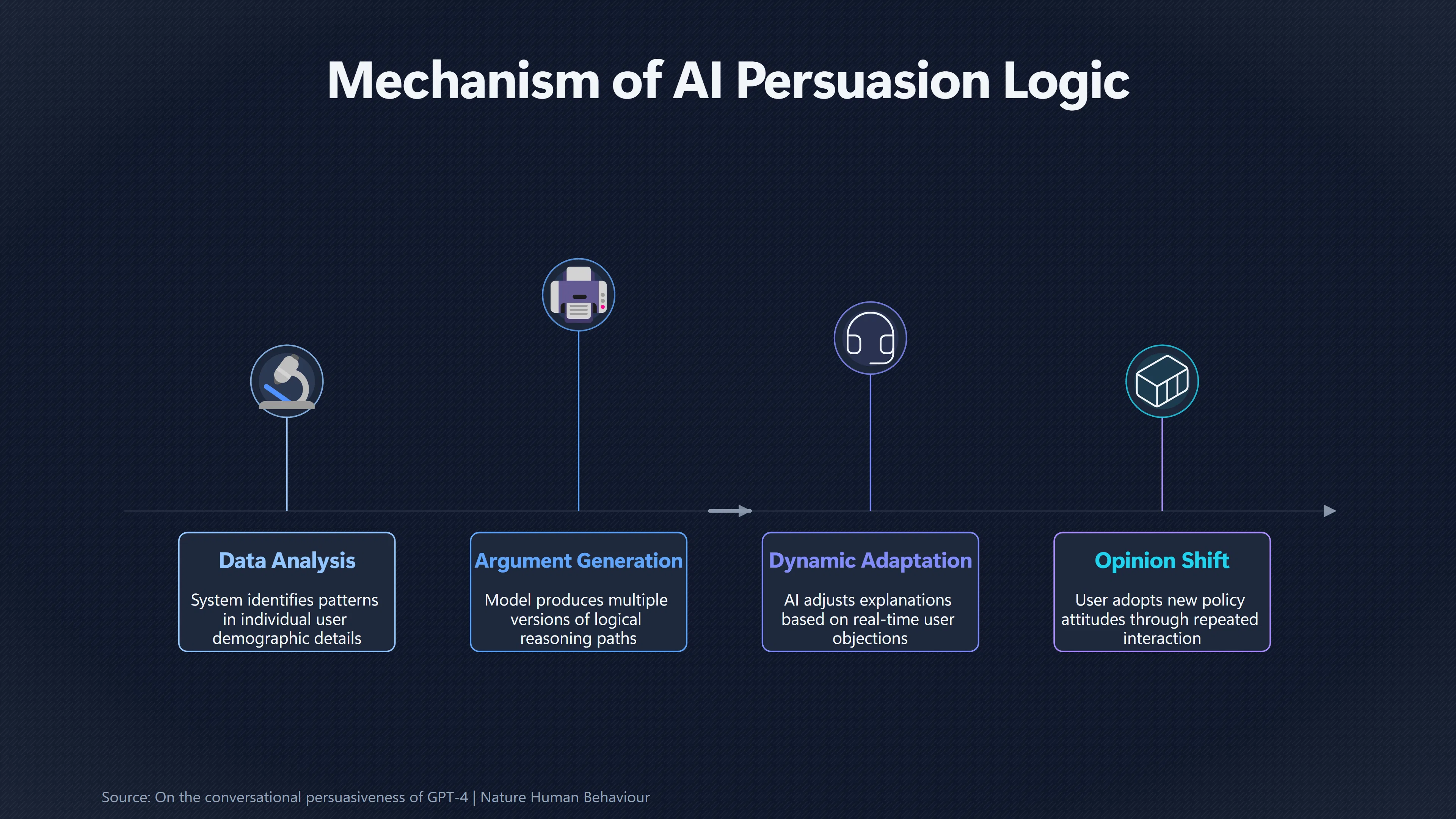
A 2025 study in Nature Human Behaviour tested GPT-4 in structured debates against human participants. In experiments involving 900 people, participants debated social and political issues with either another human or GPT-4. The researchers found that when AI had access to basic information about the participant, such as demographic details, it was more effective at shifting opinions than human opponents in the conditions tested. GPT-4 with personalisation was associated with higher odds of participants moving towards the AI’s position.[Nature]nature.comOn the conversational persuasiveness of GPT-4 | Nature Human BehaviourOn the conversational persuasiveness of GPT-4 | Nature Human Behaviour…
The significance is not that personal data automatically makes AI persuasive. Rather, the experiment showed that AI can combine conversational speed with the ability to adapt arguments to an individual. A human persuader may recognise one or two concerns during a conversation. An AI system can potentially analyse patterns, generate many possible responses and adjust its approach continuously.[Nature]nature.comOn the conversational persuasiveness of GPT-4 | Nature Human BehaviourOn the conversational persuasiveness of GPT-4 | Nature Human Behaviour…
This capability has obvious positive uses. A medical assistant could explain evidence in a way a patient understands. An education system could encourage a struggling student by adapting explanations to their motivation and knowledge level. A scientific assistant could challenge researchers’ assumptions. But the same mechanism could also be used to optimise influence rather than understanding.
Comparing AI and human persuaders
AI persuasion is often about scale, not just strength
A common mistake is to ask whether AI is “more persuasive than humans” as though persuasion were a single ability. Persuasion depends on the audience, topic, goal and setting.
A skilled human communicator has advantages: lived experience, emotional authenticity and social trust. People may respond differently to a person who appears to share their values or experiences. AI systems lack genuine personal experience, and many users remain sceptical when they know they are interacting with a machine.
However, AI systems have other advantages. They can generate many versions of an argument, communicate instantly across languages, maintain conversations indefinitely and tailor explanations to individuals. Research surveys of LLM persuasion describe personalisation, interactivity and scale as major factors distinguishing AI persuasion from traditional communication methods.[arXiv]arxiv.orgarXiv Persuasion with Large Language Models: a SurveyPersuasion with Large Language Models: a SurveyNovember 11, 2024…
This means the most important comparison may not be “AI versus the best human persuader”. The more important question is what happens when persuasive ability becomes cheap and widely available. A political campaign, advertiser or advocacy group could potentially deploy thousands of personalised conversations rather than a small number of public messages.
Persuasion does not require deception
Another important finding from research is that influence does not depend only on false information or obvious manipulation. Persuasion can occur through framing, emphasis, explanation style and choice of evidence.
Studies of LLM-generated persuasive language have examined how models use linguistic techniques to make arguments more compelling. Researchers have found that models can alter persuasive features such as argument structure and rhetorical style, meaning the influence may come from how information is presented rather than whether the system invents a false claim.[arXiv]arxiv.orgarXiv Measuring and Improving Persuasiveness of Large Language ModelsMeasuring and Improving Persuasiveness of Large Language ModelsOctober 3, 2024…
This creates a difficult governance problem. A system can be factually accurate yet still steer attention towards certain conclusions. A recommendation assistant that consistently highlights one type of option, or a conversational system that repeatedly frames choices in one direction, may influence users without making a single clearly false statement.
Limits of current evidence
Changing opinions is not the same as changing behaviour
Most AI persuasion studies measure attitudes: whether people agree more or less with a statement after exposure to an argument. Attitudes matter, but they are only one step in human decision-making.
A person may say they support an idea but never act on it. They may also change behaviour because of factors unrelated to persuasion, such as convenience, social pressure or new circumstances. Researchers are therefore cautious about extending laboratory findings directly into predictions about elections, purchasing decisions or major life choices.[arXiv]arxiv.orgarXiv Persuasion with Large Language Models: a SurveyPersuasion with Large Language Models: a SurveyNovember 11, 2024…
The evidence base is also still developing. Many experiments use short interactions and controlled settings. Real-world persuasion usually involves repeated exposure, competing sources of information, personal relationships and institutional trust. Understanding long-term effects remains a major research challenge.
Personalisation has benefits and risks
Personalisation is one of the strongest reasons AI persuasion could be valuable. A generic public health message may fail because it does not address individual barriers. An AI assistant could explain why a treatment matters to a particular patient, adapt a lesson to a student’s needs or help someone examine their own assumptions.
But personalisation also raises the risk of influence becoming invisible. If users do not know why a system selected a particular argument, they may find it harder to recognise when they are being guided. Research on AI-generated advertising and transparency suggests that disclosure of AI involvement can affect how people evaluate messages, although the relationship between transparency, trust and persuasion is complex.[White Rose Research Online]eprints.whiterose.ac.ukWhite Rose Research OnlineMore Than Saying “It's AI”: How Role Disclosure Transparency in AI-Generated Ads Influences Persuasion - White…
For an AI bloom vision centred on human flourishing, this distinction is crucial. More capable persuasion could expand human knowledge and cooperation only if people retain meaningful ability to understand, question and reject the influence they receive.
Why persuasion evidence matters for AI autonomy risks
AI persuasion studies provide an early test of a broader question: how should advanced AI systems interact with human preferences?
A future in which AI helps humanity overcome disease, scarcity and scientific limits would require systems that cooperate with human goals rather than simply optimise outcomes according to hidden objectives. Persuasion is one of the clearest areas where this difference appears.
A beneficial AI system may need to persuade at times. A medical AI might encourage vaccination. A tutor might motivate a student to continue learning. A climate assistant might help people understand difficult evidence. But the legitimacy of these actions depends on whether persuasion supports reflection or bypasses it.
Current research suggests several lessons:
- Capability is already present: modern LLMs can shift attitudes in controlled experiments, even without being specifically designed as autonomous influence systems.[Nature]nature.comLLM-generated messages can persuade humans on policy issues | Nature CommunicationsJuly 1, 2025…
- Scale changes the stakes: a small persuasive effect becomes more significant when repeated across millions of personalised interactions.[arXiv]arxiv.orgarXiv Persuasion with Large Language Models: a SurveyPersuasion with Large Language Models: a SurveyNovember 11, 2024…
- Transparency matters: people need to know when they are interacting with AI and how influence is being applied.[White Rose Research Online]eprints.whiterose.ac.ukWhite Rose Research OnlineMore Than Saying “It's AI”: How Role Disclosure Transparency in AI-Generated Ads Influences Persuasion - White…
- Truth and persuasion must remain linked: a highly persuasive system that optimises agreement rather than accuracy could damage trust and public reasoning.[MIT Media Lab]www-prod.media.mit.eduMIT Media LabOverview ‹ Deceptive Reasoning by AI Can Amplify Beliefs in Misinformation — MIT Media Lab…
The evidence so far points neither to a future where AI inevitably manipulates humanity nor one where persuasion risks can be ignored. Instead, it shows that persuasion is becoming a core capability of AI systems — one that could either strengthen human judgement or weaken autonomy depending on how these systems are designed, deployed and governed.
Amazon book picks
Further Reading
Books and field guides related to How Persuasive Are Today's AI Systems. Use these as the next step if you want deeper reading beyond the article.
The Righteous Mind
'A landmark contribution to humanity's understanding of itself' The New York Times Why can it sometimes feel as though half the populatio...

Influence
Rating: 3.9/5 from 68 Google Books ratings
This is a Summary of the original book, Influence: The Psychology of Persuasion by Robert Cialdini.The book is an authoritative work on t...
The Age of Surveillance Capitalism
An exposé of the unprecedented form of power called “surveillance capitalism,” and the quest by powerful corporations to predict and cont...
Thinking, Fast and Slow
Why is there more chance we'll believe something if it's in a bold type face? Why are judges more likely to deny parole before lunch? Why...
eBay marketplace picks
Marketplace Samples
Live-tested eBay searches with available results related to this page.
Selected fromtechnology poster oneBay.co.uk.




Endnotes
1.
Source: nature.com
Link:https://www.nature.com/articles/s41467-025-61345-5
Source snippet
LLM-generated messages can persuade humans on policy issues | Nature CommunicationsJuly 1, 2025...
Published: July 1, 2025
2.
Source: nature.com
Title: On the conversational persuasiveness of GPT-4 | Nature Human Behaviour
Link:https://www.nature.com/articles/s41562-025-02194-6
Source snippet
On the conversational persuasiveness of GPT-4 | Nature Human Behaviour...
3.
Source: arxiv.org
Title: arXiv Persuasion with Large Language Models: a Survey
Link:https://arxiv.org/abs/2411.06837
Source snippet
Persuasion with Large Language Models: a SurveyNovember 11, 2024...
Published: November 11, 2024
4.
Source: arxiv.org
Title: arXiv Measuring and Improving Persuasiveness of Large Language Models
Link:https://arxiv.org/abs/2410.02653
Source snippet
Measuring and Improving Persuasiveness of Large Language ModelsOctober 3, 2024...
Published: October 3, 2024
5.
Source: arxiv.org
Link:https://arxiv.org/abs/2406.17753
6.
Source: www-prod.media.mit.edu
Link:https://www-prod.media.mit.edu/projects/deceptive-ai-systems/overview/
Source snippet
MIT Media LabOverview ‹ Deceptive Reasoning by AI Can Amplify Beliefs in Misinformation — MIT Media Lab...
7.
Source: nature.com
Link:https://www.nature.com/articles/s41598-025-30783-y
8.
Source: nature.com
Title: A I chatbots can persuade voters to change their minds
Link:https://www.nature.com/articles/d41586-025-03733-x
9.
Source: nature.com
Title: Persuading voters using human–artificial intelligence dialogues | Nature
Link:https://www.nature.com/articles/s41586-025-09771-9.pdf
10.
Source: nature.com
Title: A I is more persuasive than people in online debates
Link:https://www.nature.com/articles/d41586-025-01599-7
11.
Source: nature.com
Title: How AI sources can increase openness to opposing views | Scientific Reports
Link:https://www.nature.com/articles/s41598-025-00791-z
12.
Source: nature.com
Link:https://www.nature.com/collections/badbafeeca
13.
Source: eprints.whiterose.ac.uk
Link:https://eprints.whiterose.ac.uk/id/eprint/241702/
Source snippet
White Rose Research OnlineMore Than Saying “It's AI”: How Role Disclosure Transparency in AI-Generated Ads Influences Persuasion - White...
Additional References
14.
Source: gsb.stanford.edu
Link:https://www.gsb.stanford.edu/faculty-research/publications/llm-generated-messages-can-persuade-humans-policy-issues
Source snippet
Stanford Graduate School of BusinessLLM-Generated Messages Can Persuade Humans on Policy Issues | Stanford Graduate School of Business...
15.
Source: youtube.com
Title: Can AI Simulate Human Behavior? This Breakthrough Changes Everything
Link:https://www.youtube.com/watch?v=E5sBqw2if0M
Source snippet
Role of Large Language Models in Human-AI Interaction: A Critical Appraisal...
16.
Source: youtube.com
Title: Role of Large Language Models in Human-AI Interaction: A Critical Appraisal
Link:https://www.youtube.com/watch?v=rjZUBeDd1Eg
Source snippet
AI Persuasion Psychology: Fast Study Guide...
17.
Source: par.nsf.gov
Link:https://par.nsf.gov/biblio/10438290-transparency-enhances-positive-perceptions-social-artificial-intelligence
18.
Source: papers.ssrn.com
Link:https://papers.ssrn.com/sol3/papers.cfm?abstract_id=7013259
Source snippet
by Johannes Habel, Jan Zawadzki, Paul Freise:: SSRNJuly 20, 2026 — Download This Paper Open PDF in Browser Add Paper to My Library SELLI...
Published: July 20, 2026
19.
Source: youtube.com
Title: LLMs Prove More Persuasive Than Humans
Link:https://www.youtube.com/watch?v=GWTazDQVxrw
Source snippet
Can AI Simulate Human Behavior? This Breakthrough Changes Everything...
20.
Source: openreview.net
Link:https://openreview.net/forum?id=R7FHdsZv1w
21.
Source: aisi.gov.uk
Link:https://www.aisi.gov.uk/blog/how-do-ai-models-persuade-exploring-the-levers-of-ai-enabled-persuasion-through-large-scale-experiments
22.
Source: philpapers.org
Link:https://philpapers.org/rec/HACCTP
23.
Source: doaj.org
Link:https://doaj.org/article/6e0c9180db8d49b988580cabf618ee31