Within Long Future
Can AI coordinate humanity without control?
AI could improve cooperation across borders, but its benefits depend on avoiding excessive control by a small number of powerful actors.
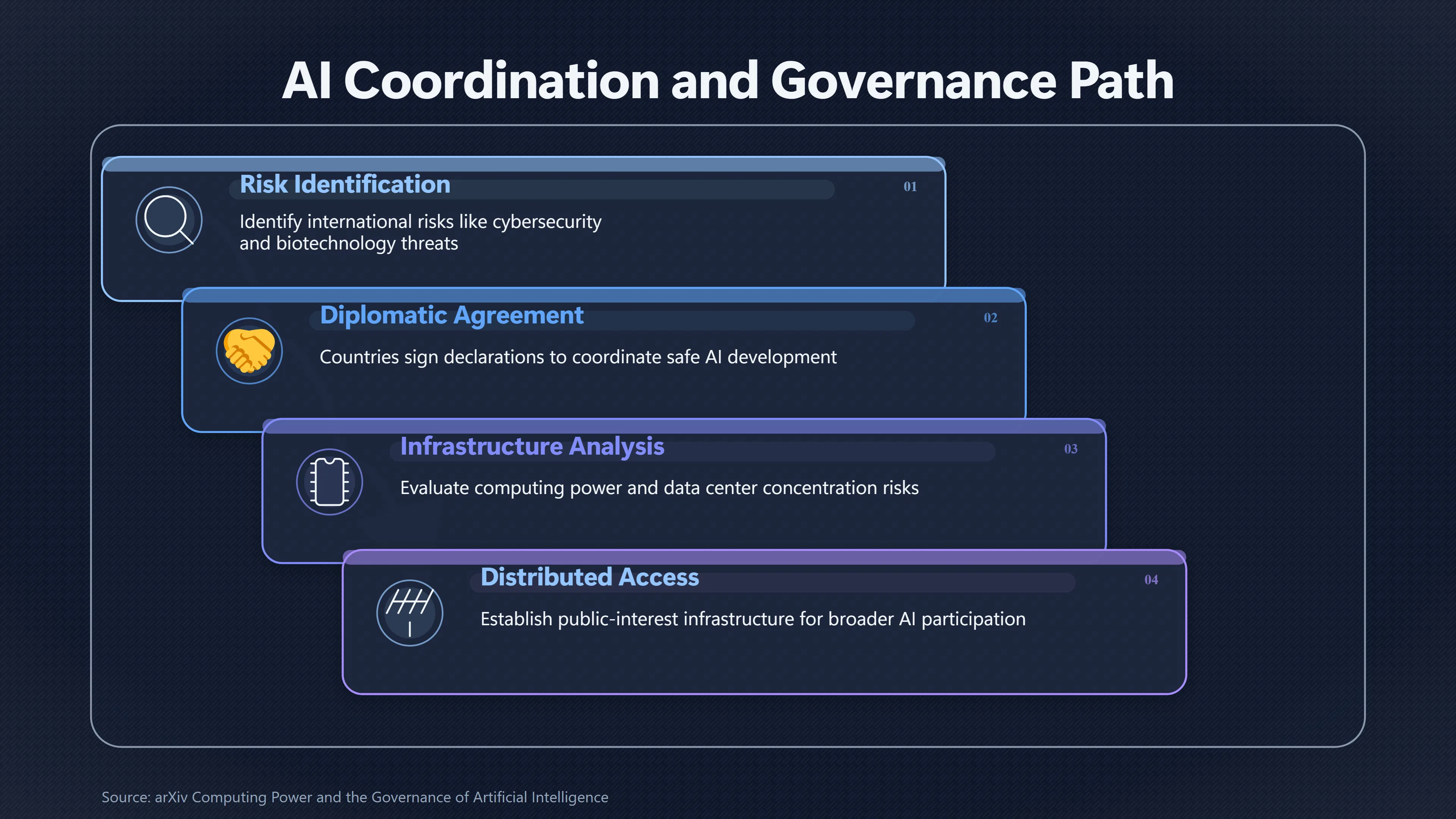
On this page
- Forecasting and decision support for societies
- Risks of concentrated AI power
- Building distributed capability
Page outline Jump by section
Introduction
Could AI help humanity coordinate itself better, or could it create a new concentration of power that weakens human agency? The answer depends on who controls advanced AI systems, how access is distributed, and whether governance structures can keep pace with technological capability. AI could improve global coordination by helping societies forecast risks, compare policy options, manage complex systems and respond faster to crises. But the same systems could also strengthen a small number of governments, companies or institutions that control the most advanced models, computing infrastructure and data.[GOV.UK]GOV.UKOpen source on gov.uk.
For an AI-enabled human bloom, coordination is a central challenge. A civilisation with much greater intelligence could potentially solve problems that currently exceed human cooperation capacity, from pandemic preparation to climate adaptation and scientific collaboration. Yet a future where intelligence becomes more powerful does not automatically become a future where power is more widely shared. The key question is whether AI becomes a tool for collective capability or a strategic advantage concentrated in the hands of a few actors.
Why advanced AI changes the coordination problem
Human societies already struggle with coordination failures: countries may delay climate action, compete over scarce resources, or fail to prepare for shared threats because the costs and benefits are distributed unevenly. Advanced AI could reduce some of these problems by improving forecasting, analysing complex evidence and helping decision-makers understand the consequences of different choices.
A sufficiently capable AI system could support governments and international organisations by modelling economic scenarios, identifying emerging health risks, improving disaster planning and translating scientific knowledge into usable policy options. These applications do not require a hypothetical superintelligence to matter. Even current AI systems are beginning to assist with large-scale information processing, scientific research and administrative tasks.
The more ambitious AI bloom vision is that increasingly capable systems could become a form of shared cognitive infrastructure: helping humanity make better decisions collectively rather than merely automating individual tasks. This possibility is closely connected to global resilience because many of civilisation’s largest challenges are coordination problems rather than purely technical problems.
However, coordination assistance is not the same as neutral advice. AI systems reflect the objectives, data sources and institutional structures behind them. A system built and controlled by one actor may optimise for that actor’s priorities, even when it is used for global decisions.
Forecasting and decision support for societies
Can AI make collective decisions more informed?
One of AI’s most promising contributions to global coordination is improved forecasting. Governments and institutions routinely make decisions under uncertainty: preparing for disease outbreaks, managing energy systems, allocating resources after disasters or responding to economic shocks. AI could help by analysing more information, detecting patterns and testing possible outcomes faster than human teams alone.
International cooperation on AI safety has already recognised this potential alongside the risks. The 2023 Bletchley Declaration, signed by countries including the United States, China, the United Kingdom and members of the European Union, argued that advanced AI risks are inherently international and require cooperation. It highlighted concerns including cybersecurity, biotechnology and misinformation while also recognising the potential benefits of responsible AI development.[GOV.UK]GOV.UKThe Bletchley Declaration by Countries Attending the AI Safety Summit, 1-2 November 2023 - GOV.UKFebruary 13, 2025…
AI could also help bridge knowledge gaps between countries. Smaller governments often lack the research capacity available to larger states or corporations. Shared AI tools could provide access to expertise in areas such as public health modelling, agricultural planning and infrastructure design, potentially reducing inequality in state capacity.
The challenge is ensuring that these systems become public capability rather than another layer of dependence. If only a few organisations possess the strongest models, the best data and the computing resources needed to operate them, global coordination may become more unequal rather than more inclusive.
The concentration problem: who controls the intelligence infrastructure?
Why compute and advanced models create new power centres
The development of frontier AI systems depends on several scarce resources: advanced computer chips, large-scale data centres, specialised expertise, investment capital and access to enormous amounts of computing power. Unlike many earlier technologies, the most capable AI systems are not easily developed by small organisations working independently.
Research on AI governance has highlighted computing power as a particularly important control point because it is measurable, geographically concentrated and essential for training advanced systems. The same characteristics that make compute useful for safety oversight also create risks of excessive centralisation if governance becomes controlled by only a few actors.[arXiv]arxiv.orgarXiv Computing Power and the Governance of Artificial IntelligenceComputing Power and the Governance of Artificial IntelligenceFebruary 13, 2024…
The current AI ecosystem already shows signs of infrastructure concentration. Major cloud providers operate much of the computing capacity used by organisations developing advanced AI, while specialised AI hardware supply chains are dominated by a small number of companies. This creates a potential dependency chain: model developers may depend on cloud providers, cloud providers depend on chip manufacturers, and governments may depend on both.[Lab Space]labs.cloudsecurityalliance.orgLab Space AI Compute Concentration and Systemic Risk – Lab SpaceLab Space AI Compute Concentration and Systemic Risk – Lab Space
Concentration can bring advantages. Large organisations may have the resources to invest in safety research, testing and security. A small number of highly capable laboratories may be easier for regulators to engage with than thousands of uncontrolled actors.
But concentration also creates risks. A small group could gain disproportionate influence over access to intelligence tools that shape science, economies, information systems and strategic decisions. The issue is not simply ownership of companies; it is whether control over increasingly powerful cognitive infrastructure becomes a political and social bottleneck.
When safety governance becomes a power question
AI safety requires oversight, but oversight mechanisms can themselves create difficult trade-offs. Some argue that advanced AI should be governed through stronger controls on frontier models, including evaluations, monitoring and restrictions on certain capabilities. Others warn that excessive concentration of regulatory authority could protect incumbents, limit competition and give a few governments or corporations too much influence over future technological development.
This tension is visible in debates over compute governance. Because access to advanced computing can reveal where powerful systems are being developed and can potentially restrict dangerous uses, compute controls are considered an important policy tool. Yet poorly designed restrictions could also reinforce existing advantages by making it harder for smaller organisations, universities or less wealthy countries to participate.[arXiv]arxiv.orgarXiv Computing Power and the Governance of Artificial IntelligenceComputing Power and the Governance of Artificial IntelligenceFebruary 13, 2024…
The central governance challenge is therefore not simply “more control” or “less control”. It is deciding what kind of control produces the greatest long-term benefit. A resilient AI future would likely require enough oversight to prevent catastrophic misuse while preserving enough openness and competition for innovation and broad participation.
Building distributed AI capability
Moving from AI ownership to AI access
If AI is to support a human bloom, access matters as much as capability. A world where only a handful of actors possess advanced AI could produce extraordinary scientific and economic gains, but those gains may not spread widely. A world with broader access could allow more researchers, governments, entrepreneurs and communities to use AI for local problems.
Several approaches aim to create a more distributed ecosystem:
- International safety cooperation: Shared standards, evaluation methods and research networks can allow countries to coordinate without requiring a single global authority. The Bletchley process and the later Seoul AI discussions reflect attempts to build common approaches while allowing different national policies.[GOV.UK]GOV.UKOpen source on gov.uk.
- Public-interest AI infrastructure: Governments and research institutions can invest in computing access, scientific resources and open tools so that advanced AI capability is not limited to private actors.
- Transparent evaluation systems: Independent testing and reporting can reduce information asymmetry between AI developers, regulators and the public.
- International participation: Countries without major AI companies need meaningful roles in setting standards and shaping governance rather than simply adopting decisions made elsewhere.
The aim is not necessarily to make every aspect of AI development completely open. Some capabilities may require careful restrictions because of security risks. The deeper goal is avoiding a future where intelligence itself becomes a scarce resource controlled by a narrow group.
The geopolitical balance between cooperation and competition
AI governance is difficult because countries may simultaneously view AI as a shared global challenge and a source of strategic advantage. Governments may want cooperation on safety while competing for economic leadership, military capability and technological independence.
The early international AI summits demonstrate this dual reality. The Bletchley Declaration created unprecedented agreement among major AI nations that cooperation was needed, including between geopolitical competitors. The Seoul Declaration later emphasised that safety, innovation and inclusivity should be considered together in international AI governance.[GOV.UK]GOV.UKThe Bletchley Declaration by Countries Attending the AI Safety Summit, 1-2 November 2023 - GOV.UKFebruary 13, 2025…
Competition can accelerate progress by encouraging investment and innovation. It can also create incentives for rushing development, limiting transparency or treating safety measures as a disadvantage. This creates a coordination dilemma similar to other strategic technologies: every actor may prefer cooperation in principle, but fear falling behind if others move faster.
A stable long-term approach may require institutions that reduce the incentive for dangerous races while preserving the benefits of technological competition. The challenge is building trust between actors that do not fully trust one another.
What a coordinated AI future would require
An AI-enabled civilisation capable of flourishing over centuries would need more than powerful systems. It would need institutions capable of ensuring that intelligence serves broad human interests.
The most important balance is between capability and accountability:
- Enough central coordination to manage genuinely global risks such as misuse, security failures and uncontrolled escalation.
- Enough distribution to prevent a permanent hierarchy where only a few actors control the benefits of advanced intelligence.
- Enough transparency for societies to understand how powerful systems are developed and used.
- Enough flexibility for different communities and countries to adapt AI to their own needs.
The optimistic case for AI is ultimately a case for expanding humanity’s collective ability to solve problems. But collective intelligence only produces a better future when collective power remains possible. The long-term question is not simply whether AI becomes smarter than humans in specific tasks; it is whether humanity develops the institutions needed to use greater intelligence without surrendering too much control over its own future.

Amazon book picks
Further Reading
Books and field guides related to Can AI coordinate humanity without control?. Use these as the next step if you want deeper reading beyond the article.
The Age of A. I.
An A.I. that learned to play chess discovered moves that no human champion would have conceived of. Driverlesscars edge forward at red li...
Enlightenment Now
Rating: 4.5/5 from 6 Google Books ratings
INSTANT NEW YORK TIMES BESTSELLER A NEW YORK TIMES NOTABLE BOOK OF 2018 ONE OF THE ECONOMIST'S BOOKS OF THE YEAR "My new favorite book of...
AI Superpowers
THE NEW YORK TIMES, USA TODAY, AND WALL STREET JOURNAL BESTSELLER "Kai-Fu Lee believes China will be the next tech-innovation superpower...

The future of power
First published 2011. Subjects: Power (Social sciences), Power (social sciences), Relations internationales, Politique étrangère, Grandes...
eBay marketplace picks
Marketplace Samples
Live-tested eBay searches with available results related to this page.
Selected fromtechnology poster oneBay.co.uk.




Endnotes
1.
Source: GOV.UK
Link:https://www.gov.uk/government/news/countries-agree-to-safe-and-responsible-development-of-frontier-ai-in-landmark-bletchley-declaration
2.
Source: GOV.UK
Link:https://www.gov.uk/government/publications/ai-safety-summit-2023-the-bletchley-declaration/the-bletchley-declaration-by-countries-attending-the-ai-safety-summit-1-2-november-2023
Source snippet
The Bletchley Declaration by Countries Attending the AI Safety Summit, 1-2 November 2023 - GOV.UKFebruary 13, 2025...
Published: november 2023
3.
Source: arxiv.org
Title: arXiv Computing Power and the Governance of Artificial Intelligence
Link:https://arxiv.org/abs/2402.08797
Source snippet
Computing Power and the Governance of Artificial IntelligenceFebruary 13, 2024...
Published: February 13, 2024
4.
Source: industry.gov.au
Title: seoul declaration countries attending ai seoul summit 21 22 may 2024
Link:https://www.industry.gov.au/publications/seoul-declaration-countries-attending-ai-seoul-summit-21-22-may-2024
Source snippet
The Seoul Declaration by countries attending the AI Seoul Summit, 21-22 May 2024 | Department of Industry Science and Resources...
Published: may 2024
5.
Source: GOV.UK
Link:https://www.gov.uk/government/news/new-commitmentto-deepen-work-on-severe-ai-risks-concludes-ai-seoul-summit
6.
Source: governance.ai
Title: computing power and the governance of artificial intelligence
Link:https://www.governance.ai/research-paper/computing-power-and-the-governance-of-artificial-intelligence
7.
Source: labs.cloudsecurityalliance.org
Title: Lab Space AI Compute Concentration and Systemic Risk – Lab Space
Link:https://labs.cloudsecurityalliance.org/research/ai-compute-concentration-systemic-risk-v1-csa-styled/
Additional References
8.
Source: carnegieendowment.org
Title:
Source: Getty Paper THE COMPUTE COALITION: HOW T
Link:https://carnegieendowment.org/research/2026/06/the-compute-coalition-how-to-build-the-future-of-ai-in-the-free-world
Source snippet
The Compute Coalition: How to Build the Future of AI in the Free World | Carnegie Endowment for International PeaceJune 8, 2026 — * The C...
Published: June 8, 2026
9.
Source: youtube.com
Title: Centralized vs Decentralized AI: The Future of Data Control and Privacy
Link:https://www.youtube.com/watch?v=JhL9vBCNUOs
Source snippet
From centralized to self-organized: Towards decentralized AI | Abhishek Singh...
10.
Source: youtube.com
Title: AI and Global Power: A Geopolitics Expert on the Road Ahead
Link:https://www.youtube.com/watch?v=ooUv_XG-c10
Source snippet
Centralized vs Decentralized AI: The Future of Data Control and Privacy...
11.
Source: papers.ssrn.com
Link:https://papers.ssrn.com/sol3/Delivery.cfm/6504361.pdf?abstractid=6504361&mirid=1
Source snippet
Architecture of Leverage: Structural Concentration and Competitive Moats in the AI Compute Supply Chain by Po-Sung (Sinclair) Huang:: SS...
12.
Source: cepr.org
Link:https://cepr.org/publications/dp21607
Source snippet
Capacity, Technology Portfolios, and the Paradox of Concentration | CEPRJune 9, 2026 — Discussion paper DP21607 CAPACITY, TECHNOLOGY PORT...
Published: June 9, 2026
13.
Source: aistackmap.org
Link:https://aistackmap.org/
14.
Source: aisecurityandsafety.org
Link:https://aisecurityandsafety.org/en/compare/bletchley-declaration-ai-safety-vs-frontier-ai-safety-commitments/
15.
Source: doi.org
Link:https://doi.org/10.1007/s43681-025-00902-6
16.
Source: overseas.mofa.go.kr
Link:https://overseas.mofa.go.kr/eng/brd/m_5674/view.do?company_cd=&company_nm=&itm_seq_1=0&itm_seq_2=0&multi_itm_seq=0&seq=321007&srchFr=&srchTo=&srchTp=&srchWord=
17.
Source: aisecurityandsafety.org
Link:https://aisecurityandsafety.org/en/compare/bletchley-declaration-ai-safety-vs-seoul-ai-safety-commitments/