Within AI Screening
Do Fewer Interval Cancers Prove AI Helps?
Cancers found between screening rounds offer a tougher test of AI mammography than simply counting extra diagnoses at the initial scan.
On this page
- Why interval cancers matter more than detection totals
- What the Swedish trial found after follow up
- What the results still cannot prove
Page outline Jump by section
Introduction
Finding more cancers during mammography screening is encouraging, but it is not the strongest proof that artificial intelligence (AI) improves breast cancer screening. A tougher and more clinically meaningful test is whether AI reduces interval cancers: cancers diagnosed after a woman has received a negative screening result but before her next scheduled screening appointment.
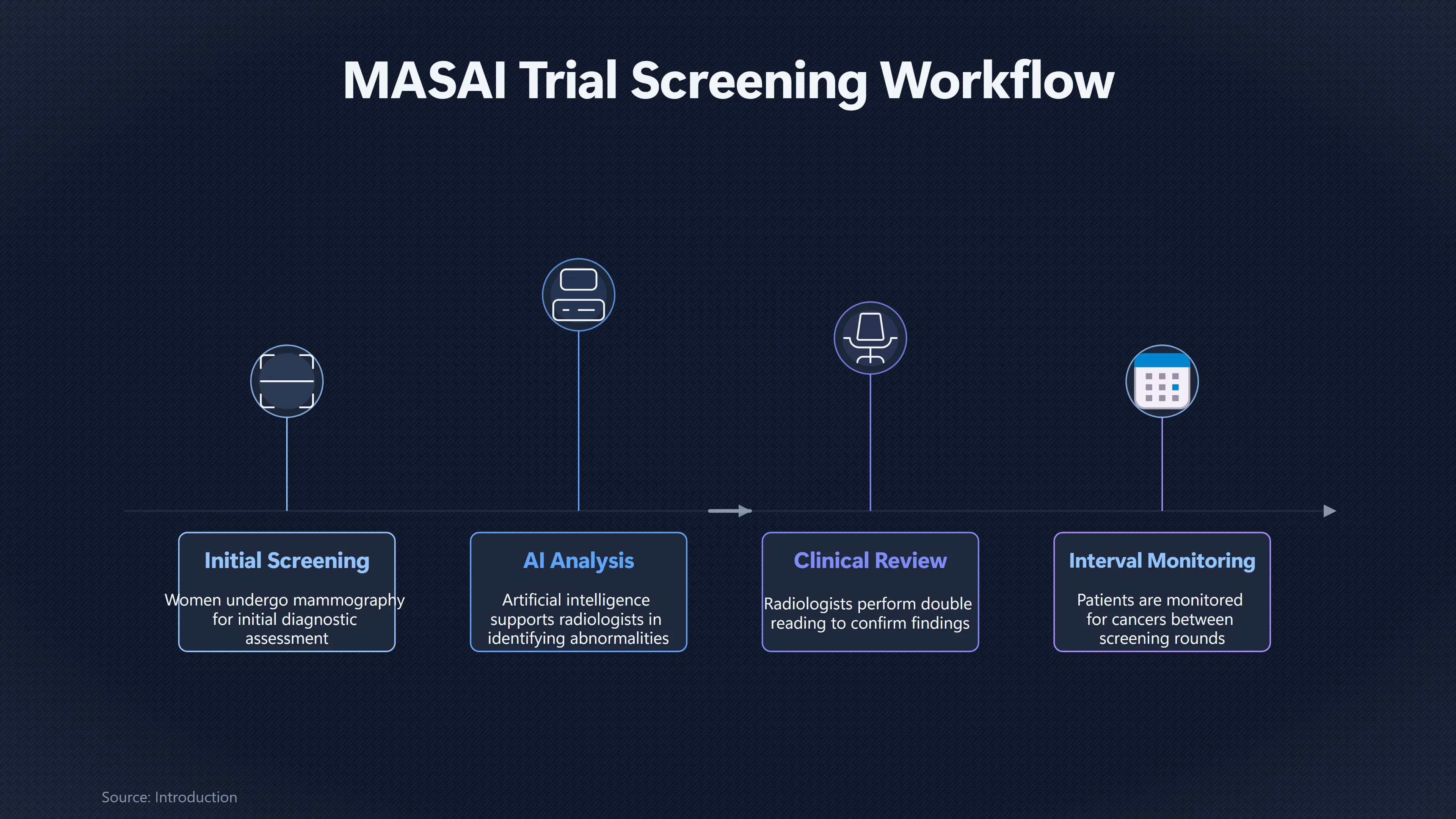
Interval cancers matter because they often represent cancers that screening failed to detect or aggressive tumours that developed rapidly between screening rounds. They are more likely than screen-detected cancers to be larger, invasive, and associated with poorer outcomes. If AI genuinely improves screening rather than simply increasing the number of diagnoses, one of the clearest signs should be fewer clinically important interval cancers over time. Recent follow-up from the Swedish Mammography Screening with Artificial Intelligence (MASAI) trial provides the strongest evidence yet on this question, while also showing why important uncertainties remain.[PubMed]pubmed.ncbi.nlm.nih.govInterval cancer, sensitivity, and specificity comparing AI-supported mammography screening with standard double reading without AI…
Why interval cancers matter more than detection totals
Counting cancers detected during screening can be misleading. A screening programme may report higher detection rates simply because it finds more slow-growing or very early abnormalities, some of which might never have become life-threatening. This is the longstanding concern about overdiagnosis in cancer screening.
Interval cancers provide a more demanding measure because they reflect what screening missed. If a screening method truly identifies dangerous cancers earlier, fewer women should later present with cancers between routine screening rounds.
This makes interval cancer rates a useful surrogate outcome for judging screening quality. They are not identical to reductions in breast cancer mortality, but they are more closely connected to clinically meaningful benefit than detection counts alone. An increase in cancer detection without any fall in interval cancers could suggest that additional diagnoses mainly represent less aggressive disease rather than improved identification of cancers that genuinely matter.[PubMed]pubmed.ncbi.nlm.nih.govInterval cancer, sensitivity, and specificity comparing AI-supported mammography screening with standard double reading without AI…
There are two main reasons interval cancers occur:
- Missed cancers, where subtle abnormalities were already present but not recognised during screening.
- Rapidly growing cancers, which genuinely developed between screening examinations and may remain difficult for any current screening method to detect.
Because these two mechanisms differ, even an excellent AI system cannot eliminate interval cancers entirely.
What the Swedish trial found after follow-up
The MASAI trial is particularly important because it was a large randomised controlled trial embedded within Sweden’s national breast screening programme. More than 105,000 women were randomly assigned either to conventional double reading by radiologists or to AI-supported screening, making it one of the strongest prospective evaluations of AI mammography yet conducted.[PubMed]pubmed.ncbi.nlm.nih.govScreening performance and characteristics of breast cancer detected in the Mammography Screening with Artificial Intelligence trial…
Early analyses had already shown that AI-supported screening:
- detected more breast cancers overall;[aacrjournals.org]aacrjournals.orgSource details in endnotes.
- increased detection of invasive cancers rather than only very early lesions;
- maintained similar recall and false-positive rates; and
- substantially reduced radiologists’ reading workload.[PubMed]pubmed.ncbi.nlm.nih.govScreening performance and characteristics of breast cancer detected in the Mammography Screening with Artificial Intelligence trial…
The crucial follow-up analysis examined what happened after women left the screening programme and entered the interval before their next invitation.
The primary finding was that AI-supported screening achieved an interval cancer rate of 1.55 per 1,000 participants, compared with 1.76 per 1,000 in the conventional double-reading group. Statistically, this met the trial’s predefined criterion for non-inferiority, meaning AI performed at least as well as standard screening rather than worse. The trial was not designed to prove a statistically significant superiority in reducing interval cancers.[PubMed]pubmed.ncbi.nlm.nih.govInterval cancer, sensitivity, and specificity comparing AI-supported mammography screening with standard double reading without AI…
The follow-up also reported several encouraging secondary findings.
Sensitivity—the proportion of cancers correctly identified—rose from 73.8% with standard screening to 80.5% with AI-supported screening, while specificity remained essentially identical at 98.5% in both groups. Higher sensitivity without sacrificing specificity is an unusual and clinically valuable combination because screening methods often improve one only by worsening the other.[PubMed]pubmed.ncbi.nlm.nih.govInterval cancer, sensitivity, and specificity comparing AI-supported mammography screening with standard double reading without AI…
Researchers also observed that interval cancers appearing after AI-supported screening tended to have more favourable characteristics. Compared with the standard screening arm, there were descriptively fewer invasive interval cancers, fewer larger (T2 or greater) tumours, and fewer biologically aggressive non-luminal A cancers. These differences suggest that AI may preferentially detect clinically important cancers before they become symptomatic rather than simply increasing diagnosis of indolent disease.[PubMed]pubmed.ncbi.nlm.nih.govInterval cancer, sensitivity, and specificity comparing AI-supported mammography screening with standard double reading without AI…

What the results still cannot prove
Although these findings strengthen the case for AI-assisted mammography, they do not settle the most important question: whether AI ultimately reduces deaths from breast cancer or improves long-term quality of life.
Several reasons explain this remaining uncertainty.
First, interval cancers are an intermediate outcome, not a final clinical endpoint. Lower interval cancer rates have historically been associated with better screening performance, but they are still a surrogate measure. Demonstrating improved survival requires substantially longer follow-up because breast cancer outcomes unfold over many years.[PubMed]pubmed.ncbi.nlm.nih.govInterval cancer, sensitivity, and specificity comparing AI-supported mammography screening with standard double reading without AI…
Second, the observed reduction in interval cancers was relatively modest. The trial demonstrated that AI was not inferior to conventional screening and showed favourable trends across several outcomes, but the confidence intervals mean the exact magnitude of any clinical advantage remains uncertain.[PubMed]pubmed.ncbi.nlm.nih.govInterval cancer, sensitivity, and specificity comparing AI-supported mammography screening with standard double reading without AI…
Third, some interval cancers represent rapidly developing tumours that no currently available screening strategy is likely to detect early enough. Even a highly accurate AI system cannot remove this biological limitation.
Finally, questions about overdiagnosis have not disappeared simply because interval cancers appear favourable. Long-term follow-up is still required to determine whether additional cancers detected by AI translate into fewer advanced cancers, less intensive treatment, lower mortality, or instead increase treatment for disease that would never have become clinically significant.[PubMed]pubmed.ncbi.nlm.nih.govScreening performance and characteristics of breast cancer detected in the Mammography Screening with Artificial Intelligence trial…
Why this evidence matters for AI’s wider promise in medicine
Within the broader discussion of AI’s potential to accelerate medical progress, interval cancers illustrate an important principle: success should be judged by meaningful patient outcomes rather than by impressive technical metrics alone.
AI systems can achieve high accuracy in retrospective image datasets, but healthcare ultimately depends on whether those improvements change patients’ lives. The MASAI trial moves beyond laboratory performance by testing AI under routine clinical conditions and following women after screening has finished.
That shift—from asking whether AI detects more abnormalities to asking whether fewer dangerous cancers emerge between screening rounds—is precisely the kind of evidence needed to assess whether AI contributes to genuine improvements in healthcare. If future follow-up also demonstrates reductions in advanced disease and breast cancer mortality while preserving low false-positive rates, AI-assisted mammography would become a stronger example of how advanced AI can improve real-world medicine rather than merely increase diagnostic activity. For a broader discussion of the trade-offs between additional cancer detection, overdiagnosis and patient benefit, interval cancer outcomes are therefore one of the most informative pieces of evidence available.[nih.gov]pubmed.ncbi.nlm.nih.govInterval cancer, sensitivity, and specificity comparing AI-supported mammography screening with standard double reading without AI…

Amazon book picks
Further Reading
Books and field guides related to Do Fewer Interval Cancers Prove AI Helps?. Use these as the next step if you want deeper reading beyond the article.

Deep Medicine: How Artificial Intelligence Can Make Healthcar...
First published 2019. Subjects: Artificial intelligence, Medical informatics, Medical applications, Diagnosis, Data processing.
The Emperor of All Maladies: A Biography of Cancer
A historical assessment of cancer addresses both the courageous battles against the complex disease and the misperceptions and hubris tha...
The Digital Doctor: Hope, Hype, and Harm at the Dawn of Medic...
The New York Times Science Bestseller from Robert Wachter, Modern Healthcare’s #1 Most Influential Physician-Executive in the US While mo...
eBay marketplace picks
Marketplace Samples
Live-tested eBay searches with available results related to this page.
Selected fromhealthcare wall art oneBay.co.uk.

Current eBay listing
Vintage health motivation wall art, healthcare wall art, hot


Current eBay listing
Healthcare Human Care Framed Wall Art Poster Canvas Print Picture
Endnotes
1.
Source: pubmed.ncbi.nlm.nih.gov
Link:https://pubmed.ncbi.nlm.nih.gov/41620232/
Source snippet
Interval cancer, sensitivity, and specificity comparing AI-supported mammography screening with standard double reading without AI...
2.
Source: pubmed.ncbi.nlm.nih.gov
Link:https://pubmed.ncbi.nlm.nih.gov/39904652/
Source snippet
Screening performance and characteristics of breast cancer detected in the Mammography Screening with Artificial Intelligence trial...
3.
Source: pmc.ncbi.nlm.nih.gov
Link:https://pmc.ncbi.nlm.nih.gov/articles/PMC13036691/
Source snippet
PubMed Central (PMC)AI and Breast Cancer Screening at a Crossroads: Insights from the MASAI Trial - PMC...
4.
Source: pubmed.ncbi.nlm.nih.gov
Link:https://pubmed.ncbi.nlm.nih.gov/42316764/
Source snippet
2026 Jun 15;132(12):e70440. doi: 10.1002/cncr.70440. MASAI [TRIAL RESULTS]({{ 'trial-results/' | relative_url }}) SUPPORT LARGER SCALE USE OF AI-SUPPORTED MAMMOGRAPHY Leah Lawren...
5.
Source: pmc.ncbi.nlm.nih.gov
Link:https://pmc.ncbi.nlm.nih.gov/articles/PMC13236438/
Source snippet
Intelligence for Mammography Ready for the Real-World: Turning Promise Into Reality - PMCMay 26, 2026 — RESULTS OF THE MASAI TRIAL EVALUA...
Published: May 26, 2026
6.
Source: pubmed.ncbi.nlm.nih.gov
Link:https://pubmed.ncbi.nlm.nih.gov/41891825/
Additional References
7.
Source: kjronline.org
Link:https://kjronline.org/DOIx.php?id=10.3348%2Fkjr.2026.0339
Source snippet
2026 Jun;27(6):515...
5
1
-
English. Published online May 26, 2026. https://doi.org/10.3348/kjr.2026.0339 Copyright © 2026 The Korean Society
Published: May 26, 2026
8.
Source: sciencedirect.com
Link:https://www.sciencedirect.com/science/article/abs/pii/S014067362502464X
Source snippet
MASAI study: a randomised, controlled, non-inferiority, single-blinded, population-based, screening-accuracy trial - ScienceDirect...
9.
Source: youtube.com
Title: AI Improving Breast Cancer Screening | The MASAI Trial
Link:https://www.youtube.com/watch?v=ZX4XEYQUyhs
Source snippet
MASAI trial interval cancer rate AI mammography AI Improving Breast Cancer Screening | The MASAI Trial Bio sapiens...
10.
Source: nature.com
Link:https://www.nature.com/nature-index/article/10.1016/s0140-6736%2825%2902464-x
11.
Source: youtube.com
Title: AI detection of breast cancer in interval screening mammograms
Link:https://www.youtube.com/watch?v=PjuOSWJUXZc
Source snippet
AI Improving Breast Cancer Screening | The MASAI Trial...
13.
Source: youtube.com
Title: Paper of the week MASAI Trial – Full videocast
Link:https://www.youtube.com/watch?v=3GvyGJLYk24
Source snippet
AI detection of breast cancer in interval screening mammograms...
14.
Source: youtube.com
Title: The Imaging Wire Show – AI And Interval Breast Cancer
Link:https://www.youtube.com/watch?v=XvXzYnfm2aU
Source snippet
New Mammography AI Results from the MASAI Study...
15.
Source: aacrjournals.org
Link:https://aacrjournals.org/cdnews/news/3005/AI-More-Sensitive-than-Radiologists-in-Catching
16.
Source: ascoai.org
Link:https://ascoai.org/articles/2026/02/noninferiority-randomized-trial-of-ai-augmented-mammography-reading-in-breast-cancer-screening/