Within Smart Infrastructure
Can Digital Twins Prevent Infrastructure Failures?
Digital twins use live infrastructure data and simulations to help engineers spot weaknesses before failures disrupt essential services.
On this page
- How digital twins model cities and networks
- Using sensors and simulations to find risks
- Limits of virtual replicas for real disasters
Page outline Jump by section
Introduction
Can digital twins prevent infrastructure failures? They cannot create a world where bridges never weaken, power grids never fail, or cities become immune to floods and storms. Their more realistic promise is to help societies detect hidden risks earlier, test possible responses before damage occurs, and maintain essential systems more intelligently. An AI-enabled digital twin is a continuously updated virtual model of a physical asset or network, combining real-world data, engineering models and machine-learning analysis to predict how infrastructure may behave under future conditions.[GOV.UK]GOV.UKInfrastructure digital twins: data requirements30, 2025…
This matters for the wider possibility of AI helping humanity become more resilient. A civilisation capable of anticipating failures in its roads, energy systems, water networks and public infrastructure has greater capacity to protect lives, preserve economic activity and invest in long-term human flourishing. Digital twins are therefore not simply tools for efficiency; they represent an early step towards infrastructure that can observe, learn and adapt. However, their value depends on accurate data, trustworthy models and human decisions. A virtual copy of a city or bridge is only as useful as its connection to reality.[GOV.UK]GOV.UKInfrastructure digital twins: data requirements30, 2025…
How digital twins model cities and networks
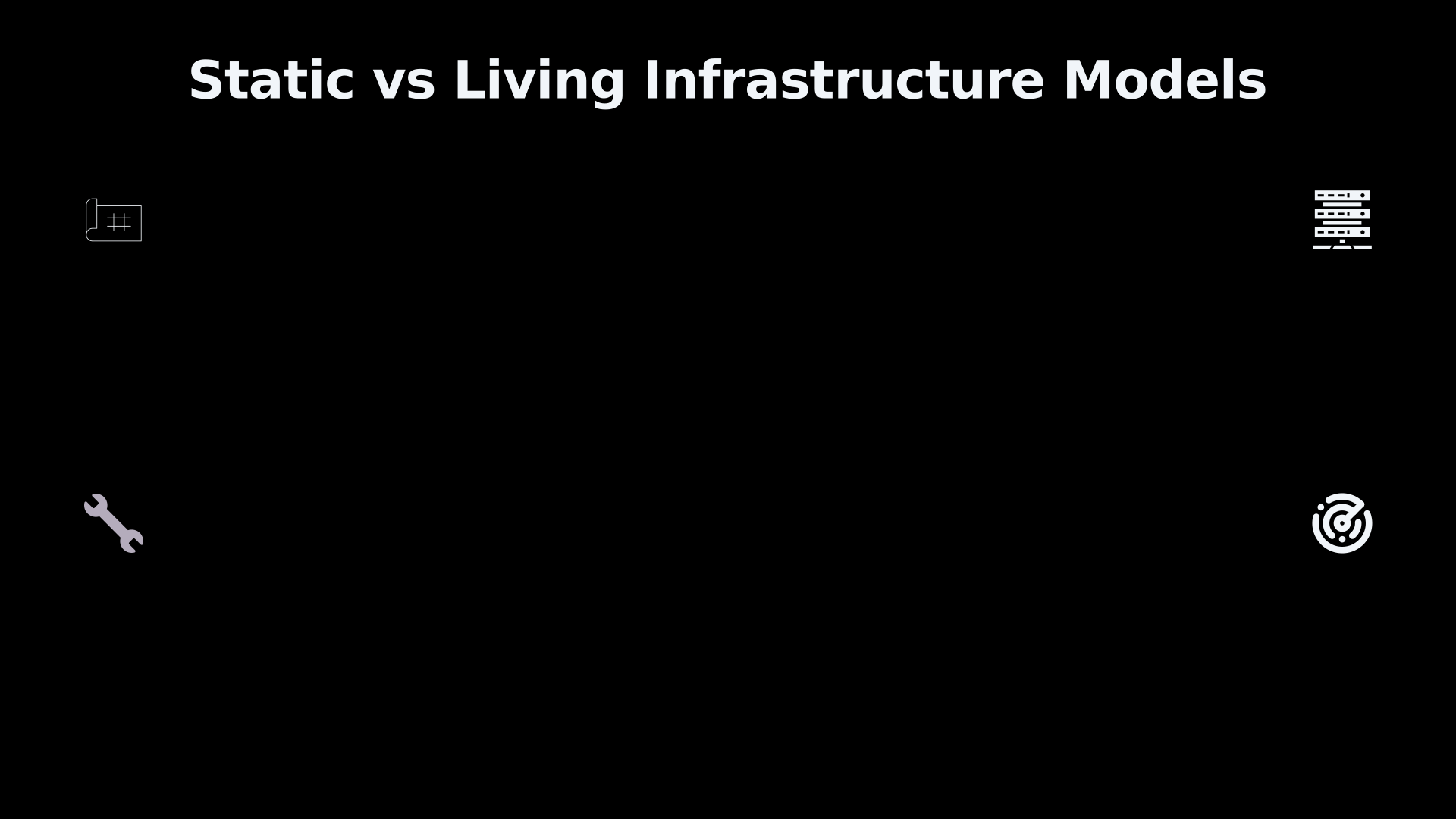
A traditional infrastructure model is often static: an engineering drawing, a database of assets or a maintenance schedule based on age. A digital twin attempts to create a living representation. Sensors, inspection records, satellite observations, weather information and operational data can continuously update the model, allowing engineers to explore questions such as: What happens if a bridge experiences heavier traffic than expected? Which railway components are most vulnerable during extreme heat? Which parts of a power network need reinforcement before a major storm?
The UK Department for Transport describes infrastructure digital twins as connected virtual models that use real-time data flows to improve understanding of asset condition, maintenance timing and future design decisions. Its research highlights potential uses in protecting infrastructure from risks including ageing assets, climate change and emerging threats such as cybersecurity problems.[GOV.UK]GOV.UKInfrastructure digital twins: data requirements30, 2025…
The important change is that infrastructure management moves from reacting after failure towards anticipating failure. Instead of waiting for a transformer to break, a water pipe to burst or a structure to show visible damage, operators can use AI systems to identify patterns that suggest rising risk.
From individual assets to connected systems
Infrastructure failures rarely happen in isolation. A flooded road can disrupt emergency services, a damaged power substation can affect hospitals and communications, and a railway failure can create wider economic disruption. Digital twins are increasingly designed to represent these connections rather than only individual objects.
Urban digital twins combine information from multiple systems to simulate how cities behave as complex networks. Research reviews suggest that these systems can support climate adaptation and infrastructure resilience by combining real-time sensing, predictive analytics and simulation. However, researchers also stress that interoperability — the ability of different systems and organisations to work together — remains a major challenge.[Enlighten Publications]eprints.gla.ac.ukEnlighten PublicationsData‐driven urban digital twins and critical infrastructure under climate change: a review of frameworks and applic…
This system-level view is important for disaster resilience. A city does not simply need to know that a bridge is weakening; it needs to understand what that failure means for evacuation routes, supply chains, public services and communities.
Using sensors and simulations to find risks
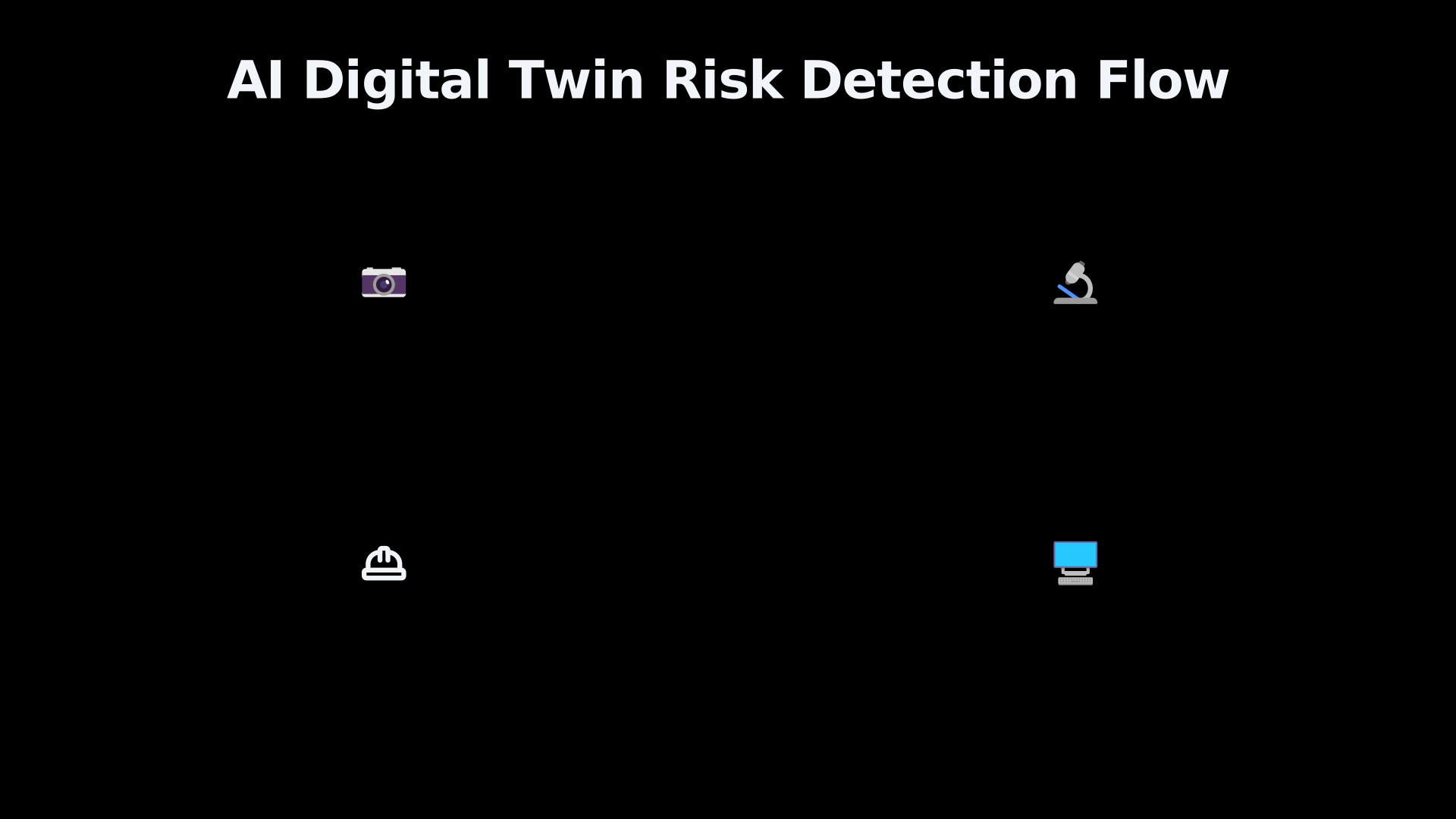
AI digital twins usually combine three capabilities: collecting information from the physical world, analysing patterns in that information, and testing possible futures through simulation.
Sensors provide the first layer. Infrastructure operators increasingly collect data from vibration monitors, cameras, weather stations, traffic systems and industrial equipment. AI can then identify unusual behaviour, compare current conditions with historical patterns and estimate where deterioration may be occurring.
For bridges, this can mean analysing images for cracks, monitoring changes in vibration or combining traffic and weather information to estimate structural stress. Recent research into bridge monitoring has explored hybrid digital twins that combine camera-based traffic estimates, weather data and machine-learning models to assess fatigue risks and maintenance needs.[arXiv]arxiv.orgarXiv Traffic and weather driven hybrid digital twin for bridge monitoringTraffic and weather driven hybrid digital twin for bridge monitoringMarch 14, 2026…
For energy networks, the challenge is scale. Electricity grids contain many interconnected components, and failures can cascade across regions. AI-enhanced digital twins aim to combine physical models of grid behaviour with operational data and climate information, helping operators test scenarios before real-world events occur. Research into AI-based grid resilience approaches highlights the potential of digital twins to support predictive failure analysis, although practical deployment still depends on reliable data and validated models.[ResearchGate]researchgate.netOpen source on researchgate.net.
Simulation is where digital twins become different from ordinary monitoring systems. A monitoring system might warn that a component is deteriorating. A digital twin can ask what would happen under different choices: repair now or later, reinforce one section or another, close a route temporarily, or change operations during extreme weather.
Real examples show promise, but not perfection
One reason digital twins attract attention is that they allow societies to experiment with infrastructure decisions without experimenting on the infrastructure itself. Disaster planning is especially suited to this approach because many of the most important events are rare but high-impact.
Urban resilience research has explored digital twins as tools for modelling disasters such as floods and earthquakes. By creating a dynamic connection between a physical city and a virtual environment, planners can test possible responses and study how different interventions affect outcomes.[Directory of Open Access Journals]doaj.orgOpen source on doaj.org.
Ports provide another example of how digital twins can support complex operations. The Port of Corpus Christi has developed an AI-supported digital replica that combines live and historical information to improve situational awareness, including tracking vessel movements and supporting emergency preparation.[Business Insider]businessinsider.comseaport by tonnage and top crude oil exporter, has implemented an AI-powered digital replica system called OPTICS (Overall Port Tactical…
These examples show an important distinction: the strongest current uses are usually focused on specific operational problems rather than creating a complete virtual copy of an entire civilisation. Successful systems often begin with a clear question — such as predicting equipment failure, improving maintenance scheduling or preparing for a known hazard — rather than attempting to model everything at once.
Limits of virtual replicas for real disasters
Digital twins are powerful, but they are not crystal balls. A model can only predict what it has enough information to represent. Infrastructure systems contain uncertainties: unexpected human behaviour, rare weather extremes, hidden damage, poor-quality records and changing environments.
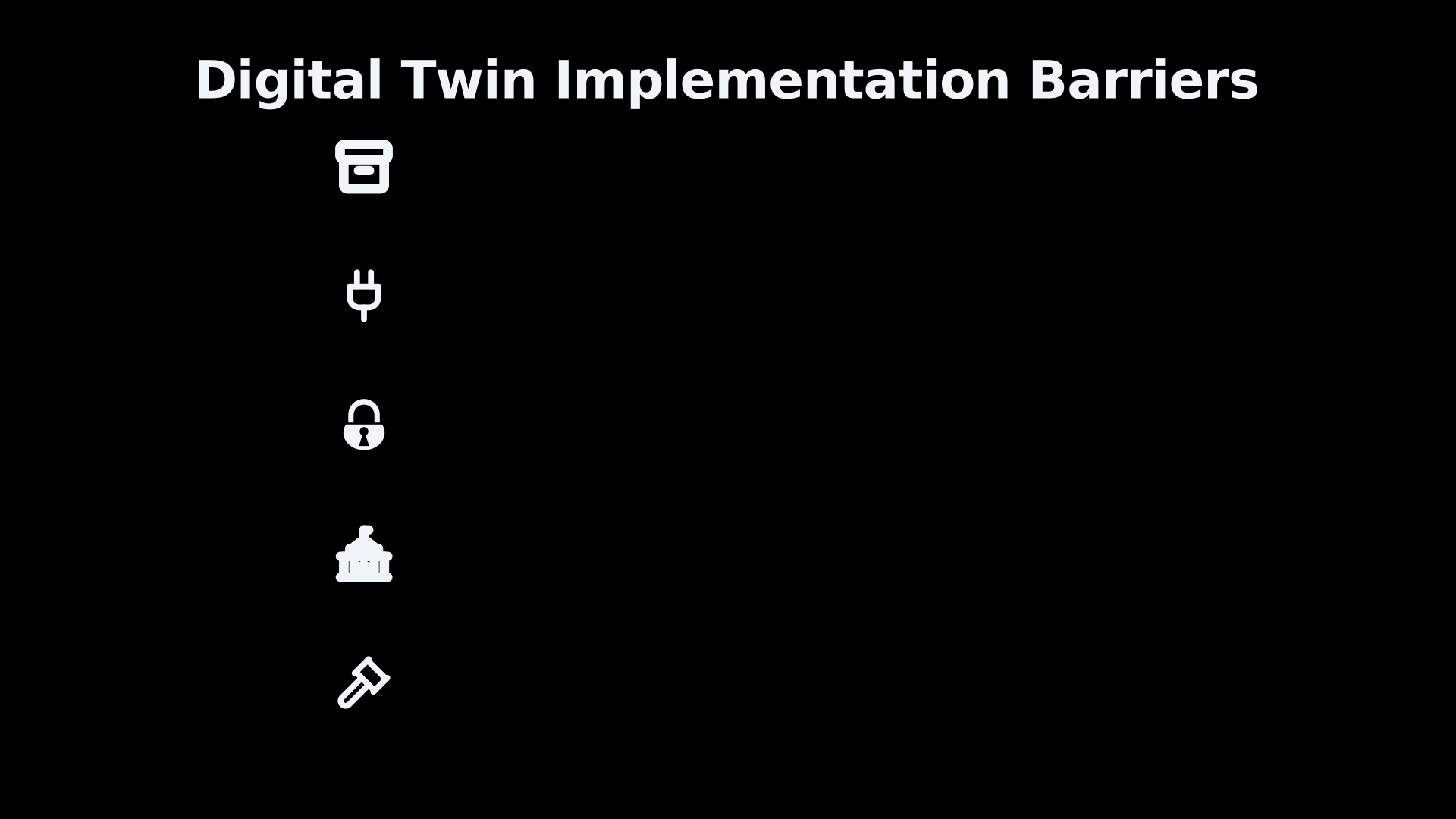
Data quality is one of the largest barriers. Many infrastructure assets were built decades ago and may have incomplete documentation. Different organisations may store information in incompatible formats, making it difficult to build a single reliable picture. Reviews of urban digital twins identify data integration, interoperability and governance as continuing challenges.[Enlighten Publications]eprints.gla.ac.ukEnlighten PublicationsData‐driven urban digital twins and critical infrastructure under climate change: a review of frameworks and applic…
There are also limits to the idea of a complete city-scale replica. Some researchers argue that urban digital twins face fundamental difficulties because cities are not purely technical systems; they involve politics, human choices, social relationships and unpredictable events that cannot be perfectly captured in a model.[DOI]doi.orgInsurmountable limitations of city-scale digital twins? On urban knowledge and planning | Computational Urban Science | Springer Natur…
Cybersecurity is another concern. A digital twin depends on connected data flows, which creates new opportunities for manipulation or attack. If operators trust incorrect information, an apparently intelligent system could make infrastructure decisions worse rather than better.
For this reason, digital twins are best understood as decision-support tools rather than autonomous replacements for engineers, emergency managers or public institutions.
What digital twins could mean for a more resilient civilisation
The deeper significance of AI digital twins is not that they make infrastructure invisible or automatic. Their importance is that they could help societies become more capable of learning from their own complexity.
A future with mature digital twins could allow cities and nations to maintain infrastructure more proactively, adapt to climate pressures, reduce avoidable failures and coordinate responses more effectively. In the context of AI-driven human flourishing, this represents a modest but meaningful part of a larger possibility: using advanced intelligence to help civilisation understand itself and make better decisions.
The optimistic case depends on more than technology. The benefits must be broadly shared, with investment in public infrastructure, trustworthy institutions and access to reliable data. Without those conditions, digital twins could become expensive tools available only to wealthy organisations rather than foundations for wider resilience.
The realistic promise is therefore not a perfect simulation of reality. It is a civilisation that can see problems earlier, test solutions faster and preserve more of the systems on which human progress depends.
Amazon book picks
Further Reading
Books and field guides related to Can Digital Twins Prevent Infrastructure Failures?. Use these as the next step if you want deeper reading beyond the article.

The Fourth Industrial Revolution
Professor Klaus Schwab, Founder and Executive Chairman of the World Economic Forum, has been at the center of global affairs for over fou...
The Industries of the Future
This book answers the question: 'What's next?' The Internet had a world-changing impact on businesses and the global community over the t...
Designing Data-intensive Applications
Want to know how the best software engineers and architects structure their applications to make them scalable, reliable, and maintainabl...
AI Superpowers: China, Silicon Valley, and the New World Order
AI Superpowers is Kai-Fu Lee's New York Times and USA Today bestseller about the American-Chinese competition over the future of artifici...
eBay marketplace picks
Marketplace Samples
Live-tested eBay searches with available results related to this page.
Selected fromcity model oneBay.co.uk.



Endnotes
1.
Source: GOV.UK
Title: Infrastructure digital twins: data requirements
Link:https://www.gov.uk/government/publications/infrastructure-digital-twins-data-requirements
Source snippet
30, 2025...
2.
Source: arxiv.org
Title: arXiv Traffic and weather driven hybrid digital twin for bridge monitoring
Link:https://arxiv.org/abs/2603.14028
Source snippet
Traffic and weather driven hybrid digital twin for bridge monitoringMarch 14, 2026...
Published: March 14, 2026
3.
Source: researchgate.net
Link:https://www.researchgate.net/publication/408219363_AI-Enhanced_Digital_Twin_for_Proactive_Grid_Resilience_Predictive_Failure_Analysis_Under_Climate_Change_Scenarios
4.
Source: arxiv.org
Title: arXiv Digital Twin Based Disaster Management System Proposal: DT-DMS
Link:https://arxiv.org/abs/2103.17245
5.
Source: doi.org
Link:https://doi.org/10.1007/s43762-025-00174-0
Source snippet
Insurmountable limitations of city-scale digital twins? On urban knowledge and planning | Computational Urban Science | Springer Natur...
6.
Source: doi.org
Link:https://doi.org/10.1007/s10791-026-10048-6
7.
Source: doi.org
Link:https://doi.org/10.1038/s41598-026-42046-5
8.
Source: researchgate.net
Link:https://www.researchgate.net/publication/390184870_Insurmountable_limitations_of_city-scale_digital_twins_On_urban_knowledge_and_planning
9.
Source: researchgate.net
Link:https://www.researchgate.net/publication/381679004_Digital_Post-Disaster_Risk_Management_Twinning_A_Review_and_Improved_Conceptual_Framework
10.
Source: GOV.UK
Title: www.gov.uk RT A: Digital twins
Link:https://www.gov.uk/government/publications/rapid-technology-assessment-digital-twins/rta-digital-twins
11.
Source: ouci.dntb.gov.ua
Link:https://ouci.dntb.gov.ua/en/works/986DemV2/
12.
Source: eprints.gla.ac.uk
Link:https://eprints.gla.ac.uk/364522/
Source snippet
Enlighten PublicationsData‐driven urban digital twins and critical infrastructure under climate change: a review of frameworks and applic...
13.
Source: doaj.org
Link:https://doaj.org/article/652039e25c3f4d80ab856250011ed116
14.
Source: businessinsider.com
Link:https://www.businessinsider.com/corpus-christi-port-ai-ship-tracking-emergency-training
Source snippet
seaport by tonnage and top crude oil exporter, has implemented an AI-powered digital replica system called OPTICS (Overall Port Tactical...
15.
Source: webstore.iec.ch
Link:https://webstore.iec.ch/en/publication/102354
Additional References
16.
Source: cogitatiopress.com
Link:https://www.cogitatiopress.com/urbanplanning/article/view/10109
17.
Source: youtube.com
Link:https://www.youtube.com/watch?v=868T116fJiU
Source snippet
iTwin IoT Patterns: AI/ML [Forecasting]({{ 'forecast-gains/' | relative_url }}) for Predictive Infrastructure Monitoring demonstrates how machine learning forecasting within digit...
18.
Source: youtube.com
Link:https://www.youtube.com/watch?v=TaKWsHtSTE4
Source snippet
AI & Digital Twins: Rebuilding Modern Infrastructure as Living Systems | Uplatz...
19.
Source: youtube.com
Title: Why Your Operation Is Still Reacting Instead of Predicting | Digital Twin
Link:https://www.youtube.com/watch?v=FANE9T_7-fE
Source snippet
Real-Time Structural [Health]({{ 'health/' | relative_url }}) Monitoring Using Physics-Driven Digital Twins | Shady Adib | DSC MENA 25...
20.
Source: youtube.com
Title: AI & Digital Twins: Rebuilding Modern Infrastructure as Living Systems | Uplatz
Link:https://www.youtube.com/watch?v=fn5GZN6l3sQ
Source snippet
Digital Twins in Action: Transforming Infrastructure for Smarter, Resilient Cities...
21.
Source: youtube.com
Title: i Twin Io T Patterns: AI/ML Forecasting for Predictive Infrastructure Monitoring
Link:https://www.youtube.com/watch?v=PzIaTUYkBGo
Source snippet
Why Your Operation Is Still Reacting Instead of Predicting | Digital Twin...
22.
Source: nature.com
Link:https://www.nature.com/articles/s41598-026-46719-z
23.
Source: eurekamag.com
Link:https://eurekamag.com/research/106/870/106870031.php
24.
Source: sciencedirect.com
Link:https://www.sciencedirect.com/science/article/pii/S2772991525000477
25.
Source: dataknobs.com
Link:https://www.dataknobs.com/customers/case-study/