Within Alpha Fold
When Should Scientists Trust an Alpha Fold Model?
AlphaFold's confidence scores help researchers decide which protein regions are reliable enough to guide experiments and which need caution.
On this page
- What Alpha Fold confidence scores measure
- How researchers use confidence to prioritise experiments
- Where high confidence can still mislead
Page outline Jump by section
Introduction
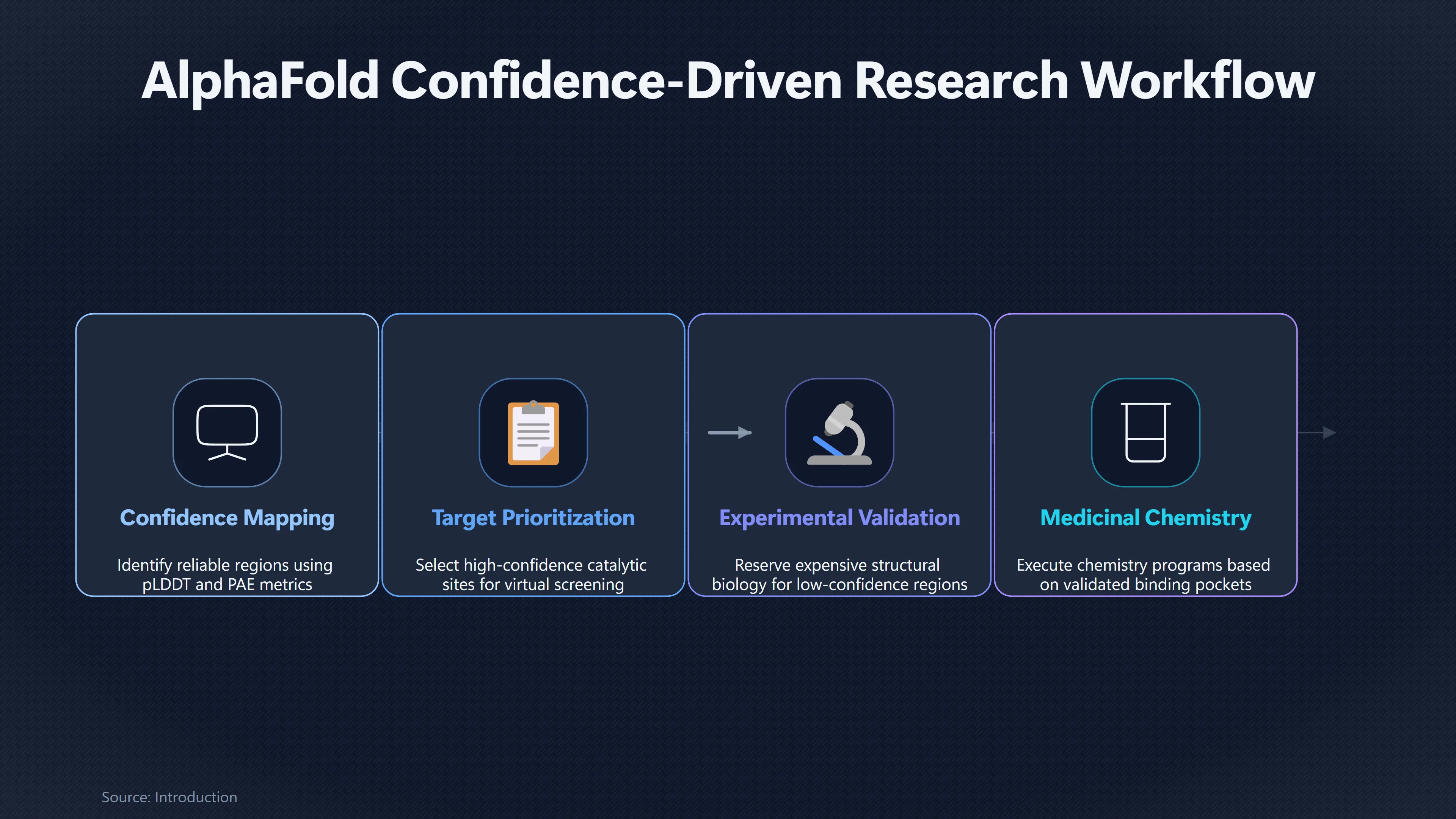
AlphaFold’s confidence scores are one of the most important reasons the system is useful for drug research rather than merely impressive. Every predicted protein structure is accompanied by measures of uncertainty that help scientists judge which parts of the model are likely to be accurate and which require scepticism. Instead of treating an AI-generated structure as a finished answer, researchers use these scores to decide where to trust the prediction, where to invest laboratory resources, and where additional experimental work is essential.
Within the broader story of how AlphaFold changes early drug discovery, these confidence measures are the mechanism that allows researchers to work faster without abandoning scientific caution. They make the predictions far more actionable because they distinguish reliable structural information from regions that remain uncertain. At the same time, the scores are not guarantees of biological truth. They estimate the AI model’s confidence in its own prediction, not whether a protein behaves that way inside a living cell.[EMBL-EBI]ebi.ac.ukEMBL-EBIInputs and outputs | Alpha FoldEMBL-EBIInputs and outputs | Alpha Fold
What AlphaFold confidence scores measure
AlphaFold provides several complementary measures of confidence, each answering a different scientific question.
The best-known is predicted Local Distance Difference Test (pLDDT). This assigns every amino acid residue a score between 0 and 100, estimating how accurately AlphaFold believes it has predicted the local structure around that position.
Researchers commonly interpret the scores approximately as follows:
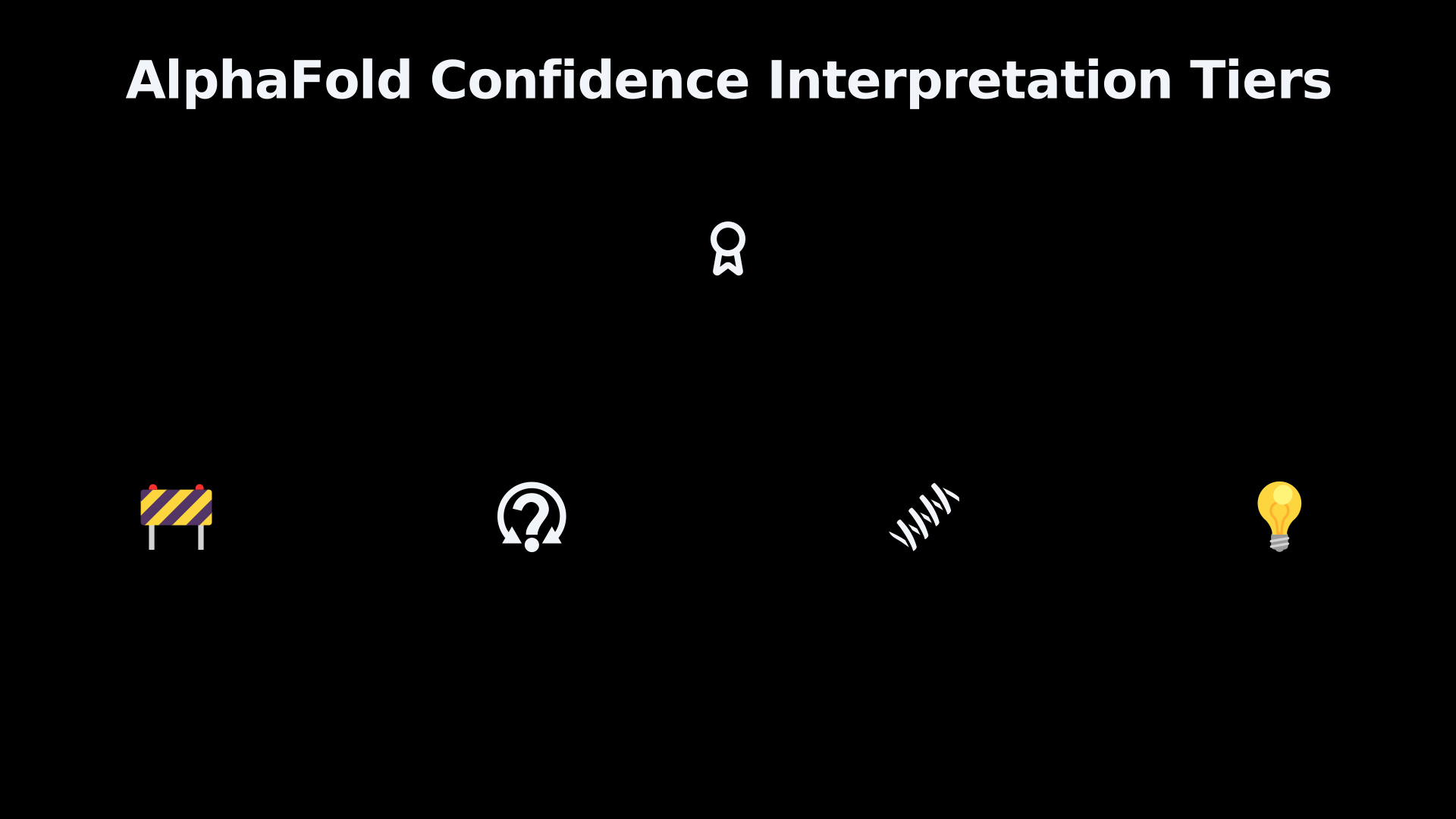
- Above 90: very high confidence. Both the protein backbone and many side chains are often predicted with near-experimental accuracy.
- 70–90: generally reliable backbone structure, although side-chain positions may be less certain.
- 50–70: low confidence. The broad fold may be uncertain.
- Below 50: very low confidence. These regions are frequently flexible, intrinsically disordered or simply difficult for the model to predict reliably.[EMBL-EBI]ebi.ac.ukEMBL-EBIp LDDT: Understanding local confidence | Alpha FoldEMBL-EBIp LDDT: Understanding local confidence | Alpha Fold
A second important metric is the Predicted Aligned Error (PAE).
Unlike pLDDT, which evaluates confidence at individual residues, PAE estimates how certain AlphaFold is about the relative positions of different parts of the protein. Two domains may each receive excellent local confidence scores while their orientation relative to one another remains uncertain. PAE helps researchers identify exactly this type of ambiguity, which can be crucial when studying proteins that change shape or contain multiple domains.[EMBL-EBI]ebi.ac.ukEMBL-EBIInputs and outputs | Alpha FoldEMBL-EBIInputs and outputs | Alpha Fold
For protein complexes predicted by AlphaFold-Multimer, additional interface confidence scores help estimate whether predicted interactions between different protein chains are likely to be reliable. These are especially important when studying protein-protein interactions that may become drug targets.[AlphaFold]alphafold.ebi.ac.ukOpen source on ebi.ac.uk.
How researchers use confidence to prioritise experiments
Confidence scores do not replace experiments. Instead, they determine which experiments deserve priority.
Rather than accepting or rejecting an entire model, researchers evaluate confidence region by region.
For example:
- A highly confident catalytic site may be suitable for computational drug screening.
- A poorly predicted flexible loop may be ignored during initial modelling.
- A domain with low PAE may be trusted individually while its overall orientation is tested experimentally.
- A protein with uniformly poor confidence may be selected for cryo-electron microscopy or X-ray crystallography before expensive medicinal chemistry begins.[EMBL-EBI]ebi.ac.ukEMBL-EBIInputs and outputs | Alpha FoldEMBL-EBIInputs and outputs | Alpha Fold
This changes the economics of early-stage drug discovery. Instead of experimentally determining every candidate structure from scratch, scientists can reserve the slowest and most expensive structural biology methods for proteins where AlphaFold itself signals uncertainty.
In practice, many research groups now treat confidence maps as planning tools. The question becomes not “Is this prediction correct?” but “Which parts are reliable enough to justify the next experiment?”
Confidence helps identify useful binding sites
Many medicines work by fitting into pockets on a protein’s surface.
When a predicted binding pocket lies within a region of consistently high pLDDT, researchers have greater confidence that the pocket’s geometry is close to reality. This makes virtual screening and structure-based drug design substantially more informative.
Conversely, if the proposed binding site lies inside a poorly predicted region, researchers know that computational docking results should be interpreted much more cautiously or validated experimentally before large chemistry programmes begin.[EMBL-EBI]ebi.ac.ukEMBL-EBIp LDDT: Understanding local confidence | Alpha FoldEMBL-EBIp LDDT: Understanding local confidence | Alpha Fold
The confidence scores therefore influence not only whether a protein becomes a drug target but also which specific regions medicinal chemists attempt to exploit.
Low confidence is not always bad news
One common misunderstanding is that low confidence simply means AlphaFold has failed.
In reality, low-confidence regions often correspond to intrinsically disordered regions—parts of proteins that genuinely do not adopt a single stable three-dimensional shape. Many signalling proteins, transcription factors and regulatory proteins contain these flexible segments.
In these cases, AlphaFold is communicating an important biological insight rather than merely expressing uncertainty. The model’s inability to predict one stable structure often reflects the underlying biology, because the protein itself exists in many conformations instead of one fixed shape. Researchers increasingly use pLDDT as one indicator when identifying such disordered regions, although additional experimental evidence is still required.[EMBL-EBI]ebi.ac.ukEMBL-EBIStrengths and limitations of Alpha Fold 2 | Alpha FoldEMBL-EBIStrengths and limitations of Alpha Fold 2 | Alpha Fold
Where high confidence can still mislead
High confidence should never be confused with complete biological accuracy.
AlphaFold predicts the structure it considers most probable from sequence information. It does not necessarily capture everything that determines how a protein behaves inside cells.
Important limitations remain.
Proteins are dynamic rather than static. Many proteins change shape while performing their biological functions. AlphaFold generally predicts one structural state rather than an entire range of conformations. A highly confident prediction may therefore represent only one snapshot of a moving molecular machine.[EMBL-EBI]ebi.ac.ukEMBL-EBIStrengths and limitations of Alpha Fold 2 | Alpha FoldEMBL-EBIStrengths and limitations of Alpha Fold 2 | Alpha Fold
Binding partners can change structure. Proteins often alter their shape when interacting with small molecules, DNA, RNA, ions or other proteins. AlphaFold was not originally trained to model many of these interactions, meaning a confident prediction may still omit biologically important structural changes.[EMBL-EBI]ebi.ac.ukEMBL-EBIStrengths and limitations of Alpha Fold 2 | Alpha FoldEMBL-EBIStrengths and limitations of Alpha Fold 2 | Alpha Fold
Disease-causing mutations may have effects beyond the predicted fold. A mutation can alter stability, dynamics or interactions without producing a dramatic structural change in the AlphaFold model. Consequently, researchers avoid using confidence scores alone to predict the effects of genetic variants.[EMBL-EBI]ebi.ac.ukEMBL-EBIStrengths and limitations of Alpha Fold 2 | Alpha FoldEMBL-EBIStrengths and limitations of Alpha Fold 2 | Alpha Fold
Confidence is not the same as correctness. As the AlphaFold Protein Structure Database notes, the scores estimate confidence in the predicted geometry, not confidence that the prediction reflects the protein’s full biological behaviour. Experimental validation remains essential.[AlphaFold]alphafold.ebi.ac.ukOpen source on ebi.ac.uk.
Why confidence scores matter for AI-enabled scientific acceleration
From the perspective of AI-driven scientific progress, AlphaFold’s confidence metrics are almost as important as the structural predictions themselves.
Many AI systems produce answers without clearly expressing uncertainty. AlphaFold instead exposes where it believes its own predictions are strong and where they are weak. This allows human researchers to combine machine-generated hypotheses with established experimental methods rather than replacing one with the other.
That combination is especially valuable in early drug discovery. Confidence scores help scientists allocate scarce laboratory time, expensive instrumentation and medicinal chemistry effort towards the questions most likely to produce useful results. They reduce wasted work while preserving the principle that important medical decisions ultimately depend on experimental evidence.
Within the broader vision of AI accelerating scientific discovery, this illustrates a recurring pattern: the greatest gains often come not from AI making final decisions, but from AI helping researchers ask better questions, recognise uncertainty earlier and direct human expertise more effectively.[EMBL-EBI]ebi.ac.ukEMBL-EBIKey takeaways about Alpha Fold | Alpha FoldEMBL-EBIKey takeaways about Alpha Fold | Alpha Fold
Amazon book picks
Further Reading
Books and field guides related to When Should Scientists Trust an Alpha Fold Model?. Use these as the next step if you want deeper reading beyond the article.
Protein Structure and Function
Each title in the 'Primers in Biology' series is constructed on a modular principle that is intended to make them easy to teach from, to...
The Gene: An Intimate History
Prologue: Families -- "The missing science of heredity" 1865-1935 -- "In the sum of the parts, there are only the parts" 1930-1970 -- "Th...

The Eighth Day of Creation: Makers of the Revolution in Biology
First published 1969. Subjects: DNA, Molecular biology, Histoire, Biología molecular, Historia.

Life's Greatest Secret: The Race to Crack the Genetic Code
First published 2015. Subjects: Genetic code, DNA, Dna.
eBay marketplace picks
Marketplace Samples
Live-tested eBay searches with available results related to this page.
Selected fromprotein model oneBay.co.uk.



Endnotes
1.
Source: ebi.ac.uk
Title: EMBL-EBIInputs and outputs | [Alpha Fold]({{ ‘alpha-fold/’ | relative_url }})
Link:https://www.ebi.ac.uk/training/online/courses/alphafold/inputs-and-outputs/
2.
Source: ebi.ac.uk
Title: EMBL-EBIStrengths and limitations of Alpha Fold 2 | Alpha Fold
Link:https://www.ebi.ac.uk/training/online/courses/alphafold/an-introductory-guide-to-its-strengths-and-limitations/strengths-and-limitations-of-alphafold/
3.
Source: ebi.ac.uk
Title: EMBL-EBIKey takeaways about Alpha Fold | Alpha Fold
Link:https://www.ebi.ac.uk/training/online/courses/alphafold/future-directions-and-summary/key-takeaways-about-alphafold/
4.
Source: embl.org
Title: alphafold potential impacts
Link:https://www.embl.org/news/science/alphafold-potential-impacts/
Source snippet
Great expectations – the potential impacts of AlphaFold DB | EMBLJuly 22, 2021 — CURRENT LIMITATIONS OF THE PREDICTION METHOD Although th...
Published: July 22, 2021
5.
Source: youtube.com
Title: Interpreting Alpha Fold predictions and confidence indicators
Link:https://www.youtube.com/watch?v=i_aou7FRySw
Source snippet
AlphaFold and the End of the Protein Folding Problem...
6.
Source: youtube.com
Title: Alpha Fold and the End of the Protein Folding Problem
Link:https://www.youtube.com/watch?v=Y48UmC3ODFk
Source snippet
Protein Model Quality - Part 2: Visualising AlphaFold's PAE in Jalview...
7.
Source: alphafold.ebi.ac.uk
Link:https://www.alphafold.ebi.ac.uk/faq
8.
Source: ebi.ac.uk
Title: EMBL-EBIp LDDT: Understanding local confidence | Alpha Fold
Link:https://www.ebi.ac.uk/training/online/courses/alphafold/inputs-and-outputs/evaluating-alphafolds-predicted-structures-using-confidence-scores/plddt-understanding-local-confidence/
9.
Source: nature.com
Link:https://www.nature.com/articles/s41592-023-02087-4
Source snippet
AlphaFold predictions are valuable hypotheses and accelerate but do not replace experimental structure determination | Nature MethodsNove...
10.
Source: ebi.ac.uk
Link:https://www.ebi.ac.uk/training/online/courses/alphafold
Source snippet
AlphaFold | EMBL-EBI TrainingALPHAFOLD A PRACTICAL GUIDE Image Enter course Mark as favourite Image: progress Course progress: 0% Time to...
11.
Source: ebi.ac.uk
Link:https://www.ebi.ac.uk/training/online/courses/alphafold/alphafold-3-and-alphafold-server/how-to-assess-the-quality-of-alphafold-3-predictions/
Source snippet
AlphaFold 3 uses the same confidence scores...
12.
Source: ebi.ac.uk
Link:https://www.ebi.ac.uk/training/online/courses/alphafold/inputs-and-outputs/alphafold-inputs-and-outputs-recap/
13.
Source: ebi.ac.uk
Link:https://www.ebi.ac.uk/training/online/courses/alphafold/inputs-and-outputs/evaluating-alphafolds-predicted-structures-using-confidence-scores/pae-a-measure-of-global-confidence-in-alphafold-predictions/
14.
Source: ebi.ac.uk
Link:https://www.ebi.ac.uk/training/online/courses/alphafold/inputs-and-outputs/evaluating-alphafolds-predicted-structures-using-confidence-scores/
16.
Source: ebi.ac.uk
Link:https://www.ebi.ac.uk/training/online/courses/alphafold/alphafold-3-and-alphafold-server/introducing-alphafold-3/what-alphafold-3-struggles-with/
17.
Source: github.com
Link:https://github.com/google-deepmind/alphafold3/blob/main/docs/output.md
Additional References
18.
Source: youtube.com
Link:https://www.youtube.com/watch?v=dVFHr0ZV4-0
Source snippet
Interpreting AlphaFold predictions and confidence indicators...
19.
Source: arxiv.org
Link:https://arxiv.org/abs/2410.14898
20.
Source: youtube.com
Title: Protein Model Quality
Link:https://www.youtube.com/watch?v=jowUEG47F-Q
Source snippet
How to show AlphaFold error estimates with ChimeraX...
21.
Source: neuro-psycho-group.github.io
Link:https://neuro-psycho-group.github.io/AlphaFold/pages/5-confidence.html
22.
Source: youtube.com
Title: How to show Alpha Fold error estimates with Chimera X
Link:https://www.youtube.com/watch?v=oxblwn0_PMM