Within Sellafield Robots
Why Sellafield Cannot Fully Automate Clean Up
Radiation damage, unreliable communications and unpredictable debris make supervised robotics safer than fully autonomous clean-up at Sellafield.
On this page
- How radiation and contamination damage robotic systems
- What happens when communications or manipulators fail
- Why expert judgement remains central to safe operations
Page outline Jump by section
Introduction
Sellafield demonstrates both the promise and the limits of advanced robotics. Robots already inspect hazardous areas, map radioactive facilities, collect contamination data and manipulate dangerous materials that would expose people to unacceptable radiation doses. Yet they have not eliminated the need for skilled human operators. Instead, the most successful systems combine increasingly capable machines with continuous human supervision.
This matters beyond nuclear decommissioning. Within the wider discussion of AI, robotics and long-term human flourishing, Sellafield shows that removing people from dangerous environments does not necessarily mean removing people from decision-making. Extreme radiation, incomplete knowledge of ageing facilities, unreliable communications and the consequences of mistakes all make human judgement a critical part of safe operations. Rather than being a failure of automation, this reflects the reality that some environments remain too uncertain for fully autonomous systems.[gov.uk]GOV.UKSellafield robots leading an evolution in nuclear decommissioningSellafield robots leading an evolution in nuclear decommissioning
Radiation Is Hard on Robots as Well as People
Radiation is usually discussed in terms of its effects on human health, but it can also damage machines. High-energy particles gradually degrade electronic components, corrupt computer memory, damage image sensors and shorten the operating life of cameras, processors and communications equipment. The more sophisticated a robot becomes, the more electronics it typically contains, creating additional vulnerabilities in the harshest environments.
Engineers therefore often adapt commercial robotic platforms with radiation-tolerant components, shielding or replaceable payloads rather than assuming standard industrial robots can simply be deployed underground or inside contaminated facilities. Even then, exposure limits may restrict how long a robot can remain in certain locations before maintenance or replacement becomes necessary.[GOV.UK]GOV.UKSellafield robots leading an evolution in nuclear decommissioningSellafield robots leading an evolution in nuclear decommissioning
Radiation also reduces the reliability of sensing. Cameras may become noisy, laser scanners may lose accuracy as equipment ages, and sensor failures can occur without warning. Because operators cannot always trust every data stream equally, they must continuously interpret multiple sources of information instead of relying on automated decisions alone.
Unknown Environments Defeat Simple Automation
Unlike a modern factory, Sellafield is not a structured workplace built for robots. Many facilities date back to the 1950s and 1960s, with incomplete records of modifications, ageing equipment, corrosion, accumulated waste and changing internal conditions.
Autonomous robots perform best when operating in environments that are predictable and well mapped. Sellafield often presents the opposite:
- unexpected debris blocking planned routes;
- damaged structures whose stability is uncertain;
- pools, sludge or loose material with unknown properties;
- changing radiation fields;
- poor lighting, dust or contamination affecting sensors;
- confined spaces never designed for robotic access.
In these situations, a robot may encounter conditions that were never represented in its software or training data. Human operators can recognise unusual situations, reconsider objectives and decide whether continuing is acceptable or whether work should stop for further assessment.[gov.uk]GOV.UKfuture research and development requirements 2021future research and development requirements 2021
What Happens When Communications Fail?
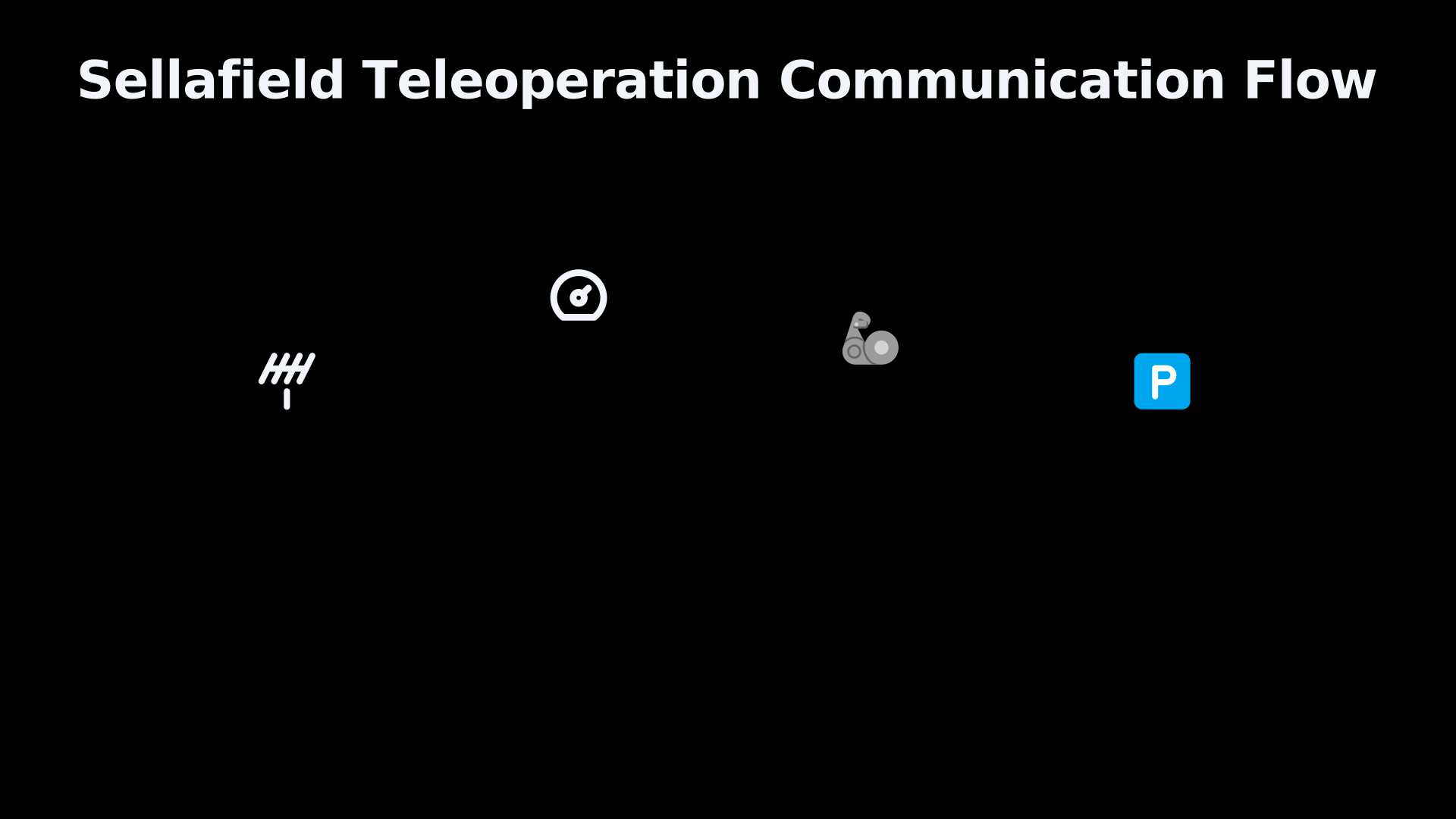
Most hazardous work at Sellafield relies on teleoperation: robots execute physical actions while people remain in protected control rooms.
This arrangement depends on reliable communication. Video feeds, sensor readings and control commands must travel between operator and machine with minimal interruption. If communications degrade, several problems emerge:
- delayed video can make precise manipulation difficult;
- temporary signal loss may leave operators uncertain about a robot’s exact position;
- sensor failures can remove essential situational awareness;
- robotic arms may become immobilised while holding hazardous objects;
- recovery itself may require another specialised robot.
Because the consequences of an error can include contamination, equipment damage or loss of access to expensive machinery inside radioactive facilities, operators generally adopt conservative procedures. Robots are designed to enter safe states if communication is interrupted, but deciding how to recover from an unexpected failure remains a human responsibility.[uknnl.com]uknnl.comUK National Nuclear Laboratory Decommissioning at SellafieldUK National Nuclear LaboratoryDecommissioning at Sellafield - United Kingdom National Nuclear Laboratory…

Manipulation Remains More Difficult Than Inspection
Inspection robots have progressed rapidly because surveying, mapping and radiation measurement involve relatively predictable sensing tasks. Physical manipulation is substantially harder.
Many decommissioning activities require cutting, lifting, gripping or sorting objects whose condition is only partly understood. A corroded pipe may fracture unexpectedly. A container may be heavier than anticipated. Debris can shift as material is removed.
Even when robotic arms perform the movement itself, experienced operators decide:
- where cutting should begin;
- whether a component appears structurally safe;
- how to respond if material behaves unexpectedly;
- when to abandon a planned sequence;
- whether contamination risks have changed.
UK National Nuclear Laboratory’s work on remotely operated laser cutting illustrates this balance. Automation assists execution, but the overall process remains directed by operators who understand the wider engineering and safety context.[UK National Nuclear Laboratory]uknnl.comUK National Nuclear Laboratory Decommissioning at SellafieldUK National Nuclear LaboratoryDecommissioning at Sellafield - United Kingdom National Nuclear Laboratory…
Expert Judgement Is a Safety System
Human supervision is not merely a backup in case robots fail. It is an active layer of the safety strategy.
Experienced nuclear engineers integrate information that current AI systems cannot easily combine with sufficient confidence:
- historical knowledge of particular facilities;
- understanding of plant operating history;
- interpretation of ambiguous radiation readings;
- awareness of regulatory requirements;
- assessment of risks that cannot be quantified precisely.
This matters because nuclear decommissioning is rarely an optimisation problem with one correct answer. Operators frequently choose between several imperfect options, balancing worker safety, contamination control, equipment preservation, cost and long-term waste management.
Research into nuclear robotics increasingly describes this as “variable autonomy”: robots perform routine navigation or repetitive actions, while humans retain authority over higher-level decisions and intervene whenever uncertainty increases.[arXiv]arxiv.orgOpen source on arxiv.org.

AI Can Reduce Workload Without Replacing Responsibility
Modern AI already improves robotic capability in several ways. Computer vision helps identify equipment, LiDAR creates detailed three-dimensional maps, autonomous navigation reduces repetitive driving, and digital twins help operators understand complex facilities before entering them remotely.
Sellafield has demonstrated robots that autonomously gather inspection data, build detailed maps and perform repeated monitoring routes. More recent projects have expanded remote operation of quadruped robots while integrating inspection data into digital models of facilities. These developments reduce operator workload and allow experts to supervise more effectively rather than manually controlling every movement.[GOV.UK]GOV.UKHow are robot dogs helping clean up Sellafield?Case study - GOV.UK…
However, AI assistance differs from AI authority. The systems propose routes, detect anomalies or automate routine actions, but humans continue to validate important decisions before work proceeds. This reflects a deliberate engineering choice rather than a technological shortcoming.
What Sellafield Suggests About AI and Human Flourishing
Within the broader vision of AI enabling humanity to flourish, Sellafield offers an instructive example of technological progress that is both ambitious and cautious.
The benefit is already substantial: robots dramatically reduce the amount of time people must spend in hazardous environments, allowing inspection, mapping and waste retrieval that would otherwise expose workers to unacceptable risks. That is a genuine improvement in safety and productivity.
At the same time, Sellafield illustrates why advanced AI does not automatically eliminate the need for human expertise. High-stakes environments characterised by uncertainty, degraded infrastructure and severe consequences for failure still depend on human judgement, accountability and ethical responsibility.
Rather than replacing people, the emerging model is one of partnership. AI and robotics increasingly take on the dangerous, repetitive and physically impossible aspects of nuclear clean-up, while experienced operators remain responsible for interpreting uncertainty, managing unexpected events and making the decisions that machines cannot yet make with sufficient confidence. This human-centred approach is likely to remain the defining pattern for nuclear decommissioning even as robotic capabilities continue to improve.[gov.uk]GOV.UKHow are robot dogs helping clean up Sellafield?Case study - GOV.UK…
Amazon book picks
Further Reading
Books and field guides related to Why Sellafield Cannot Fully Automate Clean Up. Use these as the next step if you want deeper reading beyond the article.
Introduction to Autonomous Mobile Robots
The second edition of a comprehensive introduction to all aspects of mobile robotics, from algorithms to mechanisms. Mobile robots range...
Robotics: Modelling, Planning and Control
Based on the successful Modelling and Control of Robot Manipulators by Sciavicco and Siciliano (Springer, 2000), Robotics provides the ba...

The Fourth Industrial Revolution
Professor Klaus Schwab, Founder and Executive Chairman of the World Economic Forum, has been at the center of global affairs for over fou...
The Second Machine Age
A New York Times Bestseller A revolution is under way. In recent years, Google’s autonomous cars have logged thousands of miles on Americ...
eBay marketplace picks
Marketplace Samples
Live-tested eBay searches with available results related to this page.
Selected fromrobot dog model oneBay.co.uk.


Endnotes
1.
Source: GOV.UK
Title: [Sellafield robots]({{ ‘sellafield-robots/’ | relative_url }}) leading an evolution in nuclear decommissioning
Link:https://www.gov.uk/government/news/sellafield-robots-leading-an-evolution-in-nuclear-decommissioning
2.
Source: GOV.UK
Title: future research and development requirements 2021
Link:https://www.gov.uk/government/publications/future-research-and-development-requirements-2021/future-research-and-development-requirements-2021
3.
Source: GOV.UK
Title: How are [robot dogs]({{ ‘robot-dogs/’ | relative_url }}) helping clean up Sellafield?
Link:https://www.gov.uk/government/case-studies/how-are-robot-dogs-helping-clean-up-sellafield
Source snippet
Case study - GOV.UK...
4.
Source: arxiv.org
Title: arXiv Towards Robotically Supported Decommissioning of Nuclear Sites
Link:https://arxiv.org/abs/1705.06401
5.
Source: arxiv.org
Link:https://arxiv.org/abs/2207.00648
6.
Source: arxiv.org
Link:https://arxiv.org/abs/1807.04814
7.
Source: GOV.UK
Link:https://www.gov.uk/government/news/new-robot-swabbing-technology-trialled-for-the-first-time-at-sellafield
Source snippet
robot swabbing technology trialled for the first time at Sellafield - GOV.UKFebruary 3, 2026 — News story NEW ROBOT SWABBING TECHNOLOGY T...
Published: February 3, 2026
8.
Source: nda.blog.gov.uk
Link:https://nda.blog.gov.uk/from-valves-and-control-systems-to-ai-and-robotics-is-sellafield-the-ultimate-engineering-training-ground/
9.
Source: GOV.UK
Title: annual research and development review 202021
Link:https://www.gov.uk/government/publications/annual-research-and-development-review-202021/annual-research-and-development-review-202021
10.
Source: uknnl.com
Title: UK National Nuclear Laboratory Decommissioning at Sellafield
Link:https://uknnl.com/customer-solutions/case-studies/decommissioning-at-sellafield/
Source snippet
UK National Nuclear LaboratoryDecommissioning at Sellafield - United Kingdom National Nuclear Laboratory...
11.
Source: onr.org.uk
Title: Two of th
Link:https://www.onr.org.uk/publications/regulatory-reports/site-specific-reports/inspection-records/2025/04/sellafield-inspection-id-52976
Source snippet
Sellafield - Inspection ID: 52976 | Office for Nuclear RegulationApril 22, 2025 — EXECUTIVE SUMMARY Date(s) of inspection: December 2024...
Published: April 22, 2025
Additional References
12.
Source: youtube.com
Link:https://www.youtube.com/watch?v=56xnHhAthl0
Source snippet
RAIN Webinar 15th July 2021: New technologies of communication and control for the nuclear industry...
Published: July 2021
13.
Source: youtube.com
Link:https://www.youtube.com/watch?v=yvIuSOUIP-8
Source snippet
RAIN Hub - Lyra deployment- inspection in ventilation duct at Dounreay...
Published: July 2021
14.
Source: youtube.com
Title: Createc takes Spot to Sellafield to complete his first active demonstration
Link:https://www.youtube.com/watch?v=9APqvyY5Pr8
Source snippet
Nuclear Facility Surveillance and Robot Deployment by Hyundai Motor Group and Boston Dynamics...
15.
Source: youtube.com
Title: RAIN Hub
Link:https://www.youtube.com/watch?v=I6jOPRSZm_w
Source snippet
Createc takes Spot to Sellafield to complete his first active demonstration...
16.
Source: onr.org.uk
Link:https://www.onr.org.uk/news/all-news/2023/03/innovative-use-of-robots-and-unmanned-aerial-vehicles-at-sellafield/
17.
Source: wired-gov.net
Link:https://www.wired-gov.net/wg/news.nsf/articles/Sellafield%2BLtd%2Band%2BAtkinsR%C3%A9alis%2Breach%2Bnew%2Brobotics%2Bmilestone%2B19032025091500?open=
18.
Source: nnlcc.forepoint.uk
Link:https://nnlcc.forepoint.uk/nuclear-operations/plant-intervention/
19.
Source: youtube.com
Link:https://www.youtube.com/watch?v=jRsFacmcEEU
20.
Source: birmingham.ac.uk
Title: The challenge
Link:https://www.birmingham.ac.uk/research/centres-institutes/energy-storage/birmingham-extreme-robotics-lab-erl/the-challenge