Within Farm Robots
Can Precision Spraying Keep Workers Away From Chemicals?
Camera-guided sprayers can target weeds plant by plant, reducing both chemical use and the time workers spend near pesticides.
On this page
- Where pesticide exposure occurs during farm work
- How camera guided nozzle control changes spraying
- What current systems prove and what remains uncertain
Page outline Jump by section
Introduction
Precision spraying aims to answer a simple question: can farmers control weeds while keeping workers further away from hazardous chemicals? Increasingly, the answer appears to be yes—but with important qualifications. Camera-guided sprayers equipped with artificial intelligence (AI) and machine vision can detect weeds in real time and activate individual spray nozzles only where treatment is needed, rather than coating an entire field. In many situations this reduces the total volume of herbicide applied, shortens the time operators spend handling chemicals, and lowers the number of spraying passes required. These are meaningful occupational health benefits, although they do not eliminate the need to mix, load and maintain spraying equipment safely.

Within the broader story of agricultural robots reducing dangerous work, precision spraying is one of the strongest near-term examples. Rather than replacing farm workers, it changes their role from repeatedly applying chemicals across large areas towards supervising more targeted, data-driven systems. That makes it an early illustration of how AI and robotics may reduce hazardous labour while also improving resource efficiency.
Where pesticide exposure occurs during farm work
Worker exposure to pesticides is not limited to the moment chemicals leave the nozzle. Agricultural health agencies identify several stages where contact can occur:
- Mixing and loading concentrates. Highly concentrated products must often be measured and transferred into sprayer tanks, creating opportunities for spills and skin contact.
- Field spraying. Operators may inhale fine droplets, encounter spray drift or receive contamination when entering treated areas.
- Cleaning equipment. Washing tanks, hoses, filters and nozzles can expose workers to chemical residues after spraying has finished.
- Maintenance and repairs. Blocked nozzles and contaminated components may require direct handling.
Although personal protective equipment remains essential, every additional spraying pass and every extra litre handled creates another opportunity for exposure. Precision spraying therefore seeks to reduce risk by reducing unnecessary chemical application rather than relying solely on protective clothing.
How camera-guided nozzle control changes spraying
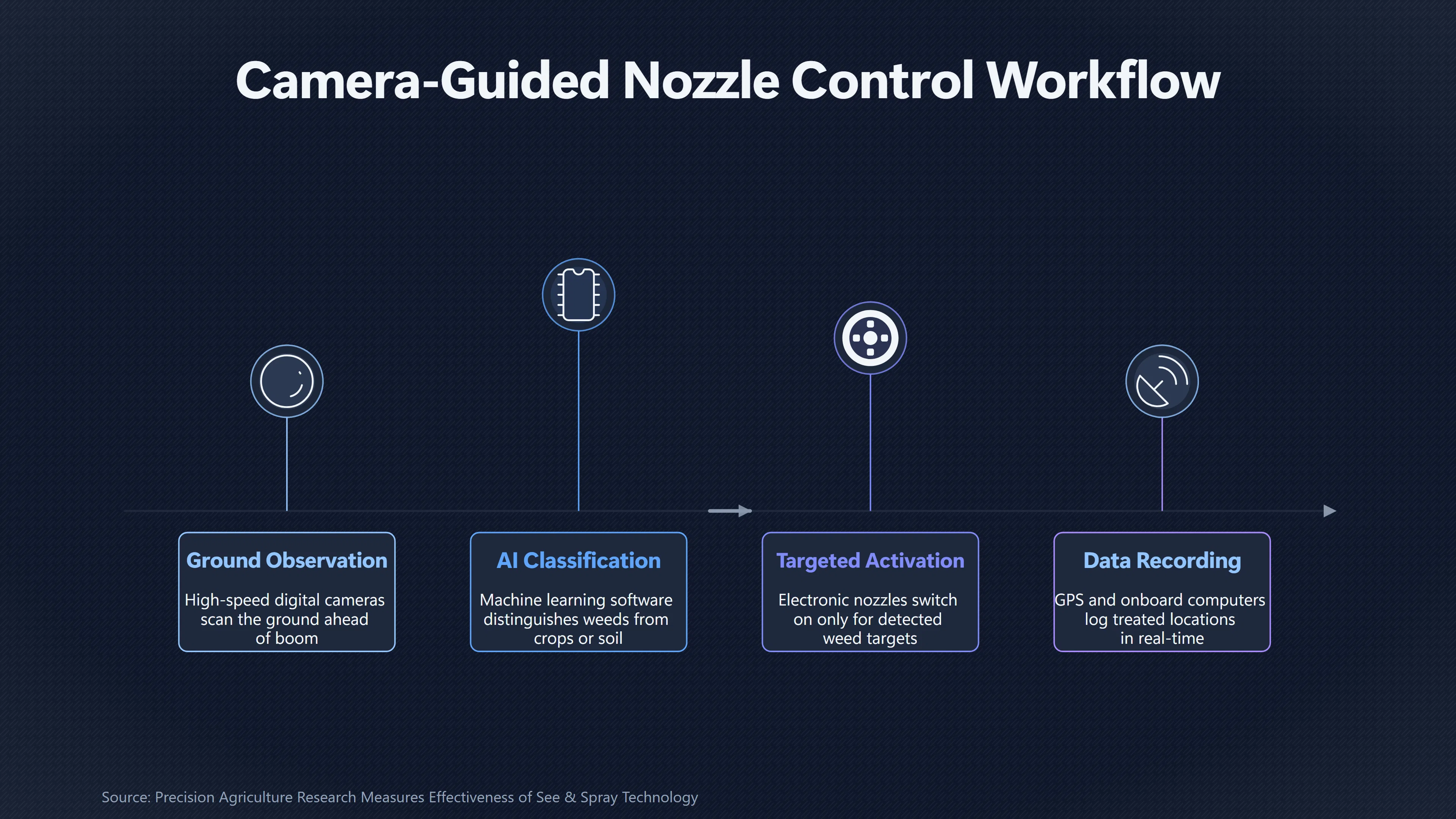
Traditional boom sprayers generally apply herbicide continuously across the entire width of a field. Precision systems instead combine several technologies:
- High-speed digital cameras or optical sensors observe the ground ahead of the spray boom.
- AI or machine learning software distinguishes weeds from crops or bare soil.
- Individual electronically controlled nozzles switch on only when a target weed is detected.
- GPS and onboard computers record treated locations and adjust spraying in real time.
Different systems operate in different environments. Some identify any green plant against bare soil (“green-on-brown”), making them particularly effective before crops emerge or in fallow fields. More advanced systems attempt “green-on-green” detection, distinguishing weeds from growing crops using increasingly sophisticated computer vision models. Recent research describes these systems as combining camera-based sensing with AI-driven classification to enable plant-by-plant herbicide application rather than blanket spraying.[PubMed Central (PMC)]pmc.ncbi.nlm.nih.govPubMed Central (PMC)Targeted herbicide spraying systems: role of nozzle type, number of nozzle activation, nozzle orientation, and boom h…
From the perspective of worker safety, the important point is not merely that spraying becomes more accurate. It is that fewer unnecessary nozzle activations generally mean less chemical passes through the machine, less refilling, fewer transport loads and potentially fewer hours spent performing pesticide application.
What today’s systems demonstrate
Several commercial and research systems now provide practical evidence that targeted spraying can substantially reduce herbicide use under suitable conditions.
John Deere’s See & Spray platform, developed from technology acquired through Blue River Technology, uses machine vision and deep learning to identify weeds while travelling across fields. Three years of field trials in Arkansas soybean production found that correctly configured targeted spraying reduced post-emergence herbicide use by roughly 43–59%, with potential cost savings depending on weed pressure and management practices. The same research also showed that poor configuration could increase surviving weeds, demonstrating that precision agriculture depends on correct setup rather than automation alone.[aaes.uada.edu]aaes.uada.eduPrecision Agriculture Research Measures Effectiveness of See & Spray TechnologyMarch 10, 2025…
Other targeted spraying technologies such as WEED-IT and similar optical systems have shown comparable reductions in herbicide use in perennial crops and specialised production systems, although results vary with weed density, crop type and local growing conditions. Trials in blueberries, for example, indicate that optically guided spraying can reduce unnecessary herbicide application while maintaining weed control in many situations.[Rutgers University]researchwithrutgers.orgRutgers UniversityAn Evaluation of Targeted Spraying for Reducing Herbicide Use in Highbush Blueberry - Rutgers, The State University of…
Research prototypes extend the same principle beyond large tractors. Robotic spot-spraying platforms using AI vision systems have demonstrated reductions in herbicide use of around one-third across commercial sugarcane trials while maintaining weed control close to conventional broadcast spraying. Lower-weed areas produced even larger savings because the robot sprayed only where weeds were actually present.[arXiv]arxiv.orgPrecise Robotic Weed Spot-Spraying for Reduced Herbicide Usage and Improved Environmental Outcomes – A Real-World Case StudyJanuary…
These results matter because occupational exposure generally scales with the amount of chemical being handled. If fewer litres need to be transported, mixed and sprayed, opportunities for accidental exposure also tend to decrease.
Does using less herbicide automatically mean safer work?
Not necessarily.
One important limitation in today’s evidence is that most studies directly measure herbicide savings, weed control and economic performance rather than operator exposure itself. The logical connection is strong—handling less pesticide should generally reduce exposure opportunities—but relatively few studies have directly monitored pesticide residues on workers, inhalation levels or biological exposure markers before and after adopting precision spraying.
A recent review of precision spraying technologies concluded that many studies report reductions of roughly 30% to 80% in pesticide use, particularly for herbicides. However, it also found comparatively limited direct evidence quantifying reductions in operator exposure, environmental contamination or spray drift under standardised conditions. More high-quality occupational health research is still needed.[Wageningen Research Portal]research.wur.nlWageningen Research PortalPrecision application and new spraying technologies: literature review - Research Portal - Wageningen Universi…
This distinction is important. Precision spraying should not be presented as eliminating chemical risk. It reduces one pathway to safer work while leaving others—especially chemical mixing and equipment cleaning—largely unchanged.
Why AI makes newer precision sprayers different
Earlier “smart sprayers” often relied on relatively simple optical detection, identifying green vegetation against brown soil. Modern AI systems add several capabilities:
- recognising different weed species;
- distinguishing weeds from crop plants;
- adapting to changing lighting conditions;
- making decisions rapidly while vehicles travel at field speeds; and
- improving detection through training on larger image datasets.
These advances expand precision spraying into situations where simple colour detection would not work reliably. They also help reduce false detections that either waste herbicide or miss weeds. At the same time, researchers continue to evaluate how camera placement, nozzle configuration, vehicle speed and lighting affect real-world performance, showing that engineering details remain critical alongside AI algorithms.[PubMed Central (PMC)]pmc.ncbi.nlm.nih.govPubMed Central (PMC)Targeted herbicide spraying systems: role of nozzle type, number of nozzle activation, nozzle orientation, and boom h…
The remaining barriers
Precision spraying is promising, but it is not a universal solution.
Adoption is influenced by several practical constraints:
- Economics. Advanced sprayers cost substantially more than conventional equipment, and savings depend heavily on weed density and herbicide prices.
- Crop suitability. Some crops and growth stages are much easier for AI systems to analyse than others.
- Detection errors. Missing weeds can reduce yields or encourage herbicide resistance if surviving weeds reproduce.
- Maintenance. Cameras, sensors and electronically controlled nozzles require calibration and upkeep.
- Worker training. Operators need new technical skills to configure detection sensitivity and interpret system performance.
Research on commercial use shows that the financial case varies considerably between regions, crops and spraying scenarios rather than being universally favourable.[Acess]acsess.onlinelibrary.wiley.comAcessTargeted herbicide cost requirements for adoption of See & Spray technology and ways to improve area sprayed - Avent - 2026 - Agrosy…

Why precision spraying matters for AI-enabled human flourishing
Precision sprayers are unlikely to transform agriculture on their own, but they illustrate an important pattern in the wider AI story.
The immediate benefit is modest yet tangible: workers spend less time applying chemicals, farms often use fewer herbicides, and spraying becomes more selective instead of more intensive. These improvements can lower occupational risks while also reducing input costs and, in many cases, decreasing unnecessary chemical release into the environment.
From the perspective of long-term human flourishing, this is valuable not because it creates a fully autonomous farm, but because it demonstrates how AI can shift people away from repetitive hazardous work and towards supervision, planning and decision-making. If similar advances spread across agriculture, mining, construction and other dangerous industries, they could gradually reduce the amount of routine work that exposes people to toxic substances, extreme temperatures and preventable occupational injury. Precision spraying is therefore best understood as an early, evidence-backed example of AI improving both productivity and workplace safety, while also revealing the practical limits, governance questions and implementation challenges that must be addressed before such benefits become widespread.
Amazon book picks
Further Reading
Books and field guides related to Can Precision Spraying Keep Workers Away From Chemicals?. Use these as the next step if you want deeper reading beyond the article.
Introduction to Autonomous Mobile Robots
The second edition of a comprehensive introduction to all aspects of mobile robotics, from algorithms to mechanisms. Mobile robots range...
Robotics: Modelling, Planning and Control
Based on the successful Modelling and Control of Robot Manipulators by Sciavicco and Siciliano (Springer, 2000), Robotics provides the ba...
The Omnivore's Dilemma
Tracing from source to table each of the food chains that sustain us--industrial or organic, alternative or processed--Pollan develops a...
eBay marketplace picks
Marketplace Samples
Live-tested eBay searches with available results related to this page.
Selected fromagriculture poster oneBay.co.uk.




Endnotes
1.
Source: aaes.uada.edu
Title: Precision Agriculture Research Measures Effectiveness of See & Spray Technology
Link:https://aaes.uada.edu/news/see-and-spray-research/
Source snippet
March 10, 2025...
Published: March 10, 2025
2.
Source: arxiv.org
Link:https://arxiv.org/abs/2401.13931
Source snippet
Precise Robotic Weed Spot-Spraying for Reduced Herbicide Usage and Improved Environmental Outcomes -- A Real-World Case StudyJanuary...
3.
Source: pmc.ncbi.nlm.nih.gov
Link:https://pmc.ncbi.nlm.nih.gov/articles/PMC13158438/
Source snippet
PubMed Central (PMC)Targeted herbicide spraying systems: role of nozzle type, number of nozzle activation, nozzle orientation, and boom h...
4.
Source: researchwithrutgers.org
Link:https://www.researchwithrutgers.org/en/publications/an-evaluation-of-targeted-spraying-for-reducing-herbicide-use-in-/
Source snippet
Rutgers UniversityAn Evaluation of Targeted Spraying for Reducing Herbicide Use in Highbush Blueberry - Rutgers, The State University of...
5.
Source: research.wur.nl
Link:https://research.wur.nl/en/publications/precision-application-and-new-spraying-technologies-literature-re/
Source snippet
Wageningen Research PortalPrecision application and new spraying technologies: literature review - Research Portal - Wageningen Universi...
6.
Source: acsess.onlinelibrary.wiley.com
Link:https://acsess.onlinelibrary.wiley.com/doi/10.1002/agg2.70324
Source snippet
AcessTargeted herbicide cost requirements for adoption of See & Spray technology and ways to improve area sprayed - Avent - 2026 - Agrosy...
7.
Source: scijournals.onlinelibrary.wiley.com
Link:https://scijournals.onlinelibrary.wiley.com/doi/abs/10.1002/ps.70629
Source snippet
herbicide spraying systems: role of nozzle type, number of nozzle activation, nozzle orientation, and boom height on spray coverage and w...
Additional References
8.
Source: cambridge.org
Link:https://www.cambridge.org/core/journals/weed-technology/article/comparing-herbicide-application-methods-with-see-spray-technology-in-soybean/05967C11D1BF0B174A13BE687B865AF2
Source snippet
Cambridge University PressComparing herbicide application methods with See & Spray™ technology in soybean | Weed Technology | Cambridge Core...
9.
Source: youtube.com
Title: Smart Spraying Live Demo – BASF and Bosch
Link:https://www.youtube.com/watch?v=l9t2aP-LyIU
Source snippet
This video is relevant because it demonstrates how intelligent smart-spraying technologies use camera-guided vision to target weeds and s...
10.
Source: youtube.com
Title: AI-enabled See & Spray™ technology now available on Hagie STS sprayers
Link:https://www.youtube.com/watch?v=K9ExajaeXtk
Source snippet
SKAi AI Spot Sprayer: Precision Weed Control & A New On-Farm Service...
11.
Source: youtube.com
Title: SKAi AI Spot Sprayer: Precision Weed Control & A New On-Farm Service
Link:https://www.youtube.com/watch?v=ugZUkqjSVtc
Source snippet
Smart Spraying Live Demo – BASF and Bosch...
12.
Source: sciencedirect.com
Link:https://www.sciencedirect.com/science/article/pii/S0013935115001747
13.
Source: soci.org
Link:https://www.soci.org/climate-change-solutions/sustainability/pesticide-dilemma
14.
Source: youtube.com
Title: John Deere & Spray Ultimate
Link:https://www.youtube.com/watch?v=uyy45qFuJ7k
Source snippet
AI-enabled See & Spray™ technology now available on Hagie STS sprayers...
15.
Source: sciencedirect.com
Title: [Development]({{ ‘build-rights/’ | relative_url }}) of a sensor-based precision herbicide application system
Link:https://www.sciencedirect.com/science/article/pii/S0168169902000972
Source snippet
ScienceDirect...
16.
Source: sciencedirect.com
Title: Development of a sensor-based precision herbicide application system
Link:https://www.sciencedirect.com/science/article/abs/pii/S0168169902000972
17.
Source: youtube.com
Title: Everything You Need to Know About John Deere’s See & Spray™ Ultimate
Link:https://www.youtube.com/watch?v=JF0n8pMkK3k
Source snippet
John Deere & Spray Ultimate...