Within AI Principles
Who Chooses the Values Inside AI Constitutions?
AI constitutions make guiding principles visible, but the people who write them still decide which values and trade-offs shape advanced systems.
On this page
- Why written principles do not remove value choices
- How institutional priorities enter AI rules
- Ways to make AI principles more legitimate
Page outline Jump by section
Introduction
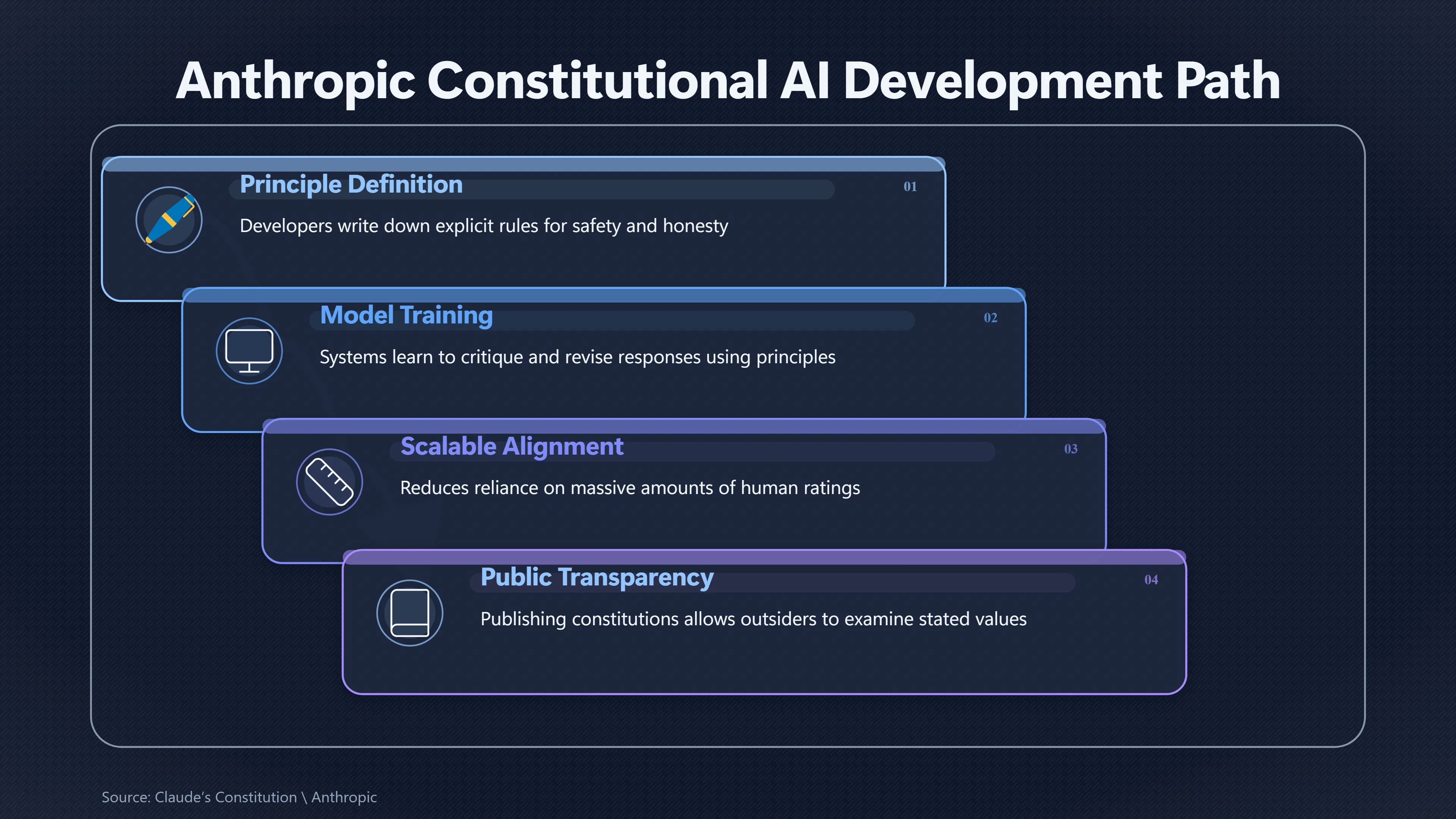
AI constitutions aim to make the principles guiding advanced AI systems more visible. Instead of leaving behaviour shaped only by hidden training data, human feedback, or internal company decisions, developers can write down rules about safety, honesty, helpfulness, autonomy, fairness, and human interests. The attraction is clear: if AI could one day influence science, healthcare, education, governance, and the wider conditions of human flourishing, society should understand what values are steering it.[anthropic.com]anthropic.comClaude’s Constitution \ AnthropicClaude’s Constitution \ Anthropic
Yet written principles do not eliminate value choices. They reveal them. Every constitution must still answer difficult questions: whose idea of harm matters most, how freedom should be balanced against protection, whether equality or efficiency should take priority, and who has the authority to decide. For an AI-enabled human bloom — a future where AI could expand scientific discovery, health, abundance, and human capability — these choices matter because the same powerful systems could either widen human opportunity or reinforce the priorities of a small group of institutions.[UNESCO]unesco.orgEthics of Artificial IntelligenceEthics of Artificial Intelligence - AI | UNESCO…
Why written principles do not remove value choices
Constitutional AI is built on a simple idea: instead of relying only on human ratings of AI outputs, a system can be guided by an explicit set of principles. Anthropic’s Constitutional AI research explored training models using written principles that allow an AI model to critique and revise responses according to those principles. The approach was designed partly to make alignment more scalable and less dependent on collecting enormous numbers of individual human judgements.[anthropic.com]anthropic.comSpecific versus General Principles for Constitutional AI \ AnthropicOctober 24, 2023…
The important change is not that AI becomes free from human values. It is that value decisions move to an earlier stage. Someone must decide what the constitution says.
A principle such as “protect human wellbeing” sounds broadly acceptable, but it immediately raises deeper questions:
- Does wellbeing mean protecting people from harm even when they lose some freedom?
- Should an AI favour the greatest total benefit, or give priority to protecting vulnerable minorities?
- Should preserving human choice always come before preventing foreseeable mistakes?
- Should future generations, ecosystems, or non-human life receive explicit consideration?
These are not engineering questions with a single correct answer. They are disagreements about what a good society should be.
This matters particularly for advanced AI because the scale of influence may be much larger than previous technologies. A recommendation system that chooses entertainment preferences and a future scientific or organisational AI that helps make decisions about medicine, resource allocation, or public policy involve very different stakes. A constitution becomes a kind of value framework for systems that may operate across many areas of life.[UNESCO]unesco.orgEthics of Artificial IntelligenceEthics of Artificial Intelligence - AI | UNESCO…
How institutional priorities enter AI rules
An AI constitution is shaped by the people and organisations that create it. Even when authors aim for universal principles, their choices reflect assumptions about what problems are most important and which trade-offs are acceptable.
Safety, freedom, and control can point in different directions
Many AI developers place strong emphasis on preventing serious harms. OpenAI’s Model Spec, for example, describes principles including minimising harm, preserving user freedom where safe, and following a hierarchy of instructions when values conflict.[Model Spec]model-spec.openai.comModel SpecModel Spec (2025/10/27)October 27, 2025…
These priorities address real risks. More capable AI systems could potentially be misused, manipulated, or deployed in ways that undermine human autonomy. However, emphasising safety can also create difficult questions about who decides when restrictions are justified.
A system designed to minimise risk might refuse more requests. A system designed to maximise user freedom might permit more experimentation. Both approaches reflect values.
The disagreement is not simply between “safe” and “unsafe” approaches. It is often about where to draw boundaries.
Cultural assumptions can become embedded
Values that appear universal may be interpreted differently across societies. Ideas such as fairness, dignity, privacy, authority, individual rights, and social responsibility have broad support, but their practical meaning varies.
International frameworks attempt to address this by widening participation. UNESCO’s Recommendation on the Ethics of Artificial Intelligence, adopted by its member states, emphasises human rights, diversity, inclusion, environmental sustainability, transparency, accountability, and human oversight. It also argues that AI governance should involve multiple stakeholders rather than only technical developers.[UNESCO]unesco.orgEthics of Artificial IntelligenceEthics of Artificial Intelligence - AI | UNESCO…
However, global agreement at the level of principles does not remove difficult implementation choices. Different communities may agree that fairness matters while disagreeing about what fairness requires in practice.
A future AI tutor, medical assistant, scientific researcher, or policymaking tool may need to navigate these disagreements directly. The constitution guiding it will influence which interpretations become embedded in everyday decisions.
The legitimacy problem: who gets to write the constitution?
The deepest challenge is not only choosing good principles, but establishing legitimate authority over those choices.
Today, many AI constitutions are created by private organisations developing AI systems. Anthropic’s public constitution for Claude makes its guiding principles visible, including goals such as safety, ethical behaviour, compliance with guidelines, and helpfulness. The publication of such documents improves transparency because outsiders can examine the stated values behind a system.[anthropic.com]anthropic.comClaude’s Constitution \ AnthropicClaude’s Constitution \ Anthropic
But transparency is not the same as democratic legitimacy.
A company can publish its principles while still making decisions that affect people who had no role in writing them. This creates a governance question: should the values embedded in widely used AI systems be determined mainly by developers, governments, experts, users, or broader public processes?
Researchers studying “Public Constitutional AI” have argued that legitimacy may require greater participation from affected communities, rather than treating AI values as purely a technical design decision. Such approaches suggest that AI constitutions could involve public deliberation and institutional oversight alongside expert input.[arXiv]arxiv.orgarXiv Public Constitutional AIarXiv Public Constitutional AI
There are practical difficulties. A global public process could become slow, politically contested, or vulnerable to manipulation. Expert-led systems may be faster and more technically informed but risk concentrating authority among a small group. The challenge is finding structures that combine competence with accountability.
Making AI principles more legitimate
A more trustworthy approach to AI constitutions would likely require several layers of accountability rather than a single document.
Public visibility: Principles should be published clearly enough that people can understand what an AI system is designed to prioritise. Hidden objectives make meaningful oversight impossible.
Multiple perspectives: Developers, researchers, policymakers, civil society groups, and affected communities can identify different risks and blind spots. A medical AI constitution, for example, should not be shaped only by engineers; patients, clinicians, and ethicists have relevant knowledge about human consequences.
Clear handling of conflicts: Real constitutions need more than lists of good intentions. They need guidance for situations where values collide. Protecting privacy may conflict with medical research. Maximising access may conflict with preventing misuse. Encouraging innovation may conflict with caution.
Ability to revise: Values and circumstances change. A constitution written for early AI assistants may not be sufficient for highly autonomous systems used in science, industry, or governance. Adaptive review processes may be necessary as capabilities and social expectations evolve. UNESCO’s framework similarly emphasises adaptive governance rather than a fixed one-time solution.[UNESCO]unesco.orgEthics of Artificial IntelligenceEthics of Artificial Intelligence - AI | UNESCO…
Why this matters for an AI-enabled human bloom
The optimistic case for advanced AI is not only that machines become more capable. It is that those capabilities could help humanity overcome major constraints: accelerate science, improve medicine, expand education, reduce scarcity, and create new possibilities for human creativity and exploration.
But capability alone does not determine outcomes. The values built into advanced systems influence whether abundance becomes broadly shared or concentrated, whether automation expands human freedom or reduces human agency, and whether powerful intelligence serves diverse human futures or a narrow vision of progress.
AI constitutions are therefore not just technical documents. They are early attempts to answer a much larger question: what kind of civilisation should increasingly powerful intelligence help create?
A flourishing long-term future may require AI systems that are not only capable, but also governed by principles that people can examine, challenge, and legitimately shape. The central issue is not simply finding the perfect set of values. It is building processes that allow humanity to make those choices openly and responsibly.
Amazon book picks
Further Reading
Books and field guides related to Who Chooses the Values Inside AI Constitutions?. Use these as the next step if you want deeper reading beyond the article.
The Alignment Problem
Finalist for the Los Angeles Times Book Prize A jaw-dropping exploration of everything that goes wrong when we build AI systems and the m...
Human Compatible
A leading artificial intelligence researcher lays out a new approach to AI that will enable us to coexist successfully with increasingly...
Superintelligence
This profoundly ambitious and original book picks its way carefully through a vast tract of forbiddingly difficult intellectual terrain.
Life 3.0
'This is the most important conversation of our time, and Tegmark's thought-provoking book will help you join it' Stephen Hawking THE INT...
eBay marketplace picks
Marketplace Samples
Live-tested eBay searches with available results related to this page.
Selected fromai technology poster oneBay.co.uk.



Endnotes
1.
Source: anthropic.com
Title: Claude’s Constitution \ Anthropic
Link:https://www.anthropic.com/constitution
2.
Source: OpenAI
Title: Open AIIntroducing the Model Spec | Open AI
Link:https://openai.com/index/introducing-the-model-spec/
Source snippet
Introducing the Model Spec | OpenAI...
3.
Source: unesco.org
Title: Ethics of Artificial Intelligence
Link:https://www.unesco.org/en/artificial-intelligence/recommendation-ethics?hub=70235
Source snippet
Ethics of Artificial Intelligence - AI | UNESCO...
4.
Source: arxiv.org
Title: arXiv Public Constitutional AI
Link:https://arxiv.org/abs/2406.16696
5.
Source: anthropic.com
Title: Specific versus General Principles for Constitutional AI \ Anthropic
Link:https://www.anthropic.com/news/specific-versus-general-principles-for-constitutional-ai
Source snippet
October 24, 2023...
Published: October 24, 2023
6.
Source: model-spec.openai.com
Link:https://model-spec.openai.com/2025
Source snippet
Model SpecModel Spec (2025/10/27)October 27, 2025...
Published: October 27, 2025
7.
Source: unesco.org
Title: Ethics of Artificial Intelligence
Link:https://www.unesco.org/en/artificial-intelligence/recommendation-ethics?hub=66909
Source snippet
Ethics of Artificial Intelligence - AI | UNESCO...
8.
Source: anthropic.com
Title: Claude’s new constitution \ Anthropic
Link:https://www.anthropic.com/news/claude-new-constitution?_bhlid=c595d10ba7838789de6243d0af84e54335efee11
9.
Source: model-spec.openai.com
Link:https://model-spec.openai.com/2025-10-27.html
10.
Source: model-spec.openai.com
Link:https://model-spec.openai.com/2025-09-12.html
11.
Source: model-spec.openai.com
Link:https://model-spec.openai.com/2025-04-11.html
12.
Source: OpenAI
Title: sharing the latest model spec
Link:https://openai.com/index/sharing-the-latest-model-spec/
13.
Source: model-spec.openai.com
Link:https://model-spec.openai.com/2025-02-12.html?trk=public_post_comment-text
14.
Source: OpenAI
Title: sharing the latest model spec
Link:https://openai.com/jv-ID/index/sharing-the-latest-model-spec/
15.
Source: anthropic.com
Link:https://www.anthropic.com/research/collective-constitutional-ai-aligning-a-language-model-with-public-input
16.
Source: anthropic.com
Title: Claude’s Constitution
Link:https://www.anthropic.com/news/claudes-constitution?stream=top
17.
Source: unesdoc.unesco.org
Title: document Viewer.xhtml
Link:https://unesdoc.unesco.org/in/documentViewer.xhtml?ark=%2Fark%3A%2F48223%2Fpf0000381137%2FPDF%2F381137eng.pdf.multi&file=%2Fin%2Frest%2FannotationSVC%2FDownloadWatermarkedAttachment%2Fattach_import_75c9fb6b-92a6-4982-b772-79f540c9fc39%3F_%3D381137eng.pdf&fullScreen=true&id=p%3A%3Ausmarcdef_0000381137&locale=en&updateUrl=updateUrl6452&v=2.1.196
18.
Source: unesdoc.unesco.org
Title: document Viewer.xhtml
Link:https://unesdoc.unesco.org/in/documentViewer.xhtml?ark=%2Fark%3A%2F48223%2Fpf0000377897%2FPDF%2F377897eng.pdf&file=%2Fin%2Frest%2FannotationSVC%2FDownloadWatermarkedAttachment%2Fattach_import_4bc33956-d665-48ad-92af-57ae532c98ef%3F_%3D377897eng.pdf&id=p%3A%3Ausmarcdef_0000377897&locale=es&multi=true&v=2.1.196
19.
Source: help.openai.com
Title: 9624314 model release notes
Link:https://help.openai.com/en/articles/9624314-model-release-notes/
20.
Source: unesco.org
Title: Ethics of Artificial Intelligence
Link:https://www.unesco.org/en/artificial-intelligence/recommendation-ethics?hub=953
21.
Source: unesco.org
Title: Ethics of Artificial Intelligence
Link:https://www.unesco.org/en/artificial-intelligence/recommendation-ethics?hub=158596
22.
Source: unesco.org
Title: Ethics of Artificial Intelligence
Link:https://www.unesco.org/en/artificial-intelligence/recommendation-ethics?hub=66778
23.
Source: unesco.de
Title: Artificial Intelligence
Link:https://www.unesco.de/en/artificial-intelligence/
24.
Source: oecd.ai
Title: Recommendation on the Ethics of Artificial Intelligence
Link:https://oecd.ai/en/dashboards/policy-initiatives/recommendation-on-the-ethics-of-artificial-intelligence
25.
Source: github.com
Title: model_spec/model_spec.md at main · openai/model_spec · Git Hub
Link:https://github.com/openai/model_spec/blob/main/model_spec.md
26.
Source: gcedclearinghouse.org
Link:https://gcedclearinghouse.org/en/node/129375?level=7
Additional References
27.
Source: philarchive.org
Title: These documents define the values that the labs intend their AIs to h
Link:https://philarchive.org/rec/GOLATA-3
Source snippet
Simon Goldstein & Peter Salib, A Thousand AI Constitutions - PhilArchiveJuly 20, 2026 — A THOUSAND AI CONSTITUTIONS Simon Goldstein & Pet...
Published: July 20, 2026
28.
Source: youtube.com
Title: Constitutional AI: Teaching Machines a Moral Compass for Safety
Link:https://www.youtube.com/watch?v=8Wzs3HxJQ0c
Source snippet
Constitutional AI Explained: How Models Learn Ethics #AI #GenAI #MachineLearning #LLM #AIAlignment #ResponsibleAI #Anthropic #RLHF...
29.
Source: youtube.com
Link:https://www.youtube.com/watch?v=C1V0RyDgEII
Source snippet
Constitutional AI: How AI Learns Ethics, Rules, and Human Values | Uplatz...
30.
Source: youtube.com
Title: Constitutional AI: How AI Learns Ethics, Rules, and Human Values | Uplatz
Link:https://www.youtube.com/watch?v=gKzRCpZTwt8
Source snippet
Atoosa Kasirzadeh – Value Pluralism & AI Value Alignment [Alignment Workshop]...
31.
Source: papers.ssrn.com
Link:https://papers.ssrn.com/sol3/papers.cfm?abstract_id=6954798
Source snippet
AI Constitutionalism and the Paradox of Constituent Power by Nicholas Caputo:: SSRNJuly 2, 2026 — Download This Paper Open PDF in Browse...
Published: July 2, 2026
32.
Source: techcrunch.com
Link:https://techcrunch.com/2026/01/21/anthropic-revises-claudes-constitution-and-hints-at-chatbot-consciousness/
33.
Source: andrewmaynard.net
Link:https://andrewmaynard.net/constituting-responsibility-what-constitutional-ai-reveals-about-the-[limits
34.
Source: philpapers.org
Link:https://philpapers.org/rec/HUAFAT-2
35.
Source: unsceb.org
Link:https://unsceb.org/principles-ethical-use-artificial-intelligence-united-nations-system
36.
Source: cambridge.org
Link:https://www.cambridge.org/core/journals/data-and-policy/article/reversing-the-logic-of-generative-ai-alignment-a-pragmatic-approach-for-public-interest/8801BCA3832E848593E8D7F926C242CF