Within Distribution
How Should People Live When Jobs Pay Less?
Cash payments, public services, social insurance and shorter hours offer different ways to protect independence when paid work becomes less reliable.
On this page
- What social insurance can and cannot protect
- Universal income compared with universal services
- How shorter working hours could share productivity gains
Page outline Jump by section
Introduction
If AI and automation make stable jobs less common, the central question is not only how much wealth an economy creates, but how people maintain independence, security and social membership when wages become less reliable. An AI-enabled human bloom would require institutions that spread the gains of higher productivity rather than leaving households dependent on unstable employment or a small group of technology owners. The main options are not mutually exclusive: stronger social insurance can protect people through disruption, universal basic income can provide a simple cash floor, universal basic services can reduce the cost of living, and shorter working hours can share productivity gains more broadly. Each solves a different part of the problem, and each has limits.[International Labour Organization]ilo.orgOpen source on ilo.org.

The optimistic case for advanced AI is that abundant intelligence, automation and scientific progress could eventually make many goods and services far cheaper while freeing people from dangerous or repetitive work. But abundance does not automatically create security. The transition period matters: if employment becomes less stable before new systems of distribution are built, many people could experience greater insecurity even in a richer society.
What social insurance can and cannot protect
Traditional welfare systems were built around a world where most adults moved through a relatively predictable pattern: education, employment, retirement. Workers paid into systems through jobs, and those systems provided support during unemployment, illness, disability or old age. A more automated economy could weaken this link if people move more often between employment, self-employment, short contracts, caring roles and periods of training.
Modern social insurance therefore faces a design challenge: protecting people based on their lives rather than their employment category. The International Labour Organization argues that changing labour markets require broader protection that reaches temporary workers, self-employed workers and people in non-standard forms of employment, while maintaining sustainable financing.[International Labour Organization]ilo.orgOpen source on ilo.org.
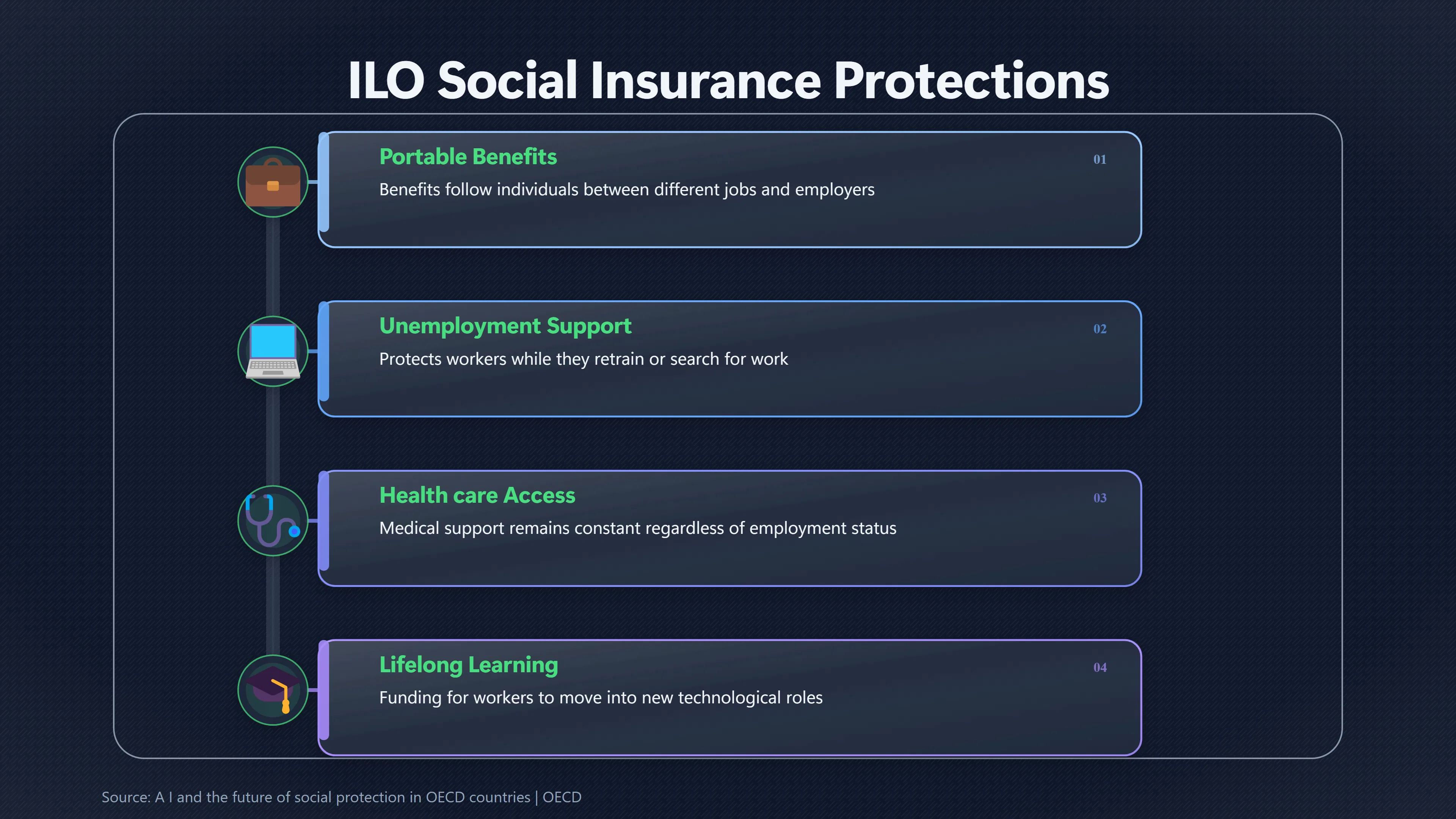
A stronger social insurance system could include:
- Portable benefits that follow individuals between jobs rather than remaining tied to one employer.
- Better unemployment protection that supports people while they retrain or search for new work.
- Healthcare, disability and family support that do not disappear when someone loses a job.
- Lifelong learning support so workers can move into new roles created by technological change.
These measures are especially important because AI may not remove all work at once. A more likely near-term pattern is uneven disruption: some occupations may be transformed quickly while others remain human-centred. Social insurance can help people navigate those transitions without turning every career change into a financial crisis.
However, insurance alone may not be enough in a highly automated economy. Traditional systems generally assume that employment remains the main route through which people obtain income. If a large share of national production increasingly comes from AI systems, robots and other forms of capital, societies may need additional ways to distribute economic gains. The OECD has highlighted that AI creates new questions for social protection systems, including how governments can maintain effective support as technology changes the nature of work.[oecd.org]oecd.orgA I and the future of social protection in OECD countries | OECDA I and the future of social protection in OECD countries | OECD
Universal income compared with universal services
Universal basic income (UBI) and universal basic services (UBS) address the income-security problem from different directions.
A universal basic income provides regular cash payments to everyone, usually without conditions. Its attraction is simplicity: people receive a reliable foundation that is not dependent on employment status, bureaucracy or proving hardship. In an economy where jobs become less predictable, this could preserve personal choice by allowing people to care for family members, study, start businesses, create art or participate in community life without immediate financial pressure.
Evidence from existing experiments suggests that cash support can improve security and wellbeing, although the results do not prove how a permanent nationwide UBI would work in every economy. Finland’s basic income experiment, which provided payments to unemployed participants, found limited employment effects but improvements in recipients’ reported wellbeing, confidence and perceptions of economic security.[wired.com]wired.comThe study aimed to evaluate the effects of UBI on employment and wellbeing. Results showed minimal impact on employment rates, but signif…
The main questions around UBI are scale and funding. A modest payment may reduce hardship but not provide genuine economic independence. A generous payment requires significant public revenue, which raises questions about taxation, ownership of productive assets and whether AI-generated wealth is sufficiently shared. In an AI economy, supporters argue that part of the returns from highly productive automated systems could become a social dividend; critics argue that governments may struggle to capture enough value without affecting innovation or economic efficiency.[arXiv]arxiv.orgAn AI Capability Threshold for Rent-Funded Universal Basic Income in an AI-Automated EconomyMay 24, 2025…
Universal basic services take a different approach. Instead of giving people more money to buy essentials, they reduce the amount of money people need by guaranteeing access to important goods and services such as healthcare, education, housing support, transport or childcare.
The strength of services is that they protect living standards even when income is uncertain. A person with unstable earnings may still have security if essential needs are covered. They can also support human flourishing by making education, healthcare and participation in society less dependent on personal wealth.
The weakness is that services cannot replace all forms of income. People still need freedom to choose how they live, purchase goods outside public provision and pursue personal ambitions. A future with abundant AI-enabled production may therefore require a combination: public services that secure basic needs, cash transfers that preserve choice, and opportunities for meaningful participation.
Shorter working hours could share productivity gains
Another response to declining reliance on traditional jobs is to distribute productivity gains through time rather than only through income. If AI allows societies to produce more with fewer human hours, one possible outcome is not permanent unemployment but a shorter working week.
Historically, technological progress has often increased output without reducing working time as much as many expected. A shorter working week would deliberately convert some productivity gains into more leisure, family time, education and community activity.
Recent trials suggest that reducing working hours can work in some settings. A large UK four-day working week pilot involving 61 organisations found improvements in employee wellbeing, while many participating organisations continued the model after the trial.[UK Research and Innovation]ukri.orgmaking the case for a four day working weekUK Research and InnovationMaking the case for a four-day working week – UKRIOctober 31, 2024… A 2025 study published in Nature Human Behaviour examining four-day week interventions across multiple countries found improvements in burnout, job satisfaction and health measures among participating workers.[nature.com]nature.comOpen source on nature.com.
Shorter hours are not a universal solution. Some industries require continuous staffing, and poorly designed reductions can increase pressure by forcing the same workload into fewer days. The strongest evidence comes from workplaces able to reorganise processes, remove unnecessary tasks and focus on outcomes rather than hours worked.[CIPD]cipd.orgfour day weekfour day week
In an AI bloom scenario, shorter working hours could become more than a workplace reform. They could represent a broader shift in what economic progress means: not only producing more goods and services, but expanding human time for relationships, creativity, learning, health and civic life.
The choice is not one policy but a new social contract
Income security in an AI economy is unlikely to come from a single replacement for the traditional job. Different systems solve different risks.
Social insurance protects people from shocks and transitions. Universal services protect access to essentials. Basic income protects individual choice. Shorter working hours distribute the benefits of productivity through time.
The deeper question is who receives the gains from AI-driven abundance. If advanced AI increases national wealth but ownership remains concentrated, governments may face pressure to expand redistribution after inequality has already widened. If institutions adapt early, automation could support a different future: one where people are less dependent on having a particular job to access security, dignity and opportunity.
The long-term AI bloom vision depends on this transition being managed well. A society with powerful AI but weak distribution systems could become richer without becoming more free. A society that combines technological abundance with broad economic security could use AI not simply to increase output, but to enlarge the range of lives people are able to choose.

Amazon book picks
Further Reading
Books and field guides related to How Should People Live When Jobs Pay Less?. Use these as the next step if you want deeper reading beyond the article.
A World Without Work
NOMINATED FOR THE FT & McKINSEY BUSINESS BOOK OF THE YEAR AWARDS 2020 'A path-breaking, thought-provoking and in-depth study of how new t...
Basic Income
Would it be possible to provide people with a basic income as a right? The idea has a long history. This book draws on two pilot schemes...
Bullshit Jobs
From bestselling writer David Graeber, a powerful argument against the rise of meaningless, unfulfilling jobs, and their consequences. Do...
eBay marketplace picks
Marketplace Samples
Live-tested eBay searches with available results related to this page.
Selected fromfuture technology poster oneBay.co.uk.

Current eBay listing
Future technology Framed Wall Art Poster Canvas Print Picture



Current eBay listing
The Future of Technology Framed Wall Art Poster Canvas Print Picture
Endnotes
1.
Source: oecd.org
Title: A I and the future of social protection in OECD countries | OECD
Link:https://www.oecd.org/en/publications/ai-and-the-future-of-social-protection-in-oecd-countries_7b245f7e-en.html
2.
Source: wired.com
Link:https://www.wired.com/story/universal-basic-income-policy-universal-credit
Source snippet
The study aimed to evaluate the effects of UBI on employment and wellbeing. Results showed minimal impact on employment rates, but signif...
3.
Source: arxiv.org
Link:https://arxiv.org/abs/2505.18687
Source snippet
An AI Capability Threshold for Rent-Funded Universal Basic Income in an AI-Automated EconomyMay 24, 2025...
Published: May 24, 2025
4.
Source: nature.com
Link:https://www.nature.com/articles/s41562-025-02259-6
5.
Source: cipd.org
Title: four day week
Link:https://www.cipd.org/en/knowledge/reports/four-day-week/
6.
Source: social-protection.org
Link:https://www.social-protection.org/gimi/gess/ShowRessource.action%3Bjsessionid%3DhLCNycBV0m2S45dq9gp_2p-GEQJ-5zCZRZBRP7g-K5vqyuydL5YA%21-955302553?id=59535
7.
Source: social-protection.org
Link:https://www.social-protection.org/gimi/gess/ShowRessource.action?id=59535
8.
Source: oecd.ai
Title: A I and the future of social protection in OECD countries
Link:https://oecd.ai/en/ai-publications/ai-and-the-future-of-social-protection-in-oecd-countries
9.
Source: oecd.org
Title: megatrends and the future of social protection 6c9202e8 en
Link:https://www.oecd.org/en/publications/megatrends-and-the-future-of-social-protection_6c9202e8-en.html
10.
Source: oecd.org
Title: full report
Link:https://www.oecd.org/en/publications/megatrends-and-the-future-of-social-protection_6c9202e8-en/full-report.html
11.
Source: oecd.org
Title: modernising access to social protection af31746d en
Link:https://www.oecd.org/en/publications/modernising-access-to-social-protection_af31746d-en.html
12.
Source: oecd.org
Link:https://www.oecd.org/en/publications/modernising-access-to-social-protection_af31746d-en/full-report/component-8.html
13.
Source: oecd.org
Title: component 4
Link:https://www.oecd.org/en/publications/modernising-access-to-social-protection_af31746d-en/full-report/component-4.html
14.
Source: oecd.org
Link:https://www.oecd.org/en/publications/modernising-access-to-social-protection_af31746d-en/full-report/component-7.html
15.
Source: toolbox.finland.fi
Title: finlands basic income experiment 2017 2018
Link:https://toolbox.finland.fi/life-society/finlands-basic-income-experiment-2017-2018/
16.
Source: oecd.org
Link:https://www.oecd.org/en/topics/future-of-social-protection.html
17.
Source: oecd.org
Link:https://www.oecd.org/en/about/projects/ai-and-the-future-of-social-protection.html
18.
Source: ilo.org
Link:https://www.ilo.org/publications/universal-social-protection-changing-labour-markets-protecting-workers-all
19.
Source: ilo.org
Link:https://www.ilo.org/publications/promoting-adequate-social-protection-and-social-security-coverage-all
Source snippet
International Labour OrganizationPromoting adequate social protection and social security coverage for all workers, including those in no...
20.
Source: ukri.org
Title: making the case for a four day working week
Link:https://www.ukri.org/who-we-are/how-we-are-doing/research-outcomes-and-impact/esrc/making-the-case-for-a-four-day-working-week/
Source snippet
UK Research and InnovationMaking the case for a four-day working week – UKRIOctober 31, 2024...
Published: October 31, 2024
21.
Source: live.ilo.org
Link:https://live.ilo.org/event/rethinking-fight-against-poverty-and-inequalities-future-work-and-social-protection
22.
Source: ilo.org
Link:https://www.ilo.org/resource/news/ilo-calls-stronger-social-protection-changing-world-work
23.
Source: ilo.org
Title: employment and social trends 2026
Link:https://www.ilo.org/publications/flagship-reports/employment-and-social-trends-2026
24.
Source: oecd-ilibrary.org
Title: ai and the future of social protection in oecd countries 7b245f7e en
Link:https://www.oecd-ilibrary.org/en/publications/ai-and-the-future-of-social-protection-in-oecd-countries_7b245f7e-en.html
25.
Source: ilo.org
Link:https://www.ilo.org/resource/article/digital-transformation-pivotal-achieving-goal-universal-social-protection
26.
Source: ilo.org
Link:https://www.ilo.org/publications/social-security-and-digitalization-inclusive-future-work
27.
Source: ilo.org
Title: Social protection | International Labour Organization
Link:https://www.ilo.org/topics-and-sectors/social-protection
28.
Source: ilo.org
Link:https://www.ilo.org/topics-and-sectors/labour-migration/social-protection-migrant-workers-refugees-and-their-families
29.
Source: tietotarjotin.fi
Title: Basic income experiment | Kela’s Info Tray
Link:https://tietotarjotin.fi/en/information-package/158070/basic-income-experiment
30.
Source: researchrepository.ilo.org
Title: Social protection systems and the future
Link:https://researchrepository.ilo.org/esploro/outputs/journalArticle/Social-protection-systems-and-the-future/995268387402676
31.
Source: ilo.org
Link:https://www.ilo.org/publications/innovative-approaches-ensuring-universal-social-protection-future-work
32.
Source: researchrepository.ilo.org
Title: Universal social protection in changing labour
Link:https://researchrepository.ilo.org/esploro/outputs/report/Universal-social-protection-in-changing-labour/995699172902676
33.
Source: webapps.ilo.org
Link:https://webapps.ilo.org/static/english/reports/flagship/world_social_protection_report_2024-26/Executive%20Summary.html
34.
Source: givedirectly.org
Link:https://www.givedirectly.org/ubi
Additional References
35.
Source: apnews.com
Link:https://apnews.com/article/d114ef8be69e1665fd22c39515bdaecf
Source snippet
The trial indicated that most companies would continue with the shorter workweek due to benefits such as improved employee well-being and...
36.
Source: theguardian.com
Link:https://www.theguardian.com/business/2025/dec/15/universal-basic-income-ai-andrew-yang
Source snippet
Although popularized by Andrew Yang during his 2020 presidential campaign, UBI is portrayed as inadequate to meet either current economic...
37.
Source: reddit.com
Link:https://www.reddit.com/r/econmonitor/comments/iffz4h
Source snippet
Results of Finland's basic income experiment: small employment effects, better perceived economic security and mental wellbeing...
38.
Source: youtube.com
Title: Universal Basic Income (UBI) Simply Explained
Link:https://www.youtube.com/watch?v=PJWoldMY1p4
Source snippet
These videos are relevant because they explore how advanced automation and artificial intelligence impact job stability, economic securit...
39.
Source: youtube.com
Title: AI, UBI, and the Collapse of the Two-Party System — Andrew Yang Breaks It Down
Link:https://www.youtube.com/watch?v=dKX7qDig24g
Source snippet
The Work of the Future: Building Better Jobs in an Age of Intelligent Machines...
40.
Source: youtube.com
Title: The Work of the Future: Building Better Jobs in an Age of Intelligent Machines
Link:https://www.youtube.com/watch?v=pk_Ws6RuTfo
Source snippet
If AI erases 85 million jobs... then what?...
41.
Source: 4dayweek.com
Link:https://www.4dayweek.com/research
42.
Source: givedirectly.org
Link:https://www.givedirectly.org/kenya
43.
Source: cambridge.org
Link:https://www.cambridge.org/core/journals/political-science-research-and-methods/article/does-a-universal-basic-income-affect-voter-turnout-evidence-from-alaska/11D46D5315AEB1C6D01D88D4DB1A8647
44.
Source: nber.org
Link:https://www.nber.org/papers/w26712