Within Discovery
Will Automated Science Be Open to Everyone?
Automated discovery could widen scientific capacity, but costly instruments and proprietary platforms may concentrate it in a few powerful institutions.
On this page
- Why autonomous laboratories are expensive to build
- How shared facilities and open standards could broaden access
- Who owns the data, tools and resulting discoveries
Page outline Jump by section
Introduction
Self-driving laboratories promise to make scientific discovery much faster by combining AI, robotics and automated instruments into systems that can design, perform and analyse experiments with limited human intervention. Yet an equally important question is who will actually be able to use them. If only a handful of wealthy universities, technology companies and governments can afford these platforms, the benefits of AI-accelerated science may become concentrated rather than widely shared. If, however, autonomous laboratories become interoperable, shareable and accessible across institutions and countries, they could expand global scientific capacity rather than merely increasing the productivity of existing leaders. Access is therefore not a side issue. It is one of the main governance questions determining whether AI-driven scientific acceleration contributes to broad human flourishing or reinforces existing inequalities.[NIST]nist.govAutonomous laboratories | NISTAutonomous laboratories | NIST…

Why autonomous laboratories are expensive to build
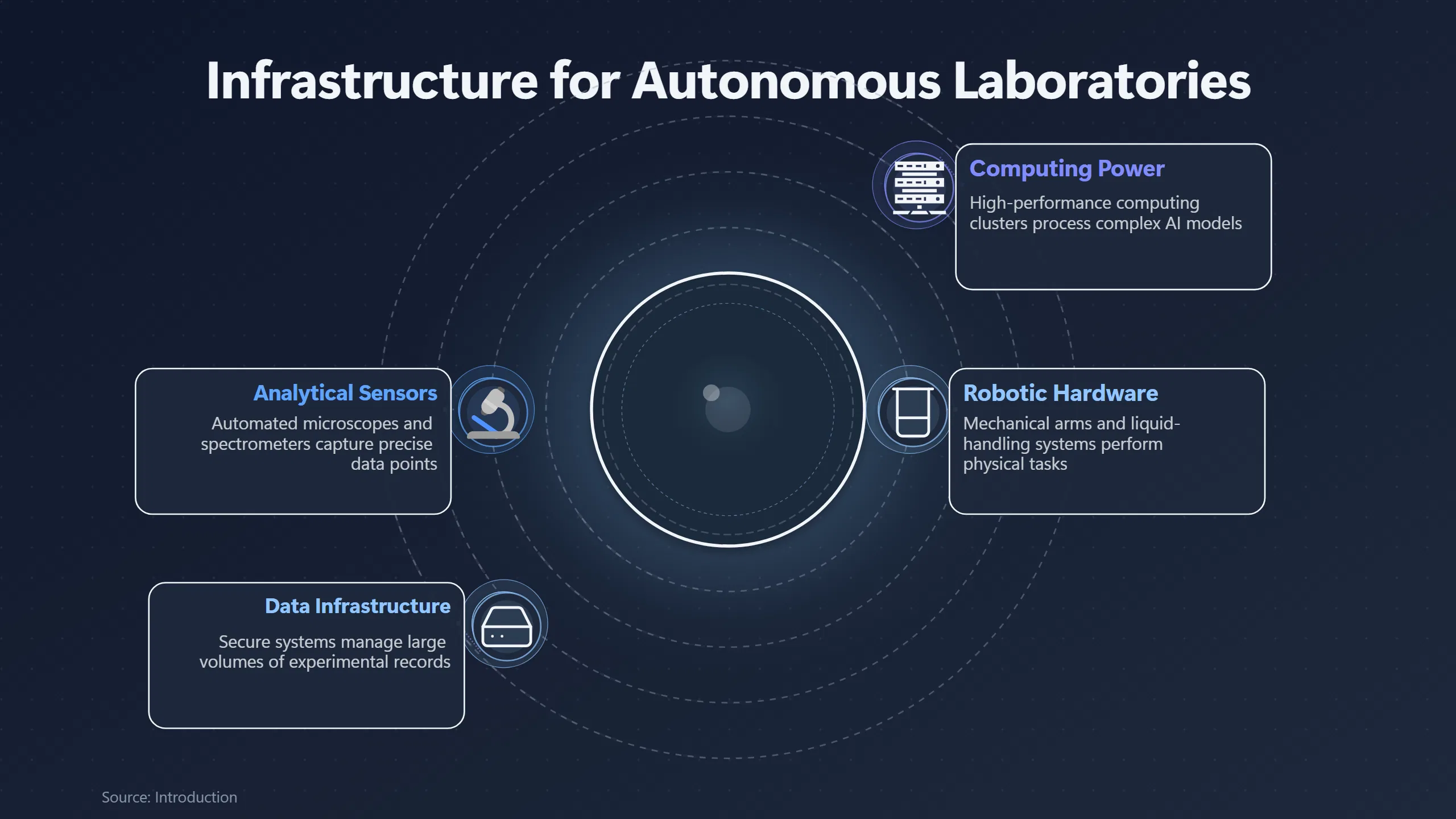
Unlike software-based AI tools, self-driving laboratories depend on expensive physical infrastructure. A modern autonomous laboratory typically combines robotic arms, liquid-handling systems, automated microscopes or spectrometers, sensors, high-performance computing, specialised software, secure data infrastructure and AI models capable of deciding which experiment should be run next.
Many of these instruments already cost hundreds of thousands or even millions of pounds before automation is added. Integrating them into a reliable closed-loop system requires engineers, software developers, laboratory scientists and maintenance specialists. Even after installation, calibration, upgrades and repairs remain significant ongoing costs.[NIST]nist.govAutonomous laboratories | NISTAutonomous laboratories | NIST…
This means that today’s leading autonomous laboratories are concentrated in:[nist.gov]nist.govAutonomous laboratories | NISTAutonomous laboratories | NIST…
- major research universities;
- national laboratories;
- well-funded industrial research centres;
- government-backed innovation programmes.
These organisations already possess the capital, technical expertise and computing infrastructure needed to operate sophisticated robotic research facilities. Smaller universities, teaching institutions and laboratories in lower-income countries often do not.
The result could resemble earlier waves of scientific infrastructure. Just as particle accelerators, synchrotrons and advanced genome sequencing facilities became concentrated in relatively few locations, autonomous laboratories may initially emerge as scarce scientific assets rather than everyday laboratory equipment.[axios.com]axios.comSelf-driving labs are the new AI assetThese labs autonomously conduct experiments in a closed-loop system, learning from outcomes to refine future experimentation. The goal is…
Concentration is not inevitable
The high cost of the first generation of self-driving laboratories does not necessarily mean access must remain limited.
Many scientific technologies have followed a familiar pattern. Early computers, DNA sequencing machines and supercomputers were available only to elite institutions before becoming cheaper, more modular and easier to share.
Researchers developing autonomous laboratories increasingly argue that software interoperability may matter almost as much as cheaper hardware. Instead of every university building an entire autonomous laboratory from scratch, researchers could connect existing instruments through common standards and remotely coordinate experiments across institutions. Community roadmaps increasingly describe networks of interconnected laboratories rather than isolated flagship facilities.[arXiv]arxiv.orgA Grassroots Network and Community Roadmap for Interconnected Autonomous Science Laboratories for Accelerated DiscoveryJune 21, 2025…
Whether this transition happens depends less on AI itself than on decisions about infrastructure, funding and governance.
How shared facilities could broaden access
Scientific research already offers models for widening access to expensive equipment.
Many countries operate national facilities where researchers apply for instrument time rather than owning major equipment themselves. Astronomers share telescopes, physicists share synchrotrons and biologists increasingly use shared sequencing centres.
[Autonomous laboratories]nist.govAutonomous laboratories | NISTAutonomous laboratories | NIST… could develop similar access models.
Possible approaches include:
- National autonomous laboratory centres, where universities compete for experimental time.
- Regional facilities, allowing smaller institutions to access robotics without building complete laboratories.
- Cloud-operated laboratories, where researchers upload experimental designs while robots execute them remotely.
- University consortia, jointly funding equipment that no single institution could afford alone.
- Public-private partnerships, where industrial infrastructure supports academic research under agreed access rules.
Some existing research programmes already envision networks of laboratories connected through shared software and coordinated workflows rather than isolated robotic systems. The goal is to let researchers access capabilities distributed across multiple institutions while maintaining reproducible records of every experiment.[Oak Ridge National Laboratory]ornl.govOak Ridge National Laboratory Autonomous Science | ORNLOak Ridge National Laboratory Autonomous Science | ORNL
Such models would not eliminate inequality, but they could substantially reduce the gap between laboratories that own advanced robotics and those that merely collaborate with them.
Open standards may matter more than any single laboratory
One of the biggest technical barriers to broader access is incompatibility.
Many laboratory instruments use proprietary software, unique communication protocols and vendor-specific data formats. Connecting equipment from different manufacturers often requires extensive custom engineering.
Researchers and standards organisations increasingly argue that autonomous science needs common technical standards for:
- instrument communication;
- sample tracking;
- experimental metadata;
- AI model interfaces;
- workflow orchestration;
- data provenance and reproducibility.
Without shared standards, laboratories risk becoming isolated ecosystems tied to particular companies or research groups.
The US National Institute of Standards and Technology (NIST), for example, has identified standardisation across sample management, instrument control, data management and algorithm integration as a major prerequisite for scalable autonomous experimentation. Community workshops have likewise highlighted interoperability and accessibility as central priorities for expanding participation beyond specialist groups.[NIST]nist.govDevelopment of Standards to Support a Modular and Autonomous Laboratory Ecosystem | NIST…
Open standards lower switching costs, reduce dependence on individual vendors and make it easier for smaller laboratories to adopt new technologies gradually rather than replacing entire research systems.
Access is also about data
Owning a self-driving laboratory is only part of the competitive advantage.
These systems continuously generate large volumes of experimental data, including unsuccessful experiments that are often omitted from published papers. Such datasets can become valuable resources for training future AI systems.
This creates several governance questions.
If companies keep experimental data private:
- their AI systems may improve faster than public alternatives;
- academic researchers may struggle to reproduce findings;
- scientific progress could become increasingly dependent on proprietary datasets.
Conversely, broader publication of machine-readable experimental records could allow many research groups to benefit from discoveries made elsewhere while improving reproducibility across science.
Many advocates therefore emphasise FAIR data principles—making research data findable, accessible, interoperable and reusable—as an important complement to laboratory automation. Interoperable data infrastructure is increasingly viewed as a prerequisite for collaborative autonomous science rather than an optional extra.[AutonomousScience.org]autonomousscience.orgOpen source on autonomousscience.org.
Who owns discoveries made by autonomous laboratories?
Automation also raises difficult questions about intellectual property.
When AI proposes experiments, robots execute them and automated systems identify promising results, ownership remains legally attached to the institutions and people operating those systems rather than the AI itself. However, economic ownership may become increasingly concentrated if only a few organisations control the underlying infrastructure.
Several models are possible:
- Private ownership, where companies retain exclusive rights to discoveries.
- University ownership, following traditional academic patent systems.
- Public-interest licensing, encouraging wider downstream use.
- Open science models, where discoveries enter shared knowledge bases.
Different choices create different incentives.
Strong patent protection may encourage investment in expensive facilities, but excessive concentration could slow the diffusion of technologies with large public benefits, particularly in medicine, clean energy and advanced materials.
The appropriate balance is likely to differ across fields, but governance decisions about ownership will influence whether autonomous science produces broadly shared abundance or primarily strengthens existing market leaders.
Global inequality could widen—or narrow
The international picture is equally important.
Countries with advanced robotics industries, large AI computing resources and substantial research funding are currently better positioned to build autonomous laboratories. Wealthier nations may therefore accelerate scientific productivity faster than countries with fewer resources.
However, remote access and networked laboratories could also allow researchers in regions lacking expensive infrastructure to participate in experiments they could never perform locally.
Whether autonomous science narrows or widens global inequality will depend on factors including:
- investment in shared research infrastructure;
- affordable access to cloud computing;
- international scientific collaboration;
- open software ecosystems;
- technology transfer;
- training and education.
The technology itself does not determine the outcome. Institutional choices do.
The governance choices that shape broad access
Within the wider vision of AI accelerating scientific discovery, access to self-driving laboratories may prove just as important as improvements in AI capability.
A future in which autonomous laboratories are concentrated in a few corporations or elite research institutions could still accelerate discovery, but many of the benefits might arrive unevenly. A future built around interoperable systems, shared facilities, common standards and broad participation would spread scientific capability more widely, enabling many more researchers to contribute to solving problems in health, energy, materials and environmental science.
The debate is therefore not simply about building smarter laboratories. It is about designing scientific infrastructure that allows more people, institutions and countries to participate in discovery itself. The choices made today about standards, funding, data governance and intellectual property may determine whether AI-driven scientific acceleration becomes a narrowly concentrated advantage or a widely shared engine of long-term human flourishing.[nist.gov]nist.govDevelopment of Standards to Support a Modular and Autonomous Laboratory Ecosystem | NIST…
Amazon book picks
Further Reading
Books and field guides related to Will Automated Science Be Open to Everyone?. Use these as the next step if you want deeper reading beyond the article.
Reinventing Discovery
A pioneer of quantum computing describes how the Internet and powerful new online tools are democratising and accelerating scientific dis...
The Coming Wave
"We are approaching a critical threshold in the history of our species. Everything is about to change. Soon you will live surrounded by A...
The Fourth Paradigm
Foreword. A transformed scientific method. Earth and environment. Health and wellbeing. Scientific infrastructure. Scholarly communication.
Life 3.0
'This is the most important conversation of our time, and Tegmark's thought-provoking book will help you join it' Stephen Hawking THE INT...
eBay marketplace picks
Marketplace Samples
Live-tested eBay searches with available results related to this page.
Selected fromrobotics kit oneBay.co.uk.
Endnotes
1.
Source: nist.gov
Title: Autonomous laboratories | NIST
Link:https://www.nist.gov/autonomous-laboratories
Source snippet
Autonomous laboratories | NIST...
2.
Source: nist.gov
Link:https://www.nist.gov/programs-projects/development-standards-support-modular-and-autonomous-laboratory-ecosystem
Source snippet
Development of Standards to Support a Modular and Autonomous Laboratory Ecosystem | NIST...
3.
Source: axios.com
Title: Self-driving labs are the new AI asset
Link:https://www.axios.com/2024/08/09/ai-self-driving-science-labs-research
Source snippet
These labs autonomously conduct experiments in a closed-loop system, learning from outcomes to refine future experimentation. The goal is...
4.
Source: arxiv.org
Link:https://arxiv.org/abs/2506.17510
Source snippet
A Grassroots Network and Community Roadmap for Interconnected Autonomous Science Laboratories for Accelerated DiscoveryJune 21, 2025...
Published: June 21, 2025
5.
Source: autonomousscience.org
Title: Autonomous Science.org About
Link:https://autonomousscience.org/about
Source snippet
About - AutonomousScience.org...
6.
Source: autonomousscience.org
Link:https://autonomousscience.org/
7.
Source: nist.gov
Title: autonomous formulation lab
Link:https://www.nist.gov/programs-projects/autonomous-formulation-lab
8.
Source: ornl.gov
Title: Oak Ridge National Laboratory Autonomous Science | ORNL
Link:https://www.ornl.gov/autonomousscience
9.
Source: pureportal.strath.ac.uk
Title: thinkfactory 2025 community discussion on harmonizing and acceler
Link:https://pureportal.strath.ac.uk/en/publications/thinkfactory-2025-community-discussion-on-harmonizing-and-acceler/
Source snippet
University of StrathclydeThinkFactory 2025: community discussion on harmonizing and accelerating self-driving laboratories - University o...
10.
Source: GOV.UK
Link:https://www.gov.uk/government/publications/sovereign-ai-open-call-[autonomous-labs
11.
Source: york.ac.uk
Link:https://www.york.ac.uk/safe-autonomy/facilities/
Additional References
12.
Source: nature.com
Link:https://www.nature.com/articles/s43246-026-01219-5
Source snippet
July 8, 2026 — Managing autonomous materials labs with multi-agent AI and its implications for the science of science Download PDF Downlo...
Published: July 8, 2026
13.
Source: ft.com
Link:https://www.ft.com/content/684a5f85-6061-45aa-a00a-beb9a7241c74
Source snippet
While Cooper focuses on scalable industrial integration, Cronin develops specialized, bespoke solutions—both approaches contributing uniq...
14.
Source: youtube.com
Link:https://www.youtube.com/watch?v=_GbZn7hJdfc
Source snippet
EP 06: DJ Kleinbaum (Co-founder of Emerald Cloud Lab)...
15.
Source: youtube.com
Title: CMU Cloud Lab
Link:https://www.youtube.com/watch?v=At8-brZTCMM
Source snippet
Breaking Boundaries: AI CoScientist to Accelerate Science Research with Gabe Gomes, Professor at CMU...
16.
Source: nature.com
Link:https://www.nature.com/articles/s41467-025-59231-1
17.
Source: youtube.com
Title: EP 06: DJ Kleinbaum (Co-founder of Emerald Cloud Lab)
Link:https://www.youtube.com/watch?v=rkQjBRB5_4Y
Source snippet
The Future of Chemistry is Self-Driving | Alán Aspuru-Guzik...
18.
Source: youtube.com
Title: The Future of Chemistry is Self-Driving | Alán Aspuru-Guzik
Link:https://www.youtube.com/watch?v=AWf6y1Q2dF4
Source snippet
Self-driving lab made super easy and inexpensive...
19.
Source: youtube.com
Title: Self-driving lab made super easy and inexpensive
Link:https://www.youtube.com/watch?v=LNkRjByzeZg
20.
Source: pureportal.strath.ac.uk
Link:https://pureportal.strath.ac.uk/en/publications/87127a9f-bf34-4808-aa94-c5e3e282d800/