Within Lab Access
Can Open Standards Unlock Shared Laboratories?
Common standards could connect instruments, software and data across institutions instead of locking researchers into isolated vendor systems.
On this page
- Why laboratory systems struggle to communicate
- What common standards need to cover
- How interoperability could lower access barriers
Page outline Jump by section
Introduction
Open standards may prove just as important as artificial intelligence itself in determining who benefits from self-driving laboratories. If every robotic instrument, software platform and data system speaks a different proprietary language, only wealthy organisations able to pay for custom integration will be able to build autonomous laboratories. If, instead, equipment from different manufacturers can communicate through shared technical standards, laboratories become easier to assemble, upgrade, share and connect across institutions.

Within the broader question of who gets access to self-driving laboratories, interoperability is therefore a practical mechanism for widening participation. Rather than forcing every university, company or public research institute into a single vendor’s ecosystem, open standards could allow instruments, AI systems and scientific data to move more freely between organisations. That does not guarantee equal access, but it could significantly reduce one of today’s biggest barriers: the cost and complexity of making different laboratory technologies work together.[NIST]nist.govdevelopment standards support modular and autonomous laboratory ecosystemDevelopment of Standards to Support a Modular and Autonomous Laboratory Ecosystem | NISTFebruary 14, 2025…
Why laboratory systems struggle to communicate
Modern laboratories are already highly digital, yet they often remain surprisingly fragmented. A single research workflow might involve robotic liquid handlers, microscopes, spectrometers, incubators, laboratory information management systems (LIMS), electronic laboratory notebooks (ELNs), cloud databases and AI models supplied by entirely different companies.
Each component frequently comes with its own:
- communication protocol;
- software interface (API);
- file format;
- metadata structure;
- authentication system;
- maintenance tools.
Even when every instrument performs well individually, combining them into a closed-loop autonomous laboratory often requires bespoke software engineering. Every additional instrument can mean another custom integration project.
The US National Institute of Standards and Technology (NIST) identifies this lack of standardisation as one of the principal obstacles preventing autonomous experimentation from becoming widely adopted. According to NIST, today’s systems are frequently connected through “fragile hacks” rather than robust, reusable interfaces, making platforms expensive to build and difficult to modify over time.[NIST]nist.govdevelopment standards support modular and autonomous laboratory ecosystemDevelopment of Standards to Support a Modular and Autonomous Laboratory Ecosystem | NISTFebruary 14, 2025…
What common standards need to cover
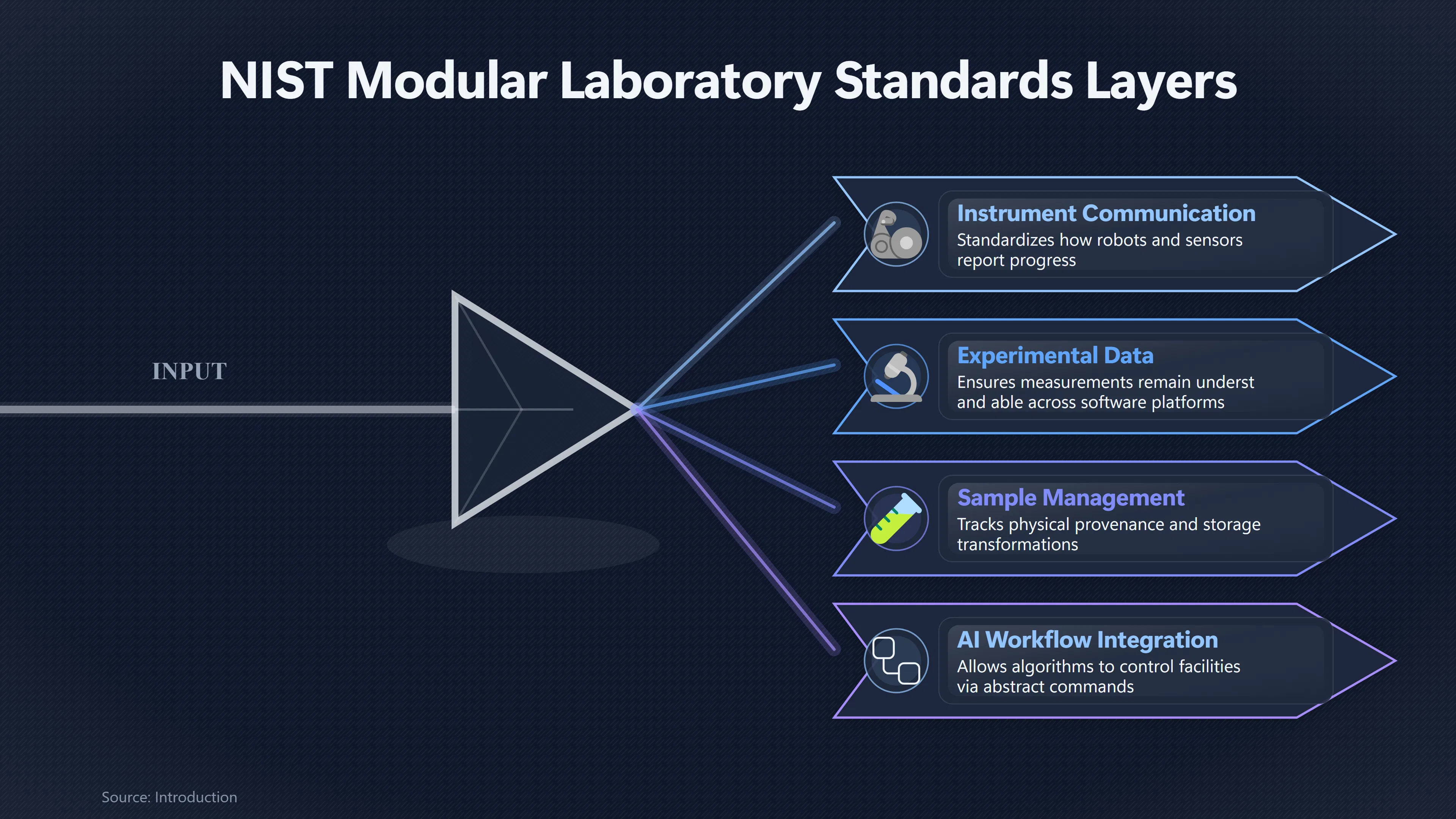
Interoperability is broader than agreeing on a single communications protocol. An autonomous laboratory requires multiple layers of compatibility.
Instrument communication. Robots, sensors and analytical instruments need a common way to announce their capabilities, receive instructions, report progress and return results. Standards such as SiLA 2 (Standardisation in Lab Automation) aim to provide consistent communication between laboratory devices, while industrial protocols such as OPC UA are increasingly being adapted for laboratory environments.[Sila Standard]sila-standard.comSila Standard Standards | Si LA Rapid IntegrationSila StandardStandards | SiLA Rapid IntegrationAugust 24, 2017…
Experimental data. Scientific measurements must remain understandable regardless of which instrument created them. Standards including AnIML (Analytical Information Markup Language) and the Allotrope Framework seek to standardise how analytical data, metadata and experimental context are represented, reducing information loss when results move between software systems.[sila-standard.com]sila-standard.comSila Standard FAQ | Si LA Rapid IntegrationSila Standard FAQ | Si LA Rapid Integration
Samples and materials. Autonomous laboratories also need common ways of identifying physical samples, recording provenance, tracking storage and documenting transformations. Without this, AI systems may know the data but lose confidence about which physical sample produced it. NIST lists sample management as one of four foundational standards required for modular autonomous laboratories.[NIST]nist.govdevelopment standards support modular and autonomous laboratory ecosystemDevelopment of Standards to Support a Modular and Autonomous Laboratory Ecosystem | NISTFebruary 14, 2025…
AI and workflow integration. The highest level concerns how planning software, optimisation algorithms and AI agents interact with laboratory equipment. Rather than rewriting software for every laboratory, researchers increasingly propose standard interfaces allowing algorithms to control different facilities through the same abstract commands.[NIST]nist.govdevelopment standards support modular and autonomous laboratory ecosystemDevelopment of Standards to Support a Modular and Autonomous Laboratory Ecosystem | NISTFebruary 14, 2025…
Why interoperability could lower access barriers
Open standards do not make expensive robots cheap, but they can reduce many hidden costs that limit access.
Today, building an autonomous laboratory often means commissioning large amounts of custom software. If instruments instead expose standard interfaces, organisations could purchase components separately and expect them to work together with much less engineering effort.
This creates several potential advantages.
- Lower integration costs. Less custom programming means smaller research groups can assemble capable systems.
- Greater competition. Laboratories can combine equipment from multiple suppliers rather than remaining locked into one vendor.
- Easier upgrades. Individual instruments can be replaced without rebuilding the entire automation platform.
- Shared infrastructure. Remote users can access standardised laboratory services more easily if different facilities expose compatible interfaces.
- Software portability. AI workflows developed in one laboratory become easier to reproduce elsewhere.
NIST argues that a standards-based ecosystem could dramatically reduce engineering costs while also reducing the risk that expensive laboratory investments become obsolete when individual vendors discontinue products or change proprietary interfaces.[NIST]nist.govdevelopment standards support modular and autonomous laboratory ecosystemDevelopment of Standards to Support a Modular and Autonomous Laboratory Ecosystem | NISTFebruary 14, 2025…
Emerging examples of open laboratory standards
No single universal laboratory standard exists today, but several complementary efforts are beginning to converge.
SiLA 2 focuses on communication between laboratory devices and software. It defines common services, discovery mechanisms, security features and standard ways for instruments to expose their capabilities. The consortium positions it as an open communication layer rather than a proprietary vendor protocol.[Sila Standard]sila-standard.comSila Standard Standards | Si LA Rapid IntegrationSila StandardStandards | SiLA Rapid IntegrationAugust 24, 2017…
AnIML provides an open structure for representing analytical measurement data so that experimental results remain understandable across software platforms. Recent work has extended AnIML with richer semantic definitions to improve machine-readable interoperability between laboratories.[arXiv]arxiv.orgOpen source on arxiv.org.
OPC UA originated in industrial automation but is increasingly being applied to laboratory equipment. Recent collaborations between the OPC Foundation, Spectaris and the Allotrope Foundation have demonstrated how laboratory communication standards can be combined with shared scientific data models to support machine-readable, FAIR (Findable, Accessible, Interoperable and Reusable) laboratory information.[OPC Foundation]opcfoundation.orgOPC FoundationBreakthrough in Smarter Labs: Spectaris LADS Showcases Integration of OPC UA with Allotrope Standards - OPC Foundation…
NIST’s modular laboratory initiative aims to define standards spanning sample management, instrument communication, data management and AI integration, explicitly seeking an ecosystem where hardware and software from different suppliers can be combined as interchangeable components.[NIST]nist.govdevelopment standards support modular and autonomous laboratory ecosystemDevelopment of Standards to Support a Modular and Autonomous Laboratory Ecosystem | NISTFebruary 14, 2025…

Open standards do not eliminate every obstacle
Interoperability should not be confused with complete compatibility.
Different instruments often have genuinely different physical capabilities. A robotic liquid handler cannot simply substitute for a mass spectrometer because they perform different scientific functions. Standards therefore need to describe capabilities precisely rather than pretending all instruments are interchangeable.
Commercial incentives also complicate adoption. Some manufacturers benefit from proprietary ecosystems that encourage customers to purchase compatible equipment from a single supplier. Opening interfaces may reduce switching costs for customers while increasing competitive pressure on vendors.
There are also technical concerns. Greater connectivity can expand cybersecurity risks if standards are implemented poorly. Experience from industrial automation shows that secure protocols still require careful implementation, configuration and maintenance to deliver their intended protections.[arXiv]arxiv.orgSecurity Analysis of Vendor Implementations of the OPC UA Protocol for Industrial Control SystemsApril 13, 2021…
Why this matters for broad scientific access
The long-term promise of AI-enabled scientific acceleration depends not only on better algorithms but also on whether laboratories become part of a larger scientific infrastructure rather than isolated technological islands.
If autonomous laboratories remain collections of bespoke integrations, only a relatively small number of well-funded institutions may be able to build and maintain them. Open standards offer an alternative path in which instruments, AI software and scientific data become more modular, reusable and portable across institutions.
That would make it easier to imagine national laboratory networks, shared research facilities and international collaborations where researchers can develop AI workflows in one location and execute them in another without rebuilding the entire software stack. Such interoperability would not remove inequalities in funding or infrastructure, but it could reduce unnecessary technical barriers that currently prevent wider participation.
Within the broader vision of AI contributing to long-term human flourishing, open standards are therefore less about technical elegance than about governance. They influence whether autonomous laboratories evolve into a collection of isolated proprietary systems or into shared scientific infrastructure capable of spreading the benefits of accelerated discovery far beyond the institutions that built the first generation.[NIST]nist.govdevelopment standards support modular and autonomous laboratory ecosystemDevelopment of Standards to Support a Modular and Autonomous Laboratory Ecosystem | NISTFebruary 14, 2025…
Amazon book picks
Further Reading
Books and field guides related to Can Open Standards Unlock Shared Laboratories?. Use these as the next step if you want deeper reading beyond the article.
The Innovator's Dilemma
An innovation classic. From Steve Jobs to Jeff Bezos, Clay Christensen’s work continues to underpin today’s most innovative leaders and o...
Open Science by Design: Realizing a Vision for 21st Century R...
Openness and sharing of information are fundamental to the progress of science and to the effective functioning of the research enterpris...
The Master Switch
A New Yorker and Fortune Best Book of the Year "A must-read for all Americans who want to remain the ones deciding what they can read, wa...
The Age of A.I.: And Our Human Future
Traditional Chinese edition of The Age of A.I.: And Our Human Future
eBay marketplace picks
Marketplace Samples
Live-tested eBay searches with available results related to this page.
Selected fromrobotics kit oneBay.co.uk.
Endnotes
1.
Source: nist.gov
Title: development standards support modular and autonomous laboratory ecosystem
Link:https://www.nist.gov/programs-projects/development-standards-support-modular-and-autonomous-laboratory-ecosystem
Source snippet
Development of Standards to Support a Modular and Autonomous Laboratory Ecosystem | NISTFebruary 14, 2025...
Published: February 14, 2025
2.
Source: nist.gov
Title: Autonomous laboratories | NIST
Link:https://www.nist.gov/autonomous-laboratories
Source snippet
Autonomous laboratories | NIST...
3.
Source: nist.gov
Link:https://www.nist.gov/publications/towards-composable-modular-laboratory-ecosystem-autonomous-materials-research-and
Source snippet
Towards a composable, modular laboratory ecosystem for autonomous materials research and development | NIST...
4.
Source: sila-standard.com
Title: Sila Standard Standards | Si LA Rapid Integration
Link:https://sila-standard.com/standards/
Source snippet
Sila StandardStandards | SiLA Rapid IntegrationAugust 24, 2017...
Published: August 24, 2017
5.
Source: sila-standard.com
Title: Sila Standard FAQ | Si LA Rapid Integration
Link:https://sila-standard.com/faq/
6.
Source: opcfoundation.org
Link:https://opcfoundation.org/news/press-releases/breakthrough-in-smarter-labs-spectaris-lads-showcases-integration-of-opc-ua-with-allotrope-standards/
Source snippet
OPC FoundationBreakthrough in Smarter Labs: Spectaris LADS Showcases Integration of OPC UA with Allotrope Standards - OPC Foundation...
7.
Source: arxiv.org
Link:https://arxiv.org/abs/2604.01728
8.
Source: arxiv.org
Title: arXiv LAP: An Agent-to-Instrument Protocol for Autonomous Science
Link:https://arxiv.org/abs/2606.03755
9.
Source: sila-standard.com
Title: Sila Standard About Us | Si LA Rapid Integration
Link:https://sila-standard.com/about-us/
10.
Source: nvlpubs.nist.gov
Title: Publications NIST Research Data Framework (RDa F)
Link:https://nvlpubs.nist.gov/nistpubs/SpecialPublications/1500-18/NIST.SP.1500-18r2.html
Source snippet
NIST PublicationsNIST Research Data Framework (RDaF)...
11.
Source: arxiv.org
Link:https://arxiv.org/abs/2104.06051
Source snippet
Security Analysis of Vendor Implementations of the OPC UA Protocol for Industrial Control SystemsApril 13, 2021...
Published: April 13, 2021
12.
Source: nist.gov
Title: autonomous formulation lab
Link:https://www.nist.gov/programs-projects/autonomous-formulation-lab
13.
Source: sila-standard.com
Title: Downloads | Si LA Rapid Integration
Link:https://sila-standard.com/downloads/
14.
Source: sila-standard.com
Title: Si L A Rapid Integration
Link:https://sila-standard.com/
15.
Source: nist.gov
Link:https://www.nist.gov/adlp/research-data-and-computing-office
Additional References
16.
Source: youtube.com
Link:https://www.youtube.com/watch?v=99ImjkeSO1I
Source snippet
Laboratory Automation 2025: From Static Workflows to Adaptive AI & Strategic Growth...
17.
Source: youtube.com
Title: Material Discovery in The World Avatar with Markus Kraft
Link:https://www.youtube.com/watch?v=Ob6b_Wn0NFs
Source snippet
Knowledge Graphs for the Research Labs of the Future 2024...
18.
Source: youtube.com
Link:https://www.youtube.com/watch?v=PuIyDqaxXv8
Source snippet
bioSASH - Lab Automation Intro Video...
19.
Source: youtube.com
Title: bio SASH
Link:https://www.youtube.com/watch?v=6k7H8v-NSOk
Source snippet
Material Discovery in The World Avatar with Markus Kraft...
20.
Source: youtube.com
Link:https://www.youtube.com/watch?v=qaxTx_buX-0