Within Energy Limits
When AI Growth Outruns the Local Grid
Global data-centre demand may look manageable, yet concentrated AI clusters can overwhelm local grids, delay connections and reshape regional power planning.
On this page
- Why national averages hide regional pressure
- How clustered data centres reshape power investment
- Who bears the costs of new generation and transmission
Page outline Jump by section
Introduction
The biggest electricity challenge created by AI is often not a global shortage of power, but a local shortage of infrastructure. Even if total national electricity generation is sufficient, large AI data centres tend to cluster in a small number of regions where fibre networks, skilled workers, tax incentives and existing digital infrastructure already exist. That concentration can overwhelm local substations, transmission lines and planning systems years before new power stations or grid upgrades are completed. The result is that the practical limit on AI expansion is often not how much electricity a country produces overall, but how quickly particular places can connect large new loads.
This distinction matters for the wider idea of AI-enabled abundance. If advanced AI is to accelerate science, medicine and productivity on a civilisation-wide scale, it will need reliable physical infrastructure. Local grid bottlenecks therefore become a governance challenge rather than simply an engineering one: deciding where new AI facilities should be built, who pays for the required upgrades, and how to balance the interests of technology companies with those of existing electricity users. The International Energy Agency (IEA) concludes that grid connection delays are already becoming one of the principal constraints on AI infrastructure in several regions.[IEA]iea.orgEnergy and AI – AnalysisEnergy and AI – Analysis - IEAApril 10, 2025…
Why national averages hide regional pressure
National electricity statistics can give a misleading impression that AI demand is modest. Even where data centres account for only a few per cent of total electricity consumption, individual facilities can require hundreds of megawatts of continuous power, comparable to a large industrial complex or a medium-sized city.
The crucial issue is that AI infrastructure is highly concentrated rather than evenly distributed. Companies typically choose locations with excellent internet connectivity, existing cloud ecosystems and favourable regulation. Instead of demand growing gradually across an entire country, multiple hyperscale facilities may all seek connections within the same transmission area over only a few years.
This creates several distinct pressures:
- Transmission congestion, where high-voltage lines cannot safely deliver additional electricity.
- Substation shortages, requiring entirely new switching equipment and transformers.
- Long interconnection queues, while grid operators study the impact of proposed projects.
- Competition between new customers, with AI facilities joining manufacturers, renewable-energy projects and electrification initiatives seeking the same scarce grid capacity.
The IEA estimates that grid constraints could delay roughly one-fifth of planned global data-centre capacity scheduled for construction by 2030 unless permitting, transmission expansion and connection processes improve.[IEA]iea.orgAI and energy security – Energy and AI – AnalysisAI and energy security – Energy and AI – Analysis - IEA…
How clustered data centres reshape power investment
Unlike traditional office buildings, AI data centres often operate continuously, with little seasonal variation. Training large AI models may require tens of thousands of graphics processing units (GPUs) running simultaneously for weeks or months, while inference services increasingly provide around-the-clock computing for millions of users.
Utilities therefore cannot simply consider annual electricity consumption. They must ensure enough capacity exists during periods of peak demand, which often requires investment throughout the entire electricity system.
From digital project to grid project
Building a major AI cluster increasingly involves much more than constructing server halls.
Utilities and transmission operators may need to deliver:
- new high-voltage transmission lines;
- additional substations;
- larger transformers;
- upgraded distribution infrastructure;
- backup generation and system reserves;
- expanded control and protection systems.
Many of these assets take far longer to build than the data centre itself. Transformers can have multi-year manufacturing lead times, while transmission projects frequently spend longer in planning and permitting than in physical construction. The IEA identifies transformers, gas turbines, grid approvals and transmission infrastructure among the major physical bottlenecks slowing AI expansion.[IEA]iea.orgKey Questions on Energy and AI – AnalysisKey Questions on Energy and AI – Analysis - IEAApril 16, 2026…
Real-world examples of local power strain
Several regions illustrate how AI demand becomes a local infrastructure problem rather than a national one.
Northern Virginia
Northern Virginia hosts the world’s largest concentration of data centres because of its dense internet infrastructure and proximity to major cloud providers.
The region’s success has created its own constraint. Utilities have warned that demand growth is now forcing major investment in transmission, substations and generation. The PJM Interconnection grid, which serves much of the Mid-Atlantic United States, has identified data centres as one of the principal drivers of sharply rising future electricity demand and is considering new approaches to managing very large electricity users during periods of system stress.[Reuters]reuters.compower grid operator serving 13 states in the Mid-Atlantic and Midwest, is addressing growing electricity shortages driven by the surge in…
Dublin and Ireland
Ireland provides another widely discussed example.
Data centres account for an unusually large share of national electricity demand because many international technology firms have clustered around Dublin. Concern over grid capacity led the national grid operator to restrict new connections in the Dublin area while reinforcement projects proceeded, illustrating how local infrastructure rather than national generation can become the limiting factor. The IEA cites Ireland among jurisdictions where concentrated demand has created connection challenges.[IEA]iea.orgAI and energy security – Energy and AI – AnalysisAI and energy security – Energy and AI – Analysis - IEA…
Emerging AI regions
Texas, parts of the US Midwest, Scandinavia and regions with abundant renewable resources are increasingly attracting AI investment partly because they can sometimes provide faster access to power than already congested technology hubs.
This illustrates an important shift in site selection. For many AI developers, “time to power” is becoming nearly as important as land prices or network connectivity.[techradar.com]techradar.comConcepts like "energy parks," which combine renewable sources, storage, and centralized grid access, are gaining traction for their abili…
Why connection queues matter as much as power stations
A common misconception is that electricity shortages are mainly caused by insufficient generating capacity.
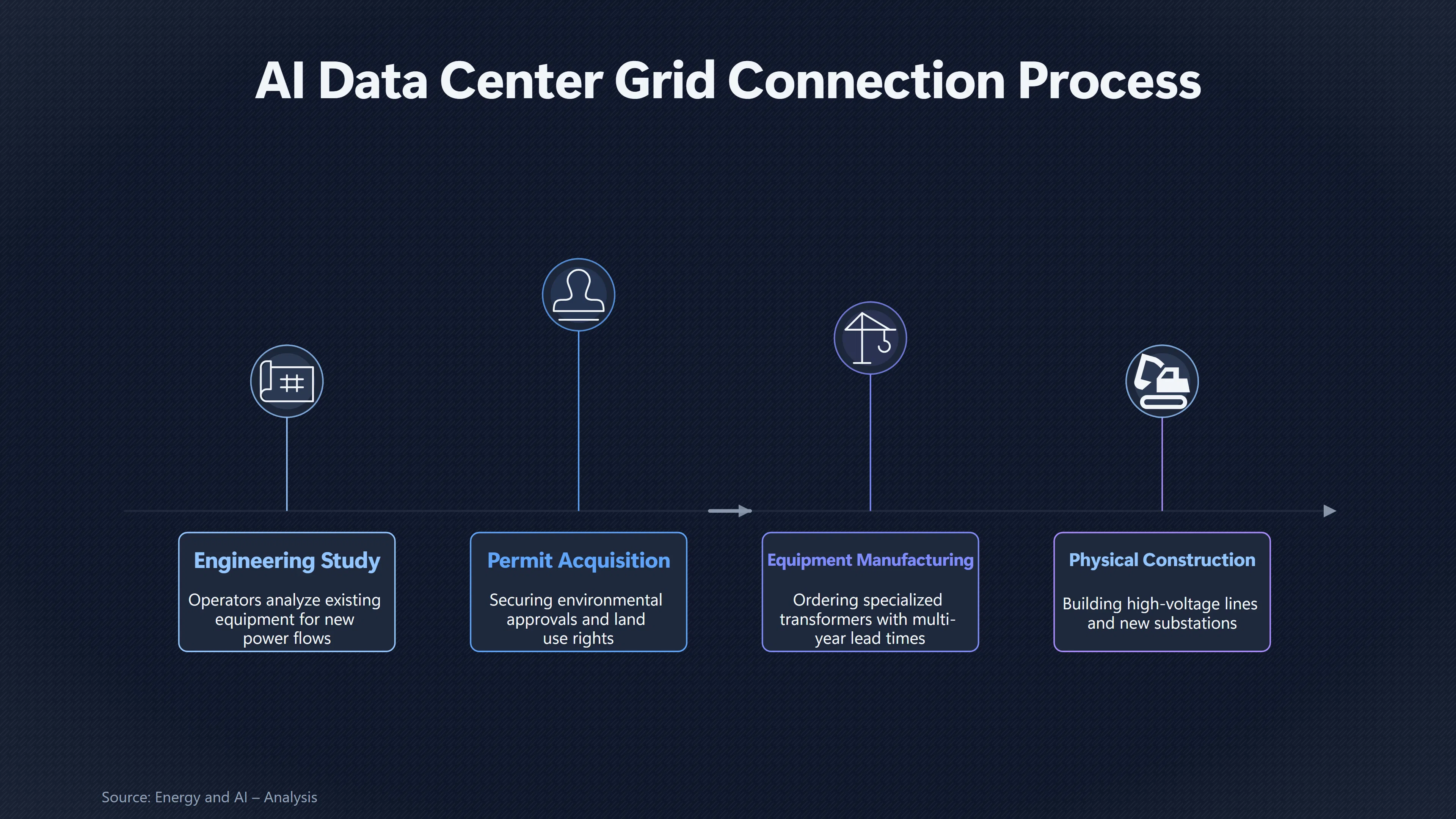
In reality, many delays arise because connecting a large new customer safely requires detailed engineering studies. Operators must determine whether existing transmission equipment can withstand new power flows during both normal operation and equipment failures.
If upgrades are required, construction may involve:
- acquiring land;
- securing environmental approvals;
- manufacturing specialised equipment;
- coordinating multiple utilities;
- upgrading neighbouring substations;
- reinforcing transmission corridors.
These processes often take several years.
The same infrastructure bottlenecks also affect renewable-energy developers, meaning AI projects increasingly compete with solar farms, wind farms, battery storage and new industrial facilities for available connection capacity. Lawrence Berkeley National Laboratory has identified accelerating large-load interconnections as one of the central planning challenges created by rapid data-centre growth.[Energy Markets & Planning]emp.lbl.govOpen source on lbl.gov.
Who bears the costs of grid expansion?
One of the most contested questions is financial rather than technical.
Expanding transmission networks and substations costs billions of pounds or dollars. Regulators must decide how these investments are funded.
Possible approaches include:
- requiring AI developers to finance dedicated infrastructure;
- spreading costs across all electricity customers;
- sharing costs between utilities and large industrial users;
- creating special tariffs for exceptionally large loads;
- allowing flexible rather than guaranteed connections in exchange for lower upgrade costs.
Each approach distributes costs and benefits differently.
Technology companies argue that new facilities generate employment, tax revenue and long-term electricity demand that helps justify infrastructure investment. Critics counter that households and existing businesses should not subsidise infrastructure built primarily for highly profitable AI firms.
The answer often depends on local regulation rather than engineering. Cost allocation has therefore become a central governance issue wherever AI infrastructure expands rapidly. Lawrence Berkeley National Laboratory identifies cost allocation and electricity-rate design among the key policy areas needing reform as large loads proliferate.[Energy Markets & Planning]emp.lbl.govOpen source on lbl.gov.

Can flexible AI computing reduce local bottlenecks?
One reason for cautious optimism is that AI workloads may prove more flexible than traditional industrial demand.
Not every computation must occur immediately. Some model training, batch processing and non-urgent tasks can potentially be shifted:
- to different times of day;
- to regions with spare electricity capacity;
- towards periods of abundant renewable generation;
- away from local grid emergencies.
Recent demonstrations have shown that GPU clusters can temporarily reduce electricity demand during periods of peak grid stress while maintaining agreed computing performance for many workloads. Researchers are increasingly exploring “grid-responsive” AI facilities that adjust electricity consumption in response to system conditions rather than behaving as completely inflexible loads.[arXiv]arxiv.orgarXiv Power-Flexible AI Data Centers: A New Paradigm for Grid-Responsive ComputearXiv Power-Flexible AI Data Centers: A New Paradigm for Grid-Responsive Compute
This flexibility is unlikely to eliminate the need for new transmission and generation, but it could reduce the size of upgrades required and help connect facilities more quickly.
What local bottlenecks mean for AI-enabled abundance
The existence of local grid bottlenecks does not undermine the broader case that AI could contribute to long-term human flourishing. Instead, it illustrates that intelligence alone cannot remove physical constraints overnight.
Advanced AI may accelerate scientific discovery, improve energy forecasting, optimise grid operation and even help design better electrical infrastructure. Yet transmission lines, substations, transformers and planning systems still require time, investment and political agreement.
The central lesson is that electricity demand should not be understood solely through national statistics or global projections. The practical pace of AI deployment is increasingly determined by local infrastructure, permitting systems and governance choices. Whether AI ultimately supports a future of broader abundance will depend not only on more capable algorithms but also on building the physical energy networks that allow those capabilities to spread beyond a handful of already congested technology hubs.
Amazon book picks
Further Reading
Books and field guides related to When AI Growth Outruns the Local Grid. Use these as the next step if you want deeper reading beyond the article.
The Grid
One of Bill Gates's Favorite Books of 2016 A revelatory look at our national power grid--how it developed, its current flaws, and how it...
How the World Really Works
INSTANT NEW YORK TIMES BESTSELLER “A new masterpiece from one of my favorite authors… [How The World Really Works] is a compelling and hi...

The Big Switch
A hundred years ago, companies stopped producing their own power with steam engines and plugged into the newly built electric grid. The c...
Power Hungry
The promise of "green jobs" and a "clean energy future" has roused the masses. But as Robert Bryce makes clear in this provocative book,...
eBay marketplace picks
Marketplace Samples
Live-tested eBay searches with available results related to this page.
Selected fromdata center model oneBay.co.uk.


Endnotes
1.
Source: iea.org
Title: Energy and AI – Analysis
Link:https://www.iea.org/reports/energy-and-ai/
Source snippet
Energy and AI – Analysis - IEAApril 10, 2025...
Published: April 10, 2025
2.
Source: iea.org
Title: AI and energy security – Energy and AI – Analysis
Link:https://www.iea.org/reports/energy-and-ai/ai-and-energy-security
Source snippet
AI and energy security – Energy and AI – Analysis - IEA...
3.
Source: iea.org
Title: Key Questions on Energy and AI – Analysis
Link:https://www.iea.org/reports/key-questions-on-energy-and-ai
Source snippet
Key Questions on Energy and AI – Analysis - IEAApril 16, 2026...
Published: April 16, 2026
4.
Source: iea.org
Link:https://www.iea.org/news/data-centre-electricity-use-surged-in-2025-even-with-tightening-bottlenecks-driving-a-scramble-for-solutions?__cf_chl_f_tk=mPlSI9KgDo0inioCRhuh6kU7U80qA.4CGq1WWVhvZcU-1783084545-1.0.1.1-072zjVfFsXXPnHR.edts3ccVzFC5OHDol3NSdHt3s8Y
Source snippet
Data centre electricity use surged in 2025, even with tightening bottlenecks driving a scramble for solutions - News - IEA...
5.
Source: reuters.com
Link:https://www.reuters.com/business/energy/largest-us-power-grid-moves-ahead-with-plan-meet-swelling-demand-2026-07-28/
Source snippet
power grid operator serving 13 states in the Mid-Atlantic and Midwest, is addressing growing electricity shortages driven by the surge in...
6.
Source: energy.gov
Title: Electricity Demand Growth Resource Hub | Department of Energy
Link:https://www.energy.gov/policy/electricity-demand-growth-resource-hub
7.
Source: techradar.com
Link:https://www.techradar.com/pro/why-access-to-power-will-determine-the-winners-and-losers-in-the-ai-race
Source snippet
Concepts like "energy parks," which combine renewable sources, storage, and centralized grid access, are gaining traction for their abili...
8.
Source: arxiv.org
Title: arXiv Power-Flexible AI Data Centers: A New Paradigm for Grid-Responsive Compute
Link:https://arxiv.org/abs/2606.25098
9.
Source: energy.gov
Link:https://www.energy.gov/articles/doe-releases-new-report-evaluating-increase-electricity-demand-data-centers
10.
Source: iea.org
Link:https://www.iea.org/reports/key-questions-on-energy-and-ai/executive-summary?_bhlid=10646f272364cf3af59c0fa8f3886b1cfe01e627
11.
Source: energy.gov
Link:https://www.energy.gov/oe/clean-energy-resources-meet-data-center-electricity-demand
12.
Source: emp.lbl.gov
Link:https://emp.lbl.gov/news/beyond-bottleneck-new-report-identifies-solutions-accelerating-large-load-connections
13.
Source: newscenter.lbl.gov
Link:https://newscenter.lbl.gov/2025/01/15/berkeley-lab-report-evaluates-increase-in-electricity-demand-from-data-centers/
Source snippet
Berkeley Lab News CenterBerkeley Lab Report Evaluates Increase in Electricity Demand from Data Centers - Berkeley Lab – Berkeley Lab News...
14.
Source: powering-intelligence.epri.com
Link:https://powering-intelligence.epri.com/introduction.html
15.
Source: newscenter.lbl.gov
Title: how researchers are driving advances for data centers
Link:https://newscenter.lbl.gov/2025/12/16/how-researchers-are-driving-advances-for-data-centers/
16.
Source: cs.lbl.gov
Title: ai based approach speeds diagnosis of i o performance bottlenecks in hpc
Link:https://cs.lbl.gov/news-and-events/news/2024/ai-based-approach-speeds-diagnosis-of-i-o-performance-bottlenecks-in-hpc/
17.
Source: bies.lbl.gov
Title: berkeley lab report evaluates increase electricity demand data centers
Link:https://bies.lbl.gov/news/berkeley-lab-report-evaluates-increase-electricity-demand-data-centers
18.
Source: research.lbl.gov
Title: addressing data center energy efficiency challenges posed by the growth of ai
Link:https://research.lbl.gov/2024/11/20/addressing-data-center-energy-efficiency-challenges-posed-by-the-growth-of-ai/
19.
Source: bies.lbl.gov
Title: demand flexibility
Link:https://bies.lbl.gov/demand-flexibility
Additional References
20.
Source: youtube.com
Title: AI Centers Are Flooding Into Korea! Why Top-Tier Companies Are Coming Here
Link:https://www.youtube.com/watch?v=KTxVaeg9Ikk
Source snippet
AI Is About to Break the Power Grid — And Space Solar Might Be the Only Escape Hatch...
21.
Source: youtube.com
Link:https://www.youtube.com/watch?v=JLnaSXmwajk
Source snippet
AI's Biggest Problem Isn't Chips.. It's Electricity...
22.
Source: youtube.com
Title: AI’s Biggest Problem Isn’t Chips.. It’s Electricity
Link:https://www.youtube.com/watch?v=SVzxIq7H8UI
Source snippet
AI Is About to Drain America's Power Grid?, with Andrew Chien...
23.
Source: youtube.com
Title: AI Is About to Drain America’s Power Grid?, with Andrew Chien
Link:https://www.youtube.com/watch?v=Y8tQB3ouXzM
Source snippet
AI Is About to Change the Power Grid Forever...
24.
Source: eia.gov
Title: Commercial electricity sales have soared in Virginia, driven by data centers
Link:https://www.eia.gov/TODAYINENERGY/detail.php?id=67664
25.
Source: enline.energy
Title: Data Center Grid Limitations: The Power Bottleneck Holding Back the AI Era
Link:https://enline.energy/articles/data-center-grid-limitations
26.
Source: iea-4e.org
Title: Energy efficiency of data centres
Link:https://www.iea-4e.org/edna/tasks/energy-efficiency-of-data-centres/
27.
Source: youtube.com
Title: AI Is About to Change the Power Grid Forever
Link:https://www.youtube.com/watch?v=pcIU-Wujhys
28.
Source: resourcecenter.ieee.org
Title: pes tp tr131 itslc 060225
Link:https://resourcecenter.ieee.org/publications/technical-reports/pes_tp_tr131_itslc_060225
29.
Source: powering-intelligence.epri.com
Link:https://powering-intelligence.epri.com/executive-summary.html