Within Smarter Grids
When Can Power Lines Safely Carry More?
Dynamic line ratings can raise safe power flows in cool, windy conditions while reducing them when heat, sunlight or low wind increase risk.
On this page
- How weather changes a line's thermal limit
- How sensors and forecasts produce live ratings
- Why capacity gains vary by place and season
Page outline Jump by section
Introduction
Dynamic line ratings (DLR) allow electricity transmission lines to carry more power when real weather conditions make it safe to do so, rather than relying on conservative fixed limits designed for worst-case conditions. On cool, windy days a transmission line may safely transport substantially more electricity than its static rating suggests. On hot, still, sunny days, however, its safe capacity may fall back towards—or even below—the traditional limit.
This matters because many electricity grids are becoming constrained long before their physical infrastructure is fully utilised. Wind farms and solar plants are increasingly curtailed not because electricity cannot be generated, but because operators cannot always move it across the network. Dynamic line ratings are one of the most mature grid-enhancing technologies for revealing this hidden capacity. Combined with improved weather forecasting and AI systems that continuously interpret sensor data, they can increase power transfers without building new transmission corridors, while still respecting the underlying physics of conductor heating and safety. They are therefore an important near-term mechanism within the broader story of AI forecasting and hidden grid capacity, even though they cannot replace the need for major long-term investment in transmission infrastructure.[IEA]iea.orgGrids – Electricity 2026 – Analysis - IEA…
How Weather Changes a Line’s Thermal Limit
The limiting factor for most overhead transmission lines is temperature.
As electrical current flows through a conductor it generates heat. A hotter conductor expands, causing it to sag. If sag becomes excessive, legal safety clearances above roads, railways, buildings or vegetation may no longer be maintained. The challenge for grid operators is therefore to keep conductor temperature within safe limits rather than simply limiting electrical current.
The key point is that conductor temperature depends on both electrical loading and the surrounding weather.
Cooling is strongly affected by:
- air temperature
- wind speed
- wind direction
- cloud cover and solar heating
- precipitation in some circumstances
Wind is especially important. Even a moderate crosswind dramatically improves convective cooling, allowing a conductor to carry more current without exceeding its maximum operating temperature. Conversely, a hot afternoon with little wind and intense sunshine leaves much less cooling available, reducing the safe current.
Traditional static ratings deliberately assume combinations of unfavourable weather that may occur only occasionally. This conservative approach has protected system reliability for decades, but it also means many lines spend much of the year operating below their actual thermal capability. IEEE standards for transmission line thermal calculations are built around heat-balance physics rather than arbitrary limits, making weather-dependent ratings a natural extension of established engineering practice.[IEEE Standards Association]standards.ieee.orgStandards Association IEEE SAIEEE Standards AssociationIEEE SA - IEEE 738-2023December 19, 2023…
How Sensors and Forecasts Produce Live Ratings
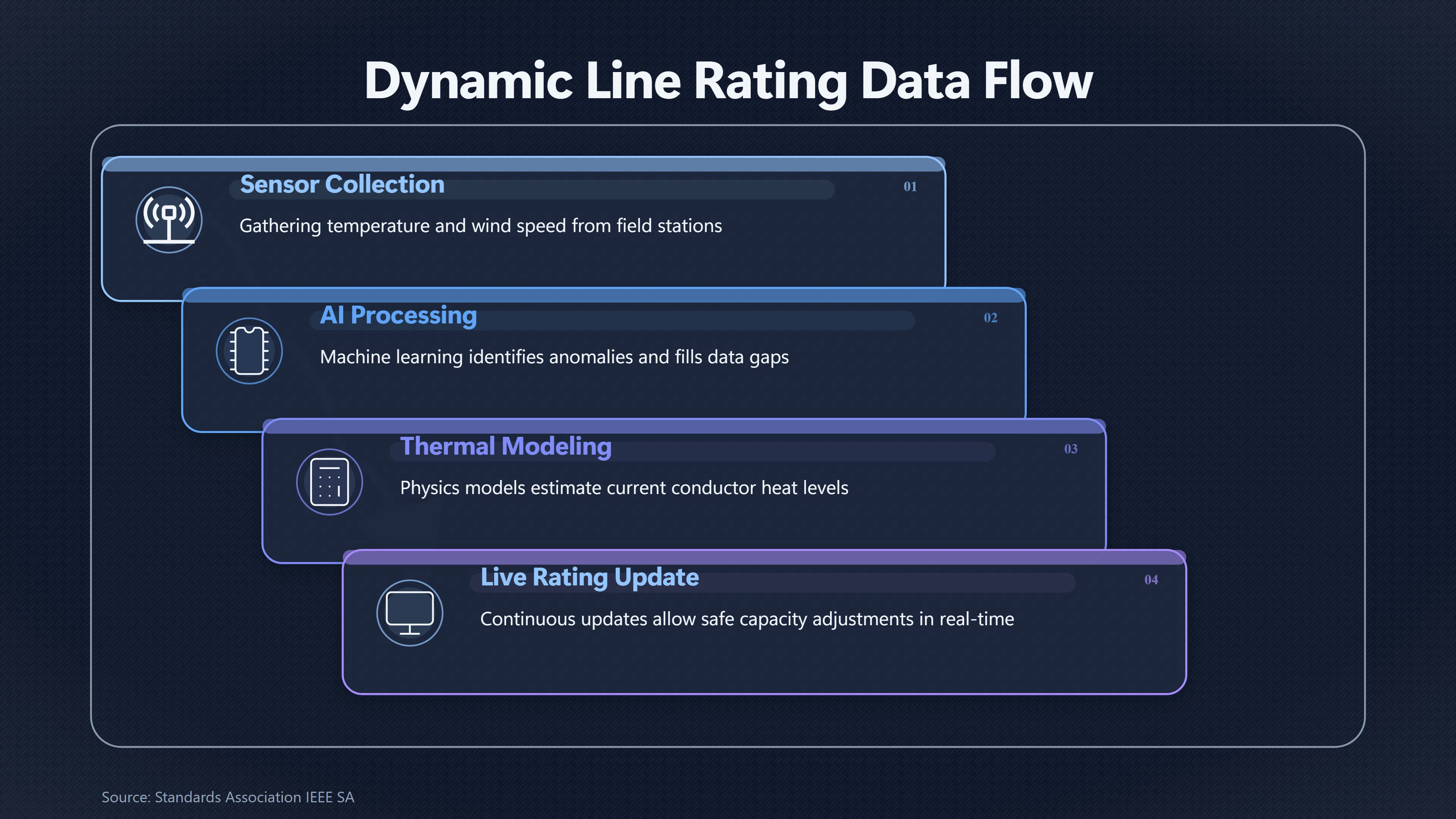
Dynamic line ratings do not replace physics with artificial intelligence. Instead, they combine physical thermal models with better observations and better forecasts.
Modern systems may collect information from several sources simultaneously:
- weather stations installed along transmission routes
- conductor temperature sensors[standards.ieee.org]standards.ieee.orgIEEE SA - IEEE 738-1986December 31, 1985 — Superseded Standard IEEE 738-1986 IEEE STANDARD FOR CALCULATION OF BARE OVERHEAD CONDUCTOR…
- line sag or tension monitors
- satellite and radar weather information
- numerical weather prediction models
- historical operating data
- electrical loading measurements
These measurements feed thermal models that estimate how hot each conductor is now and how hot it is likely to become over the next several minutes or hours.
AI becomes valuable because it helps combine large quantities of weather observations, sensor readings and forecast models into more accurate predictions. Machine learning can improve local wind estimation, identify sensor anomalies, fill data gaps and refine short-term forecasts for specific transmission corridors. Better forecasts reduce uncertainty, allowing operators to use available capacity more confidently while still maintaining safety margins.
Importantly, ratings are continuously updated rather than fixed for an entire season. If cooling conditions deteriorate unexpectedly, the permissible loading can be reduced before safety limits are reached.[doi.org]doi.orgDynamic Line Rating in Power Grids: Technologies, Challenges, and Future DirectionsJanuary 2, 2026…
Why Capacity Gains Vary by Place and Season
Dynamic line ratings should not be thought of as providing a fixed percentage increase everywhere.
Their benefits depend heavily on local geography and climate.
A transmission corridor crossing open plains with frequent winds may experience significant increases in allowable current for much of the year. Mountain valleys, coastal regions and high-latitude areas can also experience favourable cooling during substantial periods.
By contrast, lines located in sheltered terrain with consistently hot, calm conditions may gain relatively little additional capacity.
Seasonal variation is equally important.
During cooler months, many networks experience naturally higher conductor cooling, allowing dynamic ratings to exceed conservative summer-based assumptions. During heatwaves, however, dynamic ratings may provide little advantage and can occasionally fall below traditional static limits if real conditions are worse than those assumed in historical planning.
This variability is not a weakness of the approach; it is precisely the point. Dynamic ratings replace a single conservative number with a continuously updated estimate that reflects actual operating conditions. The International Energy Agency estimates that dynamic line ratings can often increase transfer capability by roughly 20–30% where suitable, but also notes that these gains depend on weather and are therefore not uniformly available across every hour or every transmission corridor.[IEA]iea.orgGrids – Electricity 2026 – Analysis - IEA…
Why Wind and Renewable Generation Often Align
One reason dynamic ratings attract particular interest is that they often complement renewable generation.
Wind farms produce their highest output during windy conditions. Those same winds also cool nearby transmission conductors.
This creates a fortunate coincidence:
- wind generation increases
- conductor cooling increases
- safe transmission capacity often increases simultaneously
Static ratings cannot fully exploit this relationship because they ignore the actual weather at any given moment.
The same relationship is weaker for solar generation. Solar farms often produce maximum output during sunny periods that also increase conductor heating. Nevertheless, local wind conditions, lower ambient temperatures outside peak summer and improved forecasting can still provide additional transmission capacity in many situations.
The practical consequence is reduced renewable curtailment. Rather than asking wind farms to reduce output because of conservative transmission limits, operators may be able to move more electricity across existing infrastructure whenever weather conditions genuinely permit it. Studies reviewed in the technical literature consistently identify reductions in congestion, renewable curtailment and operating costs as among the principal benefits of dynamic thermal ratings.[sciencedirect.com]sciencedirect.comDynamic thermal rating of transmission lines: A reviewScienceDirect…
Why Dynamic Ratings Do Not Eliminate the Need for New Power Lines
Dynamic ratings are sometimes presented as though they could solve transmission shortages by themselves. The evidence is more measured.
They work best when congestion occurs only during part of the year or during specific weather conditions. If a corridor remains overloaded almost continuously, revealing hidden capacity cannot create enough additional headroom to meet long-term demand.
Grid operators therefore increasingly describe dynamic line ratings as one member of a broader family of grid-enhancing technologies alongside topology optimisation, advanced power-flow control and dynamic transformer ratings. These technologies improve utilisation of existing assets while larger infrastructure projects are planned and constructed.
The International Energy Agency notes that grid-enhancing technologies generally have much shorter deployment times than building entirely new transmission lines, often requiring one to two years rather than the decade or more frequently needed for major transmission expansion. That makes them particularly valuable during periods of rapidly growing electricity demand from electrification, data centres and renewable energy, even though they cannot remove the long-term need for additional transmission investment.[IEA]iea.orgGrids – Electricity 2026 – Analysis - IEA…
The Operational Challenges
Using dynamic ratings safely requires more than installing sensors.
Operators must trust weather forecasts, integrate continuously changing limits into dispatch software and prepare for unexpected changes in atmospheric conditions. Protection systems, market software and operational procedures may all need updating.
Forecast uncertainty also matters. If predicted winds fail to materialise, available cooling may be lower than expected. Modern operational approaches therefore combine conservative forecasting, safety margins and continuous monitoring so that line ratings can be revised before thermal limits are exceeded.
Regulators have increasingly recognised these issues. In the United States, the Federal Energy Regulatory Commission has argued that overly conservative static ratings can leave transmission capability underused, while also emphasising that more accurate ratings require robust operational processes and transparent methodologies rather than simply higher limits.[Federal Energy Regulatory Commission]ferc.govFederal Energy Regulatory CommissionFERC Opens Inquiry on Use of Dynamic Line Ratings to Promote Grid Efficiency | Federal Energy Regulat…
Why Dynamic Ratings Matter for AI and Human Flourishing
Within the wider vision of AI-enabled abundance, dynamic line ratings illustrate an important principle: sometimes progress comes not from building entirely new physical infrastructure but from understanding existing infrastructure better.
AI cannot repeal thermal limits or create electricity from nowhere. What it can do is reduce uncertainty. By combining physics-based models, dense sensing networks and increasingly accurate weather forecasts, AI helps operators identify when unused capacity genuinely exists and when it does not.
The immediate gains are practical: lower congestion, better use of renewable generation, fewer unnecessary curtailments and more efficient transmission networks. Over time, those improvements support broader goals such as cheaper clean electricity, faster electrification and a power system capable of supporting AI-driven scientific research, advanced manufacturing and other energy-intensive activities.
Dynamic line ratings therefore represent a modest but concrete example of how better prediction can reveal hidden capacity. Rather than changing the laws of physics, they make it possible to operate closer to those laws’ true limits—safely, transparently and with a clearer understanding of when additional capacity is genuinely available.
Amazon book picks
Further Reading
Books and field guides related to When Can Power Lines Safely Carry More?. Use these as the next step if you want deeper reading beyond the article.
The Grid
One of Bill Gates's Favorite Books of 2016 A revelatory look at our national power grid--how it developed, its current flaws, and how it...
How the World Really Works
INSTANT NEW YORK TIMES BESTSELLER “A new masterpiece from one of my favorite authors… [How The World Really Works] is a compelling and hi...
Electrify
An optimistic--but realistic and feasible--action plan for fighting climate change while creating new jobs and a healthier environment: e...
Power Hungry
The promise of "green jobs" and a "clean energy future" has roused the masses. But as Robert Bryce makes clear in this provocative book,...
eBay marketplace picks
Marketplace Samples
Live-tested eBay searches with available results related to this page.
Selected fromelectrical engineering poster oneBay.co.uk.




Endnotes
1.
Source: iea.org
Link:https://www.iea.org/reports/electricity-2026/grids
Source snippet
Grids – Electricity 2026 – Analysis - IEA...
2.
Source: standards.ieee.org
Title: Standards Association IEEE SA
Link:https://standards.ieee.org/ieee/738/10207/
Source snippet
IEEE Standards AssociationIEEE SA - IEEE 738-2023December 19, 2023...
Published: December 19, 2023
3.
Source: sciencedirect.com
Title: Dynamic thermal rating of transmission lines: A review
Link:https://www.sciencedirect.com/science/article/pii/S1364032118302119
Source snippet
ScienceDirect...
4.
Source: doi.org
Link:https://doi.org/10.1109/EPREC66546.2026.11412093
Source snippet
Dynamic Line Rating in Power Grids: Technologies, Challenges, and Future DirectionsJanuary 2, 2026...
Published: January 2, 2026
5.
Source: standards.ieee.org
Link:https://standards.ieee.org/ieee/738/975/
Source snippet
IEEE SA - IEEE 738-1986December 31, 1985 — Superseded Standard IEEE 738-1986 IEEE STANDARD FOR CALCULATION OF BARE OVERHEAD CONDUCTOR...
Published: December 31, 1985
6.
Source: standards.ieee.org
Link:https://standards.ieee.org/ieee/738.1/12007/
Source snippet
SA - P738.1Active PAR P738.1 APPLICATION GUIDE FOR IEEE STD 738-2023 (IEEE STANDARD FOR CALCULATING THE CURRENT TEMPERATURE RELATIONSHIP...
7.
Source: ferc.gov
Link:https://www.ferc.gov/news-events/news/ferc-opens-inquiry-use-dynamic-line-ratings-promote-grid-efficiency
Source snippet
Federal Energy Regulatory CommissionFERC Opens Inquiry on Use of Dynamic Line Ratings to Promote Grid Efficiency | Federal Energy Regulat...
8.
Source: ferc.gov
Link:https://www.ferc.gov/news-events/news/presentation-e-1-implementation-dynamic-line-ratings
Source snippet
Presentation | E-1: Implementation of Dynamic Line Ratings | Federal Energy Regulatory CommissionJune 27, 2024 — PRESENTATION | E-1: IMPL...
Published: June 27, 2024
9.
Source: ferc.gov
Link:https://www.ferc.gov/news-events/news/staff-presentation-final-order-regarding-managing-transmission-line-ratings
Source snippet
Staff Presentation | Final Order Regarding Managing Transmission Line Ratings | Federal Energy Regulatory CommissionDecember 16, 2021 — S...
Published: December 16, 2021
10.
Source: ferc.gov
Link:https://ferc.gov/staff-presentation-managing-transmission-line-ratings
Source snippet
Chairman and Commissioners. Item E-1 is a draft notice of proposed rulemaking (or NOPR) that would...
Additional References
11.
Source: gridtechpedia.inl.gov
Title: Grid Tech Pedia Dynamic Line Rating (DLR)
Link:https://gridtechpedia.inl.gov/technology/dynamic-line-rating-dlr/
Source snippet
Line Rating (DLR) - GridTechPediaDYNAMIC LINE RATING (DLR) DYNAMIC LINE RATING (DLR) Updated February 2026 Technology Readiness Level 9 /...
Published: February 2026
12.
Source: inl.elsevierpure.com
Title: a review of dynamic thermal line rating methods with forecasting
Link:https://inl.elsevierpure.com/en/publications/a-review-of-dynamic-thermal-line-rating-methods-with-forecasting/
Source snippet
Douglass *, Ian Grant *, Jose Antonio Jardini *, Robert Kluge *, Paula Traynor *, Cody Davis *, Jake Gentle *, Huu M...
13.
Source: youtube.com
Title: Dynamic Line Ratings A Discussion with Line Vision and AES
Link:https://www.youtube.com/watch?v=jS-eNmXmVfQ
Source snippet
This selection of videos is relevant because they detail how dynamic line ratings leverage weather and real-time sensor monitoring to unl...
14.
Source: youtube.com
Title: Revolutionizing Grid Management with Dynamic Line Rating
Link:https://www.youtube.com/watch?v=-CwzmnEmeE8
Source snippet
Lessons Learned from AES's Deployment of Dynamic Line Ratings...
15.
Source: youtube.com
Title: Lessons Learned from AES’s Deployment of Dynamic Line Ratings
Link:https://www.youtube.com/watch?v=RxpFHoWpgAk
Source snippet
What is DLR? Dynamic Line Ratings Explained...
16.
Source: arxiv.org
Title: arXiv Impacts of Dynamic Line Ratings on the ERCOT Transmission System
Link:https://arxiv.org/abs/2207.11309
17.
Source: youtube.com
Title: What is DLR? Dynamic Line Ratings Explained
Link:https://www.youtube.com/watch?v=gA-klae4GOI
Source snippet
Dynamic Line Ratings A Discussion with LineVision and AES...
18.
Source: youtube.com
Title: Grid’s Hidden Potential Dynamic Line Rating
Link:https://www.youtube.com/watch?v=jzAHUYIXo5U
Source snippet
Revolutionizing Grid Management with Dynamic Line Rating...