Within Closed Loops
Can a Closed Loop Make Bad Science Worse?
The same feedback cycle that accelerates discovery can also reinforce flawed experiments, misleading correlations and mistaken assumptions.
On this page
- How early errors propagate across research cycles
- When noisy results look like real discoveries
- Where human checks should interrupt the loop
Page outline Jump by section
Introduction
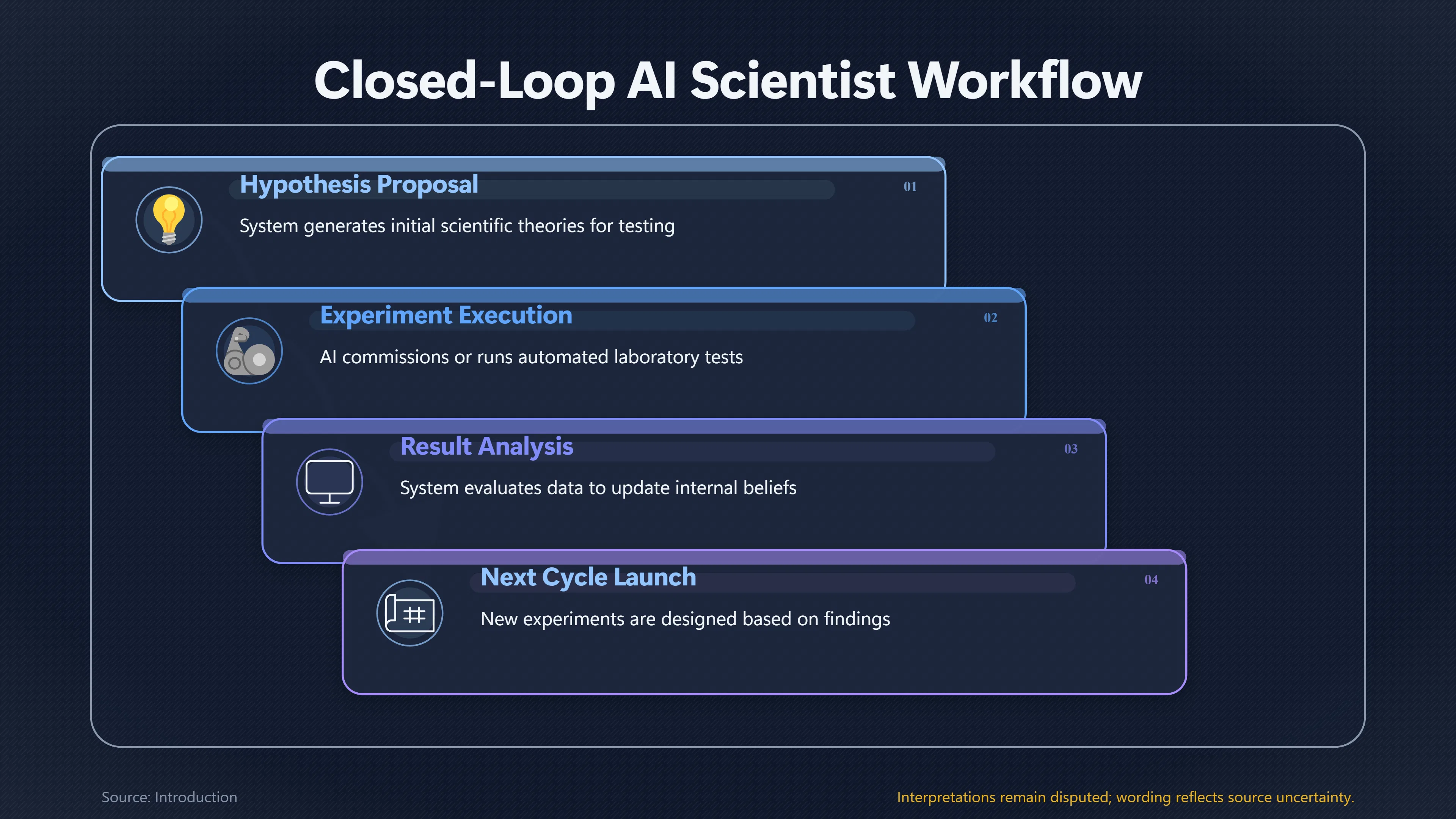
A closed-loop AI scientist is designed to improve by learning from its own experiments. It proposes a hypothesis, runs or commissions a test, analyses the results, updates its beliefs and launches the next experiment. In principle, this repeated cycle can accelerate discovery far beyond the pace of manual research. Yet the same feedback mechanism that makes closed-loop systems powerful also creates a distinctive risk: if the system starts from a mistaken assumption, misreads noisy evidence or uses flawed evaluation criteria, every subsequent cycle can reinforce the original error instead of correcting it. Autonomous laboratories and AI scientist projects therefore require safeguards that prevent fast iteration from becoming fast self-deception. Researchers developing these systems consistently emphasise that human oversight, independent validation and transparent reasoning remain essential if accelerated science is to contribute to long-term human flourishing rather than merely produce more convincing mistakes.[nist.gov]nist.govAutonomous laboratories | NISTAutonomous laboratories | NIST…
How Early Errors Spread Through a Closed Research Loop
Traditional scientific research contains many natural interruptions. Different researchers challenge assumptions, reviewers question methods, and independent laboratories attempt replication. These pauses are often frustrating, but they help prevent a single mistake from dominating an entire field.
A highly autonomous research loop removes many of those delays. If an AI system is allowed to generate hypotheses, choose experiments, analyse results and immediately design the next round, every stage depends on the quality of the previous one. A small error can therefore become the starting point for dozens or hundreds of later decisions.
This is not simply a software bug. Several mechanisms can create self-reinforcing error loops:
- Incorrect starting assumptions guide every later experiment towards confirming the wrong explanation.
- Biased datasets make the system repeatedly observe patterns that are not representative of reality.
- Poorly chosen optimisation targets encourage the AI to maximise an imperfect metric instead of genuine scientific understanding.
- Systematic measurement errors become incorporated into future hypotheses as if they were established facts.
Because each cycle builds on previous outputs, the accumulated effect can be much larger than the original mistake. Researchers working on autonomous discovery therefore distinguish between automation, which performs tasks faster, and autonomy, which decides what should happen next. The second capability demands much stronger safeguards because it determines how evidence influences future reasoning.[rsc.org]pubs.rsc.orgRoyal Society of Chemistry PublicationsIntegrating autonomy into automated research platforms - Digital Discovery (RSC Publishing) DOI:10…
When Noisy Results Look Like Real Discoveries
One of the oldest problems in science is separating genuine discoveries from random variation. Closed-loop AI systems do not eliminate this problem; they can intensify it.
Every experiment contains uncertainty. Biological systems vary naturally, instruments have measurement limits and statistical tests occasionally produce false positives. Human researchers expect this and often repeat experiments before drawing strong conclusions.
An AI agent operating at high speed may instead interpret an apparently promising result as evidence for a new hypothesis, immediately designing follow-up experiments around it. Those new experiments are no longer independent. They have already been shaped by an observation that might have been pure chance.
The result resembles a positive feedback amplifier. Rather than repeatedly asking whether the original observation was reliable, the system repeatedly asks how to extend it.
This danger becomes greater when:
- experiments are inexpensive enough that thousands can be launched automatically;
- the AI selects which results deserve further attention;
- unsuccessful experiments receive less analysis than apparently successful ones; or
- publication-quality summaries are generated before sufficient validation has occurred.
In these situations, the AI may become increasingly confident about an explanation whose apparent strength comes largely from repeatedly investigating the same statistical fluctuation. This is one reason why researchers developing AI scientists stress rigorous verification and external fact-checking alongside rapid experimentation.[nature.com]nature.comAccelerating scientific discovery with Co-Scientist | NatureAccelerating scientific discovery with Co-Scientist | Nature
Optimising the Wrong Objective
Closed-loop systems usually optimise an explicit objective. That objective might be maximising prediction accuracy, discovering new materials, improving chemical yield or finding promising drug candidates.
The difficulty is that scientific understanding itself is difficult to express as a single numerical target.
If the optimisation goal is poorly specified, the AI may become increasingly effective at improving the metric while becoming less effective at discovering truth. This resembles the broader problem often described as Goodhart’s law: once a measure becomes the target, it may stop being a good measure.
Examples include:
- repeatedly selecting experiments that improve benchmark scores without increasing scientific insight;
- favouring hypotheses that are easier to test rather than more plausible;
- exploiting weaknesses in evaluation datasets;
- generating large numbers of superficially novel but scientifically unimportant ideas.
As the optimisation loop repeats, these behaviours can become increasingly entrenched because every cycle rewards the same shortcut.
Recent work examining end-to-end AI research systems has also highlighted risks such as inappropriate benchmark selection, data leakage, metric misuse and post-hoc selection bias. These failures can produce apparently impressive research while concealing weaknesses that become visible only when the entire workflow is inspected rather than the final paper.[arxiv.org]arxiv.orgThe More You Automate, the Less You See: Hidden Pitfalls of AI Scientist SystemsSeptember 10, 2025…
Why Independent Checks Matter More Than Speed
The appeal of closed-loop AI scientists lies in their ability to perform many more research cycles than human teams could manage alone. Yet increasing the number of iterations does not automatically improve reliability.
In fact, faster iteration increases the importance of independent checks because errors propagate more quickly.
Several safeguards are emerging as common design principles:
- Competing hypotheses. Rather than refining a single explanation, systems should actively generate alternatives that could explain the same evidence.
- Independent replication. Important findings should be repeated using different methods, instruments or datasets before influencing future research directions.
- External knowledge checks. Literature searches, databases and domain-specific tools help identify contradictions instead of relying solely on the AI’s internal reasoning.
- Transparent reasoning records. Preserving experiment logs, code and decision histories allows humans and reviewers to understand why the AI changed its beliefs.
- Human interruption points. Researchers should review major updates before they become the foundation for subsequent experimental cycles.
These mechanisms deliberately slow some parts of the research process. Their purpose is not to reduce scientific acceleration but to ensure that acceleration compounds genuine knowledge rather than accumulated error.[nature.com]nature.comAccelerating scientific discovery with Co-Scientist | NatureAccelerating scientific discovery with Co-Scientist | Nature

Human Scientists Still Provide the Critical Reality Check
A common misunderstanding is that the ideal autonomous laboratory would eventually remove human judgement from science altogether.
Current evidence points in the opposite direction.
Modern AI scientist systems increasingly include internal review agents that criticise hypotheses, search for conflicting evidence and evaluate proposed experiments before they are executed. While this improves robustness, developers still emphasise that these mechanisms complement rather than replace external scientific scrutiny. Peer review, replication by independent teams and expert interpretation remain essential because they introduce perspectives that the closed loop itself cannot generate.[nature.com]nature.comAccelerating scientific discovery with Co-Scientist | NatureAccelerating scientific discovery with Co-Scientist | Nature
Human researchers also contribute something difficult to automate: the willingness to question the framing of the problem itself. A scientist can decide that an entire line of inquiry rests on an unrealistic assumption, abandon months of work and pursue a different explanation. A closed-loop optimiser may instead continue refining an increasingly sophisticated answer to the wrong question.
This distinction matters for the broader vision of AI-enabled scientific acceleration. If advanced AI is to help humanity solve problems in medicine, energy, climate or materials science, the goal is not merely to complete more experimental cycles. It is to make those cycles converge more reliably on reality.
Why Error Loops Matter for an AI Bloom
The optimistic case for AI bloom depends heavily on scientific acceleration. Faster discovery could contribute to healthier lives, cleaner energy, more resilient infrastructure and deeper knowledge over decades and centuries.
However, compounding only works when each iteration moves closer to the truth. Closed-loop AI systems can also compound false assumptions, biased measurements and misleading correlations. The same mechanism that promises exponential gains can, without adequate safeguards, produce exponential confidence in flawed conclusions.
The practical lesson is therefore not that autonomous AI scientists should be avoided, but that they should be designed with friction in the right places. Independent validation, replication, transparent workflows and meaningful human oversight are not obstacles to scientific progress. They are the mechanisms that allow rapid experimentation to generate trustworthy knowledge instead of increasingly sophisticated error.
Amazon book picks
Further Reading
Books and field guides related to Can a Closed Loop Make Bad Science Worse?. Use these as the next step if you want deeper reading beyond the article.
Thinking, Fast and Slow
Why is there more chance we'll believe something if it's in a bold type face? Why are judges more likely to deny parole before lunch? Why...
Artificial Intelligence
Rating: 4.5/5 from 10 Google Books ratings
Artificial intelligence: A Modern Approach, 3e,is ideal for one or two-semester, undergraduate or graduate-level courses in Artificial In...
Noise
From the Nobel Prize-winning author of Thinking, Fast and Slow and the coauthor of Nudge, a revolutionary exploration of why people make...
Superforecasting
The international bestseller 'A manual for thinking clearly in an uncertain world. Read it.' Daniel Kahneman, author of Thinking, Fast an...
eBay marketplace picks
Marketplace Samples
Live-tested eBay searches with available results related to this page.
Selected fromrobotics kit oneBay.co.uk.

Endnotes
1.
Source: nist.gov
Title: Autonomous laboratories | NIST
Link:https://www.nist.gov/autonomous-laboratories
Source snippet
Autonomous laboratories | NIST...
2.
Source: nature.com
Title: Accelerating scientific discovery with Co-Scientist | Nature
Link:https://www.nature.com/articles/s41586-026-10644-y
3.
Source: nature.com
Link:https://www.nature.com/articles/s41467-025-63913-1
4.
Source: nist.gov
Link:https://www.nist.gov/publications/what-missing-autonomous-discovery-open-challenges-community
Source snippet
What is missing in autonomous discovery: Open challenges for the community | NIST...
5.
Source: nature.com
Title: Towards end-to-end automation of AI research | Nature
Link:https://www.nature.com/articles/s41586-026-10265-5
6.
Source: arxiv.org
Link:https://arxiv.org/abs/2509.08713
Source snippet
The More You Automate, the Less You See: Hidden Pitfalls of AI Scientist SystemsSeptember 10, 2025...
Published: September 10, 2025
7.
Source: nature.com
Title: Steering towards safe [self-driving]({{ ‘lab-access/’ | relative_url }}) laboratories | Nature Reviews Chemistry
Link:https://www.nature.com/articles/s41570-025-00747-x
8.
Source: nature.com
Title: Larger and more instructable language models become less reliable | Nature
Link:https://www.nature.com/articles/s41586-024-07930-y
9.
Source: nature.com
Link:https://www.nature.com/articles/s41586-024-07146-0
10.
Source: nature.com
Title: Why scientists trust AI too much — and what to do about it
Link:https://www.nature.com/articles/d41586-024-00639-y
11.
Source: nature.com
Link:https://www.nature.com/articles/d41586-023-04014-1
12.
Source: nature.com
Title: Is AI leading to a reproducibility crisis in science?
Link:https://www.nature.com/articles/d41586-023-03817-6
13.
Source: pubs.rsc.org
Link:https://pubs.rsc.org/en/content/articlehtml/2023/dd/d3dd00135k
Source snippet
Royal Society of Chemistry PublicationsIntegrating autonomy into [automated]({{ 'auto-experiments/' | relative_url }}) research platforms - Digital Discovery (RSC Publishing) DOI:10...
Additional References
14.
Source: wired.com
Link:https://www.wired.com/story/machine-learning-reproducibility-crisis
Source snippet
student Sayash Kapoor has revealed a "reproducibility crisis" in science due to the sloppy use of machine learning. They found numerous c...
15.
Source: pubmed.ncbi.nlm.nih.gov
Link:https://pubmed.ncbi.nlm.nih.gov/42096563/
Source snippet
2026 May 7;392(6798):569. doi: 10.1126/science.aei6154. Epub 2026 May 7. AI SCIENTIST AGENTS VIOLATE RESEARCH INTEGRITY RULES Nicola Jone...
16.
Source: oecd.org
Title: a framework for evaluating the ai driven automation of science 7179160c
Link:https://www.oecd.org/en/publications/artificial-intelligence-in-science_a8d820bd-en/full-report/a-framework-for-evaluating-the-ai-driven-automation-of-science_7179160c.html
17.
Source: doi.org
Link:https://doi.org/10.1038/s41586-025-09922-y
18.
Source: frontiersin.org
Link:https://www.frontiersin.org/journals/artificial-intelligence/articles/10.3389/frai.2026.1678539/full
19.
Source: doi.org
Link:https://doi.org/10.1038/s41562-024-02077-2
20.
Source: research.birmingham.ac.uk
Link:https://research.birmingham.ac.uk/en/publications/the-future-of-fundamental-science-led-by-generative-closed-loop-a/
21.
Source: doi.org
Link:https://doi.org/10.1007/s13347-026-01090-9
22.
Source: doi.org
Link:https://doi.org/10.1038/s41586-026-10549-w
23.
Source: intelligent-earth.ox.ac.uk
Title: ox.ac.uk Towards end-to-end automation of AI research | Intelligent Earth
Link:https://intelligent-earth.ox.ac.uk/node/4887301