Within Education
Can AI Tutors Make Learning More Accessible For Everyone?
Adaptive tutoring can widen access, but only when translation and accessibility tools are designed and tested for diverse users.
On this page
- Language support and translation
- Disability focused learning tools
- Limits in low resource settings
Page outline Jump by section
Introduction
AI tutors could become one of the most important ways of widening access to education, not simply by making learning cheaper but by reducing barriers that have historically excluded millions of people. For learners who struggle because of language differences, dyslexia, visual or hearing impairments, speech difficulties, or limited access to specialist support, AI can personalise lessons in ways that conventional educational software often cannot. It can translate explanations, adapt reading materials, convert text into speech, simplify complex language, generate alternative examples and respond patiently at the learner’s own pace.
Within the broader vision of AI-enabled human flourishing, this matters because education becomes more accessible to people who have traditionally been underserved rather than only more efficient for those already well served. However, accessibility is not automatic. Translation quality varies widely between languages, many disabilities require highly specialised support, and the learners most likely to benefit often live in places with the weakest digital infrastructure. Whether AI tutors genuinely expand opportunity therefore depends as much on implementation, accessibility standards and equitable access as on improvements in AI capability.[UNESCO]unesco.orgSource details in endnotes.
Language Support Can Remove One Barrier Without Removing Educational Quality
Language remains one of the largest obstacles to education worldwide. Many learners study through a second or third language, while migrants, refugees and minority-language communities may encounter educational materials that are poorly matched to their everyday communication.
Modern AI systems introduce several capabilities that together make learning substantially more flexible:
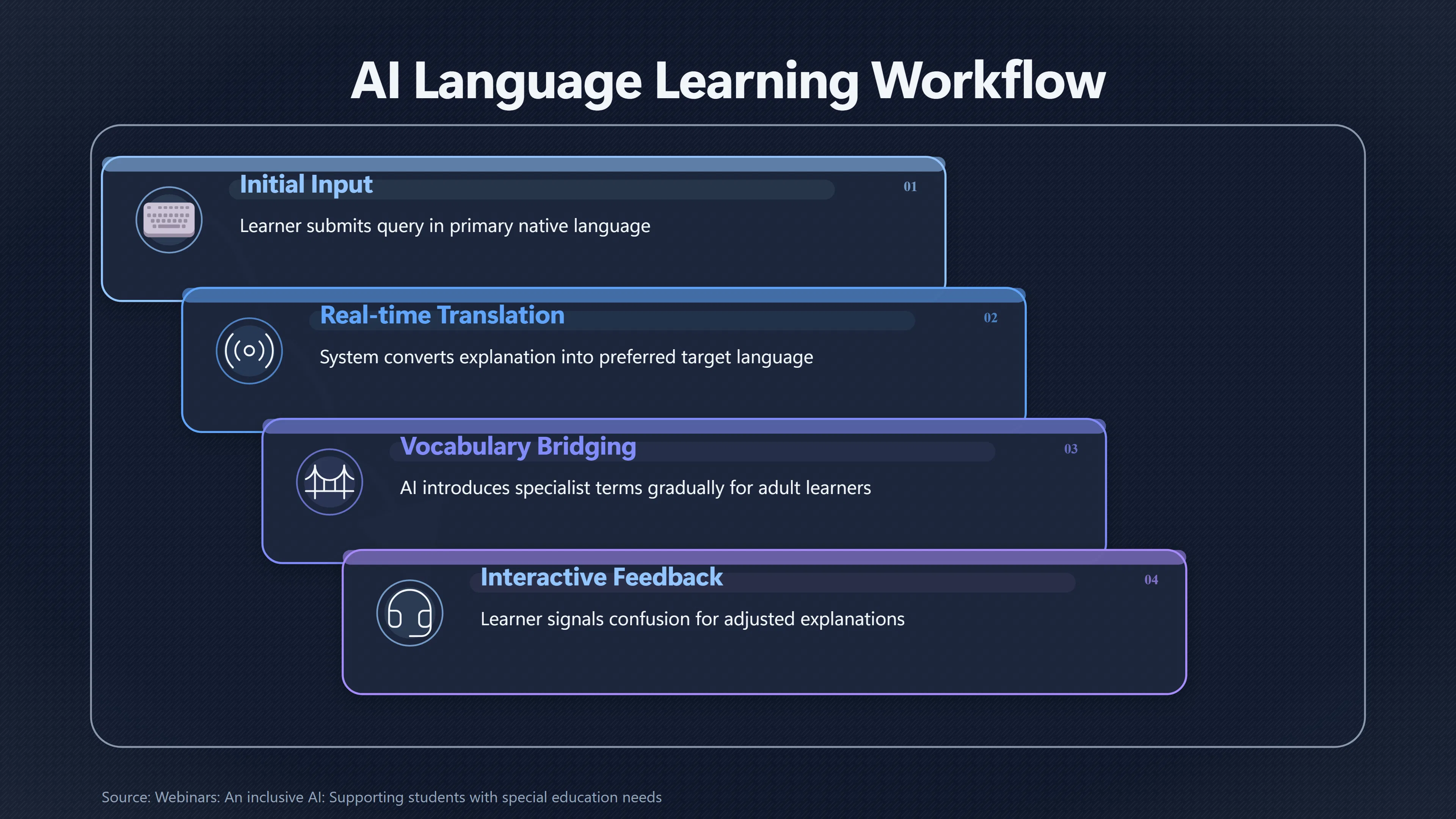
- Real-time translation of explanations into the learner’s preferred language.
- Simplification of difficult passages without entirely replacing academic vocabulary.
- The ability to ask follow-up questions in one language while receiving responses in another.
- Speech recognition that supports conversational practice.
- Personalised vocabulary building based on previous misunderstandings.
Unlike conventional machine translation, conversational AI can also explain why a translation was chosen, compare alternative meanings and adjust explanations after a learner signals confusion. This turns translation from a one-off conversion into an interactive teaching process.
For adult learners, this can support retraining and lifelong learning. Someone studying healthcare, engineering or computing may understand the underlying ideas but struggle with technical English. An AI tutor can bridge that gap while gradually increasing exposure to specialist terminology rather than forcing an abrupt transition.
This approach also fits the wider AI Bloom perspective. Making high-quality explanations available across many languages increases access to humanity’s accumulated knowledge instead of restricting it primarily to speakers of a few dominant languages.
Disability-Focused Learning Tools Are Becoming More Adaptive
Accessibility has traditionally relied on separate assistive technologies such as screen readers, speech synthesizers or captioning software. AI increasingly allows these capabilities to work together inside tutoring systems instead of remaining isolated tools.
Reading and Dyslexia Support
Learners with dyslexia often expend so much effort decoding text that less mental capacity remains for understanding the underlying subject. AI systems can reduce this cognitive load by combining several evidence-based techniques:
- Text-to-speech with natural voices.
- Simultaneous word highlighting.
- Adjustable spacing and line length.
- Syllable segmentation.
- Picture dictionaries.
- Simplified explanations alongside original text.
- Vocabulary support that adapts to reading progress.
Microsoft’s Immersive Reader integrates many of these features and builds on research showing benefits from improved text layout, text-to-speech and personalised reading support for many learners with reading difficulties. The same accessibility techniques can now be embedded within AI tutoring conversations rather than existing only inside word processors.[Microsoft Learn]learn.microsoft.comSource details in endnotes.
Recent human-computer interaction research has also explored AI systems that preserve original text while automatically adding readability cues for readers with dyslexia, reporting improved reading performance in controlled studies. Although still early-stage research, it illustrates how large language models may increasingly support accessibility rather than merely generating text.[arXiv]arxiv.orgSource details in endnotes.
Visual, Hearing and Speech Accessibility
AI tutors can also combine multiple communication channels.
For visually impaired learners this may include:
- image description,
- OCR (optical character recognition) that reads printed material aloud,
- conversational navigation through diagrams,
- Braille-compatible output where available.
For deaf or hard-of-hearing learners, systems may provide:
- automatic captions,
- transcript generation,
- visual explanations,
- sign-language resources where supported.
For learners with speech or communication disabilities, conversational AI may work alongside augmentative and alternative communication (AAC) technologies, allowing students to participate in discussions more independently.
These capabilities are particularly valuable because educational barriers often arise from communication rather than intellectual ability.

Neurodiversity
Many learners benefit from different pacing rather than fundamentally different curricula.
AI tutors can potentially:
- shorten overly long explanations,
- break complex tasks into manageable steps,
- reduce unnecessary distractions,
- repeat concepts patiently,
- generate unlimited additional practice,
- adjust feedback speed,
- personalise reminders.
However, there is no single “AI mode” that works for every autistic learner, every person with ADHD or every learner with dyslexia. Accessibility depends on individual adaptation rather than broad diagnostic categories.
Human Teachers Still Provide What AI Cannot
One common misunderstanding is that accessible AI tutoring removes the need for specialist educators.
In practice, experienced teachers perform several functions that AI currently cannot replace reliably:
- recognising emotional distress,
- identifying safeguarding concerns,
- coordinating with families,
- adapting formal assessment,
- understanding local cultural context,
- making professional judgements about long-term development.
AI is often most effective when it handles repetitive individual practice while teachers focus on motivation, diagnosis and complex human interaction.
This distinction is especially important in special education, where many learning plans involve multidisciplinary collaboration between teachers, therapists, psychologists and families.
Research on educational AI increasingly emphasises augmentation rather than replacement. Even promising AI tutors tend to perform best when their pedagogical behaviour has been deliberately designed instead of relying on unrestricted chatbot conversations.[UNESCO]unesco.orgSource details in endnotes.
Why Low-Resource Languages Remain a Major Challenge
Many impressive AI demonstrations focus on English and other well-resourced languages. The situation is much harder for thousands of languages with limited digital text, speech recordings or educational materials.
Problems include:
- lower translation accuracy,
- weaker speech recognition,
- fewer educational resources,
- limited evaluation datasets,
- poorer cultural adaptation,
- reduced support for specialist terminology.
This creates a paradox. Communities that might benefit most from AI-enabled education often receive the weakest systems.
Research groups are increasingly developing datasets and tutoring models for low-resource languages, including African language initiatives designed specifically to improve educational tutoring rather than general conversation. These efforts demonstrate progress but also highlight how much work remains before educational quality approaches that available in English.[arXiv]arxiv.orgSource details in endnotes.
Infrastructure presents another obstacle. Reliable internet access, modern devices and electricity cannot be assumed in many regions where educational shortages are greatest. Offline capability, lightweight models and locally deployable systems therefore remain important implementation priorities rather than merely technical preferences.
Accessibility Depends on Design Choices, Not Just AI Capability
The existence of powerful language models does not automatically produce accessible education.
Several implementation decisions determine whether learners benefit:
- Accessibility features should be integrated from the beginning rather than added afterwards.
- Learners should retain control over reading speed, presentation and assistance levels.
- Systems should avoid revealing disability status unnecessarily through data collection or automated profiling.
- Educational content should be tested with diverse users rather than assuming one interface suits everyone.
- Human review remains important for high-stakes educational decisions.
UNESCO’s guidance on generative AI in education stresses that inclusion, privacy, linguistic diversity and human oversight should be treated as central design principles rather than optional additions. It argues that educational institutions should evaluate both pedagogical quality and ethical suitability before deploying AI systems widely.[UNESCO]unesco.orgSource details in endnotes.
What This Means for Human Flourishing
Within the broader AI Bloom framework, accessible AI tutoring represents more than an educational convenience. It offers a pathway towards making knowledge itself more widely available.
Historically, disability, language and geography have often determined who could fully participate in education. AI cannot remove every barrier, but it may reduce several simultaneously by combining translation, accessibility, personalised explanation and continuous tutoring within a single system.
The long-term significance lies not only in higher examination scores but in expanding who can contribute to science, engineering, medicine, culture and civic life. If more people can learn effectively despite language differences or disabilities, humanity gains a larger pool of talent, creativity and lived experience.
That optimistic outcome is nevertheless conditional. Progress will depend on investment in accessibility research, support for low-resource languages, careful evaluation with diverse learners, affordable access, and educational systems that use AI to complement rather than replace skilled human teaching. Without those conditions, AI risks improving education primarily for those who already enjoy the fewest barriers.
Amazon book picks
Further Reading
Books and field guides related to Can AI Tutors Make Learning More Accessible For Everyone?. Use these as the next step if you want deeper reading beyond the article.
Universal Design for Learning: Theory and Practice
Anne Meyer and David Rose, who first laid out the principles of UDL, provide an ambitious, engaging discussion of new research and best p...
The Reason I Jump
“One of the most remarkable books I’ve ever read. It’s truly moving, eye-opening, incredibly vivid.”—Jon Stewart, The Daily Show NAMED ON...
The Dyslexia Empowerment Plan
Finally, a groundbreaking book that reveals what your dyslexic child is experiencing—and what you can do so that he or she will thrive Mo...

Inclusive Design for a Digital World: Designing with Accessib...
What is inclusive design ? It is simple. It means that your product has been created with the intention of being accessible to as many di...
eBay marketplace picks
Marketplace Samples
Live-tested eBay searches with available results related to this page.
Selected fromteacher mug oneBay.co.uk.




Endnotes
1.
Source: unesco.org
Link:https://www.unesco.org/en/articles/guidance-generative-ai-education-and-research?hub=686
Source snippet
"UNESCO[https://www.unesco.org/en/articles/guidance-generative-ai-education-and-research?hub=686..."](https://www.unesco.org/en/articles/guidance-generative-ai-education-and-research?hub=686...")...
2.
Source: learn.microsoft.com
Link:https://learn.microsoft.com/en-us/training/educator-center/product-guides/immersive-reader/research
Source snippet
"Microsoft Learn[https://learn.microsoft.com/en-us/training/educator-center/product-guides/immersive-reader/research..."](https://learn.microsoft.com/en-us/training/educator-center/product-guides/immersive-reader/research...")...
3.
Source: learn.microsoft.com
Link:https://learn.microsoft.com/en-us/training/educator-center/product-guides/immersive-reader/
Source snippet
"Microsoft Learn[https://learn.microsoft.com/en-us/training/educator-center/product-guides/immersive-reader/..."](https://learn.microsoft.com/en-us/training/educator-center/product-guides/immersive-reader/...")...
4.
Source: learn.microsoft.com
Link:https://learn.microsoft.com/en-us/azure/ai-services/immersive-reader/overview
Source snippet
"Microsoft Learn[https://learn.microsoft.com/en-us/azure/ai-services/immersive-reader/overview..."](https://learn.microsoft.com/en-us/azure/ai-services/immersive-reader/overview...")...
5.
Source: arxiv.org
Link:https://arxiv.org/abs/2504.00941
Source snippet
"arXiv[https://arxiv.org/abs/2504.00941..."](https://arxiv.org/abs/2504.00941...")...
6.
Source: arxiv.org
Link:https://arxiv.org/abs/2604.20996
Source snippet
"arXiv[https://arxiv.org/abs/2604.20996..."](https://arxiv.org/abs/2604.20996...")...
7.
Source: iicba.unesco.org
Link:https://www.iicba.unesco.org/en/africa-education-knowledge-platform/guidance-generative-ai-education-and-research
Source snippet
"UNESCO IICBA[https://www.iicba.unesco.org/en/africa-education-knowledge-platform/guidance-generative-ai-education-and-research..."](https://www.iicba.unesco.org/en/africa-education-knowledge-platform/guidance-generative-ai-education-and...
Additional References
8.
Source: youtube.com
Title: Webinars: An inclusive AI: Supporting students with special education needs
Link:https://www.youtube.com/watch?v=TGznEJxiEAk
Source snippet
The Future of Inclusive Education: How AI is Breaking Barriers...
9.
Source: youtube.com
Title: Voice AI and Dyslexia: Revolutionizing Writing for Dyslexic Learners
Link:https://www.youtube.com/watch?v=hxaLYNmcDBs
Source snippet
AI-Driven Accessibility: Rethinking IEPs and Special Education...
10.
Source: youtube.com
Title: How AI is Breaking Barriers in Education and Accessibility
Link:https://www.youtube.com/watch?v=NKU9MVg3pJA
Source snippet
Voice AI and Dyslexia: Revolutionizing Writing for Dyslexic Learners...
11.
Source: youtube.com
Title: The Future of Inclusive Education: How AI is Breaking Barriers
Link:https://www.youtube.com/watch?v=pmhajTMz14o
Source snippet
How AI is Breaking Barriers in Education and Accessibility...
12.
Source: apnews.com
Link:https://apnews.com/article/ff1f51379b3861978efb0c1334a2a953
Source snippet
"AP News[https://apnews.com/article/ff1f51379b3861978efb0c1334a2a953..."](https://apnews.com/article/ff1f51379b3861978efb0c1334a2a953...")...
13.
Source: youtube.com
Title: AI-Driven Accessibility: Rethinking IEPs and Special Education
Link:https://www.youtube.com/watch?v=VVEjArQFZZo