Within Smart Infrastructure
How AI Improves Flood Warnings
AI flood forecasting combines weather, terrain and river data to improve warnings, while showing why predictions still need human action.
On this page
- How AI models predict flood risks
- What better warnings can and cannot prevent
- Building communities that act on forecasts
Page outline Jump by section
Introduction
AI flood forecasting is changing how societies prepare for one of the most frequent and damaging natural hazards. Instead of relying only on historical flood maps or local river gauges, AI systems can combine weather forecasts, satellite observations, terrain information and past flood records to estimate where water is likely to rise and provide earlier warnings. The practical goal is not to eliminate floods, but to give people, emergency services and governments more time to protect lives and infrastructure.[Google Help]support.google.comHelp What is Google's Flood Hub?Google HelpWhat is Google's Flood Hub? - Help…
This makes flood forecasting an important part of a more resilient civilisation. In an AI-enabled future, better prediction systems could help communities anticipate shocks rather than only recover afterwards. Yet the technology also shows a central lesson of AI for disaster resilience: better intelligence does not automatically create safety. Forecasts must reach people, be trusted, and connect to decisions such as evacuation, shelter preparation and infrastructure protection.[UNDRR]undrr.orgLeveraging AI to enhance multi-hazard early warning systems | UNDRRLeveraging AI to enhance multi-hazard early warning systems | UNDRR…
How AI models predict flood risks
Traditional flood forecasting often depends on detailed hydrological models that simulate how rainfall becomes river flow. These models remain essential, but they can require extensive local data, including long records from river gauges. Many vulnerable regions lack this information, making accurate forecasting difficult precisely where warnings may have the greatest value.[Nature]nature.comGlobal prediction of extreme floods in ungauged watersheds | NatureGlobal prediction of extreme floods in ungauged watersheds | NatureMarch 20, 2024…
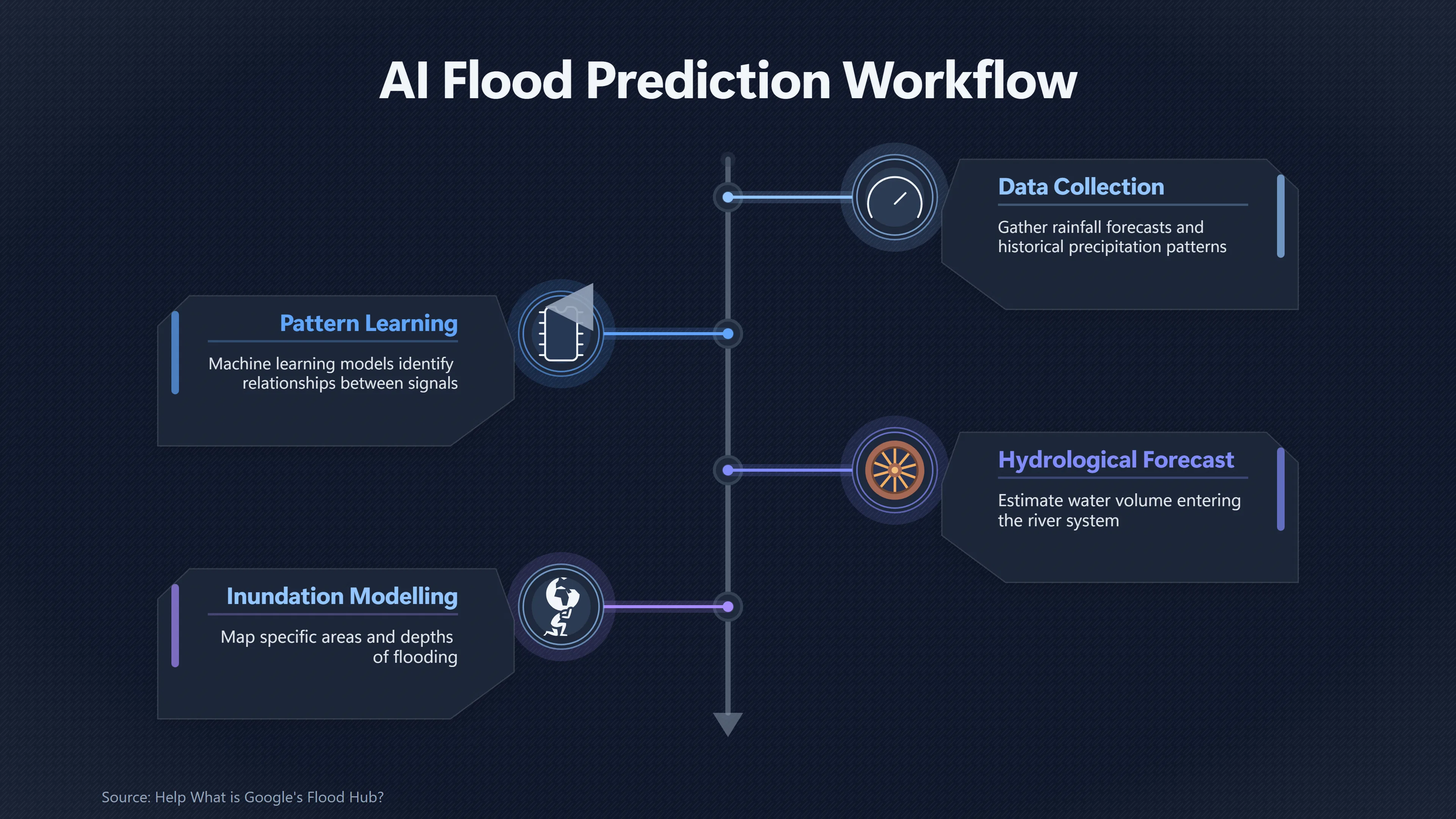
AI approaches aim to reduce some of these limitations by learning patterns from large amounts of existing information. Machine-learning models can analyse combinations of:
- rainfall forecasts and historical precipitation patterns;
- river levels and flow measurements;
- satellite imagery showing land and water conditions;
- terrain data describing how water moves across landscapes;
- previous flood events and their consequences.
Rather than following only a fixed set of physical assumptions, AI models learn relationships between these signals and likely future outcomes. The result can be faster predictions over larger areas, especially where direct measurements are limited.[arXiv]arxiv.orgarXiv AI Increases Global Access to Reliable Flood ForecastsAI Increases Global Access to Reliable Flood ForecastsJuly 30, 2023…
One of the most prominent examples is Google’s AI-based flood forecasting system, which developed operational forecasts for river flooding across many countries. Research published in Nature described an AI model capable of producing short-term flood forecasts, including in areas without dense networks of river gauges. The system was designed to provide forecasts up to seven days ahead in more than 80 countries through a publicly available platform.[Nature]nature.comGlobal prediction of extreme floods in ungauged watersheds | NatureGlobal prediction of extreme floods in ungauged watersheds | NatureMarch 20, 2024…
The importance of this capability is not simply technical accuracy. Many of the communities most exposed to flooding are in regions where monitoring infrastructure is weaker. AI can potentially extend the reach of early-warning systems by extracting more value from limited observations, although it does not remove the need for better data collection.[Nature]nature.comGlobal prediction of extreme floods in ungauged watersheds | NatureGlobal prediction of extreme floods in ungauged watersheds | NatureMarch 20, 2024…
From river prediction to local warnings
A flood forecast becomes useful only when it answers questions people actually face: Will my area flood? When could it happen? How serious could it become? What should I do now?
Modern AI flood systems increasingly combine different stages of prediction. One model may estimate how much water will enter a river system, while another estimates which areas could be affected and how deeply they might flood. Google’s Flood Hub describes this approach as combining hydrological forecasting with inundation modelling to create more actionable warnings.[Geo for Cities]cities.googleGeo for Cities Flood HubGeo for Cities Flood Hub
Newer research is also extending AI towards harder problems such as urban flash floods, where water can accumulate quickly away from major rivers. These events are especially challenging because they depend on local drainage systems, intense rainfall bursts and city landscapes. Google has developed a separate urban flash flood model designed to predict rapidly developing flood risks in built environments.[Google Help]support.google.comHelp How does the Urban Flash Flood Model Work? (BetaGoogle HelpHow does the Urban Flash Flood Model Work? (Beta) - Help…
What better warnings can and cannot prevent
AI flood forecasting can create a valuable window between recognising danger and experiencing its effects. A few additional hours or days can allow authorities to move emergency equipment, protect critical infrastructure, prepare shelters and warn residents. For households, earlier information can mean moving vehicles, securing property or leaving dangerous areas before roads become impassable.
The wider disaster-resilience case is supported by evidence that early warning systems save lives. The United Nations Office for Disaster Risk Reduction reports that countries with more comprehensive multi-hazard early warning systems experience substantially lower disaster mortality than countries with limited systems.[UNDRR]undrr.orgglobal status mhews 2025Global Status of Multi-Hazard Early Warning Systems (MHEWS) 2025 | Target G | UNDRRNovember 10, 2025…
However, forecasting is not the same as prevention. A highly accurate prediction cannot stop rainfall, overflowing rivers or rising seas. Nor can it guarantee that people will receive, understand or act on a warning. Flood losses often depend on decisions made before and during an event: whether evacuation routes are available, whether homes are built safely, whether emergency services have resources, and whether communities trust official messages.[UNDRR]undrr.orgLeveraging AI to enhance multi-hazard early warning systems | UNDRRLeveraging AI to enhance multi-hazard early warning systems | UNDRR…
This distinction matters for the broader AI bloom vision of a more capable civilisation. Advanced intelligence can expand humanity’s ability to anticipate problems, but resilience depends on institutions as much as algorithms. A society that ignores inequality, infrastructure weaknesses or communication failures may have excellent forecasts and still suffer avoidable harm.

The limits of prediction
Flood systems face several persistent challenges.
Data gaps: AI models depend on reliable information. Poor sensor coverage, missing historical records or outdated maps can reduce performance. International organisations emphasise that strong observation networks remain a foundation for trustworthy AI forecasting.[UNDRR]undrr.orgLeveraging AI to enhance multi-hazard early warning systems | UNDRRLeveraging AI to enhance multi-hazard early warning systems | UNDRR…
Extreme events: Rare floods can exceed the conditions represented in historical data. Climate change also complicates forecasting because past patterns may not fully describe future risks.
False alarms and missed warnings: Emergency systems must balance warning people early enough with avoiding excessive alerts that reduce trust. A warning that is ignored repeatedly becomes less effective.
Human responsibility: Life-safety decisions cannot be handed entirely to automated systems. The World Meteorological Organization has stressed that AI should complement rather than replace established forecasting expertise and public warning institutions.[World Meteorological Organization]wmo.intWorld Meteorological OrganizationWorld Meteorological Congress endorses actions to promote AI for forecasts and warningsOctober 24, 2025…
Building communities that act on forecasts
The strongest impact from AI flood forecasting comes when prediction is connected to preparation. A warning system is not a single model; it is a chain linking observation, forecasting, communication and action.
For vulnerable communities, this means designing systems around real conditions rather than assuming everyone has constant internet access, technical knowledge or financial flexibility. The United Nations’ AI and early-warning work highlights the importance of human-centred design, local involvement, accountability and accessibility, including for communities with limited connectivity.[UNDRR]undrr.orgLeveraging AI to enhance multi-hazard early warning systems | UNDRRLeveraging AI to enhance multi-hazard early warning systems | UNDRR…
Practical examples include:
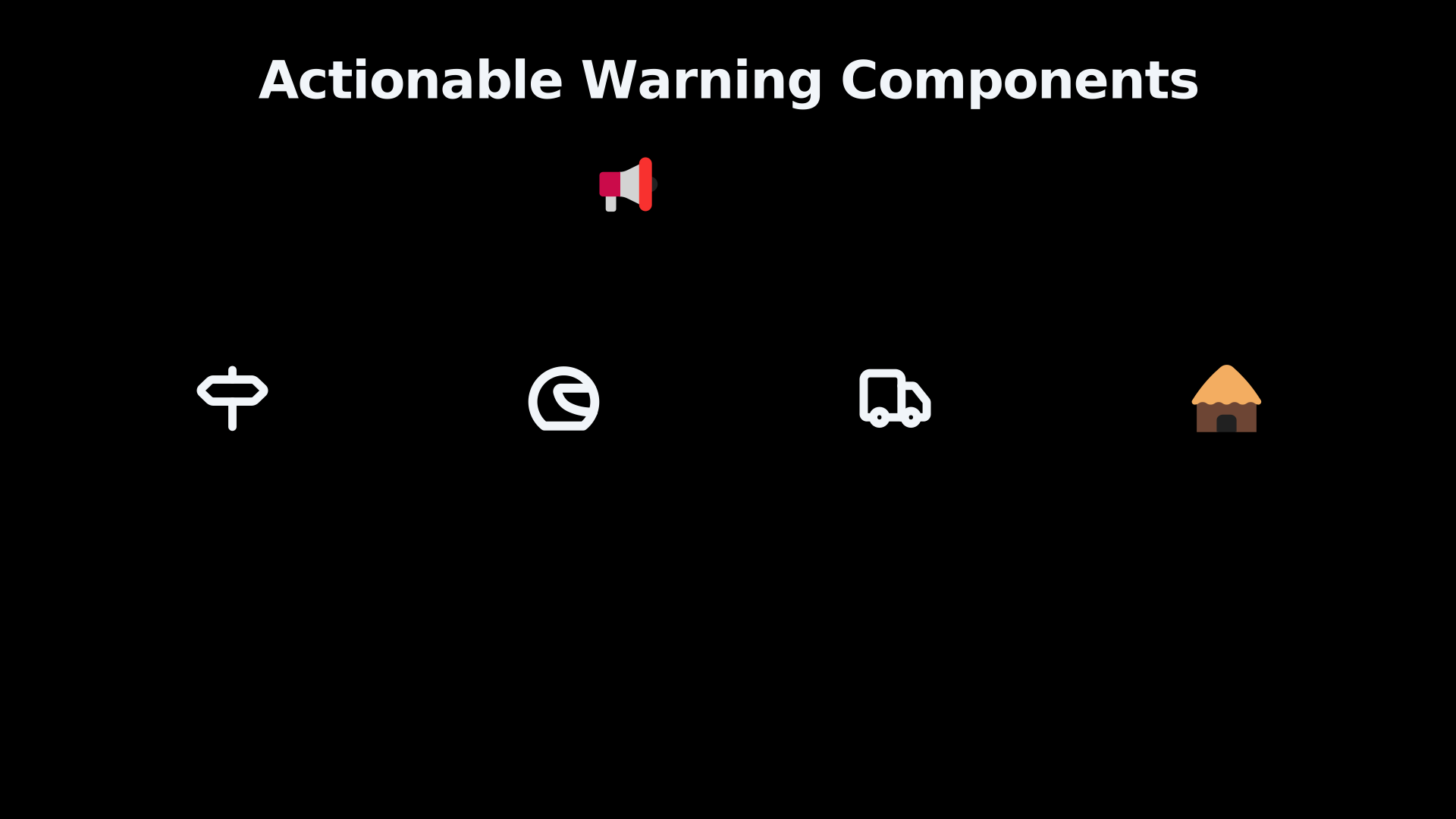
- sending warnings through multiple channels rather than relying on one app or website;
- translating alerts into clear actions rather than technical probability statements;
- training local responders to interpret forecasts;
- linking forecasts with evacuation plans and emergency supplies;
- ensuring poorer communities receive the same protective benefits as wealthier regions.
Google’s flood forecasting work illustrates the potential of wider access. Its Flood Hub platform provides publicly available river flood forecasts and aims to make information usable by governments, aid organisations and individuals.[Google Help]support.google.comHelp What is Google's Flood Hub?Google HelpWhat is Google's Flood Hub? - Help…
The deeper significance is that AI can help move disaster resilience from a reactive model towards a predictive one. Instead of waiting for infrastructure to fail or communities to be overwhelmed, societies can increasingly identify risks earlier and organise responses before damage spreads.
For the long-term future of human flourishing, this is a modest but important example of what advanced AI could contribute: not removing all uncertainty from life, but increasing civilisation’s ability to understand complex systems, protect vulnerable people and preserve the conditions needed for future progress. Flood forecasting alone will not create a safer world, but it demonstrates how better intelligence can become part of a broader effort to build a more resilient and capable civilisation.
Amazon book picks
Further Reading
Books and field guides related to How AI Improves Flood Warnings. Use these as the next step if you want deeper reading beyond the article.
The Way of Shadows: The Graphic Novel
For Durzo Blint, assassination is an art-and he is the city's most accomplished artist.For Azoth, survival is precarious. Something you n...
The Disaster Preparedness Handbook: A Guide for Families
Let survival expert, Army veteran, NASA scientist help you and your family prepare for any kind of disaster—flood, civil unrest, hurrican...
The Sixth Extinction: An Unnatural History
WINNER OF THE PULITZER PRIZE ONE OF THE NEW YORK TIMES BOOK REVIEW'S 10 BEST BOOKS OF THE YEAR A NEW YORK TIMES BESTSELLER A NATIONAL BOO...

Forecasting, structural time series models, and the Kalman fi...
First published 1989. Subjects: Kalman filtering, Time-series analysis, Kalman filter, academic, economics.
eBay marketplace picks
Marketplace Samples
Live-tested eBay searches with available results related to this page.
Selected fromweather poster oneBay.co.uk.


Endnotes
1.
Source: support.google.com
Title: Help What is Google’s Flood Hub?
Link:https://support.google.com/flood-hub/answer/15636593?hl=en
Source snippet
Google HelpWhat is Google's Flood Hub? - Help...
2.
Source: undrr.org
Title: Leveraging AI to enhance multi-hazard early warning systems | UNDRR
Link:https://www.undrr.org/publication/documents-and-publications/leveraging-ai-enhance-multi-hazard-early-warning-systems
Source snippet
Leveraging AI to enhance multi-hazard early warning systems | UNDRR...
3.
Source: nature.com
Title: Global prediction of extreme floods in ungauged watersheds | Nature
Link:https://www.nature.com/articles/s41586-024-07145-1
Source snippet
Global prediction of extreme floods in ungauged watersheds | NatureMarch 20, 2024...
Published: March 20, 2024
4.
Source: arxiv.org
Title: arXiv AI Increases Global Access to Reliable Flood Forecasts
Link:https://arxiv.org/abs/2307.16104
Source snippet
AI Increases Global Access to Reliable Flood ForecastsJuly 30, 2023...
Published: July 30, 2023
5.
Source: cities.google
Title: Geo for Cities Flood Hub
Link:https://cities.google/flood-hub
6.
Source: support.google.com
Title: Help How does the Urban Flash Flood Model Work? (Beta)
Link:https://support.google.com/flood-hub/answer/16811681?hl=en
Source snippet
Google HelpHow does the Urban Flash Flood Model Work? (Beta) - Help...
7.
Source: undrr.org
Title: global status mhews 2025
Link:https://www.undrr.org/reports/global-status-mhews-2025
Source snippet
Global Status of Multi-Hazard Early Warning Systems (MHEWS) 2025 | Target G | UNDRRNovember 10, 2025...
Published: November 10, 2025
8.
Source: undrr.org
Title: Special report on the use of technology for disaster risk reduction | UNDRR
Link:https://www.undrr.org/publication/documents-and-publications/special-report-use-technology-disaster-risk-reduction
Source snippet
Special report on the use of technology for disaster risk reduction | UNDRR...
9.
Source: undrr.org
Title: global ai powered early warning systems under early warnings all ew4all
Link:https://www.undrr.org/resource/case-study/global-ai-powered-early-warning-systems-under-early-warnings-all-ew4all
10.
Source: nature.com
Title: Deep Mind AI weather forecaster beats world-class system | Nature
Link:https://www.nature.com/articles/d41586-024-03957-3
11.
Source: undrr.org
Title: global status MHEWS 2024
Link:https://www.undrr.org/reports/global-status-MHEWS-2024
12.
Source: nature.com
Link:https://www.nature.com/articles/s41598-024-59145-w
13.
Source: nature.com
Link:https://www.nature.com/articles/d41586-024-00835-w
14.
Source: undrr.org
Link:https://www.undrr.org/publications?field_=&page=0
15.
Source: undrr.org
Link:https://www.undrr.org/publications
16.
Source: iddrr.undrr.org
Title: global status multi hazard early warning systems target g
Link:https://iddrr.undrr.org/2024/publication/global-status-multi-hazard-early-warning-systems-target-g
17.
Source: undrr.org
Title: global status multi hazard early warning systems 2022
Link:https://www.undrr.org/publication/global-status-multi-hazard-early-warning-systems-2022
18.
Source: iddrr.undrr.org
Title: global status multi hazard early warning systems target g
Link:https://iddrr.undrr.org/2022/publication/global-status-multi-hazard-early-warning-systems-target-g.html
19.
Source: support.google.com
Link:https://support.google.com/flood-hub/answer/15638004?hl=en
20.
Source: support.google.com
Link:https://support.google.com/flood-hub/answer/15637389?hl=en
21.
Source: wmo.int
Link:https://wmo.int/news/media-centre/world-meteorological-congress-endorses-actions-promote-ai-forecasts-and-warnings
Source snippet
World Meteorological OrganizationWorld Meteorological Congress endorses actions to promote AI for forecasts and warningsOctober 24, 2025...
Published: October 24, 2025
22.
Source: wmo.int
Title: A I in Disaster Resilience: Bridging Science, Standards and Innovation
Link:https://wmo.int/content/ai-disaster-resilience-bridging-science-standards-and-innovation
23.
Source: wmo.int
Title: Artificial intelligence
Link:https://wmo.int/themes/artificial-intelligence
24.
Source: wmo.int
Title: WM O faces the future, with action plan on Artificial Intelligence
Link:https://wmo.int/news/media-centre/wmo-faces-future-action-plan-artificial-intelligence
25.
Source: wmo.int
Title: WM O faces the future, with action plan on Artificial Intelligence
Link:https://wmo.int/media/news/wmo-faces-future-action-plan-artificial-intelligence
26.
Source: wmo.int
Title: Early Warnings for All
Link:https://wmo.int/activities/early-warnings-all
Additional References
27.
Source: wfp.org
Title: Strengthening Early Warning Systems for Anticipatory Action
Link:https://www.wfp.org/publications/2023-machine-learning-early-warning-systems
Source snippet
SEWAA project: mid-term achievements | World Food ProgrammeJuly 14, 2026 — 14 July 2026 STRENGTHENING EARLY WARNING SYSTEMS FOR ANTICIPAT...
Published: July 14, 2026
28.
Source: youtube.com
Link:https://www.youtube.com/watch?v=RfzZN7lLtgY
Source snippet
Save Lives with AI: Google's Groundbreaking Flood Forecasting System (Flood Hub) Explained...
29.
Source: youtube.com
Link:https://www.youtube.com/watch?v=8WM_6d9RQNw
Source snippet
Before Rivers Rise | Using AI to Make Global Flood Forecasts...
30.
Source: youtube.com
Title: Groundsource: Using Gemini to help communities predict a crisis | Earth AI
Link:https://www.youtube.com/watch?v=y4Uq-MJxTEQ
Source snippet
How AI is Improving Global Access to Reliable Flood Forecasts...
31.
Source: youtube.com
Title: Before Rivers Rise | Using AI to Make Global Flood Forecasts
Link:https://www.youtube.com/watch?v=iZmltPAFhY0
Source snippet
Groundsource: Using Gemini to help communities predict a crisis | Earth AI...
32.
Source: doi.org
Link:https://doi.org/10.1016/j.jhydrol.2023.130452
33.
Source: unwater.org
Link:https://www.unwater.org/our-work/un-system-wide-strategy-water-and-sanitation/contributing-actions/early-warning-systems
34.
Source: itu.int
Link:https://www.itu.int/en/ITU-D/Emergency-Telecommunications/Pages/Publications/ai-ew4all-report.aspx
35.
Source: sciencedirect.com
Link:https://www.sciencedirect.com/science/article/pii/S2212420925006417
36.
Source: sciencedirect.com
Link:https://www.sciencedirect.com/science/article/pii/S2589004225019509