Within Materials Scale Up
Why Great Materials Fail Outside the Lab
A material can excel in the laboratory yet fail commercially because of cost, durability, safety, supply chains or manufacturing yield.
On this page
- How industrial manufacturing differs from laboratory synthesis
- Why durability and safety problems emerge in real use
- When cost and supply chains outweigh peak performance
Page outline Jump by section
Introduction
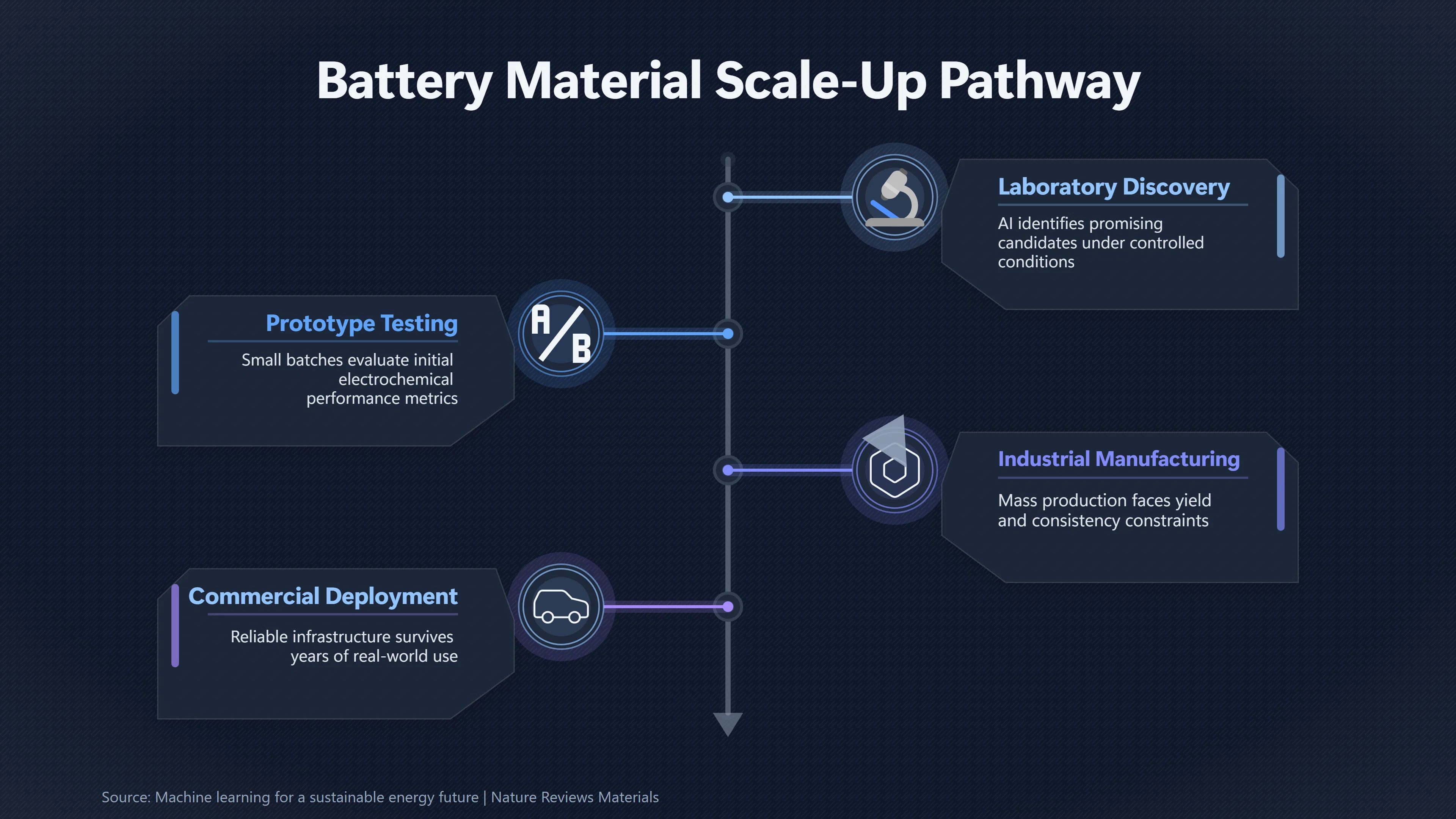
Artificial intelligence is making it much easier to identify promising battery materials and catalysts, but discovery is only the first step towards commercial success. Many materials that achieve impressive results in a laboratory never become products because they fail under the far harsher demands of industrial manufacturing, long-term operation and commercial economics. A material that is 20% better in a carefully controlled experiment may still lose to an older alternative if it is expensive to manufacture, relies on scarce minerals, degrades after repeated use or cannot be produced consistently by the tonne.
This “scale-up gap” is one of the biggest reasons why AI-driven materials discovery should not be confused with rapid technological deployment. Within the broader vision of AI accelerating scientific progress and supporting a future of greater energy abundance, the critical question is not simply whether AI can discover better materials, but whether those discoveries can survive the difficult journey from laboratory prototype to reliable, affordable infrastructure.
Why industrial manufacturing is fundamentally different from laboratory synthesis
Laboratory research is designed to answer scientific questions under controlled conditions. Industrial production must instead produce millions of identical components at low cost with minimal defects.
This changes almost every design constraint.
A battery material that can be synthesised in gram quantities using expensive precursors, precise temperature control and hours of manual handling may become impractical when manufacturers attempt to produce tonnes every day. Small variations in particle size, impurities or moisture that have little effect in the laboratory can significantly reduce battery performance or production yield in a factory. Researchers studying lithium-based batteries describe this transition from laboratory synthesis to industrial manufacturing as containing numerous “blind spots” involving quality control, impurities, processing and manufacturing consistency.[nature.com]nature.comMarch 30, 2023…
Manufacturing also introduces engineering challenges that are largely invisible during early research, including:
- continuous rather than batch production
- coating large electrode sheets uniformly
- maintaining extremely low contamination levels
- achieving high production yields with minimal waste
- ensuring every cell performs consistently rather than only the best experimental samples.
For batteries, these manufacturing details often determine commercial success more than small improvements in theoretical energy density.[nature.com]nature.comJanuary 12, 2025…
Why durability problems often appear only after years of use
Many new materials achieve excellent initial performance but deteriorate much faster than established alternatives.
This is particularly common in batteries and electrocatalysts because both operate under repeated chemical and mechanical stress.
Battery electrodes expand and contract during charging cycles. Electrolytes gradually decompose. Tiny cracks can develop inside particles. Interfaces between different materials slowly change over thousands of cycles. Laboratory experiments lasting days or weeks may fail to reveal degradation mechanisms that become serious after several years of real-world use.[nature.com]nature.comJanuary 12, 2025…
Catalysts face similar problems.
A catalyst may initially accelerate a reaction extremely efficiently but gradually lose activity because:
- nanoparticles agglomerate into larger particles
- active surface atoms dissolve into the surrounding electrolyte
- contaminants poison catalytic sites
- repeated operation changes the surface chemistry
- high temperatures alter the material’s structure.
As recent reviews emphasise, catalyst stability has become as important commercially as catalytic activity itself. A catalyst that performs slightly worse but remains stable for many years may be economically superior to one with record-breaking efficiency that rapidly degrades.[nature.com]nature.comJuly 8, 2026…
These long-term degradation mechanisms are difficult for AI models to predict because they depend on complex interactions across long timescales and operating environments rather than simply the static structure of a material.
Why safety becomes a much harder problem at scale
Small laboratory cells rarely experience the full range of mechanical shocks, manufacturing defects and environmental stresses encountered in commercial products.
A battery installed in an electric vehicle, aircraft or electricity grid must remain safe after thousands of charging cycles, accidental impacts, manufacturing variability and exposure to temperature extremes.
Minor defects that affect only one cell can become serious because commercial battery packs contain hundreds or thousands of interconnected cells. A single manufacturing flaw may trigger thermal runaway—a self-sustaining overheating process—which can propagate through neighbouring cells. Large-scale battery production therefore demands exceptionally tight quality control throughout manufacturing, not merely good average performance.[nature.com]nature.comJanuary 12, 2025…
Catalysts used in chemical plants face analogous requirements. They must tolerate continuous operation under demanding temperatures, pressures and chemical environments while maintaining predictable behaviour over years rather than weeks.
Safety testing therefore becomes a major bottleneck between discovery and commercial deployment.
When cost matters more than peak performance
The best-performing material is not always the most commercially valuable.
Manufacturers optimise total system cost rather than individual laboratory metrics.
A new battery chemistry might offer:
- 15% higher energy density
- slightly faster charging
- improved laboratory efficiency.
Yet it may still fail commercially if it:
- requires expensive purification
- depends on scarce critical minerals
- uses specialised manufacturing equipment
- reduces production yield
- increases warranty costs.
For many applications, incremental improvements in performance are outweighed by increases in manufacturing complexity.
Battery researchers increasingly argue that cost-oriented research deserves as much attention as performance-oriented research because manufacturing realities frequently dominate commercial outcomes.[PubMed]pubmed.ncbi.nlm.nih.govFrom Mining to Manufacturing: Scientific Challenges and Opportunities behind Battery Production - PubMed…
This explains why established lithium-ion chemistries continue to improve rather than being rapidly replaced by apparently superior laboratory alternatives.
Supply chains can determine which technologies survive
Raw materials influence commercial viability almost as much as electrochemical performance.
A promising catalyst that depends heavily on platinum, iridium or other scarce elements may never become economical for widespread deployment regardless of its laboratory efficiency.
Likewise, a battery chemistry requiring difficult-to-refine minerals or geographically concentrated supply chains may expose manufacturers to price volatility or geopolitical risk.
Modern AI systems increasingly attempt to optimise not only technical performance but also factors such as material abundance, environmental impact and supply-chain resilience. Nevertheless, these constraints remain difficult because future mineral prices, industrial capacity and geopolitical conditions cannot be predicted precisely.[PubMed]pubmed.ncbi.nlm.nih.govFrom Mining to Manufacturing: Scientific Challenges and Opportunities behind Battery Production - PubMed…
Commercial success therefore depends on an entire industrial ecosystem rather than a single scientific breakthrough.
Manufacturing yield is an invisible but decisive constraint
One of the least visible reasons promising materials fail is poor manufacturing yield.
Suppose a laboratory process produces an excellent battery material with 95% success.
That may appear impressive scientifically.
However, if scaling the process to industrial volumes reduces yield to 75%, the resulting waste, reprocessing and quality-control costs can eliminate any performance advantage.
Battery manufacturing is unusually sensitive because small deviations during electrode coating, drying, calendaring or assembly can produce defects that shorten battery life or create safety risks. Manufacturers therefore value repeatability as highly as raw performance. Recent industrial reviews argue that profitable gigawatt-hour-scale production depends on simultaneously achieving high throughput, high yield and consistently tight quality tolerances—a combination that remains technically demanding even for mature lithium-ion technologies.[nature.com]nature.comJanuary 12, 2025…
This helps explain why scaling production often takes many years after a promising scientific discovery.
What AI can and cannot solve
AI is reducing several long-standing bottlenecks.
Machine learning can rapidly screen millions of candidate materials, predict likely stability, suggest synthesis routes, optimise experiments and identify promising trade-offs before expensive laboratory work begins. Autonomous laboratories further shorten the cycle between prediction and experimental validation.
However, many scale-up challenges emerge only when physical products are manufactured and operated in realistic environments.
These include:
- long-term degradation over years
- factory process variation
- contamination control
- industrial quality assurance
- certification and regulatory testing
- equipment compatibility
- logistics and supply-chain resilience
- customer reliability expectations.
These problems generate data that are often unavailable during early-stage AI discovery because they arise only after prolonged industrial operation.
Rather than replacing engineering, AI increasingly shifts engineering effort towards the later stages of development, where manufacturing science, quality control and systems integration become the dominant constraints.[nature.com]nature.comApril 26, 2018…
Why this bottleneck matters for AI-enabled abundance
The optimistic case for AI-driven scientific acceleration assumes that discoveries can eventually improve real technologies, not merely expand scientific databases.
If AI can reliably shorten the journey from concept to commercially manufactured batteries, catalysts and other energy materials, it could help lower the cost of electricity, accelerate clean industrial processes, improve energy storage and reduce dependence on scarce resources. These advances would strengthen broader visions of long-term human flourishing by easing some of the physical constraints on energy and industrial production.
The key uncertainty is timing. AI is already compressing the discovery phase from years to weeks in some areas, but the remaining stages—engineering, durability testing, certification, factory design and supply-chain development—still require sustained investment and often many years of iterative improvement. The future impact of AI in materials science therefore depends not only on finding extraordinary new materials, but on making them manufacturable, dependable and affordable at global scale.
Amazon book picks
Further Reading
Books and field guides related to Why Great Materials Fail Outside the Lab. Use these as the next step if you want deeper reading beyond the article.
Stuff Matters: Exploring the Marvelous Materials That Shape O...
An eye-opening adventure deep inside the everyday materials that surround us, from concrete and steel to denim and chocolate, packed with...
Callister's Materials Science and Engineering, Global Edition
Callister's Materials Science and Engineering: An Introduction, 10th Edition promotes student understanding of the three primary types of...
How the World Really Works
INSTANT NEW YORK TIMES BESTSELLER “A new masterpiece from one of my favorite authors… [How The World Really Works] is a compelling and hi...
Scale: The Universal Laws of Life and Death in Organisms, Cit...
Geoffrey West's research centres on a quest to find unifying principles and patterns connecting everything from cells and ecosystems to c...
eBay marketplace picks
Marketplace Samples
Live-tested eBay searches with available results related to this page.
Selected fromscience wall art oneBay.co.uk.



Endnotes
1.
Source: nature.com
Link:https://www.nature.com/articles/s41560-023-01221-y
Source snippet
March 30, 2023...
Published: March 30, 2023
2.
Source: nature.com
Link:https://www.nature.com/articles/s41467-025-55861-7
Source snippet
January 12, 2025...
Published: January 12, 2025
3.
Source: nature.com
Link:https://www.nature.com/articles/s41578-026-00937-z
Source snippet
July 8, 2026...
Published: July 8, 2026
4.
Source: nature.com
Link:https://www.nature.com/articles/s41578-018-0005-z
Source snippet
April 26, 2018...
Published: April 26, 2018
5.
Source: nature.com
Title: Machine learning for a sustainable energy future | Nature Reviews Materials
Link:https://www.nature.com/articles/s41578-022-00490-5
6.
Source: nature.com
Link:https://www.nature.com/subjects/materials-for-energy-and-catalysis/natrevmats
7.
Source: pubmed.ncbi.nlm.nih.gov
Link:https://pubmed.ncbi.nlm.nih.gov/40261670/
Source snippet
From Mining to Manufacturing: Scientific Challenges and Opportunities behind Battery Production - PubMed...
8.
Source: pmc.ncbi.nlm.nih.gov
Link:https://pmc.ncbi.nlm.nih.gov/articles/PMC12257466/
9.
Source: pmc.ncbi.nlm.nih.gov
Link:https://pmc.ncbi.nlm.nih.gov/articles/PMC11725600/
Additional References
10.
Source: arxiv.org
Link:https://arxiv.org/abs/2401.04070
Source snippet
Accelerating computational materials discovery with artificial intelligence and cloud high-performance computing: from large-scale s...
11.
Source: sciencedirect.com
Link:https://www.sciencedirect.com/science/article/pii/S2666675826002560
Source snippet
July 17, 2026 — Review Accelerated Development of Energy Materials through [Automation]({{ 'labour-share/' | relative_url }}) and Artificial Intelligence●,●,●,●,● h...
Published: July 17, 2026
12.
Source: frontiersin.org
Link:https://www.frontiersin.org/journals/energy-research/articles/10.3389/fenrg.2026.1798886/full
Source snippet
Energy Res., 24 June 2026 Sec. Electrochemical Energy Storage Volume 14 - 2026 | [https://doi.org/10.3389/fenrg.2026.1798886](https://doi.org/10.3389/fenrg.2026.1798886) Published in...
Published: June 2026
13.
Source: now.solar
Title: You are using a browser version with limited support for CSS
Link:https://now.solar/2026/06/13/taking-perovskite-photovoltaics-from-promise-to-product-nature/
Source snippet
Taking perovskite photovoltaics from promise to product – Nature | Solar NowMay 26, 2026 — TAKING PEROVSKITE PHOTOVOLTAICS FROM PROMISE T...
Published: May 26, 2026
14.
Source: youtube.com
Link:https://www.youtube.com/watch?v=MSUjeOCdBFc
Source snippet
Why Does Mixing Become Difficult During Scale-Up? | Chemical & Pharmaceutical Industry | Ep. 4...
15.
Source: youtube.com
Title: Build better batteries: Part 1 | Why battery projects fail—and how to fix them
Link:https://www.youtube.com/watch?v=DrspcWMa1FM
Source snippet
Bridging the Gap from R&D to Mass Production: Lessons Learned in Battery Manufacturing Scale-up...
16.
Source: youtube.com
Link:https://www.youtube.com/watch?v=rSjoWdwLYCQ
Source snippet
The Challenge of Building Better Batteries...
17.
Source: youtube.com
Title: The Challenge of Building Better Batteries
Link:https://www.youtube.com/watch?v=BY7psN4o-7w
Source snippet
The Battery Everyone Promised Is Still 5 Years Away. A Boring One Already Won...
18.
Source: anl.gov
Title: Taking battery manufacturing to the next level | Argonne National Laboratory
Link:https://www.anl.gov/article/taking-battery-manufacturing-to-the-next-level
19.
Source: researchgate.net
Link:https://www.researchgate.net/publication/391021117_From_Mining_to_Manufacturing_Scientific_Challenges_and_Opportunities_behind_Battery_Production?_tp=eyJjb250ZXh0Ijp7InBhZ2UiOiJzY2llbnRpZmljQ29udHJpYnV0aW9ucyIsInByZXZpb3VzUGFnZSI6bnVsbCwic3ViUGFnZSI6bnVsbH19