Within Energy Limits
Why Promising AI Materials Still Fail to Scale
AI can identify promising batteries and catalysts quickly, but commercial success still depends on safety, durability, cost and scalable manufacturing.
On this page
- What large scale crystal searches can reveal
- How automated laboratories test predicted materials
- The manufacturing and performance barriers after discovery
Page outline Jump by section
Introduction
Artificial intelligence is transforming materials discovery, but identifying a promising battery material or catalyst is only the beginning. The harder challenge is turning a computer-generated prediction into a product that can be manufactured cheaply, safely and reliably at global scale.

This distinction matters for the wider vision of AI-enabled abundance. Better materials could improve batteries, hydrogen production, carbon capture, solar cells and industrial chemistry, reducing some of the physical limits that constrain clean energy. However, commercial success depends on far more than finding an attractive crystal structure. A candidate must survive years of testing, perform consistently outside the laboratory, use affordable raw materials, comply with regulations and fit existing manufacturing systems. AI may dramatically accelerate the first stage of discovery, but it cannot eliminate the physical, economic and engineering bottlenecks that follow.[nature.com]nature.comNovember 29, 2023…
What large-scale crystal searches can reveal
For decades, discovering useful inorganic materials relied heavily on slow experimentation combined with physical simulations such as density functional theory (DFT). Machine learning has changed this by allowing researchers to search enormous regions of chemical space that would be impossible for humans to explore manually.
One of the best-known examples is Google DeepMind’s GNoME (Graph Networks for Materials Exploration). Rather than testing materials one by one, the system learned patterns linking crystal structures to stability, allowing it to screen millions of hypothetical compounds rapidly. The project identified roughly 2.2 million candidate crystal structures, including around 381,000 predicted to be thermodynamically stable, expanding the catalogue of potentially useful materials by almost an order of magnitude.[nature.com]nature.comScaling deep learning for materials discovery | NatureScaling deep learning for materials discovery | Nature
For clean-energy technologies, this capability is important because many current systems depend on materials that are either expensive, scarce or technically limited. Researchers are searching for:
- battery electrodes with higher energy density and longer lifetimes
- solid electrolytes that improve battery safety
- catalysts requiring less platinum or other critical minerals
- materials for hydrogen production
- carbon capture sorbents
- improved thermoelectric and photovoltaic materials.
Instead of asking “Does this known material work?”, generative AI increasingly asks “Can we design an entirely new material with the properties we want?” Models such as MatterGen attempt to generate crystal structures directly while optimising for multiple desired characteristics simultaneously, such as stability, magnetism or reduced supply-chain risk.[arXiv]arxiv.orgarXiv Matter Gen: a generative model for inorganic materials designMatterGen: a generative model for inorganic materials designDecember 6, 2023…
This represents an important conceptual shift. AI is beginning to function not only as a screening tool but also as a design partner that proposes entirely new candidates rather than merely ranking existing ones.
How automated laboratories test predicted materials
The enormous increase in predicted materials creates a new problem: most candidates still need to be manufactured and tested.
This is where autonomous laboratories, sometimes called self-driving laboratories, have become increasingly important. They combine robotics, machine learning, laboratory automation and active learning into a closed experimental loop.
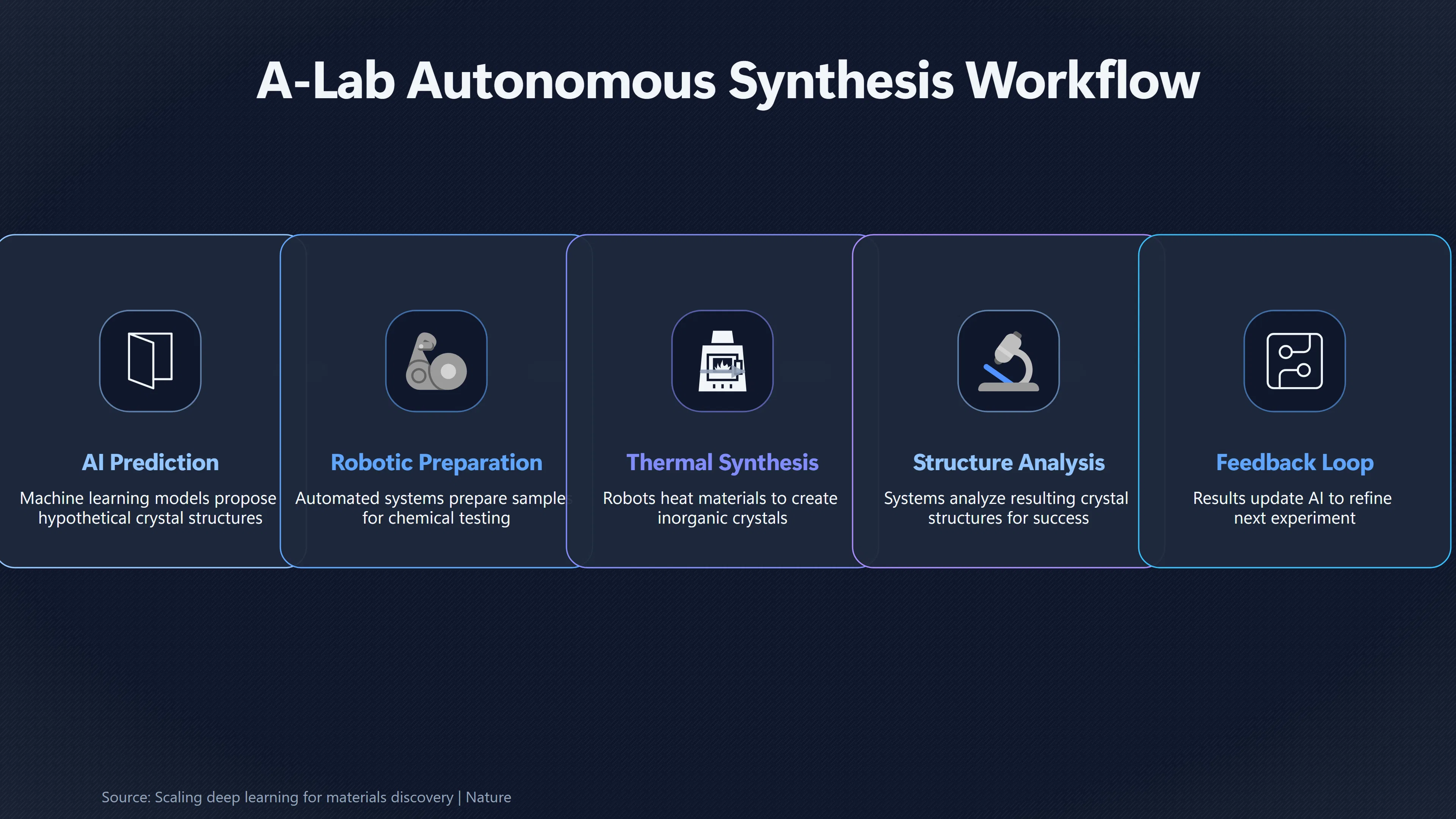
A leading example is Berkeley Lab’s A-Lab. Rather than relying on researchers to perform every synthesis manually, robots prepare samples, heat materials, analyse their crystal structures and feed the results back into AI systems that decide what experiment should be attempted next.
During one demonstration, the system operated continuously for 17 days, performing hundreds of experiments and successfully synthesising dozens of previously predicted inorganic materials with minimal human intervention. Equally important, the failed experiments were analysed automatically to improve subsequent synthesis strategies rather than simply being discarded.[nature.com]nature.comNovember 29, 2023…
This approach narrows one of the largest historical bottlenecks in materials science. Traditional research often proceeds through an iterative cycle:
- Predict a material.
- Attempt synthesis.
- Discover the recipe fails.
- Modify the experiment.
- Repeat.
Each iteration may take weeks or months when performed manually. Autonomous laboratories compress this cycle dramatically by allowing robots to work continuously while AI adjusts experimental plans in response to incoming data.
For AI Bloom, this matters because scientific acceleration depends not only on better algorithms but also on shortening the feedback loop between prediction and physical reality.
Why promising materials still fail to scale
Despite impressive demonstrations, laboratory success does not guarantee commercial success.
Many AI-discovered materials fail for reasons unrelated to the quality of the prediction itself.
Manufacturing can be fundamentally different from laboratory synthesis
Producing milligrams of a material inside a research laboratory is very different from manufacturing thousands of tonnes every year.
Industrial production requires:
- reproducible quality
- inexpensive raw materials
- acceptable energy consumption
- low waste
- compatibility with existing factories
- stable supply chains.
A synthesis pathway that works beautifully in a university laboratory may prove economically impossible at industrial scale.
Real-world operating conditions are harsher
Many candidate materials perform well under carefully controlled laboratory conditions but degrade under real use.
Battery materials may experience thousands of charging cycles.
Catalysts may slowly poison themselves through contamination.
Solar materials must tolerate decades of sunlight, moisture and temperature changes.
Hydrogen-production catalysts operate under chemically aggressive conditions.
These long-term durability questions cannot be answered by AI prediction alone.

Safety constraints are unforgiving
Commercial energy technologies often require years of validation.
Battery chemistries must avoid thermal runaway.
Industrial catalysts must remain chemically stable.
New compounds may introduce unexpected toxicity or environmental hazards.
AI can help identify candidates, but regulatory approval and safety testing remain essential.
Cost often dominates performance
The best-performing material is not necessarily the most commercially valuable.
A catalyst offering a 5% efficiency improvement may never be adopted if it depends on scarce elements, difficult processing or expensive manufacturing equipment.
Likewise, a battery chemistry using abundant sodium instead of lithium may ultimately prove more valuable despite lower theoretical performance because its overall system cost is lower.
For this reason, researchers increasingly train AI systems to optimise multiple objectives simultaneously rather than focusing only on peak performance.[arXiv]arxiv.orgarXiv Matter Gen: a generative model for inorganic materials designMatterGen: a generative model for inorganic materials designDecember 6, 2023…
Discovery is becoming faster than validation
One emerging imbalance is that computational discovery is accelerating much faster than experimental verification.
Large AI systems can now generate millions of hypothetical materials, while even highly automated laboratories can only synthesise and characterise a tiny fraction of them.
This creates a growing prioritisation problem.
Researchers increasingly use additional AI models to estimate:
- likelihood of successful synthesis
- expected manufacturing complexity
- chemical novelty
- stability under realistic conditions
- economic attractiveness.
Rather than asking only whether a material is theoretically stable, researchers increasingly ask whether it is synthesisable, manufacturable and commercially meaningful.
Recent research suggests that many computationally generated materials occupy regions of chemical space that differ substantially from historically realised materials, highlighting the importance of estimating practical synthesisability rather than assuming every predicted structure can be produced economically.[arXiv]arxiv.orgComputed materials proposals depart from the structural memory of experimental discoveryJune 30, 2026…

The bottleneck is shifting from computation to engineering
As prediction improves, the slowest part of the innovation pipeline increasingly becomes engineering rather than discovery.
After identifying a promising material, developers may still need to solve problems involving:
- purification processes
- crystal defects
- grain boundaries
- mechanical stability
- manufacturing yield
- packaging
- integration into complete devices
- quality control during mass production.
For batteries, this means assembling complete cells rather than testing isolated materials.
For catalysts, it means designing industrial reactors.
For carbon capture materials, it means proving reliable operation over many years while minimising energy consumption.
These engineering problems frequently dominate commercial timelines.
What this means for AI and long-term abundance
Materials discovery illustrates both the promise and the limits of AI acceleration.
The optimistic case is strong in one important respect. Machine learning appears capable of expanding humanity’s search across chemical space by orders of magnitude while autonomous laboratories reduce the time needed to validate promising candidates. Scientific progress that once depended on decades of manual experimentation may increasingly occur through continuous cycles of prediction, robotic testing and refinement.[nature.com]nature.comNovember 29, 2023…
However, this does not mean that abundance arrives automatically. Every successful material still requires mining, manufacturing, engineering, financing, regulation and deployment. New battery chemistries must compete with mature lithium-ion supply chains. Novel catalysts must outperform established industrial processes. Manufacturing plants cannot be redesigned overnight simply because an AI system has proposed a better crystal.
For the broader AI Bloom perspective, this is an important lesson. Advanced AI may dramatically accelerate scientific discovery, but civilisation-scale benefits depend on the less glamorous work that follows: scaling factories, improving supply chains, reducing costs, ensuring safety and building institutions capable of turning laboratory breakthroughs into technologies that improve everyday life. The pace of human flourishing will therefore be determined not only by how quickly AI discovers new materials, but by how effectively societies translate those discoveries into reliable, affordable and widely accessible infrastructure.
Amazon book picks
Further Reading
Books and field guides related to Why Promising AI Materials Still Fail to Scale. Use these as the next step if you want deeper reading beyond the article.
Energy and Civilization: A History
A comprehensive account of how energy has shaped society throughout history, from pre-agricultural foraging societies through today's fos...
Callister's Materials Science and Engineering, Global Edition
Callister's Materials Science and Engineering: An Introduction, 10th Edition promotes student understanding of the three primary types of...
Stuff Matters: Exploring the Marvelous Materials That Shape O...
An eye-opening adventure deep inside the everyday materials that surround us, from concrete and steel to denim and chocolate, packed with...
The Coming of Materials Science
The Coming of Materials Science both covers the discipline of materials science, and draws an impressionistic map of the present state of...
eBay marketplace picks
Marketplace Samples
Live-tested eBay searches with available results related to this page.
Selected fromscience poster oneBay.co.uk.


Endnotes
1.
Source: nature.com
Link:https://www.nature.com/articles/s41586-023-06734-w
Source snippet
November 29, 2023...
Published: November 29, 2023
2.
Source: nature.com
Title: Scaling deep learning for materials discovery | Nature
Link:https://www.nature.com/articles/s41586-023-06735-9
3.
Source: arxiv.org
Title: arXiv Matter Gen: a generative model for inorganic materials design
Link:https://arxiv.org/abs/2312.03687
Source snippet
MatterGen: a generative model for inorganic materials designDecember 6, 2023...
Published: December 6, 2023
4.
Source: arxiv.org
Link:https://arxiv.org/abs/2401.04070
Source snippet
Accelerating computational materials discovery with artificial intelligence and cloud high-performance computing: from large-scale s...
5.
Source: arxiv.org
Link:https://arxiv.org/abs/2606.30967
Source snippet
Computed materials proposals depart from the structural memory of experimental discoveryJune 30, 2026...
Published: June 30, 2026
6.
Source: deepmind.google
Title: Millions of new materials discovered with deep learning
Link:https://deepmind.google/en/blog/millions-of-new-materials-discovered-with-deep-learning/
7.
Source: deepmind.google
Title: Millions of new materials discovered with deep learning — Google Deep Mind
Link:https://deepmind.google/blog/millions-of-new-materials-discovered-with-deep-learning/
8.
Source: nature.com
Title: Autonomous experiments using active learning and AI | Nature Reviews Materials
Link:https://www.nature.com/articles/s41578-023-00588-4
9.
Source: nature.com
Title: Combinatorial synthesis for AI-driven materials discovery | Nature Synthesis
Link:https://www.nature.com/articles/s44160-023-00251-4
Additional References
10.
Source: pubs.rsc.org
Title: Yager ^{b}, Danielle Monteverde ^{b}, Dave Baiocchi ^{b}, Ha-Kyung
Link:https://pubs.rsc.org/en/content/articlehtml/2024/dd/d4dd00059e
Source snippet
laboratories for accelerated materials discovery: a community survey and practical insights - Digital Discovery (RSC Publishing) DOI:10.1...
11.
Source: pubmed.ncbi.nlm.nih.gov
Link:https://pubmed.ncbi.nlm.nih.gov/38030721/
Source snippet
An autonomous laboratory for the accelerated synthesis of novel materials - PubMed...
12.
Source: youtube.com
Link:https://www.youtube.com/watch?v=Oepxd27_5JE
Source snippet
Accelerating Materials Discovery, Design, and [Development]({{ 'build-rights/' | relative_url }}) with Materials Informatics | James Saal...
13.
Source: pubs.rsc.org
Title: Yager,^{b} Danielle Monteverde,^{b}
Link:https://pubs.rsc.org/en/content/articlelanding/2024/dd/d4dd00059e
Source snippet
laboratories for accelerated materials discovery: a community survey and practical insights - Digital Discovery (RSC Publishing)May 31, 2...
14.
Source: pubmed.ncbi.nlm.nih.gov
Title: Pub Med Scaling deep learning for materials discovery
Link:https://pubmed.ncbi.nlm.nih.gov/38030720/
Source snippet
Scaling deep learning for materials discovery - PubMed...
15.
Source: youtube.com
Link:https://www.youtube.com/watch?v=ajmSiHCZo1Q
Source snippet
Discovering New Materials With AI | Jonathan Godwin...
16.
Source: youtube.com
Link:https://www.youtube.com/watch?v=lVa7v8AbTM8
Source snippet
Can AI Create Materials That Never Existed?...
17.
Source: youtube.com
Title: Discovering New Materials With AI | Jonathan Godwin
Link:https://www.youtube.com/watch?v=P3uHQGGQiLs
Source snippet
Public Lecture | How scientists are building the AI-powered laboratory presented by Sean Gasiorowski...
18.
Source: osti.gov
Link:https://www.osti.gov/biblio/2281696
19.
Source: cambridge.org
Link:https://www.cambridge.org/engage/chemrxiv/article-details/65e0ce79e9ebbb4db993d6fe