Within Pandemic Defence
How AI biology needs stronger safeguards
Advanced AI for biology requires safeguards that reduce the chance of harmful use while preserving legitimate medical progress.
On this page
- The dual use challenge in biology
- Testing and controlling risky capabilities
- International cooperation on AI safety
Page outline Jump by section
Introduction
AI could strengthen humanity’s defences against pandemics by helping scientists discover medicines, monitor emerging diseases and accelerate biological research. But the same ability to analyse and design biological systems creates a new governance challenge: advanced AI for biology is a dual-use technology, meaning the same tools that support health breakthroughs could also be misused. The central biosecurity question is therefore not whether AI biology should be slowed down, but how societies can preserve its enormous medical potential while reducing the chance of harmful applications.[National Academies]nationalacademies.orgNational Academies The Age of AI in the Life SciencesNational Academies The Age of AI in the Life Sciences
For an AI-enabled human bloom, this distinction is crucial. A future where AI helps eliminate disease and extend healthy lives depends on maintaining trust in scientific progress. If biological AI systems become easier to misuse without adequate safeguards, the technologies intended to improve human flourishing could also create new vulnerabilities. Effective biosecurity safeguards aim to keep the benefits of scientific acceleration while ensuring that powerful capabilities develop within responsible limits.[National Academies]nationalacademies.orgNational AcademiesAI Tools Can Enhance U.S. Biosecurity; Monitoring and Mitigation Will Be Needed to Protect Against MisuseMarch 14, 2025…
The dual-use challenge in biology
AI is becoming increasingly important in life sciences because it can process enormous biological datasets, predict molecular structures, assist with drug discovery and help researchers design new biological tools. These same capabilities create concerns because biological knowledge that is useful for medicine can sometimes also be relevant to harmful purposes. The National Academies of Sciences, Engineering, and Medicine’s 2025 consensus report on AI and life sciences describes this as a central challenge: AI-enabled biological tools may accelerate beneficial research while also introducing new biosecurity risks.[National Academies]nationalacademies.orgOpen source on nationalacademies.org.
The difficulty is that biology does not divide neatly into “safe” and “dangerous” categories. A technique developed to understand viruses, engineer therapies or improve vaccines may also increase knowledge about biological systems more generally. The goal of biosecurity is therefore not to block biological innovation, but to manage where additional caution is needed.
Several features make AI biology different from earlier scientific risks:
- Lower barriers to expertise: AI systems can make complex scientific information easier to search, summarise and apply, potentially widening access to capabilities that previously required years of specialist training.
- Rapid capability improvement: AI models are improving quickly, making it harder for oversight systems to rely only on past assumptions about what tools can do.
- Global accessibility: Scientific information and computational tools increasingly cross national borders, meaning safeguards need international coordination rather than isolated national action.
- Difficulty of prediction: Researchers cannot always know in advance which biological applications will become important or which capabilities may create unexpected risks.
These challenges do not mean AI biology is uniquely dangerous. Many previous technologies, from synthetic biology to chemical manufacturing, have required safety standards because they combine valuable uses with possible misuse. The difference is that AI may accelerate the pace at which biological design becomes possible.
Testing and controlling risky capabilities
A major safeguard is testing AI systems before they are widely deployed. Traditional software testing asks whether a system works as intended; biosecurity evaluations must also ask whether a system can produce or enable harmful outcomes when deliberately misused.
This has led to the growth of red-teaming and capability evaluations, where researchers actively test whether AI models can be pushed beyond their intended boundaries. The UK’s AI Security Institute has argued that misuse safeguards need rigorous evaluation rather than assumptions that safety measures will work. Its framework recommends clearer methods for testing whether AI protections actually prevent harmful requests and actions.[AI Security Institute]aisi.gov.ukAI Security Institute Principles for evaluating misuse safeguards of frontier AI systemsAI Security Institute Principles for evaluating misuse safeguards of frontier AI systems
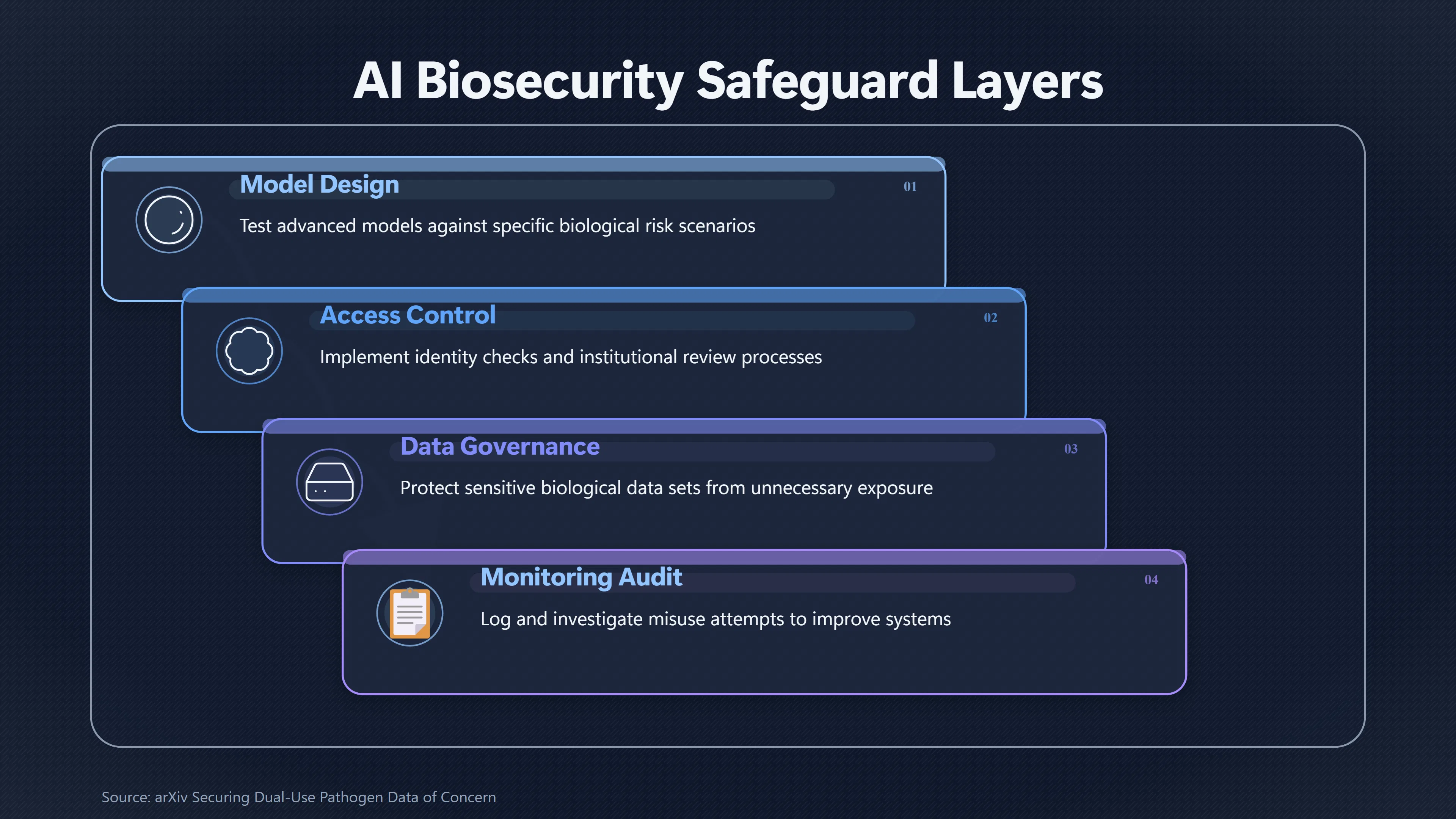
For biological AI, safeguards can operate at several layers:
Model design and evaluation
Developers can test advanced models against carefully designed biological risk scenarios before release. These assessments can examine whether a model provides inappropriate assistance, whether restrictions can be bypassed and whether new capabilities create risks that were not present in earlier systems.
Access controls
Not every AI capability needs to be equally available to every user or application. Systems with more advanced biological capabilities may require stronger identity checks, monitoring, institutional access or additional review processes.
Data governance
AI models depend heavily on training data. Some researchers argue that particularly sensitive biological datasets should receive greater protection, similar to other forms of sensitive information. A proposed framework for classifying dual-use pathogen data highlights the challenge of balancing scientific openness with preventing unnecessary exposure of high-risk information.[arXiv]arxiv.orgarXiv Securing Dual-Use Pathogen Data of ConcernSecuring Dual-Use Pathogen Data of ConcernFebruary 8, 2026…
Monitoring and accountability
Safeguards are more effective when organisations can detect misuse attempts, investigate incidents and improve systems over time. This requires logging, auditing and clear responsibility for decisions made during development and deployment.
However, safeguards are not perfect. Security researchers have repeatedly shown that AI protections can fail under unexpected conditions, including attempts to bypass restrictions. This is why biosecurity cannot depend on a single technical barrier. It requires multiple layers of defence across AI companies, research institutions, governments and international bodies.[The Guardian]theguardian.comThe Guardian AI safeguards can easily be broken, UK Safety Institute findsThe institute's research revealed that AI safeguards could be easily bypassed using basic prompts or more sophisticated jailbreaking tech…
International cooperation on AI safety
Biological risks do not respect borders, and neither do modern AI systems. A researcher, company or government in one country may develop tools whose effects are felt globally. This makes international cooperation a core part of AI biosecurity.
The challenge resembles earlier efforts to govern other dual-use technologies: societies need rules that reduce catastrophic risks without preventing legitimate scientific progress. Effective systems need cooperation on standards, information sharing, research security and responsible innovation.
The World Health Organization’s guidance on AI in health provides a broader foundation for this approach, emphasising that AI systems should be developed with accountability, transparency, equity and human benefit in mind. These principles matter for biosecurity because public trust is essential when powerful technologies influence health decisions and research priorities.[World Health Organization]who.intWorld Health OrganizationEthics and governance of artificial intelligence for healthJune 28, 2021…
International cooperation is developing through several routes:
- Shared evaluation standards: Countries and organisations can work towards common approaches for assessing biological risks from advanced AI systems.
- Research security norms: Universities and companies can establish clearer practices for handling sensitive biological information and technologies.
- Global inclusion: Safeguards should not become a way for wealthy countries to monopolise scientific progress. A secure AI future must also allow researchers worldwide to benefit from medical advances.
- Crisis coordination: If an AI-enabled biological risk emerges, rapid communication between governments, scientists and health organisations will be essential.
The 2023 AI Safety Summit’s Bletchley Declaration reflected growing recognition among governments that advanced AI risks require international attention, including cooperation around potentially serious harms.[Reddit]reddit.comUK, US, EU and China sign declaration of AI's 'catastrophic' dangerUK, US, EU and China sign declaration of AI's 'catastrophic' dangerNovember 1, 2023…
Protecting innovation while preserving trust
The strongest case for AI in biology is also the reason safeguards matter. AI could contribute to faster drug discovery, improved pandemic preparedness and new medical breakthroughs that expand human health and longevity. Preventing misuse is therefore not simply a defensive goal; it is part of creating the conditions where beneficial innovation can continue.
A balanced approach avoids two extremes. One is assuming that technological progress will automatically produce good outcomes. The other is treating every powerful biological AI capability as too dangerous to develop. Both approaches ignore the central governance challenge: building institutions that allow humanity to gain the benefits while managing the risks.
For the wider AI bloom vision, biosecurity safeguards represent a form of long-term resilience. A civilisation capable of using advanced intelligence to understand biology, prevent disease and improve human wellbeing must also become capable of governing powerful tools responsibly. The future gains from AI in health depend not only on what these systems can discover, but on whether societies can ensure that their capabilities remain aligned with human flourishing.
Amazon book picks
Further Reading
Books and field guides related to How AI biology needs stronger safeguards. Use these as the next step if you want deeper reading beyond the article.
The Fifth Risk
'Will set your hair on end' Telegraph, Top 50 Books of the Year 'I forgot to breathe while reading The Fifth Risk' Michael Hofmann, TLS,...
The Demon in the Freezer
Jahrling is haunted by the thought that biologists in secret labs are using genetic engineering to create a new superpox virus, a smallpo...
Weapons of Math Destruction
'A manual for the 21st-century citizen... accessible, refreshingly critical, relevant and urgent' - Financial Times 'Fascinating and deep...
eBay marketplace picks
Marketplace Samples
Live-tested eBay searches with available results related to this page.
Selected frombiology model oneBay.co.uk.

Endnotes
1.
Source: arxiv.org
Title: arXiv Securing Dual-Use Pathogen Data of Concern
Link:https://arxiv.org/abs/2602.08061
Source snippet
Securing Dual-Use Pathogen Data of ConcernFebruary 8, 2026...
Published: February 8, 2026
2.
Source: reddit.com
Title: UK, US, EU and China sign declaration of AI’s ‘catastrophic’ danger
Link:https://www.reddit.com/r/artificial/comments/17lkvz6
Source snippet
UK, US, EU and China sign declaration of AI's 'catastrophic' dangerNovember 1, 2023...
Published: November 1, 2023
3.
Source: nationalacademies.org
Title: National Academies The Age of AI in the Life Sciences
Link:https://www.nationalacademies.org/projects/DELS-BLS-24-04/publication/28868
4.
Source: nationalacademies.org
Link:https://www.nationalacademies.org/news/ai-tools-can-enhance-u-s-biosecurity-monitoring-and-mitigation-will-be-needed-to-protect-against-misuse
Source snippet
National AcademiesAI Tools Can Enhance U.S. Biosecurity; Monitoring and Mitigation Will Be Needed to Protect Against MisuseMarch 14, 2025...
Published: March 14, 2025
5.
Source: nationalacademies.org
Link:https://www.nationalacademies.org/publications/28868?page=57
6.
Source: aisi.gov.uk
Link:https://www.aisi.gov.uk/research/principles-for-evaluating-misuse-safeguards-of-[frontier
7.
Source: theguardian.com
Title: The Guardian AI safeguards can easily be broken, UK Safety Institute finds
Link:https://www.theguardian.com/technology/2024/feb/09/ai-safeguards-can-easily-be-broken-uk-safety-institute-finds
Source snippet
The institute's research revealed that AI safeguards could be easily bypassed using basic prompts or more sophisticated jailbreaking tech...
8.
Source: who.int
Link:https://www.who.int/publications/i/item/9789240029200
Source snippet
World Health OrganizationEthics and governance of artificial intelligence for healthJune 28, 2021...
Published: June 28, 2021
9.
Source: aiwiki.ai
Title: Bletchley Declaration | AI Wiki
Link:https://aiwiki.ai/wiki/bletchley_declaration
Source snippet
June 21, 2026 — Bletchley Declaration BLETCHLEY DECLARATION AI Policy & RegulationAI Safety 26 min read Updated Jun 21, 2026 Suggest edit...
Published: June 21, 2026
10.
Source: GOV.UK
Title: www.gov.uk Data and AI Ethics Framework
Link:https://www.gov.uk/government/publications/data-ethics-framework/data-and-ai-ethics-framework
11.
Source: who.int
Link:https://www.who.int/publications/i/item/9789240108868
12.
Source: GOV.UK
Link:https://www.gov.uk/government/publications/ai-safety-summit-2023-the-bletchley-declaration/the-bletchley-declaration-by-countries-attending-the-ai-safety-summit-1-2-november-2023
Published: november 2023
13.
Source: uwnxt.nationalacademies.org
Link:https://uwnxt.nationalacademies.org/read/28868
14.
Source: uwnxt.nationalacademies.org
Link:https://uwnxt.nationalacademies.org/read/28868/chapter/2
15.
Source: uwnxt.nationalacademies.org
Link:https://uwnxt.nationalacademies.org/read/28868/chapter/3
16.
Source: uwnxt.nationalacademies.org
Link:https://uwnxt.nationalacademies.org/projects/DELS-BLS-24-04/event/43297
17.
Source: GOV.UK
Title: www.gov.uk A I Safety Institute approach to evaluations
Link:https://www.gov.uk/government/publications/ai-safety-institute-approach-to-evaluations/ai-safety-institute-approach-to-evaluations
18.
Source: GOV.UK
Title: ai safety summit 2023 the bletchley declaration
Link:https://www.gov.uk/government/publications/ai-safety-summit-2023-the-bletchley-declaration
19.
Source: GOV.UK
Link:https://www.gov.uk/government/news/countries-agree-to-safe-and-responsible-development-of-frontier-ai-in-landmark-bletchley-declaration?bxid=5cec23dffc942d3ada01da49&cndid=38838028&esrc=Wired_etl_load
20.
Source: GOV.UK
Title: ai safety summit 2023 the bletchley declaration.es 419
Link:https://www.gov.uk/government/publications/ai-safety-summit-2023-the-bletchley-declaration.es-419
21.
Source: industry.gov.au
Title: bletchley declaration countries attending ai safety summit 1 2 november 2023
Link:https://www.industry.gov.au/publications/bletchley-declaration-countries-attending-ai-safety-summit-1-2-november-2023
Published: november 2023
22.
Source: who.int
Link:https://www.who.int/publications-detail-redirect/9789240037403
23.
Source: who.int
Link:https://www.who.int/news/item/28-06-2021-who-issues-first-global-report-on-ai-in-health-and-six-guiding-principles-for-its-design-and-use
24.
Source: who.int
Title: Health Ethics & Governance
Link:https://www.who.int/teams/health-ethics-governance/emerging-technologies/big-data-and-artificial-intelligence
25.
Source: who.int
Link:https://www.who.int/publications/b/81594
26.
Source: who.int
Link:https://www.who.int/publications/b/58847
27.
Source: who.int
Link:https://www.who.int/teams/health-ethics-governance/emerging-technologies
28.
Source: who.int
Link:https://www.who.int/groups/technical-advisory-group-on-the-responsible-use-of-the-life-sciences-and-dual-use-research-%28tag-ruls-dur%29
29.
Source: emro.who.int
Title: int WH O EMRO
Link:https://www.emro.who.int/emhj-volume-30-2024/volume-30-issue-6/adhering-to-ethics-guidelines-in-biomedical-research-and-medical-practice-is-crucial-to-save-lives.html
30.
Source: nationalacademies.org
Link:https://www.nationalacademies.org/read/28868
31.
Source: nationalacademies.org
Link:https://www.nationalacademies.org/publications/28868?page=552&publication_date%5Bquick%5D=past_5_years&sort=asc
32.
Source: nap.nationalacademies.org
Link:https://nap.nationalacademies.org/collection/69/biosecurity
33.
Source: nap.nationalacademies.org
Link:https://nap.nationalacademies.org/catalog/27971/strategic-report-on-research-and-development-in-biotechnology-for-defense-innovation?s=z1120
34.
Source: aisi.gov.uk
Link:https://www.aisi.gov.uk/blog/principles-for-safeguard-evaluation
35.
Source: aisi.gov.uk
Link:https://www.aisi.gov.uk/frontier-ai-trends-report
36.
Source: aisi.gov.uk
Link:https://www.aisi.gov.uk/research
37.
Source: aisi.gov.uk
Link:https://www.aisi.gov.uk/research-agenda
38.
Source: aisi.gov.uk
Link:https://www.aisi.gov.uk/blog
39.
Source: oecd.org
Link:https://www.oecd.org/en/topics/sub-issues/synthetic-biology.html
40.
Source: regulations.ai
Title: Bletchley Declaration
Link:https://regulations.ai/glossary/bletchley-declaration
Additional References
41.
Source: youtube.com
Link:https://www.youtube.com/watch?v=SvPcxRiFauY
Source snippet
discusses frameworks for governing biological data and implementing safeguards to manage misuse risks associated with advanced AI foundat...
42.
Source: youtube.com
Link:https://www.youtube.com/watch?v=S0idP71jyGg
Source snippet
Scaling Laws: Why Data Governance Is the Key to AI Biosecurity, with Jassi Pannu and Doni Bloomfield...
43.
Source: youtube.com
Title: How can the BWC address the dual-use challenges of AI-driven biodesign tools?
Link:https://www.youtube.com/watch?v=lBgmASzueR0
Source snippet
Day 2 High-Level Virtual Workshop on Dual-Use Research of Concern and Responsible Life Sciences...
44.
Source: youtube.com
Title: From AI Boom To Bioweapons Battle: CEOs Demand New Safeguards
Link:https://www.youtube.com/watch?v=MZAHa4G–7s
Source snippet
How can the BWC address the dual-use challenges of AI-driven biodesign tools?...
45.
Source: youtube.com
Title: In New Delhi, Hassabis Warns of AI Biosecurity and Cybersecurity Risks
Link:https://www.youtube.com/watch?v=_au-zciGxD8
Source snippet
From AI Boom To Bioweapons Battle: CEOs Demand New Safeguards...
46.
Source: oecd.org
Link:https://www.oecd.org/en/publications/anticipatory-governance-for-responsible-innovation-in-synthetic-biology_864dd003-en/full-report/component-5.html
47.
Source: oecd.org
Link:https://www.oecd.org/en/publications/anticipatory-governance-for-responsible-innovation-in-synthetic-biology_864dd003-en/full-report/component-4.html
48.
Source: nature.com
Link:https://www.nature.com/articles/s41587-025-02650-8
49.
Source: oecd.ai
Link:https://oecd.ai/en/ai-publications/advancing-accountability
50.
Source: doi.org
Link:https://doi.org/10.1007/s43681-025-00872-9