Within AI Abundance
Why Better AI Plans Will Not Make Homes Cheap
AI can improve plans and reduce design costs, but land, materials, labour, energy and planning permission still constrain housing.
On this page
- What AI can reduce in housing design and administration
- The physical bottlenecks that remain after the plan
- How land rules and ownership shape affordability
Page outline Jump by section
Introduction
Advanced AI could make many parts of the housing industry faster, cheaper and more accurate. It can generate architectural concepts in seconds, optimise structural designs, automate paperwork, identify suitable development sites and help planners process applications more efficiently. Those improvements matter. They could reduce some professional costs, shorten delays and increase the number of homes that can be built with the same amount of human expertise.

However, cheaper intelligence does not make housing post-scarcity. A home is not simply information. Every additional dwelling still requires land, physical materials, energy, transport, skilled construction work, financing, legal approval and supporting infrastructure such as roads, water, sewage and electricity. In many of the world’s most expensive housing markets, the largest barriers are not a shortage of architectural drawings but restrictions on where homes may be built and who controls valuable land. Research on housing supply consistently finds that regulatory constraints and land scarcity remain central drivers of affordability in high-demand regions.[National Bureau of Economic Research]nber.orgOpen source on nber.org.
Housing therefore illustrates one of the central themes of the wider AI abundance debate: making intelligence abundant does not automatically make physical goods abundant.
What AI can reduce in housing design and administration
Housing development contains many information-intensive tasks that AI is well suited to assist.
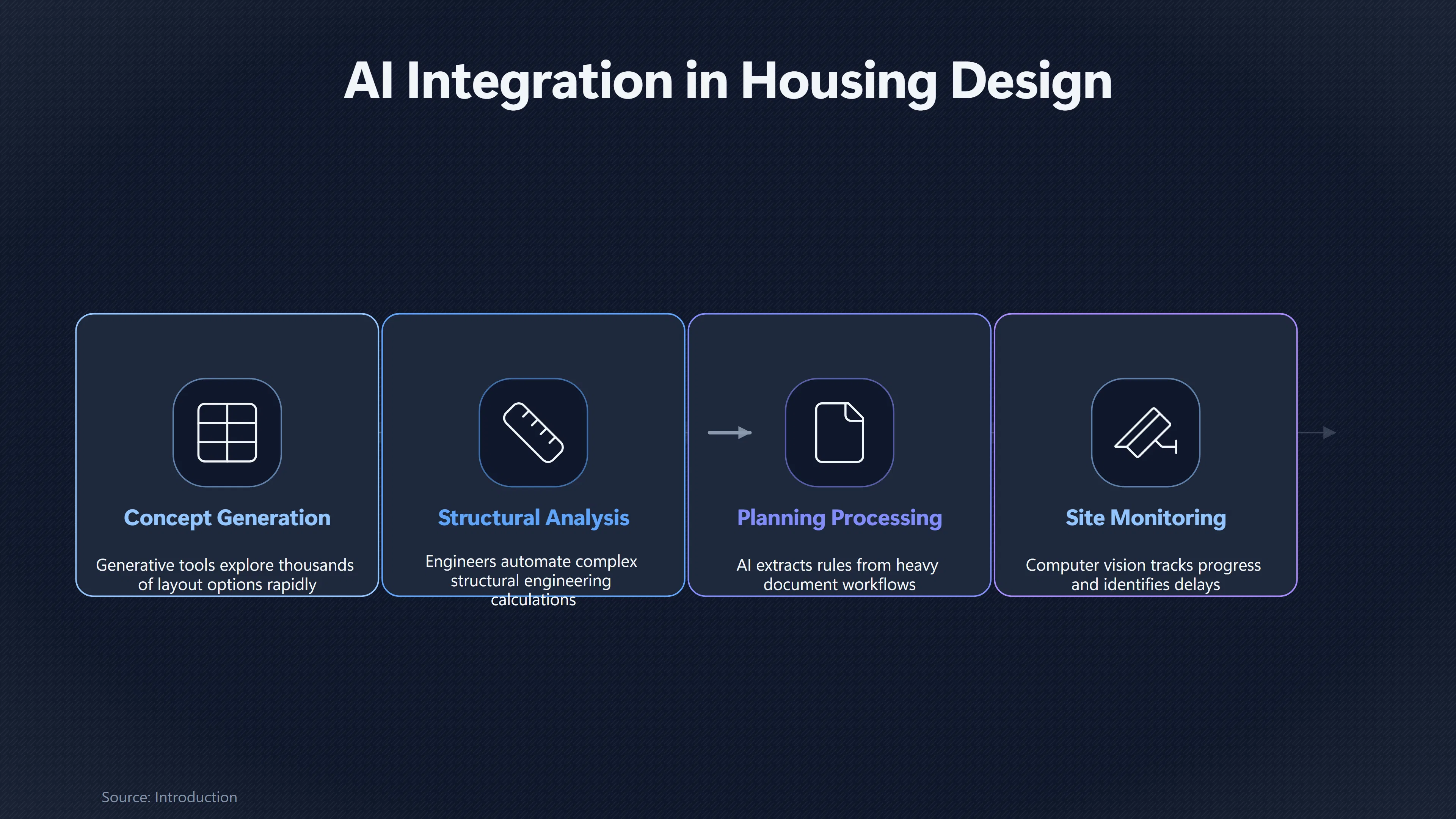
Architects already use generative design tools to explore alternative layouts, optimise daylight, reduce material use and evaluate thousands of design options much faster than traditional methods. Engineers can automate parts of structural analysis, while quantity surveyors can estimate costs more rapidly. Construction firms increasingly use AI to coordinate schedules, predict delays and monitor sites.
Planning systems also contain large amounts of paperwork that AI can help process. Digitising planning documents, extracting relevant rules and identifying missing information can reduce administrative delays. Governments have begun experimenting with AI-assisted planning tools precisely because the planning process is often slowed by document-heavy workflows rather than difficult engineering.[mckinsey.com]mckinsey.comMc Kinsey & Company How agentic AI is transforming the AEC industry | Mc KinseyMcKinsey & CompanyHow agentic AI is transforming the AEC industry | McKinseyJuly 15, 2026…
These improvements can lower costs in areas such as:
- Architectural drafting and concept generation.
- Planning document preparation.
- Building information modelling (BIM).
- Cost estimation.
- Scheduling and procurement.
- Compliance checking.
- Site inspection using computer vision.
- Maintenance planning after construction.
All of these reduce the cost of producing and managing information. None directly creates additional land or concrete.
The physical bottlenecks that remain after the plan
A complete architectural design is only the beginning of a building project.
Once the plans exist, developers must still acquire land, obtain finance, secure planning permission, purchase materials, hire contractors, coordinate utilities and complete months or years of physical construction. These steps depend on scarce resources that cannot simply be copied in the way software can.
Several constraints remain largely physical.
Land. Central urban land exists in fixed locations. AI cannot create more waterfront property in London or Manhattan.
Construction labour. Although robotics may automate some tasks over time, housing construction still depends heavily on electricians, plumbers, steel workers, carpenters, crane operators and inspectors.
Materials. Cement, steel, timber, glass, insulation and copper all require mines, factories, transport networks and energy.
Infrastructure. New homes need roads, schools, hospitals, electricity networks, water systems and drainage capacity.
Capital. Large housing projects require financing over long periods, exposing developers to interest-rate risk and market uncertainty.
These bottlenecks explain why housing cannot become infinitely scalable merely because the design process becomes inexpensive.
Why land matters more than blueprints
In expensive cities, the largest component of housing prices is often not the building itself but the right to build in a desirable location.
Economic research has long distinguished between the physical cost of constructing a house and the market value of land. Where land is plentiful and regulation is relatively permissive, new housing prices often remain close to construction costs. Where development rights are tightly constrained, land values can rise dramatically above the cost of the building placed upon them.[National Bureau of Economic Research]nber.orgOpen source on nber.org.
This creates an important distinction.
If AI cuts architectural costs by 50%, but architectural fees account for only a small share of the total development cost, overall housing prices may fall only modestly.
Conversely, if planning restrictions allow very few homes to be built in desirable areas, lower design costs may simply increase competition for the same scarce parcels of land, pushing land prices higher instead.
Housing therefore behaves differently from software. Software can usually be duplicated at almost zero marginal cost. Prime urban land cannot.

How land rules and ownership shape affordability
Housing affordability is influenced not only by engineering but also by institutions.[t.co]t.coSource details in endnotes.
Planning systems decide where housing may be built, at what density and under which conditions. Local governments often impose limits on building height, setbacks, parking requirements, heritage protections and environmental standards. Many of these rules pursue legitimate goals such as safety, environmental protection or neighbourhood character, but collectively they can substantially restrict housing supply.[National Bureau of Economic Research]nber.orgNational Bureau of Economic Research Regulation and Housing Supply | NBERNational Bureau of Economic Research Regulation and Housing Supply | NBER
Ownership patterns matter as well.
Where a relatively small number of owners control developable land, rising demand can increase land values faster than construction capacity expands. Developers may also delay projects for commercial reasons, while fragmented ownership can make assembling suitable sites extremely difficult.
AI cannot resolve these institutional questions on its own. It may identify the optimal location for new housing, but it cannot compel landowners to sell or governments to approve development.
Better planning software is helpful but not sufficient
One genuine opportunity for AI lies in making planning systems more efficient.
Many planning authorities still process large volumes of paper records, manually review routine applications and spend considerable staff time on repetitive administrative tasks. AI can help digitise records, extract planning constraints, identify inconsistencies and assist officers with routine analysis.
Faster administration could reduce unnecessary delays and lower some development costs. That is valuable because uncertainty itself raises financing costs and discourages investment.
But even a perfectly efficient planning office would still face policy decisions that require democratic judgement:
- How many homes should be permitted?
- Where should higher-density housing be allowed?
- Which environmental protections should apply?
- How should infrastructure costs be shared?
- How should local concerns be balanced against regional housing needs?
These are political and legal questions rather than computational ones.
Construction productivity can improve without eliminating scarcity
The construction sector has historically experienced much slower productivity growth than manufacturing.
AI, combined with robotics, modular construction, better logistics and digital project management, could improve this situation. Better forecasting may reduce delays. Automated quality inspection may reduce costly rework. Supply chains may become more efficient. Design errors may be identified before construction begins.
Yet even optimistic analyses of AI in construction focus on improving productivity rather than eliminating physical constraints. Construction remains an industry where work must occur at specific locations, often outdoors, under changing conditions and within complex regulatory environments.[mckinsey.com]mckinsey.comMc Kinsey & Company How agentic AI is transforming the AEC industry | Mc KinseyMcKinsey & CompanyHow agentic AI is transforming the AEC industry | McKinseyJuly 15, 2026…
This distinction matters.
Higher productivity means more homes can potentially be built with the same resources.
Post-scarcity would imply that housing could be supplied almost without limit at negligible cost.
Those are very different outcomes.
Could robotics eventually change the picture?
Over longer time horizons, advanced robotics could reduce some of today’s physical bottlenecks.
Autonomous excavation equipment, robotic bricklaying, automated factories producing modular housing and AI-managed construction fleets could significantly reduce labour requirements. Combined with abundant clean energy and cheaper materials, these technologies could lower construction costs much more than software alone.
Even then, however, location remains scarce.
People value proximity to jobs, culture, family, transport links, natural amenities and existing communities. If millions of people wish to live in the same neighbourhood, no amount of AI can place everyone on the same street. Demand for particular locations will continue to create scarcity even if the physical cost of constructing buildings falls dramatically.
Housing shows the limits of intelligence alone
Housing is one of the clearest examples of why abundant intelligence does not automatically create a post-scarcity economy.
AI can reduce the cost of thinking about buildings far more easily than it can reduce the cost of building them. It can make architects, engineers, planners and developers more productive, but homes still depend on land, infrastructure, finance, energy, materials and public institutions.
For the broader question of AI-enabled human flourishing, this is an important lesson. Advanced AI may remove many informational bottlenecks that currently slow economic progress. Yet whether those gains translate into broadly affordable housing depends on complementary changes in planning, infrastructure investment, construction technology, land-use policy and the distribution of valuable urban land.
The future is therefore likely to be one of selective abundance rather than universal post-scarcity. Intelligence may become increasingly cheap, while some of the goods people value most—including homes in desirable places—remain shaped by physical limits and institutional choices.
Amazon book picks
Further Reading
Books and field guides related to Why Better AI Plans Will Not Make Homes Cheap. Use these as the next step if you want deeper reading beyond the article.

The Zero Marginal Cost Society
First published 2014. Subjects: Cost, Cooperation, Capitalism, Coût, Costs.
The Color of Law
New York Times Bestseller • Notable Book of the Year • Editors' Choice Selection One of Bill Gates’ “Amazing Books” of the Year One of Pu...
The Death and Life of Great American Cities
A direct and fundamentally optimistic indictment of the short-sightedness and intellectual arrogance that has characterized much of urban...
Nature's Allies
It’s easy to feel powerless in the face of big environmental challenges—but we need inspiration more than ever. With political leaders wh...
eBay marketplace picks
Marketplace Samples
Live-tested eBay searches with available results related to this page.
Selected fromarchitecture model oneBay.co.uk.



Endnotes
1.
Source: mckinsey.com
Title: Mc Kinsey & Company How agentic AI is transforming the AEC industry | Mc Kinsey
Link:https://www.mckinsey.com/industries/engineering-construction-and-building-materials/our-insights/how-ai-is-reshaping-the-future-of-the-aec-industry
Source snippet
McKinsey & CompanyHow agentic AI is transforming the AEC industry | McKinseyJuly 15, 2026...
Published: July 15, 2026
2.
Source: arxiv.org
Title: arXiv Generative AI in the Construction Industry: A State-of-the-art Analysis
Link:https://arxiv.org/abs/2402.09939
3.
Source: arxiv.org
Link:https://arxiv.org/abs/2304.03892
4.
Source: mckinsey.com
Title: Where AI is creating real value in real estate
Link:https://www.mckinsey.com/featured-insights/mckinsey-explainers/where-ai-is-creating-real-value-in-real-estate
5.
Source: mckinsey.com
Title: Delivering on construction productivity is no longer optional
Link:https://www.mckinsey.com/capabilities/operations/our-insights/delivering-on-construction-productivity-is-no-longer-optional?cid=other-soc—-oth—-ip&linkId=566929652&sid=soc-POST_ID
6.
Source: mckinsey.com
Title: Delivering on construction productivity is no longer optional
Link:https://www.mckinsey.com/capabilities/operations/our-insights/delivering-on-construction-productivity-is-no-longer-optional
7.
Source: mckinsey.com
Title: The impact and opportunities of [automation]({{ ‘labour-share/’ | relative_url }}) in construction
Link:https://www.mckinsey.com/capabilities/operations/our-insights/the-impact-and-opportunities-of-automation-in-construction
8.
Source: mckinsey.com
Title: Housing affordability: A supply-side tool kit for cities
Link:https://www.mckinsey.com/featured-insights/future-of-cities/housing-affordability-a-supply-side-tool-kit-for-cities
9.
Source: mckinsey.de
Title: Improving construction productivity | Germany
Link:https://www.mckinsey.de/business-functions/operations/our-insights/improving-construction-productivity
10.
Source: mckinsey.com
Title: Reinventing construction through a productivity revolution
Link:https://www.mckinsey.com/capabilities/operations/our-insights/reinventing-construction-through-a-productivity-revolution
11.
Source: nber.org
Link:https://www.nber.org/papers/w33694
12.
Source: nber.org
Title: National Bureau of Economic Research Regulation and Housing Supply | NBER
Link:https://www.nber.org/papers/w20536
13.
Source: nber.org
Link:https://www.nber.org/papers/w8835
14.
Source: nber.org
Link:https://www.nber.org/papers/w28993
15.
Source: nber.org
Title: National Bureau of Economic Research Building Costs and House Prices | NBER
Link:https://www.nber.org/papers/w33958
16.
Source: nber.org
Link:https://www.nber.org/papers/w18110
17.
Source: nber.org
Link:https://www.nber.org/papers/w33188
18.
Source: nber.org
Link:https://www.nber.org/papers/w29440
Additional References
19.
Source: youtube.com
Link:https://www.youtube.com/watch?v=e5viabrSZvc
Source snippet
Why We Can't Build Anything Any More – And How To Fix It | Sam Bowman...
20.
Source: youtube.com
Title: Why We Can’t Build Anything Any More – And How To Fix It | Sam Bowman
Link:https://www.youtube.com/watch?v=sqA7xWV2Vms
Source snippet
Elasticity of Supply: Why Housing is Unaffordable...
21.
Source: pc.gov.au
Title: Interim report
Link:https://www.pc.gov.au/inquiries-and-research/housing-supply/interim/
Source snippet
Housing supply regulation | Productivity CommissionJuly 27, 2026 — HOUSING SUPPLY REGULATION Image INTERIM REPORT Released 27 / 07 / 2026...
Published: July 27, 2026
22.
Source: youtube.com
Title: Elasticity of Supply: Why Housing is Unaffordable
Link:https://www.youtube.com/watch?v=dJ9tJqwvgdg
Source snippet
Why Building More Houses Will Not Fix The Housing Crisis...
23.
Source: youtube.com
Title: Why Building More Houses Will Not Fix The Housing Crisis
Link:https://www.youtube.com/watch?v=1UHpAD13yWo
Source snippet
Why 3D Printing Buildings Leads to Problems...
24.
Source: t.co
Link:https://t.co/7hGD6gkOQW
25.
Source: alphaxiv.org
Link:https://www.alphaxiv.org/abs/2606.16652
26.
Source: kclpure.kcl.ac.uk
Link:https://kclpure.kcl.ac.uk/portal/en/publications/planning-deregulation-as-solution-to-the-housing-crisis-the-affor/
27.
Source: [discovery]({{ ‘discovery/’ | relative_url }}). ucl.ac.uk
Link:https://discovery.ucl.ac.uk/id/eprint/10178598/
28.
Source: GOV.UK
Link:https://www.gov.uk/government/news/ai-tool-to-slash-planning-decision-times-as-government-accelerates-push-to-build-15-million-homes