Within Superintelligence
Can AI accelerate its own progress?
AI systems that help design better AI could accelerate progress, but real-world limits may determine whether change is gradual or explosive.
On this page
- How AI could improve AI research
- Why feedback loops may slow down
- Signs of faster or slower take off
Page outline Jump by section
Introduction
AI research automation is one of the clearest mechanisms through which advanced AI could change the speed of technological progress. The basic idea is not that AI instantly rewrites itself into a superintelligence, but that increasingly capable systems may become valuable partners in the work of building better AI: writing code, designing experiments, analysing results, improving training methods and helping researchers explore more possibilities. If these systems substantially increase the productivity of AI researchers, they could create a feedback loop in which better AI helps produce even better AI.
This possibility matters for the intelligence explosion debate because the pace of improvement may depend less on whether AI can become powerful in isolation and more on whether AI can accelerate the process that creates future generations of AI. Current evidence suggests that AI is already becoming involved in parts of AI development, especially programming and research assistance, but there is no confirmed runaway feedback loop. The key uncertainty is whether AI research automation will produce a gradual acceleration of innovation or a much faster take-off constrained only by engineering, resources and safety challenges.[International AI Safety Report]internationalaisafetyreport.orginternational ai safety report 2025International AI Safety ReportInternational AI Safety Report 2025 | International AI Safety ReportJanuary 29, 2025…
How AI could improve AI research
The most important pathway is a shift from AI as a tool used by researchers to AI as an active collaborator in research. Today, AI systems can already assist with parts of the development process, including writing software, debugging code, generating experimental ideas, optimising prompts and training settings, selecting data, and analysing technical information. The International AI Safety Report notes that general-purpose AI systems are increasingly being applied to AI research and development tasks, although the overall impact on the pace of progress remains uncertain.[International AI Safety Report]internationalaisafetyreport.orginternational ai safety report 2025International AI Safety ReportInternational AI Safety Report 2025 | International AI Safety ReportJanuary 29, 2025…
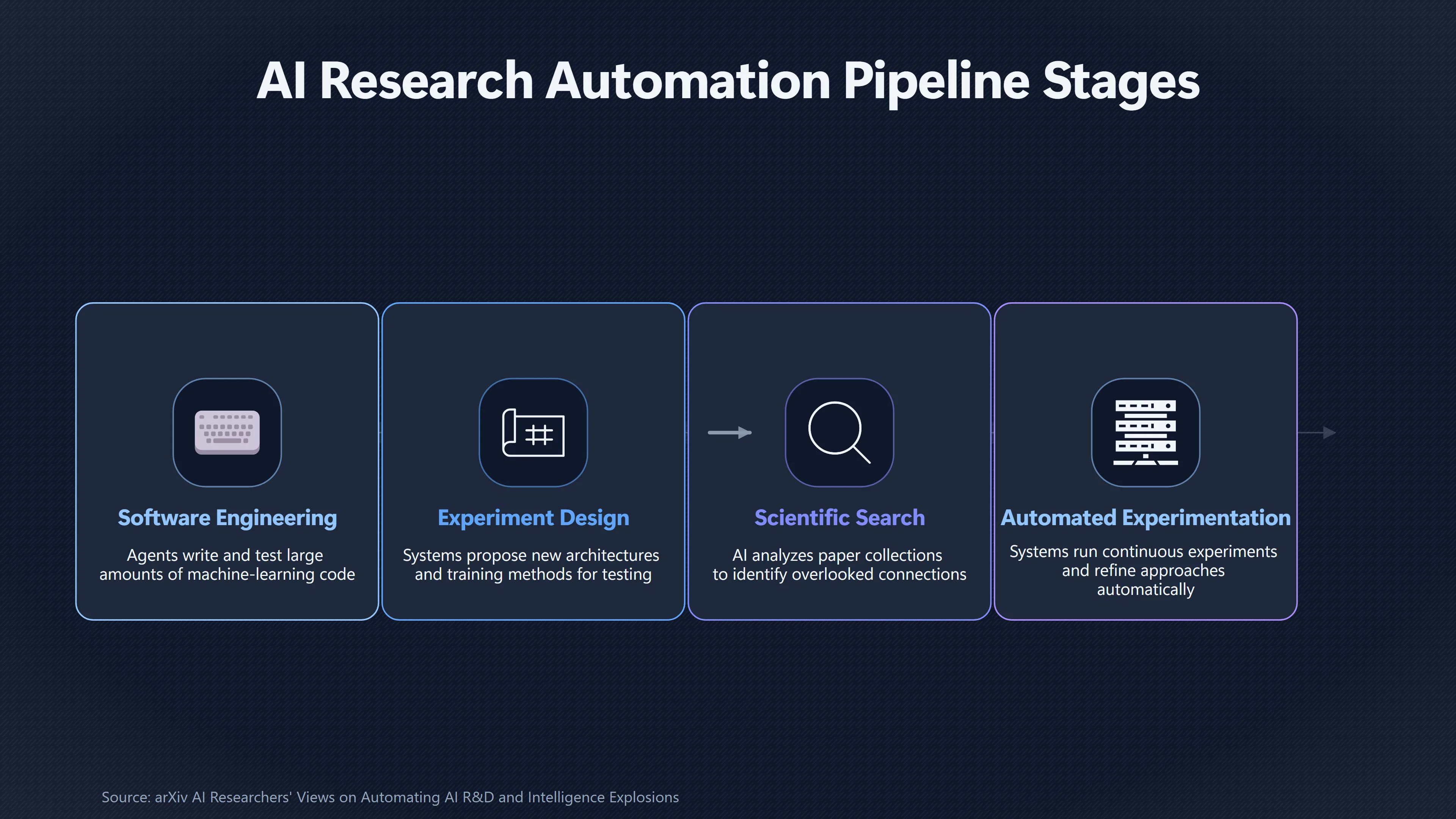
A future AI research assistant could contribute across several stages of the development pipeline:
- Software engineering: AI agents could write and test large amounts of machine-learning code, reducing the time researchers spend on routine implementation.
- Experiment design: AI systems could propose new architectures, training methods or evaluation strategies, allowing researchers to explore a larger number of possibilities.
- Scientific search: AI could analyse large collections of papers, identify overlooked connections and suggest promising research directions.
- Automated experimentation: AI systems connected to computing infrastructure could run experiments continuously, compare results and refine approaches.
The significance of these capabilities is that AI progress itself is partly a research problem. Better algorithms, better training methods and better engineering practices are not separate from AI development; they are the main drivers of it. If AI systems become substantially better at solving those problems, they could speed up the arrival of future systems.
Early examples remain limited but are becoming more visible. Research prototypes have demonstrated AI systems capable of handling parts of machine-learning engineering workflows, including coding, experimentation and optimisation tasks. Some studies have found that carefully designed AI agents can perform competitively with human engineers on specific AI research engineering tasks, although reliability and generality remain major limitations.[International AI Safety Report]internationalaisafetyreport.orginternational ai safety report 2025International AI Safety ReportInternational AI Safety Report 2025 | International AI Safety ReportJanuary 29, 2025…
Why feedback loops could accelerate progress
The intelligence explosion argument depends on a feedback loop: AI helps create better AI, which creates more capable AI helpers, which then accelerate the next cycle. This does not require an AI system to autonomously redesign its entire architecture overnight. A more realistic scenario would involve many smaller improvements accumulating through thousands or millions of research tasks.
A simple example is software development. Suppose AI systems become capable of producing useful improvements to machine-learning code. Researchers could use those improvements to create better models. Those better models could then become more capable coding and research assistants. Over time, the human contribution might shift from performing every technical step towards directing, evaluating and managing increasingly powerful research systems.
Recent economic modelling has explored when these feedback loops might become strong enough to create unusually rapid growth. Research by Tom Davidson, Basil Halperin, Thomas Houlden and Anton Korinek argues that automated research could potentially overcome some limits caused by the declining ease of finding new ideas, if technological and economic feedback loops become sufficiently powerful. The authors emphasise that explosive growth depends on the strength of these feedback mechanisms relative to real-world constraints rather than being an automatic result of AI progress.[SSRN]papers.ssrn.comWhen Does Automating AI Research Produce Explosive Growth? Feedback Loops in Innovation Networks by Tom Davidson, Basil Halperin, Tho…
This distinction is important. The phrase “self-improving AI” can suggest a machine endlessly making itself smarter without friction. In reality, research automation would likely involve a complex ecosystem: AI models, human scientists, computing infrastructure, chip production, data systems, testing environments and safety processes. The speed of take-off depends on how effectively these pieces combine.
Why the take-off may be slower than the strongest forecasts suggest
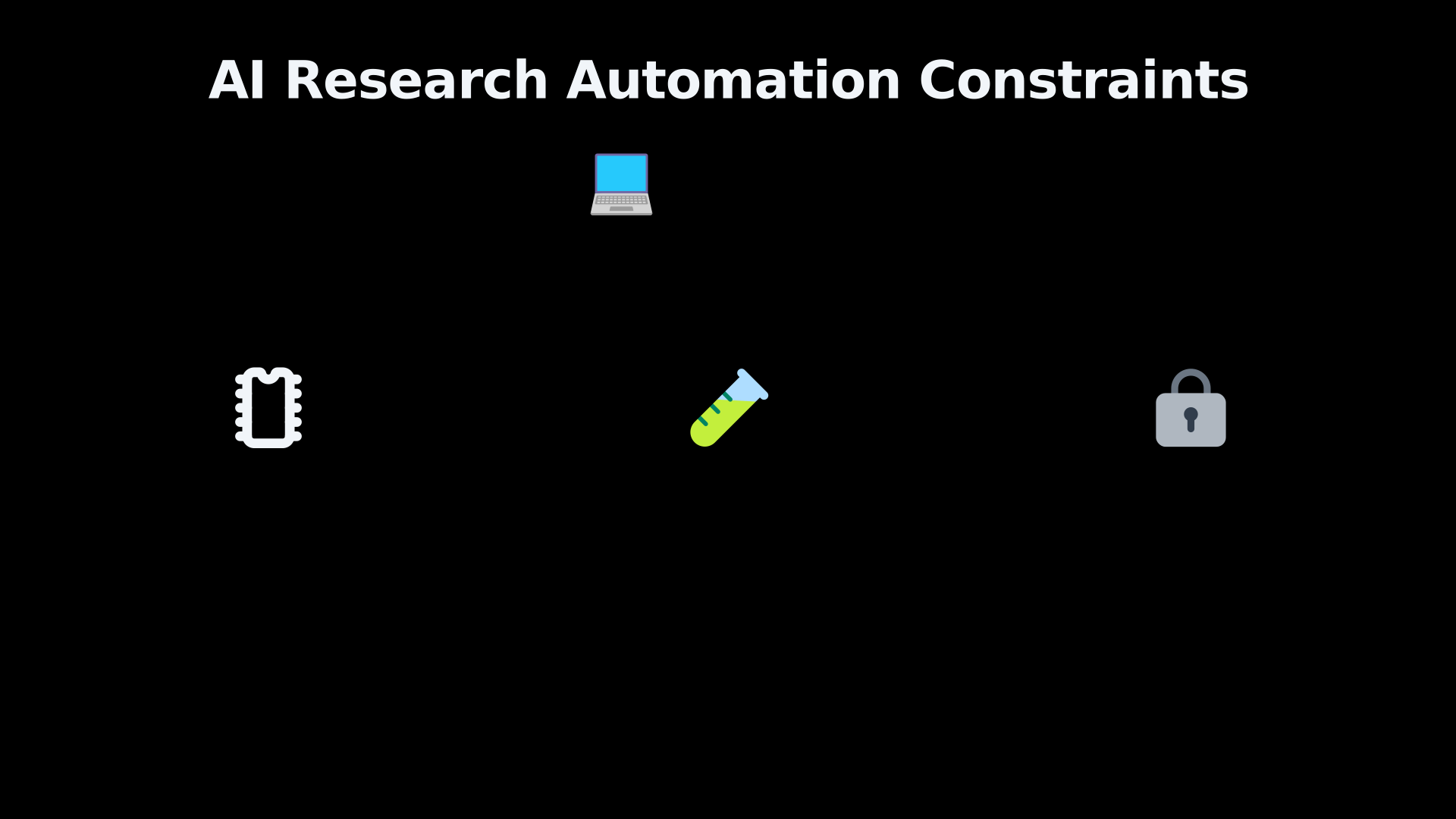
The strongest intelligence explosion scenarios face several practical obstacles. Increasing AI involvement in research does not automatically mean that progress will accelerate without limits.
Research is not just coding
A major challenge is that AI development requires more than producing software. Researchers must discover genuinely new ideas, validate whether they work, build reliable systems and overcome scientific unknowns. A system that can generate many experiments is only valuable if it can identify which experiments matter.
Current AI systems can be impressive at generating solutions while still making fundamental mistakes. They may produce plausible but incorrect explanations, fail to recognise when an approach is flawed, or struggle with long-term research planning. The International AI Safety Report highlights that newer AI systems have improved in coding, mathematics and scientific tasks, but reliability remains a significant challenge.[arXiv]arxiv.orgInternational AI Safety Report 2025: First Key Update: Capabilities and Risk ImplicationsOctober 15, 2025…

Computing and physical infrastructure still matter
Even highly capable AI researchers would depend on physical resources. Training advanced models requires specialised chips, data centres, electricity and manufacturing capacity. If AI research accelerates faster than infrastructure can expand, physical limits could slow the pace of improvement.
This means that a rapid intelligence explosion would probably not look like a purely digital event. It would involve interactions between software progress and the wider industrial system that supports AI development.
Safety and evaluation may become bottlenecks
As AI systems take on more responsibility in creating future AI systems, humans may face a harder verification problem. Researchers would need confidence that AI-generated improvements actually increase capability safely rather than introducing hidden weaknesses.
This creates a potential tension: the same automation that could accelerate AI development could also make it more difficult to understand and control the process. The International AI Safety Report identifies AI-assisted research and development as an important area where capability gains and safety questions increasingly interact.[International AI Safety Report]internationalaisafetyreport.orginternational ai safety report 2025International AI Safety ReportInternational AI Safety Report 2025 | International AI Safety ReportJanuary 29, 2025…
Signs of faster or slower take-off
The debate is not between “AI will change nothing” and “AI will instantly become superintelligent”. The more useful question is how quickly AI research automation could move through different stages.
Signs of a faster take-off would include:
- AI systems reliably completing complex AI engineering tasks with limited human supervision.
- Research agents generating useful new methods rather than mainly combining existing knowledge.
- Automated experiment systems producing repeated improvements across multiple generations of models.
- AI systems becoming significantly better at evaluating and improving other AI systems.
Signs of a slower take-off would include:
- Progress depending heavily on human creativity and judgement.
- AI-generated research ideas failing frequently when tested.
- Hardware, energy or manufacturing limits restricting expansion.
- Increasing difficulty in achieving meaningful improvements from each new generation.
Researchers themselves disagree about how close AI systems are to becoming autonomous AI developers. A 2026 study interviewing researchers from major AI laboratories and universities found broad agreement that AI automation of research could become highly important, but substantial disagreement about timelines, governance and whether the result would be explosive growth.[arXiv]arxiv.orgarXiv AI Researchers' Views on Automating AI R&D and Intelligence ExplosionsAI Researchers' Views on Automating AI R&D and Intelligence ExplosionsFebruary 13, 2026…
What AI research automation could mean for human flourishing
Within the wider AI bloom vision, AI research automation matters because it could influence how quickly humanity solves difficult problems. Faster scientific progress could potentially contribute to breakthroughs in medicine, energy, materials, climate technology and other fields that shape long-term human flourishing.
However, acceleration alone is not the same as a better future. If AI-driven progress becomes concentrated among a small number of organisations or governments, the benefits may not be broadly shared. If development moves faster than safety, governance and social adaptation, the same acceleration could create serious risks.
The central question is therefore not simply whether AI can speed up AI research. It is whether societies can build systems that convert faster innovation into widely shared improvements in human life. A successful research take-off would not be measured only by how quickly AI systems improve, but by whether that improvement helps create a safer, more capable and more flourishing civilisation.
Amazon book picks
Further Reading
Books and field guides related to Can AI accelerate its own progress?. Use these as the next step if you want deeper reading beyond the article.
Life 3.0: Being Human in the Age of Artificial Intelligence
'This is the most important conversation of our time, and Tegmark's thought-provoking book will help you join it' Stephen Hawking THE INT...
Architects of Intelligence
Financial Times Best Books of the Year 2018 TechRepublic Top Books Every Techie Should Read Book Description How will AI evolve and what...
The Coming Wave: Technology, Power, and the Twenty-first Cent...
"We are approaching a critical threshold in the history of our species. Everything is about to change. Soon you will live surrounded by A...
The AI Revolution in Medicine: GPT-4 and Beyond
AI is about to transform medicine. Here's what you need to know right now. ''The development of AI is as fundamental as the creation of t...
eBay marketplace picks
Marketplace Samples
Live-tested eBay searches with available results related to this page.
Selected fromcomputer science poster oneBay.co.uk.




Endnotes
1.
Source: papers.ssrn.com
Link:https://papers.ssrn.com/sol3/papers.cfm?abstract_id=6705512
Source snippet
When Does Automating AI Research Produce Explosive Growth? Feedback Loops in Innovation Networks by Tom Davidson, Basil Halperin, Tho...
2.
Source: arxiv.org
Link:https://arxiv.org/abs/2510.13653
Source snippet
International AI Safety Report 2025: First Key Update: Capabilities and Risk ImplicationsOctober 15, 2025...
Published: October 15, 2025
3.
Source: arxiv.org
Title: arXiv AI Researchers’ Views on Automating AI R&D and Intelligence Explosions
Link:https://arxiv.org/abs/2603.03338
Source snippet
AI Researchers' Views on Automating AI R&D and Intelligence ExplosionsFebruary 13, 2026...
Published: February 13, 2026
4.
Source: papers.ssrn.com
Link:https://papers.ssrn.com/sol3/papers.cfm?abstract_id=6322478
5.
Source: internationalaisafetyreport.org
Title: international ai safety report 2025
Link:https://internationalaisafetyreport.org/publication/international-ai-safety-report-2025
Source snippet
International AI Safety ReportInternational AI Safety Report 2025 | International AI Safety ReportJanuary 29, 2025...
Published: January 29, 2025
6.
Source: internationalaisafetyreport.org
Title: Publications | International AI Safety Report
Link:https://internationalaisafetyreport.org/publications
7.
Source: internationalaisafetyreport.org
Title: International AI Safety Report
Link:https://internationalaisafetyreport.org/
8.
Source: internationalaisafetyreport.org
Title: international ai safety report 2026
Link:https://internationalaisafetyreport.org/publication/international-ai-safety-report-2026
9.
Source: internationalaisafetyreport.org
Link:https://internationalaisafetyreport.org/publication/2026-report-executive-summary
10.
Source: internationalaisafetyreport.org
Link:https://internationalaisafetyreport.org/publication/first-key-update-capabilities-and-risk-implications
11.
Source: GOV.UK
Title: international ai safety report 2025
Link:https://www.gov.uk/government/publications/international-ai-safety-report-2025/international-ai-safety-report-2025
12.
Source: www-prod.media.mit.edu
Title: international ai safety report
Link:https://www-prod.media.mit.edu/publications/international-ai-safety-report/
13.
Source: internationalaisafetyreport.org
Link:https://internationalaisafetyreport.org/about
Additional References
14.
Source: alphaxiv.org
Link:https://www.alphaxiv.org/overview/2603.03338v2
Source snippet
AI Researchers' Views on Automating AI R&D and Intelligence Explosions | alphaXivMarch 5, 2026 — AI RESEARCHERS' VIEWS ON AUTOMATING AI R...
Published: March 5, 2026
15.
Source: eiec.kdi.re.kr
Title: kdi.re.kr When Does Automating AI Research Produce Explosive Growth?
Link:https://eiec.kdi.re.kr/policy/internationalView.do?ac=0000206121&depth1=&depth2=&issus=&pg=&pp=&search_txt=&type=
Source snippet
Feedback Loops in Innovation Networks | 국외연구자료 | KDI 경제교육·정보센터July 7, 2026 — 최신자료 When Does Automating AI Research Produce Explosive Grow...
Published: July 7, 2026
16.
Source: youtube.com
Link:https://www.youtube.com/watch?v=M5Ho6AA7rSw
Source snippet
These sources examine how automated feedback loops, recursive self-improvement, and AI research tools shape the speed of technical progress...
17.
Source: doi.org
Title: Agentic AI and the next intelligence explosion | Science
Link:https://doi.org/10.1126/science.aeg1895
Source snippet
March 19, 2026 — AGENTIC AI AND THE NEXT INTELLIGENCE EXPLOSION James Evans [https://orcid.org/0000-0001-9838-0707](https://orcid.org/0000-0001-9838-0707), Benjamin Bratton https...
Published: March 19, 2026
18.
Source: youtube.com
Link:https://www.youtube.com/watch?v=MrJVgw8dBhw
Source snippet
Recursive Self-Improvement (RSI) Concepts, Tech Trends, Commercialization Ecosystem, Security Ris...
19.
Source: youtube.com
Link:https://www.youtube.com/watch?v=5MnnuHX7Yd4
Source snippet
AI Superintelligence: Are We Racing Toward Extinction?...
20.
Source: nature.com
Link:https://www.nature.com/articles/s41562-024-02077-2
21.
Source: youtube.com
Title: AI Superintelligence: Are We Racing Toward Extinction?
Link:https://www.youtube.com/watch?v=WUYt5kUXhCI
Source snippet
Situational Awareness in Government, with UK AISI Chief Scientist Geoffrey Irving...
22.
Source: youtube.com
Title: Engineering AI Harnesses for Recursive Self-Improvement
Link:https://www.youtube.com/watch?v=ETUbqCV5lA0
Source snippet
Ajeya Cotra on RSI & AI-Powered AI Safety Work, from the 80000 Hours Podcast...
23.
Source: nature.com
Link:https://www.nature.com/articles/s44271-026-00428-5