Within AI Coordination
Who Should Control Advanced AI Compute?
Limits on advanced AI computing could reduce dangerous uses, but they may also decide who gets to participate in the future AI economy.
On this page
- Why compute became a strategic resource
- The safety case for restricting access
- How controls could reshape global power
Page outline Jump by section
Introduction
Who controls the computing power behind advanced AI may become one of the defining governance questions of the next technological era. Frontier AI systems require enormous amounts of specialised computing hardware, electricity, data-centre capacity and technical expertise. Because these resources are concentrated in a small number of companies and countries, controlling access to compute has become a possible way to reduce dangerous uses of AI — but also a way to shape who can participate in the benefits of an AI-enabled future.[arXiv]arxiv.orgarXiv Computing Power and the Governance of Artificial IntelligenceComputing Power and the Governance of Artificial IntelligenceFebruary 13, 2024…
For an AI bloom vision of greater scientific discovery, abundance and human flourishing, this creates a central trade-off. Restricting frontier compute could slow reckless development, improve oversight and reduce the chance that powerful systems are developed without safeguards. But poorly designed controls could also reinforce existing power inequalities, leaving only a few governments and corporations with the ability to build the most capable AI systems. The question is therefore not simply whether compute should be controlled, but who should control it, under what rules, and whether those rules expand or narrow humanity’s long-term options.
Why compute became a strategic resource
Advanced AI depends on a combination of algorithms, data, talent and computing power. Among these inputs, compute is unusual because it is relatively measurable and physically concentrated. Large AI training runs require thousands of specialised processors, usually high-end graphics processing units (GPUs) designed for accelerated computing. The supply chain behind these chips — from semiconductor design to manufacturing equipment and advanced memory — is controlled by a limited number of companies and countries.[arXiv]arxiv.orgarXiv Computing Power and the Governance of Artificial IntelligenceComputing Power and the Governance of Artificial IntelligenceFebruary 13, 2024…
This concentration has made compute attractive to policymakers. Unlike an abstract capability such as “AI intelligence”, computing infrastructure leaves physical traces: chips must be manufactured, shipped, installed in data centres and supplied with electricity. Governments can therefore attempt to monitor, restrict or prioritise access to it.
A growing policy debate has focused on “compute governance”: using rules around chips, data centres, cloud services and AI training resources to influence how advanced AI develops. Researchers argue that compute can provide governments with a practical point of intervention because it is quantifiable and easier to regulate than many other aspects of AI development. At the same time, they warn that compute-based approaches can create risks of excessive centralisation if they give too much control to a small number of regulators or infrastructure providers.[arXiv]arxiv.orgarXiv Computing Power and the Governance of Artificial IntelligenceComputing Power and the Governance of Artificial IntelligenceFebruary 13, 2024…
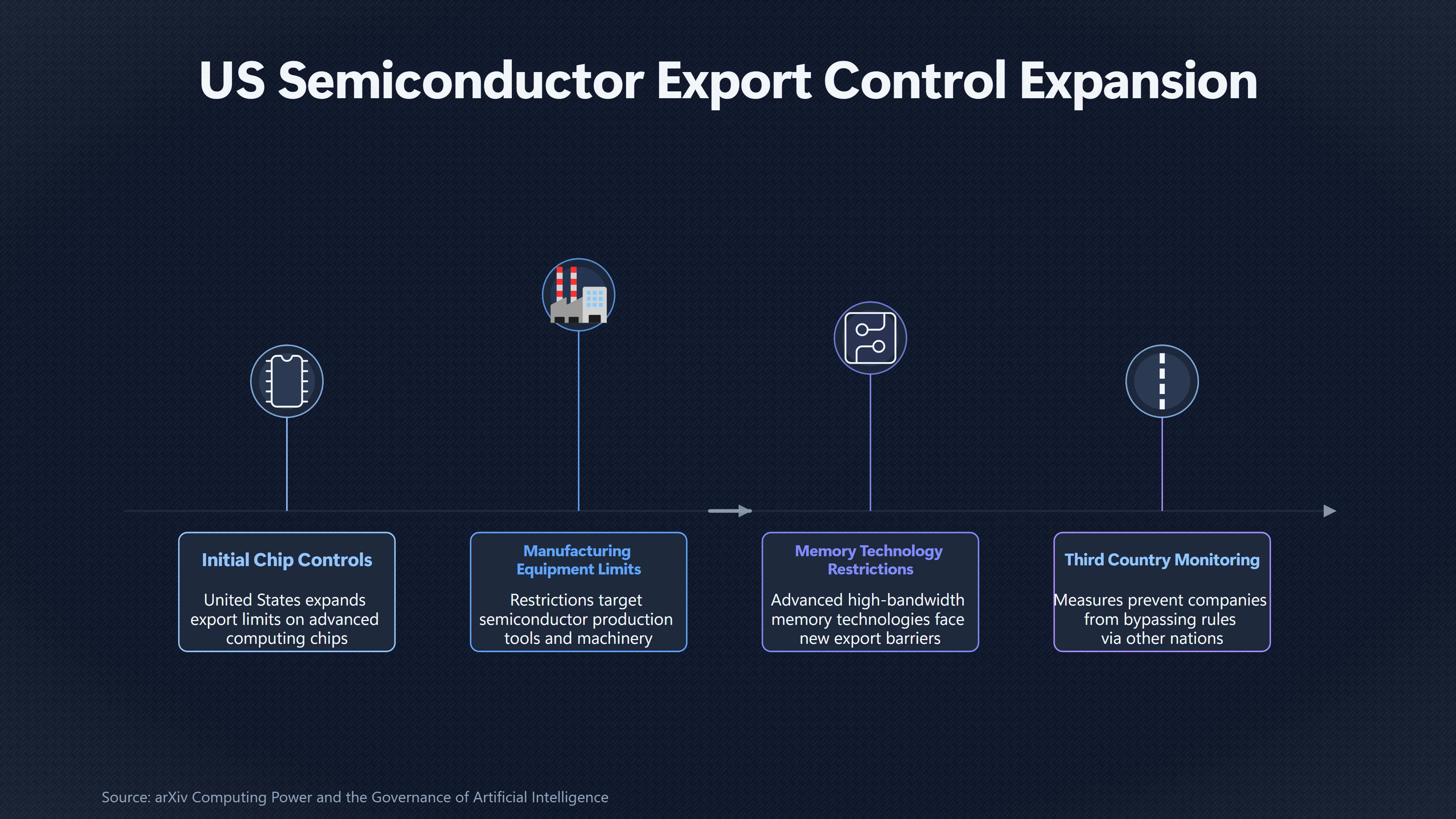
The strategic importance of compute became especially visible during the competition over advanced AI chips between the United States and China. Since 2022, the United States has progressively expanded export controls on advanced computing chips and semiconductor manufacturing equipment, arguing that leading-edge AI hardware has national security implications. Later measures added restrictions involving advanced chips, high-bandwidth memory and semiconductor production tools.[Bureau of Industry and Security]bis.govDecember 2, 2024…
The safety case for restricting access
The strongest argument for compute controls is that the most capable AI systems may create risks that are difficult to manage after deployment. If a small number of frontier developers can build systems far beyond current capabilities, governments may want earlier visibility into those projects and stronger assurance that safety testing is taking place.
One proposed mechanism is the use of compute thresholds. A threshold sets a level of training computation above which developers face additional obligations, such as reporting requirements, evaluations or risk assessments. Supporters argue that compute is a useful early warning signal because it can identify unusually large AI projects before their capabilities and risks are fully understood.[arXiv]arxiv.orgarXiv Training Compute Thresholds: Features and Functions in AI RegulationTraining Compute Thresholds: Features and Functions in AI RegulationMay 17, 2024…
However, compute is not a perfect measure of AI capability or danger. A smaller, more efficient model can sometimes outperform expectations, while a large training run does not automatically guarantee dangerous abilities. Researchers have warned that treating compute thresholds as a complete safety solution may create false confidence because the relationship between scale, capability and risk changes over time.[arXiv]arxiv.orgarXiv On the Limitations of Compute Thresholds as a Governance StrategyOn the Limitations of Compute Thresholds as a Governance StrategyJuly 8, 2024…
This creates a key design challenge. Controls that are too weak may fail to provide meaningful oversight. Controls that are too broad may slow beneficial research, discourage openness and make advanced AI development accessible only to the largest organisations.
A possible middle ground is targeted governance: requiring transparency and evaluation for the largest systems while preserving broad access to less powerful tools. This approach aims to capture some safety benefits without turning advanced AI into an exclusive capability available only to states and major technology firms.
How controls could reshape global power
Compute restrictions do more than regulate technology; they influence the distribution of geopolitical power. If only a handful of countries can access the chips, energy infrastructure and capital needed for frontier AI, those countries may gain disproportionate influence over scientific research, economic development and security.
The United States’ semiconductor export controls illustrate this tension. The stated goal has been to limit access to advanced computing capabilities that could support military or strategic competition, particularly in relation to China. The controls have expanded beyond individual chips to include manufacturing equipment, memory technologies and measures designed to prevent companies from bypassing restrictions through third countries.[Bureau of Industry and Security]bis.govDecember 2, 2024…
Supporters argue that such restrictions can slow the spread of potentially dangerous capabilities and give democratic governments time to develop stronger safeguards. Critics argue that they may accelerate technological separation between countries, encourage competing AI supply chains and create a world where access to transformative technologies depends heavily on geopolitical alignment.
The difficulty is that AI has potential benefits that extend far beyond military competition. Advanced systems could accelerate medical research, improve energy technologies, support scientific discovery and expand access to expertise. If compute controls unintentionally limit participation by researchers, companies or countries that could use AI for public benefit, they may reduce some of the very gains that make AI attractive from a human flourishing perspective.
The access dilemma: safety versus participation
A central question is whether advanced AI should be treated like a scarce strategic asset or like a general-purpose technology whose benefits should spread widely.
The case for broader access is connected to the AI bloom vision. If AI becomes a powerful tool for solving problems such as disease, climate adaptation and scientific bottlenecks, concentrating access too narrowly could slow global progress. Smaller countries and research communities may struggle to compete if they cannot access comparable computing resources.
This concern is already visible in debates over global AI infrastructure. International organisations have highlighted that access to compute is unevenly distributed, with a small number of firms controlling important parts of the AI infrastructure ecosystem. Unequal access could reinforce existing economic divides if advanced AI becomes essential for research, industry and public services.[itu.int]itu.intthe annual ai governance report 2025 steering the future of aithe annual ai governance report 2025 steering the future of ai
Yet unlimited access also has costs. The same infrastructure that enables beneficial scientific applications can potentially support harmful experimentation, cyber operations or the development of systems without adequate safeguards. The challenge is therefore not simply increasing or decreasing access, but designing institutions that distinguish between beneficial openness and reckless proliferation.
Possible approaches include international agreements on minimum safety standards, shared research compute facilities, public investment in AI infrastructure and rules that require accountability from the largest developers without blocking responsible innovation. These approaches attempt to avoid two extremes: a world where frontier AI is uncontrolled, and a world where only a few actors can shape humanity’s technological future.
The unresolved question for the AI bloom future
Frontier AI compute controls reveal a broader issue in AI governance: intelligence may become more abundant, but the infrastructure needed to create it may remain scarce. The future impact of AI will depend not only on whether humanity develops more powerful systems, but on whether access to those systems supports broad human capability or concentrates influence among a small group of actors.
A flourishing AI future would likely require both safety and inclusion. Effective compute governance could help prevent dangerous races, improve accountability and create confidence that increasingly powerful systems are developed responsibly. But governance that focuses only on restriction risks turning a technology with the potential to expand human knowledge and opportunity into a source of deeper concentration.
The long-term challenge is finding rules that make advanced AI more trustworthy without making the benefits of intelligence accessible only to those who already hold the greatest resources. In that sense, compute controls are not merely a technical policy question. They are a decision about who gets to participate in humanity’s next era of scientific and civilisational development.
Amazon book picks
Further Reading
Books and field guides related to Who Should Control Advanced AI Compute?. Use these as the next step if you want deeper reading beyond the article.
Superintelligence: Paths, Dangers, Strategies
This profoundly ambitious and original book picks its way carefully through a vast tract of forbiddingly difficult intellectual terrain.
AI 2041: Ten Visions for Our Future
How will AI change our world within twenty years? A pioneering technologist and acclaimed writer team up for a “dazzling” (The New York T...
The Coming Wave: Technology, Power, and the Twenty-first Cent...
NEW YORK TIMES BESTSELLER • An urgent warning of the unprecedented risks that AI and other fast-developing technologies pose to global or...
eBay marketplace picks
Marketplace Samples
Live-tested eBay searches with available results related to this page.
Selected fromcomputer hardware model oneBay.co.uk.



Endnotes
1.
Source: arxiv.org
Title: arXiv Computing Power and the Governance of Artificial Intelligence
Link:https://arxiv.org/abs/2402.08797
Source snippet
Computing Power and the Governance of Artificial IntelligenceFebruary 13, 2024...
Published: February 13, 2024
2.
Source: itu.int
Title: the annual ai governance report 2025 steering the future of ai
Link:https://www.itu.int/epublications/en/publication/the-annual-ai-governance-report-2025-steering-the-future-of-ai
3.
Source: arxiv.org
Title: arXiv Training Compute Thresholds: Features and Functions in AI Regulation
Link:https://arxiv.org/abs/2405.10799
Source snippet
Training Compute Thresholds: Features and Functions in AI RegulationMay 17, 2024...
Published: May 17, 2024
4.
Source: arxiv.org
Title: arXiv On the Limitations of Compute Thresholds as a Governance Strategy
Link:https://arxiv.org/abs/2407.05694
Source snippet
On the Limitations of Compute Thresholds as a Governance StrategyJuly 8, 2024...
Published: July 8, 2024
5.
Source: bis.gov
Title: Bureau of Industry and Security
Link:https://www.bis.gov/press-release/commerce-strengthens-restrictions-advanced-computing-semiconductors-semiconductor-manufacturing-equipment?ftag=YHF4eb9d17
6.
Source: governance.ai
Title: computing power and the governance of artificial intelligence
Link:https://www.governance.ai/research-paper/computing-power-and-the-governance-of-artificial-intelligence
7.
Source: itu.int
Title: Page 30
Link:https://www.itu.int/net/epub/TSB/2025-The-Annual-AI-Governance-Report-2025-Steering-the-Future-of-AI/files/basic-html/page30.html
8.
Source: bis.gov
Title: Bureau of Industry and Security
Link:https://www.bis.gov/press-release/commerce-strengthens-export-controls-restrict-chinas-capability-produce-advanced-semiconductors-military
Source snippet
December 2, 2024...
Published: December 2, 2024
9.
Source: bis.doc.gov
Link:https://www.bis.doc.gov/index.php/policy-guidance/advanced-computing-and-semiconductor-manufacturing-items-controls-to-prc
10.
Source: aisecurityandsafety.org
Title: compute governance
Link:https://aisecurityandsafety.org/en/guides/compute-governance/
Source snippet
Controlling AI Through Hardware & Compute Access (2026) | AI Safety DirectoryApril 3, 2026 — COMPUTE GOVERNANCE: CONTROLLING AI THROUGH H...
Published: April 3, 2026
11.
Source: media.bis.gov
Title: department commerce revises license review policy semiconductors exported china
Link:https://media.bis.gov/press-release/department-commerce-revises-license-review-policy-semiconductors-exported-china
12.
Source: bis.gov
Link:https://www.bis.gov/press-release/department-commerce-rescinds-biden-era-artificial-intelligence-diffusion-rule-strengthens-chip-related
13.
Source: bis.gov
Link:https://www.bis.gov/press-release/commerce-strengthens-restrictions-advanced-computing-semiconductors-enhance-foundry-due-diligence-prevent
14.
Source: bis.gov
Link:https://www.bis.gov/press-release/biden-harris-administration-announces-regulatory-framework-responsible-diffusion-advanced-artificial
15.
Source: media.bis.gov
Link:https://media.bis.gov/news-updates/about-bis/bis-leadership-and-offices/OAC
Additional References
16.
Source: labs.cloudsecurityalliance.org
Title: ai compute concentration systemic risk v1 csa styled
Link:https://labs.cloudsecurityalliance.org/research/ai-compute-concentration-systemic-risk-v1-csa-styled/
Source snippet
Compute Concentration and Systemic Risk – Lab SpaceMay 9, 2026 — AI COMPUTE CONCENTRATION AND SYSTEMIC RISK Authors: Cloud Security Allia...
Published: May 9, 2026
17.
Source: youtube.com
Title: U.S. unveils new export restrictions on AI chips | DD India
Link:https://www.youtube.com/watch?v=bxkJKyliKM8
Source snippet
This selection of videos explores the strategic, geopolitical, and economic tradeoffs involved in regulating frontier AI hardware, managi...
18.
Source: youtube.com
Link:https://www.youtube.com/watch?v=_-GE7hby21c
Source snippet
U.S. Control Over Frontier AI Access: Risks for Korean Companies and How to Respond...
19.
Source: youtube.com
Title: The Existential Risk of AI is Being IGNORED (This is SCARY) – Matthew Syed
Link:https://www.youtube.com/watch?v=pSDC2mmVQpg
Source snippet
AI Sovereignty Explained: How Geopolitics Will Change Data Scientist & Developers | Harinda...
20.
Source: youtube.com
Link:https://www.youtube.com/watch?v=N1cqBNJJaq4
Source snippet
Allied Perspectives on Semiconductor Export Controls...
21.
Source: gao.gov
Link:https://www.gao.gov/products/gao-25-107386
22.
Source: whitehouse.gov
Link:https://www.whitehouse.gov/fact-sheets/2025/07/fact-sheet-president-donald-j-trump-promotes-the-export-of-american-ai-technologies/
23.
Source: congress.gov
Link:https://www.congress.gov/crs-product/R48642
24.
Source: youtube.com
Title: Allied Perspectives on Semiconductor Export Controls
Link:https://www.youtube.com/watch?v=ohW00TPw3hQ
Source snippet
U.S. unveils new export restrictions on AI chips | DD India...
25.
Source: whitehouse.gov
Title: Promoting The Export of the American AI Technology Stack – The White House
Link:https://www.whitehouse.gov/presidential-actions/2025/07/promoting-the-export-of-the-american-ai-technology-stack/?query-11-page=89