Within Trusted Access
Could Libraries Become the Front Door to AI Tutoring?
Libraries could widen access to reliable AI tutors while adding human help, privacy safeguards and a trusted local point of accountability.
On this page
- Why libraries are suited to lifelong AI learning
- How public access and human support could work
- Funding, staffing and digital inclusion barriers
Page outline Jump by section
Introduction
Public libraries are well placed to become a trusted front door to AI tutoring because they already combine universal access, skilled staff, community trust and a public-service mission. Rather than replacing teachers or commercial learning platforms, libraries could provide a neutral place where anyone can use high-quality AI learning tools regardless of income, while also receiving human guidance when the technology falls short. If AI eventually becomes a powerful engine for lifelong learning, the institutions that govern access may matter as much as the models themselves.
Within the broader vision of AI helping humanity flourish through greater knowledge and opportunity, libraries represent a practical route to making educational AI widely available instead of concentrating its benefits among people who can afford premium subscriptions. Their existing commitments to privacy, intellectual freedom and equal access also make them unusually well suited to balancing innovation with public accountability.
Why libraries are naturally suited to lifelong AI learning
Public libraries have repeatedly adapted to new forms of knowledge infrastructure. They expanded from lending books to providing internet access, digital archives, makerspaces, online learning platforms and technology training. AI tutoring can be understood as the next step in that evolution rather than an entirely new mission.
Several characteristics distinguish libraries from purely commercial AI providers.
- Universal access. Library membership is generally free, reducing the risk that advanced educational support becomes another subscription service available mainly to higher-income households.
- Trusted public institutions. Surveys across many countries consistently place libraries among the most trusted civic institutions. That reputation makes them attractive places to introduce unfamiliar technologies carefully.
- Support for all ages. Libraries already serve school pupils, university students, job seekers, retirees, migrants, parents and lifelong learners. AI tutoring naturally fits this broad audience.
- Expert information professionals. Librarians are trained to help users evaluate sources, navigate uncertainty and develop information literacy rather than simply retrieve answers.
These strengths become increasingly valuable as generative AI makes it easier to produce convincing but inaccurate information. A library-based AI tutor can therefore be embedded within an environment where verification and critical thinking remain central goals rather than optional extras. Professional library organisations have increasingly argued that AI deployment should reinforce long-standing library values including privacy, intellectual freedom, equitable access and human-centred service.[American Library Association]ala.orgOpen source on ala.org.
How public access and human support could work
The most promising model is not an AI system operating alone but a partnership between AI and librarians.
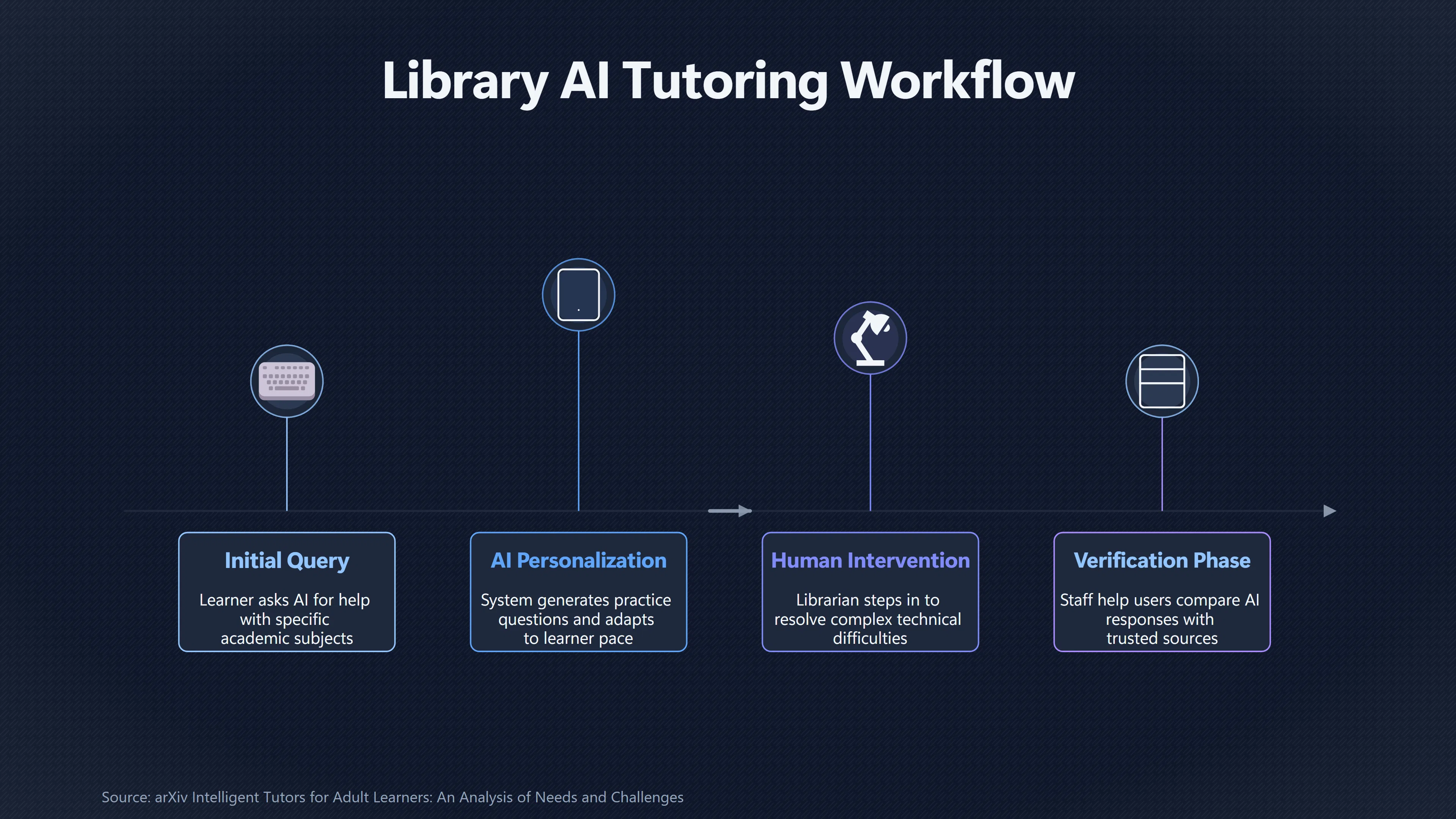
A learner might begin by asking an AI tutor for help understanding algebra, improving written English, preparing for a nursing qualification or learning computer programming. The AI could personalise explanations, generate practice questions and adapt to the learner’s pace throughout the week.
When difficulties arise, library staff could step in to help with questions that AI cannot resolve well.
For example, librarians might help users:
- recognise when an AI answer appears uncertain or unsupported;
- compare AI responses with trusted reference sources;
- improve prompts to obtain clearer educational explanations;
- identify reliable learning materials beyond the chatbot;
- connect learners with local courses or specialist human tutors where necessary.
Instead of treating AI as an authority, the library becomes a place where people learn how to work with AI responsibly.
This hybrid model also scales human expertise. A librarian cannot provide one-to-one tutoring to dozens of learners simultaneously, but an AI assistant can offer continuous support between scheduled human interactions. Staff therefore spend more time solving genuinely difficult problems while routine explanation and practice move to the AI.
Research into intelligent tutoring for adult learners likewise suggests that adult users benefit from adaptive guidance, clear progress tracking and support tailored to their own goals rather than classroom assumptions, reinforcing the value of locally supported lifelong learning environments.[arXiv]arxiv.orgarXiv Intelligent Tutors for Adult Learners: An Analysis of Needs and ChallengesIntelligent Tutors for Adult Learners: An Analysis of Needs and ChallengesNovember 19, 2024…
Privacy and trust could become a competitive advantage
Many commercial AI services improve their models by collecting user interactions or combining educational activity with broader platform ecosystems. Even where companies publish privacy commitments, many users remain unsure how their conversations are stored or analysed.
Libraries have a long tradition of protecting reader privacy. In many countries they deliberately minimise records of borrowing history and have established policies limiting unnecessary collection of personal information.
Applying those principles to AI tutoring could involve:
- choosing vendors with strong contractual privacy protections;
- allowing anonymous or minimally identified access where practical;
- making data retention policies easy to understand;
- separating educational conversations from advertising systems;
- clearly explaining when conversations are stored, deleted or reviewed.
For learners discussing literacy difficulties, financial retraining, immigration exams or health education, this additional confidence may encourage more open engagement with AI tutoring.
Professional library guidance increasingly recommends that AI procurement be evaluated against privacy, transparency and public-interest criteria rather than technical capability alone, extending existing library privacy principles into the AI era.[American Library Association]ala.orgOpen source on ala.org.
AI literacy may matter as much as AI tutoring
Libraries are unlikely to succeed if they simply install chatbots on public computers.
An equally important role is teaching people how to use AI well.
That includes helping visitors understand:
- why AI sometimes invents facts;
- when sources should be checked independently;
- how prompting influences answers;
- which tasks suit AI and which require human expertise;
- the ethical and copyright questions surrounding generated content.
This mirrors the way libraries previously expanded from providing internet access to teaching digital literacy. The objective is not merely giving people AI but helping them become capable, independent users of increasingly intelligent tools.
Recent discussions among practising librarians suggest that many patrons now ask for help understanding AI systems rather than simply accessing them. Library workers often report using these conversations to explain model limitations, verification techniques and responsible use instead of encouraging uncritical reliance on AI. While anecdotal, these discussions illustrate a growing public demand for AI guidance within library settings.[Reddit]reddit.comPatrons and AIPatrons and AI - how would you deal?Yesterday…
Funding, staffing and digital inclusion barriers
The vision is attractive, but implementation faces significant practical obstacles.
Sustainable funding
Running capable AI tutors is not free. Advanced models require computing infrastructure, software licences and ongoing maintenance. Libraries already operating under financial pressure may struggle to absorb these costs without dedicated public investment.
One option is national or regional procurement that allows many library systems to share infrastructure instead of each negotiating separately.
Staff training
Librarians do not need to become AI engineers, but they do need confidence in evaluating AI systems, recognising limitations and helping users work with them effectively.
Professional organisations have therefore begun developing AI competencies, guidance documents and model policies to support library staff as AI becomes part of routine public services. These frameworks emphasise ethical judgement, equitable access and ongoing professional development rather than purely technical skills.[American Library Association]ala.orgOpen source on ala.org.

Digital inequality
Some people lack reliable home internet, suitable devices or confidence using digital tools.
Libraries already reduce these barriers through public computers, Wi-Fi, accessible technologies and in-person support. AI tutoring could extend that role, particularly in communities where private access remains limited.
Accessibility also matters. Well-designed AI tutors could offer speech interfaces, translation, simplified explanations and adaptive learning support for people with disabilities or limited literacy, provided accessibility is built into procurement requirements rather than treated as an afterthought.
Keeping public AI accountable
If libraries become providers of AI tutoring, governance will be as important as technology.
Good practice would include:[librariesconnected.org.uk]librariesconnected.org.ukSource details in endnotes.
- clear public policies explaining which AI systems are used;
- independent evaluation of educational quality;
- transparent handling of errors and complaints;
- regular review for bias and accessibility;
- human oversight for sensitive educational situations;
- open procurement criteria rather than exclusive dependence on a single vendor.
Libraries have experience balancing public accountability with intellectual freedom. That institutional culture may prove valuable if AI systems increasingly influence how people learn throughout their lives.
Professional guidance now encourages libraries to treat AI policies as living documents that evolve with changing technology while remaining anchored in enduring public values rather than vendor priorities.[American Library Association]ala.orgOpen source on ala.org.
Why libraries matter in the larger AI bloom vision
The optimistic case for AI is not simply that tutoring becomes cheaper or more convenient. It is that intelligence itself becomes more widely available, allowing many more people to acquire knowledge, change careers, contribute to science and participate fully in civic life.
Libraries cannot deliver that future alone, but they could provide one of its most important public foundations.
If advanced AI remains concentrated inside expensive commercial products, educational gains may widen existing inequalities. If trusted public institutions can instead provide reliable AI tutors alongside skilled human support, the benefits of increasingly capable AI stand a better chance of reaching people throughout their lives rather than only those with the greatest financial resources.
In that sense, libraries could play a role analogous to their historical contribution to literacy: not by replacing schools or universities, but by ensuring that access to powerful new forms of knowledge remains a public good.
Amazon book picks
Further Reading
Books and field guides related to Could Libraries Become the Front Door to AI Tutoring?. Use these as the next step if you want deeper reading beyond the article.
The Information: A History, a Theory, a Flood
From the bestselling author of the acclaimed Chaos and Genius comes a thoughtful and provocative exploration of the big ideas of the mode...
The Library Book
A REESE WITHERSPOON x HELLO SUNSHINE BOOK CLUB PICK A WASHINGTON POST TOP 10 BOOK OF THE YEAR * A NEW YORK TIMES BESTSELLER and NEW YORK...
Palaces for the People
How can we bring people together? Sociologist and best-selling author Eric Klinenberg introduces a transformative and powerfully upliftin...
The Shallows
Finalist for the 2011 Pulitzer Prize in General Nonfiction: “Nicholas Carr has written a Silent Spring for the literary mind.”—Michael Ag...
eBay marketplace picks
Marketplace Samples
Live-tested eBay searches with available results related to this page.
Selected fromreading wall art oneBay.co.uk.




Endnotes
1.
Source: arxiv.org
Title: arXiv Intelligent Tutors for Adult Learners: An Analysis of Needs and Challenges
Link:https://arxiv.org/abs/2412.04477
Source snippet
Intelligent Tutors for Adult Learners: An Analysis of Needs and ChallengesNovember 19, 2024...
Published: November 19, 2024
2.
Source: reddit.com
Title: Patrons and AI
Link:https://www.reddit.com/r/librarians/comments/1vato3p/patrons_and_ai_how_would_you_deal/
Source snippet
Patrons and AI - how would you deal?Yesterday...
3.
Source: reddit.com
Title: Looking to talk with public librarians about AI questions from patrons
Link:https://www.reddit.com/r/Library/comments/1v6owow/looking_to_talk_with_public_librarians_about_ai/
Source snippet
Looking to talk with public librarians about AI questions from patrons...
4.
Source: ala.org
Link:https://www.ala.org/tools/standards-and-guidelines/guidance-use-artificial-intelligence-libraries
5.
Source: ala.org
Link:https://www.ala.org/news/2026/07/ala-council-adopts-guidance-use-artificial-intelligence-libraries
6.
Source: ala.org
Title: American Library Association Library Privacy Guidelines | ALA
Link:https://www.ala.org/advocacy/privacy/guidelines
7.
Source: ala.org
Link:https://www.ala.org/acrl/standards/ai
8.
Source: ala.org
Title: American Library Association ALA AI Learning Events and Resources | ALA
Link:https://www.ala.org/tools/ai-learning
9.
Source: ala.org
Link:https://www.ala.org/news/2026/07/ala-special-report-surveys-generative-ai-policies-public-and-academic-libraries
Source snippet
ALA Special Report surveys Generative AI policies for public and academic libraries | ALAJuly 6, 2026 — For immediate release | July 6, 2...
Published: July 6, 2026
10.
Source: alsc.ala.org
Title: childrens librarians and the rise of ai what should we be thinking about
Link:https://www.alsc.ala.org/blog/2026/02/childrens-librarians-and-the-rise-of-ai-what-should-we-be-thinking-about/
11.
Source: alastore.ala.org
Link:https://alastore.ala.org/genaipol
12.
Source: ala.org
Link:https://www.ala.org/news/view-all-news?topic=576
13.
Source: alastore.ala.org
Title: libgen AI
Link:https://alastore.ala.org/libgenAI
14.
Source: alastore.ala.org
Link:https://alastore.ala.org/diglitpl
Additional References
15.
Source: youtube.com
Link:https://www.youtube.com/watch?v=l-cwnh1myS8
Source snippet
"What's Up Wednesday -- AI Literacy for Librarians Understanding and Teaching AI[https://www.youtube.com/watch?v=3GzTvcd7S0I..."](https://www.youtube.com/watch?v=3GzTvcd7S0I...")...
16.
Source: youtube.com
Link:https://www.youtube.com/watch?v=yuIJuuPMQ2I
Source snippet
"'Let's Find Out' Podcast | Ep 10: “AI & Libraries: Creating Digital Literacy”[https://www.youtube.com/watch?v=qQG2KM4D-2g..."](https://www.youtube.com/watch?v=qQG2KM4D-2g...")...
17.
Source: youtube.com
Link:https://www.youtube.com/watch?v=qQG2KM4D-2g
Source snippet
"AI, Algorithms & Librarians: The evolution of the librarian in the GenAI era[https://www.youtube.com/watch?v=l-cwnh1myS8..."](https://www.youtube.com/watch?v=l-cwnh1myS8...")...
18.
Source: edworkingpapers.com
Link:https://edworkingpapers.com/ai26-1451
19.
Source: ifla.org
Link:https://www.ifla.org/entry-point-for-libraries-and-ai/
20.
Source: accesstoresearch.org.uk
Link:https://www.accesstoresearch.org.uk/about/
21.
Source: librariesconnected.org.uk
Link:https://www.librariesconnected.org.uk/resources/how-libraries-can-support-ai-and-digital-media-literacy-good-practice-innovating-trusted
22.
Source: eifl.org
Link:https://www.eifl.org/programme/ai-and-os/libraries-and-ai
23.
Source: lirgjournal.org.uk
Link:https://lirgjournal.org.uk/index.php/lir/article/view/617
24.
Source: ifla.org
Link:https://www.ifla.org/events/libraries-and-ai-in-practice-how-can-we-bridge-ais-technical-social-and-ethical-dimensions/