Within Distribution
Can Digital Abundance Coexist With Everyday Insecurity?
Abundant digital services will not guarantee security if housing, land, energy and care remain scarce and concentrated.
On this page
- Which goods AI can make dramatically cheaper
- Why housing, land and infrastructure stay scarce
- How asset ownership can block broad gains
Page outline Jump by section
Introduction
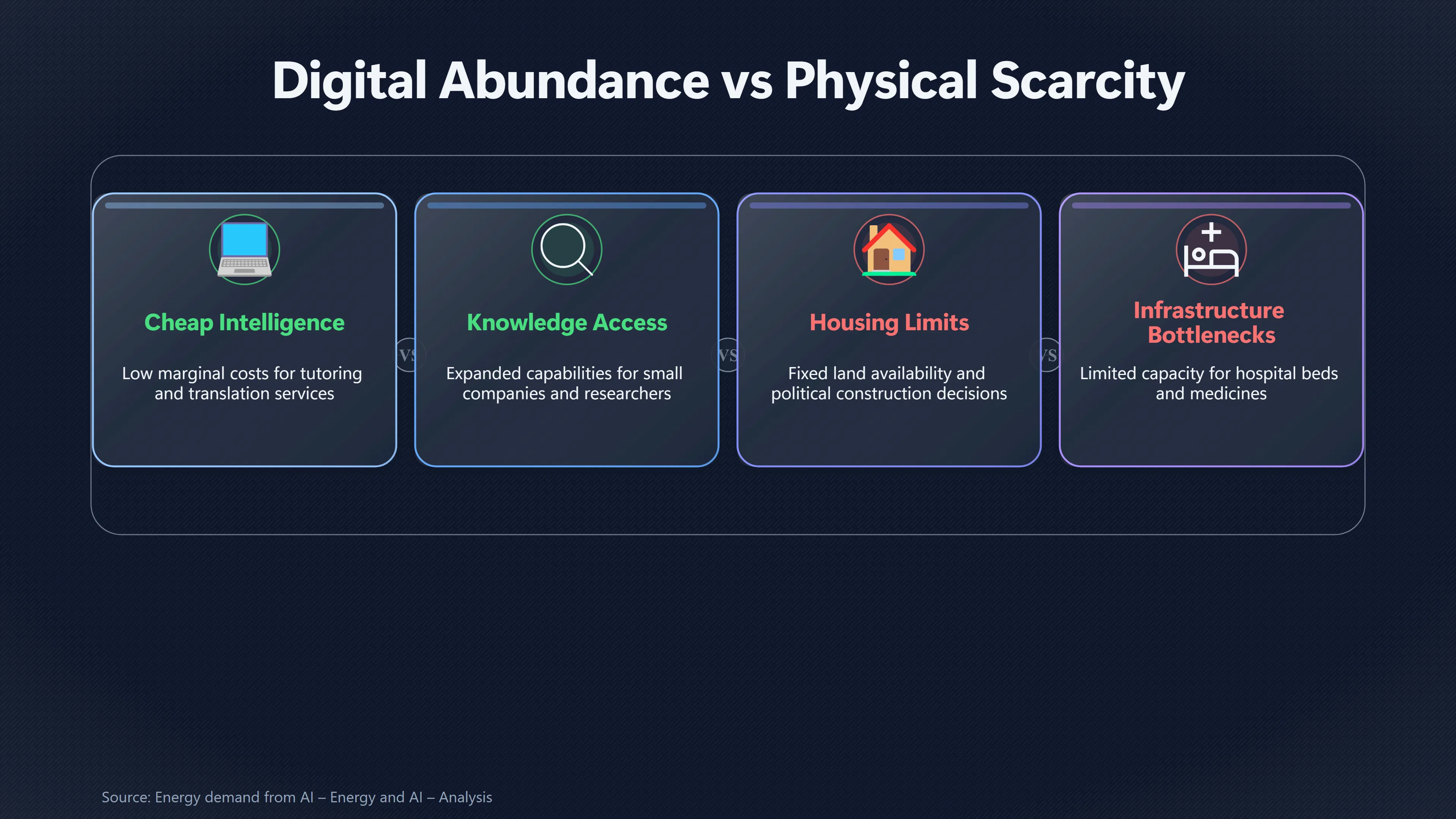
Cheap AI services could make many forms of intelligence far more affordable, from tutoring and translation to software development, research assistance and administrative work. But lower prices for digital services do not automatically create a post-scarcity economy. A society can have abundant AI-generated advice and still face shortages in the things people need most: homes, land, energy, healthcare capacity, infrastructure and secure ownership.

The reason is that scarcity is not only about the cost of information or computation. Many of the hardest constraints on human wellbeing are physical, institutional and political. If AI makes knowledge cheaper while property, essential resources and productive assets remain concentrated, the result may be a world of powerful low-cost tools alongside continuing economic insecurity. The AI-bloom vision therefore depends not only on making intelligence abundant, but on ensuring that abundance reaches the foundations of everyday life.
Which goods AI can make dramatically cheaper
AI is unusually well suited to reducing the cost of digital goods. Once a model has been trained and deployed, it can provide additional assistance to millions of people at a marginal cost far below many traditional services. This could expand access to tutoring, basic legal information, business support, scientific assistance, design, translation and many forms of professional expertise.
This matters because some important human limitations are caused by scarcity of expertise rather than scarcity of raw materials. A student who cannot afford a private tutor, a small company that cannot hire specialist consultants, or a researcher lacking support staff may gain new capabilities from inexpensive AI tools. In an optimistic scenario, this could resemble a form of intellectual abundance: more people gaining access to capabilities that were once limited to wealthy organisations.
However, digital abundance has limits. Many services that improve life depend on scarce physical systems around them. An AI health assistant cannot by itself create more hospital beds, nurses, medicines, laboratories or affordable housing. An AI tutor cannot remove overcrowded classrooms or unequal access to devices and reliable internet. The difference between abundant information and abundant living conditions becomes central when considering whether AI can help humanity move towards genuine post-scarcity.
Why cheap intelligence does not remove physical scarcity
Housing, land and infrastructure remain hard constraints
Housing is one of the clearest examples of why cheaper digital services may not end insecurity. AI could make architecture, planning, construction management and property research more efficient, but it does not eliminate the limited availability of desirable land or the political decisions that determine how much housing can be built.
In many cities, high housing costs reflect restrictions, infrastructure limits and competition for valuable locations as much as the cost of information. Even if AI reduced some construction costs, households could still struggle if ownership of land and housing assets remained concentrated or if supply failed to expand where people need to live.
The broader lesson is that productivity improvements do not automatically translate into affordability. When a scarce asset is fixed or difficult to expand, efficiency gains can increase the value of the asset rather than making access universal.

Energy could become a new bottleneck for digital abundance
AI itself depends on physical infrastructure. Data centres require electricity, chips, cooling systems, buildings and grid connections. The International Energy Agency estimates that data centres consumed around 415 terawatt hours of electricity globally in 2024 and projects that demand could roughly double by 2030 in its base case as AI adoption increases.[IEA]iea.orgEnergy demand from AI – Energy and AI – AnalysisEnergy demand from AI – Energy and AI – Analysis - IEA…
This does not mean AI will inevitably create an energy crisis. The same technology may improve energy forecasting, grid management and efficiency. The challenge is that benefits depend on building enough generation, transmission and storage capacity. In places where infrastructure cannot expand quickly, competition for electricity connections can become a practical constraint.[IEA]iea.orgEnergy demand from AI – Energy and AI – AnalysisEnergy demand from AI – Energy and AI – Analysis - IEA…
The tension is especially visible where AI infrastructure competes with other priorities. In the UK, debate around expanding data centres has highlighted concerns about electricity capacity, planning pressures and whether digital infrastructure should compete with other demands such as housing and public services.[Financial Times]ft.comIn areas like Potters Bar, residents are protesting against developments like Equinix’s 85-acre data centre, fearing environmental damage…
An AI-enabled future therefore requires more than cheap models. It requires abundant clean energy, resilient infrastructure and institutions capable of expanding physical capacity.
How asset ownership can block broad gains
The distribution question is not only whether AI makes things cheaper, but who controls the systems producing those gains. If AI services become inexpensive while ownership of the underlying infrastructure remains concentrated, society may experience lower prices without broad economic security.
A useful comparison is the difference between consuming a service and owning part of the productive system behind it. Someone may benefit from a cheap AI assistant while having little influence over the companies, computing infrastructure, intellectual property and financial assets that generate the wealth created by AI.
Economic models examining automation and AI ownership highlight this distinction. Research on AI capital ownership argues that when workers own a meaningful share of productive AI assets, capital income can offset losses from labour displacement; when ownership is concentrated, automation can reduce workers’ income and weaken their economic position.[SSRN]papers.ssrn.comWho Owns the AI? Automation, Ownership, and Capital Formation by Guillermo Lagarda, Gabriel Marin, Paulina Verastegui:: SSRNApril 4…
This does not mean that concentrated ownership is inevitable. Different choices could shape different outcomes. Public investment, wider access to AI tools, employee ownership, stronger competition policy, social dividends or other mechanisms could influence whether AI gains are broadly shared or mainly captured by existing asset holders.
The difference between cheaper services and a flourishing future
The strongest version of the AI-bloom argument is not simply that AI will make existing services cheaper. It is that advanced AI could help civilisation overcome deep constraints: accelerating scientific discovery, improving medicine, expanding education, increasing productivity and helping solve large-scale problems.
But reaching that future requires solving two separate problems. The first is technological: can AI systems become capable enough to produce extraordinary gains? The second is social: can institutions convert those gains into widely shared improvements in human life?
A world where AI provides almost free digital assistance but leaves housing unaffordable, energy constrained and ownership concentrated would be a major technological achievement without becoming true abundance. A more complete form of abundance would mean that the benefits of intelligence, automation and scientific progress combine with expanded physical capacity and fair access.
The central question is therefore not whether AI can make some things cheap. It is whether societies can build the conditions that allow cheaper intelligence to become greater human security, freedom and flourishing.
Amazon book picks
Further Reading
Books and field guides related to Can Digital Abundance Coexist With Everyday Insecurity?. Use these as the next step if you want deeper reading beyond the article.

Abundance: The Future Is Better Than You Think
First published 2012. Subjects: Social aspects, Forecasting, Technological innovations, Technology, Technological forecasting.
The Future Is Faster Than You Think: How Converging Technolog...
First published 2020. Subjects: Economic history, Technological innovations, economic aspects, Technological forecasting, Technology, soc...
The Rational Optimist: How Prosperity Evolves
By looking at human history, the author argues disasters, downturns, and setbacks are just part of a millenia-long cycle of increasing pr...
Scarcity: Why Having Too Little Means So Much
A surprising and intriguing examination of how scarcity—and our flawed responses to it—shapes our lives, our society, and our culture
eBay marketplace picks
Marketplace Samples
Live-tested eBay searches with available results related to this page.
Selected fromrobotics model oneBay.co.uk.


Endnotes
1.
Source: iea.org
Title: Energy demand from AI – Energy and AI – Analysis
Link:https://www.iea.org/reports/energy-and-ai/energy-demand-from-ai
Source snippet
Energy demand from AI – Energy and AI – Analysis - IEA...
2.
Source: papers.ssrn.com
Link:https://papers.ssrn.com/sol3/papers.cfm?abstract_id=6519998
Source snippet
Who Owns the AI? Automation, Ownership, and Capital Formation by Guillermo Lagarda, Gabriel Marin, Paulina Verastegui:: SSRNApril 4...
3.
Source: iea.org
Link:https://www.iea.org/news/data-centre-electricity-use-surged-in-2025-even-with-tightening-bottlenecks-driving-a-scramble-for-solutions?__cf_chl_f_tk=mPlSI9KgDo0inioCRhuh6kU7U80qA.4CGq1WWVhvZcU-1783084545-1.0.1.1-072zjVfFsXXPnHR.edts3ccVzFC5OHDol3NSdHt3s8Y
4.
Source: papers.ssrn.com
Link:https://papers.ssrn.com/sol3/Delivery.cfm/6519998.pdf?abstractid=6519998&mirid=1
5.
Source: papers.ssrn.com
Link:https://papers.ssrn.com/sol3/Delivery.cfm/5828804.pdf?abstractid=5828804&mirid=1
6.
Source: papers.ssrn.com
Link:https://papers.ssrn.com/sol3/papers.cfm?abstract_id=5828804
7.
Source: iea.org
Link:https://www.iea.org/news/ai-is-set-to-drive-surging-electricity-demand-from-data-centres-while-offering-the-potential-to-transform-how-the-energy-sector-works?_bhlid=a143b03d78b92f4b696509562ec3fafd5e06d86a
8.
Source: ft.com
Link:https://www.ft.com/content/67db9b64-ec26-442e-8356-6c4411eba66e
Source snippet
In areas like Potters Bar, residents are protesting against developments like Equinix’s 85-acre data centre, fearing environmental damage...
Additional References
9.
Source: thetimes.com
Link:https://www.thetimes.com/uk/technology-uk/article/ai-data-centres-burnham-prime-minister-6k6r0cw2k
Source snippet
These energy-intensive facilities, such as those in Slough (Europe’s largest data centre cluster), are essential to powering AI technolog...
10.
Source: imf.org
Title: Aggregate Gains from AI and Their Distribution: Global Evidence from Usage Data
Link:https://www.imf.org/en/publications/wp/issues/2026/07/10/aggregate-gains-from-ai-and-their-distribution-global-evidence-from-usage-data-577586
Source snippet
July 10, 2026 — AGGREGATE GAINS FROM AI AND THEIR DISTRIBUTION: GLOBAL EVIDENCE FROM USAGE DATA ByRachel Yuting Fan, Ha Minh Nguyen July...
Published: July 10, 2026
11.
Source: aienergyintelligence.co.uk
Title: ai data centres and the uk electricity grid 2026
Link:https://aienergyintelligence.co.uk/reports/ai-data-centres-and-the-uk-electricity-grid-2026
Source snippet
AI Energy Intelligence UKJuly 13, 2026 — AI DATA CENTRES AND THE UK ELECTRICITY GRID 2026 A structured briefing on how artificial intelli...
Published: July 13, 2026
12.
Source: elibrary.imf.org
Title: article A001 en.xml
Link:https://www.elibrary.imf.org/view/journals/001/2026/147/article-A001-en.xml
Source snippet
Gains from AI and Their Distribution: Global Evidence from Usage DataJuly 10, 2026 — Aggregate Gains from AI and Their Distribution: Glob...
Published: July 10, 2026
13.
Source: youtube.com
Title: Anthony Fieldman
Link:https://www.youtube.com/watch?v=yFcsZ0lNxFo
Source snippet
Industrial Age Thinking Will DESTROY Your Future: Why AI Abundance Isn't a Pipe Dream...
14.
Source: youtube.com
Title: The runtime revolution: how generative AI is reshaping value and organisations
Link:https://www.youtube.com/watch?v=kZMaBxTdqh4
Source snippet
Anthony Fieldman - Everything is Broken: The Coming Age of Abundance...
15.
Source: youtube.com
Link:https://www.youtube.com/watch?v=lILWJ8v0IZI
Source snippet
The AI Age: Knowledge Becomes a Commodity...
16.
Source: capgemini.com
Link:https://www.capgemini.com/gb-en/news/press-releases/ai-accelerates-electricity-demand-prompting-a-new-wave-of-grid-adaptation-and-investment/
17.
Source: nber.org
Link:https://www.nber.org/papers/w34984
18.
Source: nber.org
Link:https://www.nber.org/papers/w33694