Within Education
Who Should Provide Trusted AI Tutors For Everyone?
Libraries, colleges and employment services could help ensure reliable tutoring reaches more people rather than only paying subscribers.
On this page
- Why access quality may diverge
- Public institutions as trusted providers
- Certification and accountability
Page outline Jump by section
Introduction
If advanced AI is to become a genuine engine of lifelong learning rather than another premium service, one question becomes central: who should provide trustworthy AI tutors? The technical ability to build capable educational assistants is only part of the challenge. Equally important is whether everyone can access reliable, well-governed tutoring regardless of income, age or location.

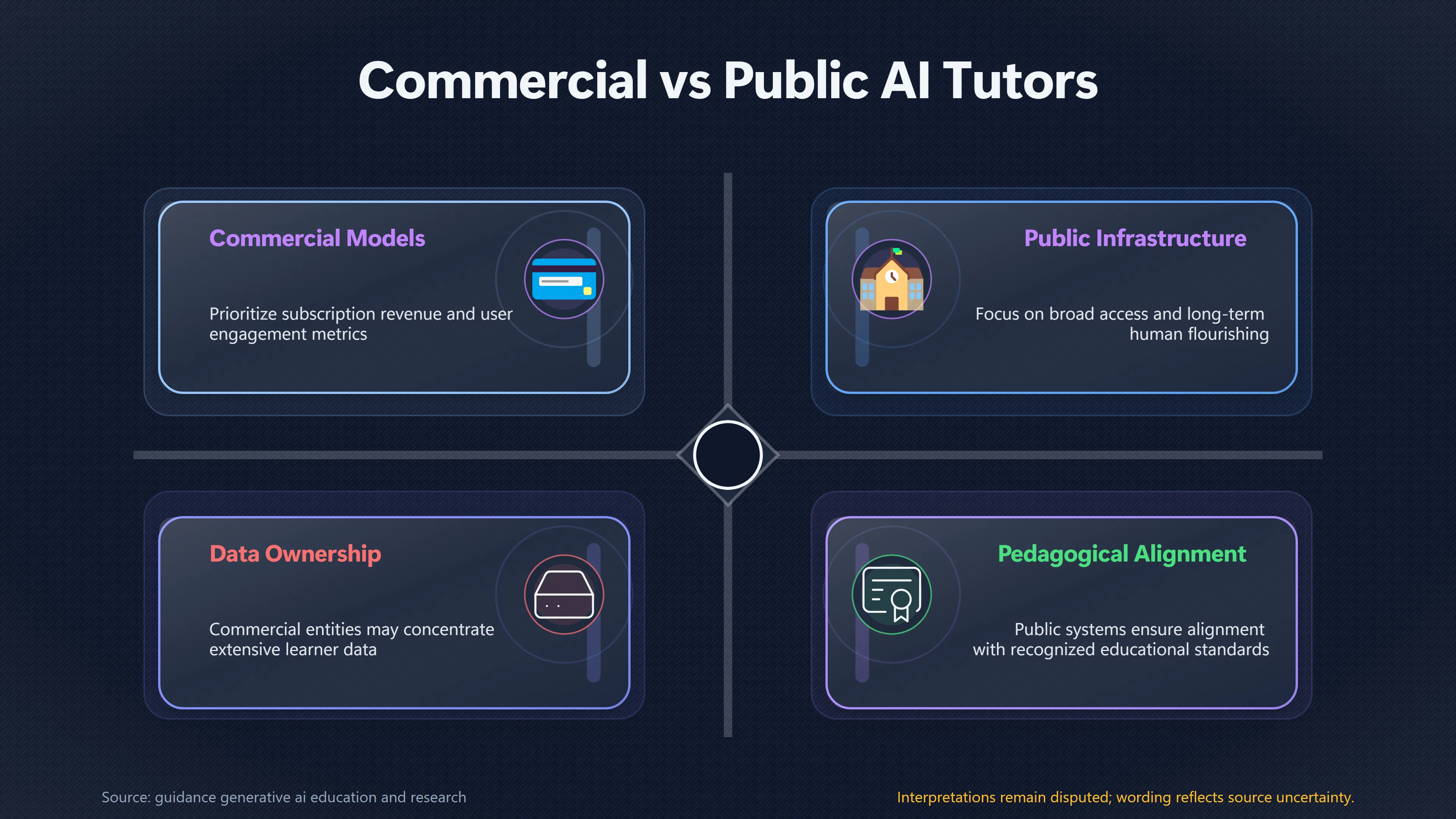
Within the broader vision of AI enabling long-term human flourishing, trusted public AI tutors could become part of society’s educational infrastructure, much as libraries, public schools and universities already are. Rather than leaving lifelong learning entirely to commercial subscriptions, governments, colleges, libraries and employment services could help ensure that high-quality AI guidance remains broadly available, accountable and aligned with educational goals. Whether that vision succeeds depends less on AI capability alone than on governance, public trust and institutional design.[unesco.org]unesco.orgguidance generative ai education and researchGuidance for generative AI in education and research | UNESCOSeptember 7, 2023…
Why access quality may diverge
Today’s AI tutors already vary enormously in quality. Some are carefully designed around established learning science, encouraging learners to reason through problems, identify misconceptions and practise retrieval. Others function mainly as conversational assistants that answer questions quickly but are less effective at promoting durable understanding.
This creates the risk of a two-tier educational system. Wealthier learners may gain access to premium tutors trained on carefully curated educational content, personalised learning histories and advanced reasoning models, while others rely on free services with weaker safeguards, intrusive advertising or lower educational quality.
The divide is not only about model capability. It also concerns:
- curriculum alignment;
- transparency over sources;
- protection of learner data;
- accessibility for disabled learners;
- support across multiple languages;
- availability throughout adult life rather than only during formal schooling.
The OECD notes that generative AI is becoming widely available outside institutional control, making public policy less about restricting access than ensuring learners have access to systems designed around sound pedagogy rather than simple task completion. It also warns that successful completion of AI-assisted tasks should not be confused with genuine learning.[oecd.org]oecd.orgoecd digital education outlook 2026 062a7394 enOECD Digital Education Outlook 2026 | OECD…
Why public institutions may become trusted providers
Education has traditionally been treated as a public good because societies benefit when knowledge is widely shared. The same logic may increasingly apply to AI tutoring.
Public institutions already possess assets that commercial providers often lack:
- established educational expertise;
- public accountability;
- existing relationships with learners;
- curriculum knowledge;
- legal responsibilities around privacy and equality;
- long-term incentives that extend beyond subscription revenue.
Libraries illustrate this particularly well. For generations they have provided trusted access to books, reference services, digital resources and community learning without requiring users to purchase everything individually. AI tutors could become a natural extension of that role, helping citizens navigate increasingly complex knowledge throughout their lives.
Similarly, community colleges, universities, adult education providers and employment services already help people retrain during economic transitions. As AI changes labour markets, these institutions may increasingly provide trusted AI learning assistants alongside human advisers, allowing workers to acquire new skills repeatedly across decades rather than relying on one-off qualifications.
Rather than replacing teachers or librarians, AI could multiply their reach by providing continuous support between human interactions while remaining embedded within accountable educational institutions.[unesco.org]unesco.orgUNESC O, UNICEF and ITU launch Charter for Public Digital LearningUNESCO, UNICEF and ITU launch Charter for Public Digital LearningMarch 19, 2026…
Public AI tutors as educational infrastructure
Thinking of AI tutors as infrastructure changes the policy discussion.
Roads, public health systems and libraries are not expected to maximise shareholder returns. They exist because broad access creates benefits that spread throughout society. Knowledge infrastructure may deserve similar treatment if AI tutoring becomes an essential gateway to education, employment and civic participation.
Within the broader AI Bloom perspective, this matters because abundant intelligence only contributes to widespread human flourishing if people can actually reach it.
Potential public benefits include:
- helping adults retrain after technological disruption;
- supporting people returning to education later in life;
- reducing educational inequality between regions;
- assisting migrants through multilingual tutoring;
- providing accessible learning for disabled users;
- supporting older adults who wish to continue learning;
- offering educational continuity during unemployment or career changes.
The economic gains from higher productivity are important, but the wider objective is expanding human capability over an entire lifetime.

Certification matters as much as capability
If public institutions recommend or provide AI tutors, citizens need reasons to trust them.
Unlike traditional textbooks, conversational AI generates new responses continuously. That makes quality assurance an ongoing process rather than a one-time review.
Useful certification could include requirements such as:
- transparent identification that users are interacting with AI;
- evidence that educational claims are grounded in reliable sources;
- regular evaluation against recognised educational standards;
- documented testing for hallucinations and misleading explanations;
- clear privacy protections for learner data;
- accessibility standards;
- independent auditing;
- mechanisms for reporting and correcting failures.
The goal is not to certify that an AI is always correct—a standard no human teacher could meet—but to demonstrate that providers meet recognised standards for educational quality, transparency and accountability.
UNESCO argues that educational AI should undergo ethical validation alongside pedagogical evaluation, while policy frameworks should address privacy, safety, transparency and age-appropriate use rather than treating AI as ordinary software.[unesco.org]unesco.orgguidance generative ai education and researchGuidance for generative AI in education and research | UNESCOSeptember 7, 2023…
Accountability cannot disappear behind the algorithm
One temptation is to imagine AI tutors replacing institutional responsibility. Most education policy points in the opposite direction.
If an AI gives poor advice, reinforces misconceptions or mishandles sensitive personal information, responsibility must remain with identifiable organisations rather than disappearing into opaque technology.
This means institutions need clear answers to practical questions:
- Who selected the model?
- Who approves educational content?
- Who investigates complaints?
- Who monitors accuracy over time?
- Who protects learner records?
- Who decides when human educators should intervene?
Recent OECD guidance on AI in vocational education argues that AI should strengthen rather than weaken institutional accountability. Organisations remain responsible for educational quality even when AI contributes to curriculum development or learner support.[oecd.org]oecd.orgfull reportFive principles for the effective use of AI in vocational education and training development | OECDJune 23, 2026…
Public trust depends on human oversight
Evidence from educational AI increasingly suggests that the strongest outcomes come from combining AI with human expertise rather than replacing it.
Human oversight serves several functions:
- correcting factual mistakes;
- recognising emotional or safeguarding concerns;
- adapting advice to local circumstances;
- identifying when learners need professional support;
- ensuring educational goals remain central.
Research into human-AI tutoring systems has found that AI can help less-experienced tutors adopt stronger pedagogical practices while leaving final judgement with humans. Other recent studies suggest that purpose-built educational AI can support learning effectively when carefully supervised and designed around educational objectives rather than unrestricted conversation.[arXiv]arxiv.orgarXiv Tutor Co Pilot: A Human-AI Approach for Scaling Real-Time ExpertiseTutor CoPilot: A Human-AI Approach for Scaling Real-Time ExpertiseOctober 3, 2024…
Risks if trusted access is neglected
If governments simply leave AI tutoring entirely to market forces, several long-term risks emerge.
First, educational quality may increasingly depend on ability to pay for better models.
Second, commercial incentives may favour engagement over learning, encouraging systems that keep users interacting rather than gradually making them more independent.
Third, extensive learner data could become concentrated within a small number of technology companies, raising concerns about privacy and market power.
Finally, educational content itself could become fragmented across incompatible proprietary ecosystems, making it harder for public institutions to maintain common standards or guarantee equal opportunity.
None of these outcomes is inevitable, but each becomes more plausible if trusted public alternatives fail to develop alongside commercial offerings.
A governance choice that shapes AI Bloom
The optimistic case for AI-assisted lifelong learning is not simply that intelligent tutors become technically impressive. It is that reliable educational guidance becomes as widely available as public schooling or libraries once made literacy.
That outcome depends on institutions as much as algorithms. Trusted public AI tutors would require investment, independent evaluation, transparent governance and sustained human oversight. If those conditions are met, AI could help make high-quality personalised education a broadly shared capability rather than a luxury, supporting repeated learning across an entire lifetime and enabling more people to participate in the larger possibilities of scientific progress, economic adaptation and long-term human flourishing.[unesco.org]unesco.orgUNESC O, UNICEF and ITU launch Charter for Public Digital LearningUNESCO, UNICEF and ITU launch Charter for Public Digital LearningMarch 19, 2026…
Amazon book picks
Further Reading
Books and field guides related to Who Should Provide Trusted AI Tutors For Everyone?. Use these as the next step if you want deeper reading beyond the article.
The Alignment Problem
Finalist for the Los Angeles Times Book Prize A jaw-dropping exploration of everything that goes wrong when we build AI systems and the m...
Weapons of Math Destruction
"A former Wall Street quantitative analyst sounds an alarm on mathematical modeling, a pervasive new force in society that threatens to u...
Algorithms of Oppression
Acknowledgments -- Introduction: the power of algorithms -- A society, searching -- Searching for Black girls -- Searching for people and...
The Fifth Estate
In the eighteenth century, the printing press enabled the rise of an independent press--the Fourth Estate--that helped check the power of...
eBay marketplace picks
Marketplace Samples
Live-tested eBay searches with available results related to this page.
Selected fromteacher mug oneBay.co.uk.




Endnotes
1.
Source: unesco.org
Title: guidance generative ai education and research
Link:https://www.unesco.org/en/articles/guidance-generative-ai-education-and-research?hub=67098
Source snippet
Guidance for generative AI in education and research | UNESCOSeptember 7, 2023...
Published: September 7, 2023
2.
Source: oecd.org
Title: oecd digital education outlook 2026 062a7394 en
Link:https://www.oecd.org/en/publications/oecd-digital-education-outlook-2026_062a7394-en.html
Source snippet
OECD Digital Education Outlook 2026 | OECD...
3.
Source: oecd.org
Title: 062a7394 en
Link:https://www.oecd.org/content/dam/oecd/en/publications/reports/2026/01/oecd-digital-education-outlook-2026_940e0dd8/062a7394-en.pdf
4.
Source: unesco.org
Title: UNESC O, UNICEF and ITU launch Charter for Public Digital Learning
Link:https://www.unesco.org/en/articles/unesco-unicef-and-itu-launch-charter-public-digital-learning-platforms?hub=701
Source snippet
UNESCO, UNICEF and ITU launch Charter for Public Digital LearningMarch 19, 2026...
Published: March 19, 2026
5.
Source: unesco.org
Title: Artificial intelligence in education
Link:https://www.unesco.org/en/digital-education/artificial-intelligence?hub=66708
Source snippet
AI | UNESCO...
6.
Source: oecd.org
Title: full report
Link:https://www.oecd.org/en/publications/five-principles-for-the-effective-use-of-ai-in-vocational-education-and-training-development_ee8c8e8e-en/full-report.html
Source snippet
Five principles for the effective use of AI in vocational education and training development | OECDJune 23, 2026...
Published: June 23, 2026
7.
Source: oecd.org
Title: Trustworthy artificial intelligence (AI) in education (EN)
Link:https://www.oecd.org/content/dam/oecd/en/publications/reports/2020/04/trustworthy-artificial-intelligence-ai-in-education_f1a7c415/a6c90fa9-en.pdf
8.
Source: arxiv.org
Title: arXiv Tutor Co Pilot: A Human-AI Approach for Scaling Real-Time Expertise
Link:https://arxiv.org/abs/2410.03017
Source snippet
Tutor CoPilot: A Human-AI Approach for Scaling Real-Time ExpertiseOctober 3, 2024...
Published: October 3, 2024
9.
Source: arxiv.org
Link:https://arxiv.org/abs/2512.23633
10.
Source: unicef.org
Link:https://www.unicef.org/digitaleducation/CharterforPublicDigitalLearningPlatforms
11.
Source: oecd.org
Title: empowering learners for the age of ai 65cd27d4 en
Link:https://www.oecd.org/en/publications/empowering-learners-for-the-age-of-ai_65cd27d4-en.html
12.
Source: unicef.org
Link:https://www.unicef.org/digitaleducation/Charter-Launch
13.
Source: oecd.org
Title: enablers guardrails and engagement for unlocking trustworthy ai 2f817983
Link:https://www.oecd.org/en/publications/2025/06/governing-with-artificial-intelligence_398fa287/full-report/enablers-guardrails-and-engagement-for-unlocking-trustworthy-ai_2f817983.html
14.
Source: unesco.org
Title: Artificial intelligence in education
Link:https://www.unesco.org/en/digital-education/artificial-intelligence?hub=67832
15.
Source: unesco.org
Title: Artificial intelligence in education
Link:https://www.unesco.org/en/digital-education/artificial-intelligence?hub=83250
Additional References
16.
Source: youtube.com
Link:https://www.youtube.com/watch?v=8FnOkxj0ZuA
Source snippet
What Schools Must Protect in an AI World with Andreas Schleicher...
17.
Source: youtube.com
Title: What Schools Must Protect in an AI World with Andreas Schleicher
Link:https://www.youtube.com/watch?v=qK1ca5vkTO4
Source snippet
Breaking Barriers: How Generative AI Levels the Playing Field...
18.
Source: youtube.com
Title: How AI could save (not destroy) education | Sal Khan
Link:https://www.youtube.com/watch?v=aropfD2GzXA
Source snippet
Co-Intelligence: AI in the Classroom with Ethan Mollick | ASU+GSV 2024...
19.
Source: oecd-ilibrary.org
Title: trustworthy artificial intelligence ai in education a6c90fa9 en
Link:https://www.oecd-ilibrary.org/en/publications/trustworthy-artificial-intelligence-ai-in-education_a6c90fa9-en.html
20.
Source: youtube.com
Title: Breaking Barriers: How Generative AI Levels the Playing Field
Link:https://www.youtube.com/watch?v=drsMThgVHQ8
Source snippet
AI, Justice and the Rule of Law...
21.
Source: youtube.com
Title: AI, Justice and the Rule of Law
Link:https://www.youtube.com/watch?v=kH5lS2rQ2wA