Within Cloud Control
Can compute scarcity limit the AI boom
Dependence on scarce computing resources may make it harder for new AI developers to compete with established infrastructure providers.
On this page
- Why frontier compute is difficult to access
- How infrastructure concentration affects competition
- Possible routes toward broader AI access
Page outline Jump by section
Introduction
Frontier AI systems depend on a resource that is becoming as strategically important as data and algorithms: large-scale computing power. The most advanced models require enormous clusters of specialised chips, high-capacity data centres, reliable electricity and billions in infrastructure investment. This creates a potential constraint on the AI boom: if only a small number of companies, countries or cloud providers can obtain enough compute, the ability to build frontier systems may become concentrated among a few powerful actors.
Compute scarcity does not mean AI progress will stop. Hardware efficiency improvements, better algorithms and smaller specialised models can reduce the amount of computing needed for many tasks. But the economics of the frontier are increasingly shaped by access to scarce infrastructure. Training costs for the largest AI models have risen rapidly, with estimates suggesting the cost of the most compute-intensive training runs has increased roughly 2.4 times per year since 2016.[arXiv]arxiv.orgarXiv The rising costs of training frontier AI modelsThe rising costs of training frontier AI modelsMay 31, 2024… The result is a tension at the heart of AI’s potential contribution to human flourishing: advanced AI could help accelerate science, medicine and abundance, but the infrastructure needed to create it may become concentrated in ways that limit who can participate.
Why frontier compute is difficult to access
Frontier AI development requires far more than simply buying faster computers. The challenge is assembling thousands or even hundreds of thousands of advanced processors into a tightly connected system that can train and operate large models efficiently.
Modern AI relies heavily on specialised accelerator chips, especially graphics processing units (GPUs), because they can perform the massive parallel calculations needed for neural networks. These chips are expensive, in high demand and difficult to deploy at scale. The supply chain itself is concentrated: the OECD notes that Nvidia has become the dominant supplier of AI-focused GPUs, with market estimates placing its share above 80% in AI GPU chips, while competition is limited by hardware development costs, software ecosystems and manufacturing complexity.[oecd.org]oecd.orgcomponent 5Overview of the AI supply chain: Competition in artificial intelligence infrastructure | OECDNovember 14, 2025…
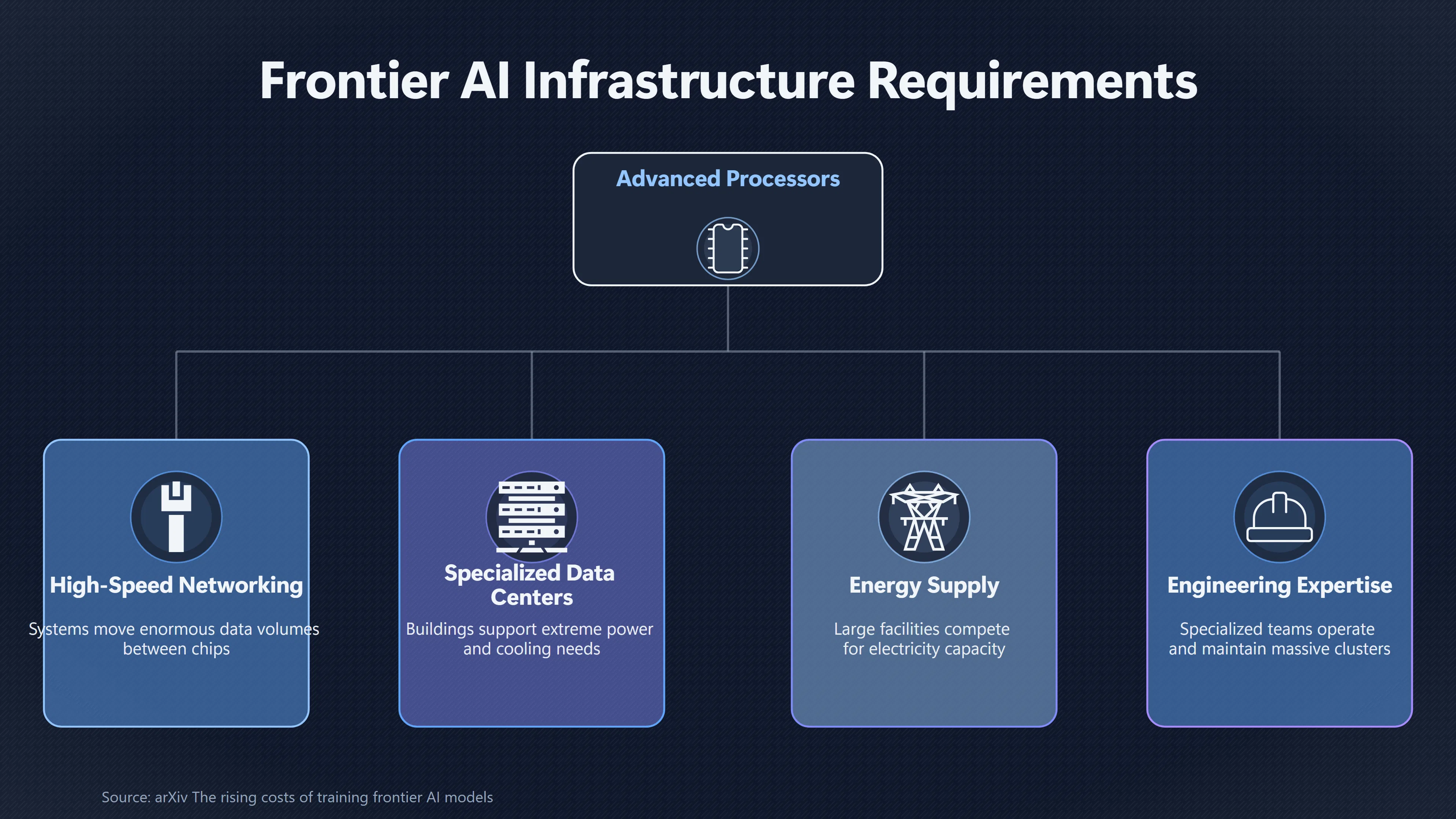
The scarcity is not only about chips. A frontier AI cluster requires:
- Advanced processors: often thousands of high-end accelerators working together.
- High-speed networking: systems must move enormous amounts of data between chips.
- Specialised data centres: buildings must support extreme power, cooling and reliability requirements.
- Energy supply: large AI facilities increasingly compete for electricity capacity.
- Engineering expertise: operating massive clusters requires specialised teams.
This creates a high entry barrier. A small research group or new company may have a good idea for a model but still be unable to compete because it cannot secure enough compute at the right time and price.
Research into AI resource access has found growing concerns about a divide between organisations with abundant computing resources and those without them. A survey of AI researchers published in the AAAI Conference on Artificial Intelligence examined compute access as a potential constraint on research progress and highlighted concerns about resource stratification between industry and academic researchers.[AAAI Open Access]ojs.aaai.orgOpen AccessResource Democratization: Is Compute the Binding Constraint on AI Research? | Proceedings of the AAAI Conference on Artificial Intelligen…
How infrastructure concentration affects competition
The risk is not simply that large companies will have better computers. The deeper concern is that control over compute could shape the entire structure of the AI ecosystem.
Frontier development may become a capital-intensive race
The largest AI models increasingly require budgets beyond the reach of most startups and universities. Stanford’s AI Index has documented rapid growth in training compute requirements, with training compute for notable AI models doubling approximately every five months in recent years.[Stanford HAI]hai.stanford.eduresearch and developmentStanford HAIResearch and Development | The 2025 AI Index Report | Stanford HAI…
This does not mean only the richest organisations can create valuable AI. Many important advances come from algorithmic improvements, open research and smaller models. Some research suggests that efficiency gains can reduce the amount of compute needed for breakthroughs.[arXiv]arxiv.orgarXiv Compute Requirements for Algorithmic Innovation in Frontier AI ModelsCompute Requirements for Algorithmic Innovation in Frontier AI ModelsJuly 13, 2025…
However, the frontier itself may become increasingly shaped by organisations capable of funding enormous infrastructure projects. This could narrow competition among companies attempting to create the most capable general-purpose systems.
A future in which only a handful of organisations can train frontier models could affect the direction of AI development. Companies with control over scarce compute may have greater influence over:
- which scientific problems receive AI investment;
- which business models dominate;
- how widely advanced capabilities are distributed;
- what safety approaches are prioritised.
For an AI bloom scenario — where advanced AI helps humanity overcome disease, scarcity and scientific bottlenecks — broad access matters because breakthroughs may depend on contributions from many researchers, institutions and regions.
Cloud providers can become essential gateways
Because buying and operating giant AI clusters is difficult, many AI developers rely on cloud providers. This creates a new dependency relationship: the companies building AI systems may depend on the companies controlling the infrastructure beneath them.
Cloud partnerships can accelerate progress by giving smaller organisations access to powerful computing without requiring them to build their own data centres. But dependence can also create strategic vulnerability. If a small number of cloud companies control much of the available capacity, they may gain influence over pricing, access terms and which AI projects can scale.
The OECD has identified competition concerns around AI infrastructure, including the possibility that concentrated markets in chips, cloud services and data-centre capacity could create barriers for new entrants.[oecd.org]oecd.orgfull reportCompetition in artificial intelligence infrastructure | OECDNovember 14, 2025…
This does not mean cloud providers will necessarily abuse their position. Large infrastructure companies also have incentives to expand access because more AI developers create more demand for their services. The challenge is maintaining a competitive environment where new AI builders have realistic alternatives.
The global competition problem
Compute concentration is also becoming a geopolitical issue. Advanced AI depends on global supply chains involving chip design, semiconductor manufacturing, cloud infrastructure and energy resources.
The most advanced AI chips are difficult to produce and rely on specialised manufacturing capabilities. This creates strategic dependence on a small number of companies and locations. Stanford’s AI Index has highlighted the concentration of AI hardware supply chains, including the importance of leading semiconductor manufacturing capacity and the growing scale of global AI infrastructure investment.[Stanford HAI]hai.stanford.eduresearch and developmentStanford HAIResearch and Development | The 2026 AI Index Report | Stanford HAI…
Governments increasingly view access to AI compute as part of national competitiveness. The European Union, for example, has launched initiatives to expand AI computing infrastructure through AI factories and proposed larger AI gigafactories designed to provide more access to advanced computing for startups, researchers and industry.[European Commission]commission.europa.euEuropean Commission AI continentEuropean CommissionAI continent - European CommissionApril 9, 2025…
Export controls add another layer of complexity. Restrictions on advanced chips are intended to protect strategic advantages and manage security risks, but they can also reshape who has access to the tools needed for AI research. Recent reporting on Chinese AI development has highlighted how difficult it can be to separate AI progress from the global availability of advanced chips and computing resources.[tomshardware.com]tomshardware.comDue to the popularity and resource demands of Kimi K3, compute resources have been strained, placing new subscriptions on a waiting list…
Possible routes toward broader AI access
Compute scarcity does not have only one possible outcome. Several developments could reduce concentration and widen participation.
More efficient AI could reduce dependence on massive clusters
One route is technological improvement. Better algorithms, more efficient training methods and specialised models can deliver useful capabilities with less computing power.
Recent years have shown that progress is not driven only by making models larger. Techniques such as improved architectures, better data strategies and efficient fine-tuning methods have allowed smaller systems to achieve capabilities that previously required much larger models.
This matters because a future where useful AI requires less compute could make the benefits of AI more widely available. Scientific researchers, universities, public institutions and smaller companies would have more opportunity to contribute.
Alternative hardware could weaken dependence on dominant suppliers
Another possibility is greater competition in AI hardware. Companies are developing alternative accelerators designed to challenge Nvidia’s position. Research comparing alternative AI processors has suggested that competing hardware can achieve competitive results in some workloads, although software ecosystems and developer adoption remain major obstacles.[arXiv]arxiv.orgarXiv Debunking the CUDA Myth Towards GPU-based AI SystemsarXiv Debunking the CUDA Myth Towards GPU-based AI Systems
The challenge is that hardware competition is not only about producing chips. Nvidia’s advantage also comes from its mature software ecosystem, developer tools and widespread adoption. Breaking this advantage requires alternatives that are not merely technically capable but easy for researchers and companies to use.
Public and shared compute could widen participation
Governments and research institutions are exploring shared AI infrastructure as a way to prevent frontier computing from becoming available only to the largest corporations.
Public compute resources could allow universities, startups and researchers to experiment with advanced models without needing billions in private investment. The European Union’s AI infrastructure plans explicitly aim to provide access for startups, researchers and industry rather than limiting frontier computing to major technology companies.[European Commission]commission.europa.euEuropean Commission Artificial IntelligenceEuropean Commission Artificial Intelligence
Shared infrastructure will not eliminate competition concerns, but it could create a broader base of participants able to contribute to AI progress.
Why compute access matters for the AI bloom vision
If advanced AI helps humanity enter a period of abundance, the infrastructure question becomes central. Scientific acceleration, medical breakthroughs, climate solutions and new forms of education may depend on increasingly capable AI systems. But those capabilities will have wider impact only if access to the underlying technology is not permanently restricted to a narrow group.
The risk is not simply economic inequality between companies. Concentrated compute could influence which societies, researchers and communities are able to participate in shaping the technology that may become one of civilisation’s most important tools.
At the same time, avoiding concentration does not mean eliminating large-scale infrastructure. Frontier AI may genuinely require enormous resources, just as major scientific projects such as particle accelerators and space programmes do. The key question is whether these resources become broadly accessible foundations for human progress or strategic bottlenecks controlled by a small number of organisations.
The future of AI competition may therefore depend on finding a balance: enough scale to build powerful systems, but enough openness and diversity that the benefits of advanced intelligence can contribute to a wider human flourishing.
Amazon book picks
Further Reading
Books and field guides related to Can compute scarcity limit the AI boom. Use these as the next step if you want deeper reading beyond the article.
The Coming Wave
"We are approaching a critical threshold in the history of our species. Everything is about to change. Soon you will live surrounded by A...
AI Superpowers
THE NEW YORK TIMES, USA TODAY, AND WALL STREET JOURNAL BESTSELLER "Kai-Fu Lee believes China will be the next tech-innovation superpower...
Chip War
***Winner of the 2022 Financial Times Business Book of the Year Award*** ***Selected as one of Barack Obama's Favourite Books of 2023***...
The Nvidia Way
"The Nvidia Way is a riveting history of Nvidia's unexpected ascent to the top of the tech sector--and a compelling case for why cofounde...
eBay marketplace picks
Marketplace Samples
Live-tested eBay searches with available results related to this page.
Selected fromdata center poster oneBay.co.uk.




Endnotes
1.
Source: arxiv.org
Title: arXiv The rising costs of training frontier AI models
Link:https://arxiv.org/abs/2405.21015
Source snippet
The rising costs of training frontier AI modelsMay 31, 2024...
Published: May 31, 2024
2.
Source: oecd.org
Title: component 5
Link:https://www.oecd.org/en/publications/competition-in-artificial-intelligence-infrastructure_623d1874-en/full-report/component-5.html
Source snippet
Overview of the AI supply chain: Competition in artificial intelligence infrastructure | OECDNovember 14, 2025...
Published: November 14, 2025
3.
Source: ojs.aaai.org
Title: Open Access
Link:https://ojs.aaai.org/index.php/AAAI/article/view/29959
Source snippet
Resource Democratization: Is Compute the Binding Constraint on AI Research? | Proceedings of the AAAI Conference on Artificial Intelligen...
4.
Source: hai.stanford.edu
Title: research and development
Link:https://hai.stanford.edu/ai-index/2025-ai-index-report/research-and-development
Source snippet
Stanford HAIResearch and Development | The 2025 AI Index Report | Stanford HAI...
5.
Source: arxiv.org
Title: arXiv Compute Requirements for Algorithmic Innovation in Frontier AI Models
Link:https://arxiv.org/abs/2507.10618
Source snippet
Compute Requirements for Algorithmic Innovation in Frontier AI ModelsJuly 13, 2025...
Published: July 13, 2025
6.
Source: oecd.org
Title: full report
Link:https://www.oecd.org/en/publications/competition-in-artificial-intelligence-infrastructure_623d1874-en/full-report.html
Source snippet
Competition in artificial intelligence infrastructure | OECDNovember 14, 2025...
Published: November 14, 2025
7.
Source: hai.stanford.edu
Title: research and development
Link:https://hai.stanford.edu/ai-index/2026-ai-index-report/research-and-development
Source snippet
Stanford HAIResearch and Development | The 2026 AI Index Report | Stanford HAI...
8.
Source: tomshardware.com
Link:https://www.tomshardware.com/tech-industry/artificial-intelligence/chinas-moonshot-ai-reportedly-used-nvidia-blackwell-chips-for-training-kimi-k3-company-circumvented-both-u-s-export-and-chinese-import-controls-to-acquire-compute
Source snippet
Due to the popularity and resource demands of Kimi K3, compute resources have been strained, placing new subscriptions on a waiting list...
9.
Source: arxiv.org
Title: arXiv Debunking the CUDA Myth Towards GPU-based AI Systems
Link:https://arxiv.org/abs/2501.00210
10.
Source: nvidianews.nvidia.com
Title: europe unveils a record 35 new nvidia ai supercomputers
Link:https://nvidianews.nvidia.com/news/europe-unveils-a-record-35-new-nvidia-ai-supercomputers
11.
Source: nvidianews.nvidia.com
Title: vera rubin full production agentic ai factory
Link:https://nvidianews.nvidia.com/news/vera-rubin-full-production-agentic-ai-factory
12.
Source: investor.nvidia.com
Link:https://investor.nvidia.com/news/press-release-details/2026/NVIDIA-Vera-Rubin-Ramps-Into-Full-Production-to-Power-Agentic-AI-Factories-Worldwide/default.aspx
13.
Source: oecd.org
Title: component 6
Link:https://www.oecd.org/en/publications/competition-in-artificial-intelligence-infrastructure_623d1874-en/full-report/component-6.html
14.
Source: oecd.org
Link:https://www.oecd.org/en/publications/competition-in-artificial-intelligence-infrastructure_623d1874-en/full-report/component-3.html
15.
Source: hai.stanford.edu
Title: 2025 ai index report
Link:https://hai.stanford.edu/ai-index/2025-ai-index-report?sf223786129=1
16.
Source: hai.stanford.edu
Title: research and development
Link:https://hai.stanford.edu/ai-index/2024-ai-index-report/research-and-development
17.
Source: hai.stanford.edu
Title: 2024 ai index report
Link:https://hai.stanford.edu/ai-index/2024-ai-index-report?hl=en-US
18.
Source: hai.stanford.edu
Title: 2025 ai index report
Link:https://hai.stanford.edu/ai-index/2025-ai-index-report?b=wsj-events&source-key=wsj.com
19.
Source: hai.stanford.edu
Title: 2025 ai index report
Link:https://hai.stanford.edu/ai-index/2025-ai-index-report?authuser=0
20.
Source: commission.europa.eu
Title: European Commission AI continent
Link:https://commission.europa.eu/topics/competitiveness/ai-continent_en
Source snippet
European CommissionAI continent - European CommissionApril 9, 2025...
Published: April 9, 2025
21.
Source: commission.europa.eu
Title: European Commission AI Gigafactories
Link:https://commission.europa.eu/topics/competitiveness/competitiveness-coordination-tool-projects/ai-gigafactories_en
Source snippet
European CommissionAI Gigafactories - European Commission...
22.
Source: commission.europa.eu
Title: European Commission Artificial Intelligence
Link:https://commission.europa.eu/topics/artificial-intelligence_en
23.
Source: commission.europa.eu
Title: eu Strengthening Europe’s tech sovereignty
Link:https://commission.europa.eu/news-and-media/news/strengthening-europes-tech-sovereignty-2026-06-03_en
24.
Source: digital-strategy.ec.europa.eu
Title: eu A I Factories | Shaping Europe’s digital future
Link:https://digital-strategy.ec.europa.eu/en/policies/ai-factories
25.
Source: eur-lex.europa.eu
Title: eu Regulation
Link:https://eur-lex.europa.eu/legal-content/EN/TXT/?qid=1780778296020&uri=CELEX%3A32026R0150
26.
Source: thekb.eu
Title: stanford hai ai index report 2025 trends 2025 04 07
Link:https://www.thekb.eu/en/fiches/stanford-hai-ai-index-report-2025-trends-2025-04-07/
27.
Source: cor.europa.eu
Link:https://www.cor.europa.eu/en/our-work/opinions/cdr
28.
Source: digital-strategy.ec.europa.eu
Title: eu A I Innovation Package | Shaping Europe’s digital future
Link:https://digital-strategy.ec.europa.eu/en/factpages/ai-innovation-package
29.
Source: doi.org
Link:https://doi.org/10.48550/arXiv.2405.21015
30.
Source: commission.europa.eu
Title: eu More support for artificial intelligence start-ups to boost innovation
Link:https://commission.europa.eu/news-and-media/news/more-support-artificial-intelligence-start-ups-boost-innovation-2024-01-24_en
31.
Source: digital-strategy.ec.europa.eu
Link:https://digital-strategy.ec.europa.eu/en/news/commission-launches-ai-innovation-package-support-artificial-intelligence-startups-and-smes
32.
Source: digital-strategy.ec.europa.eu
Link:https://digital-strategy.ec.europa.eu/en/library/communication-boosting-startups-and-innovation-trustworthy-artificial-intelligence
33.
Source: interoperable-europe.ec.europa.eu
Link:https://interoperable-europe.ec.europa.eu/eu-digital-funding-opportunities
Additional References
34.
Source: youtube.com
Link:https://www.youtube.com/watch?v=s6Ygo4_bpWU
Source snippet
Ep. 6 Is Nvidia Getting Too Big for Its Britches? | AI Insights and Innovation...
35.
Source: youtube.com
Title: Ep. 6 Is Nvidia Getting Too Big for Its Britches? | AI Insights and Innovation
Link:https://www.youtube.com/watch?v=vdiPD964TCM
Source snippet
Project Stargate: Big Tech's $500B AI Data Centers & Monopoly Risks Explained...
36.
Source: nature.com
Title: A I’s computing gap: academics lack access to powerful chips needed for research
Link:https://www.nature.com/articles/d41586-024-03792-6
37.
Source: youtube.com
Title: The Dark Side of NVIDIA: The GPU Giant
Link:https://www.youtube.com/watch?v=fY9T8iYHwuQ
Source snippet
WATCH: Nvidia & OpenAI Announce $100B Partnership in AI Infrastructure | DRM News...
38.
Source: frontier-economics.com
Link:https://www.frontier-economics.com/uk/en/news-and-insights/articles/article-i21406-ai-beyond-the-cloud-navigating-competition-innovation-and-regulation/
39.
Source: cambridge.org
Link:https://www.cambridge.org/core/journals/cambridge-forum-on-ai-law-and-governance/article/architectures-of-ai-tech-power-broking-war/90CEC9E0D9E88CCD48301228A33F2335
40.
Source: trendforce.com
Link:https://www.trendforce.com/presscenter/news/20260408-13003.html
41.
Source: carnegieendowment.org
Link:https://carnegieendowment.org/research/2026/06/the-compute-coalition-how-to-build-the-future-of-ai-in-the-free-world
42.
Source: siliconforward.com
Link:https://siliconforward.com/frontier-labs/frontier-ai-labs-compute-oligopoly-global-[distribution
43.
Source: insight.goover.ai
Link:https://insight.goover.ai/report/202605/go-public-report-en-9d66ac1b-d653-4a32-ba59-4d7df63c53d7-0-0.html