Within Long Future
Could AI help humanity reach space?
AI could accelerate space settlement by supporting autonomous construction, life support and engineering needed for a multi-world civilisation.
On this page
- Autonomous systems beyond Earth
- Engineering challenges for settlements
- Long term survival across worlds
Page outline Jump by section
Introduction
Could AI help humanity reach space? The most plausible answer is yes, but not by replacing the enormous physical challenges of spaceflight with a simple software solution. AI could become a force multiplier for space settlement by helping autonomous machines explore hostile environments, construct infrastructure before humans arrive, manage closed life-support systems, and make distant operations more resilient. The long-term significance is not merely faster exploration: spreading human activity beyond Earth could reduce the risk that a single planetary disaster ends humanity’s future.[NASA]nasa.govMoon to Mars ArchitectureMoon to Mars Architecture - Components - NASAMarch 25, 2026…
An AI-enabled space civilisation would likely begin with small steps rather than instant colonies. Robots could prepare lunar or Martian sites, extract local materials, maintain equipment and support scientific work before permanent human communities exist. Over much longer timescales, advanced AI could help make settlements increasingly self-sufficient, allowing civilisation to expand across multiple worlds. The opportunity is substantial, but so are the uncertainties: space remains an extremely hostile environment, settlement requires enormous resources, and advanced AI systems would need careful governance to ensure that expansion remains aligned with human flourishing.
Autonomous systems could build the foundations of life beyond Earth
Why robots may arrive before humans
Space settlement has a fundamental logistics problem: every kilogram launched from Earth is expensive, and every human mission requires extensive support. A settlement that depends indefinitely on supplies from Earth is not a true expansion of civilisation; it is an outpost connected to a fragile supply chain. AI-powered autonomous systems could help change this by allowing machines to perform preparation work before people arrive.
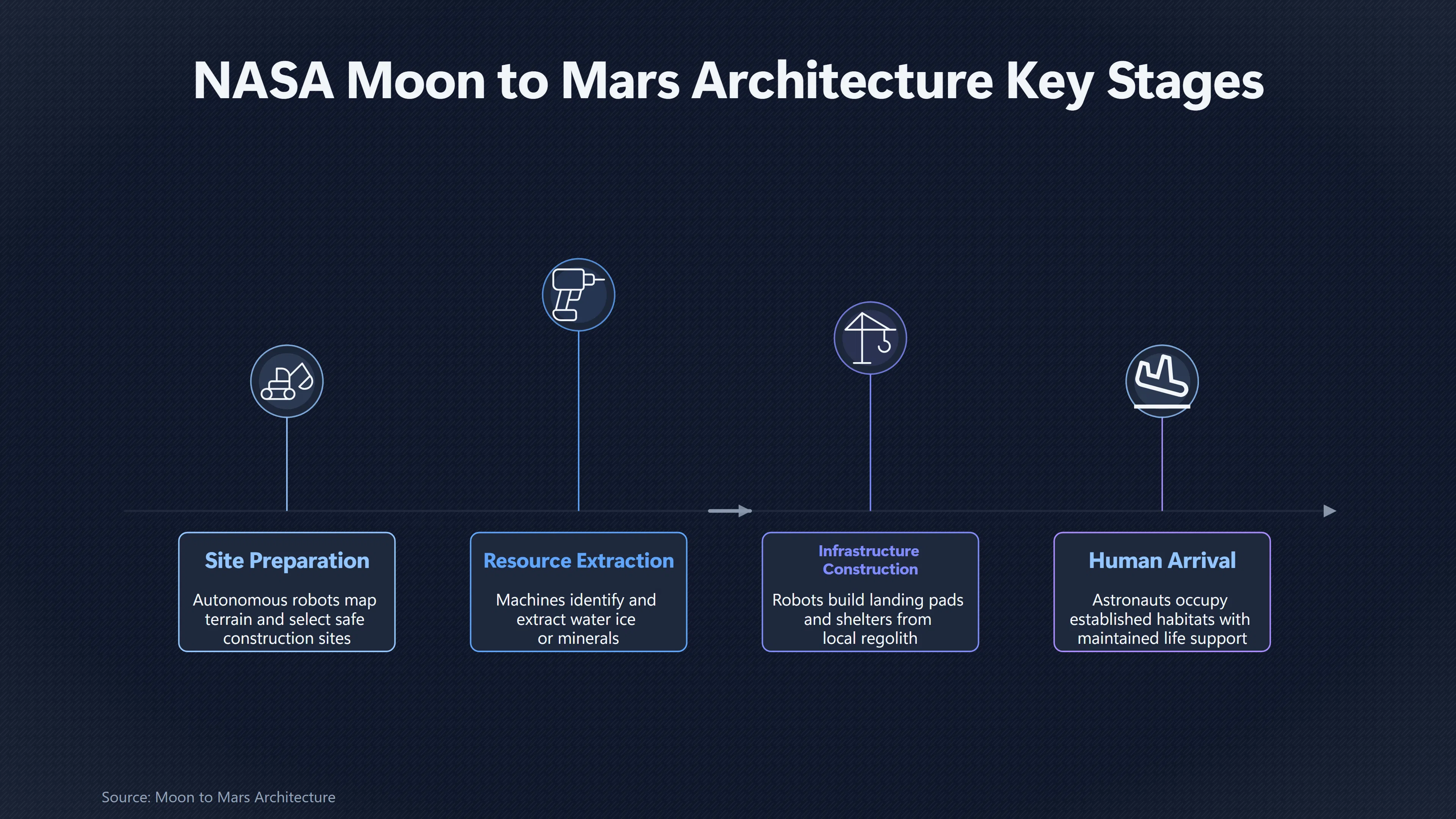
NASA’s Moon to Mars architecture identifies autonomous systems, robotics, habitation, power, communications, and in-situ resource utilisation (using local materials rather than importing everything from Earth) as essential capabilities for sustained human presence beyond Earth.[NASA]nasa.govMoon to Mars ArchitectureMoon to Mars Architecture - Components - NASAMarch 25, 2026… The logic is straightforward: before astronauts live on another world, machines must understand the environment, move materials, build infrastructure and maintain essential systems.
The Moon is likely to be the first major testing ground. NASA’s lunar technology programmes are developing autonomous rovers, resource extraction methods and construction approaches designed for long-duration operations. These include systems for moving lunar soil, detecting hazards and supporting construction from local materials.[NASA]nasa.govLunar Surface TechnologyLunar Surface Technology…
AI matters because communication delays make direct human control increasingly difficult. A rover on the Moon can often receive instructions quickly, but a Mars settlement faces communication delays of several minutes each way. Future machines will need greater independence: deciding how to navigate terrain, prioritising repairs, managing energy use and responding to unexpected failures.
From remote control to autonomous settlement workers
The most important shift is not that AI-powered robots will become “workers” in a human sense, but that they could turn space operations from manually supervised missions into more scalable systems.
Examples of possible AI-enabled tasks include:
- mapping terrain and selecting safe construction sites;
- identifying useful resources such as ice deposits or minerals;
- operating excavation and construction equipment;
- inspecting habitats and spacecraft for damage;
- coordinating fleets of robots working together;
- managing routine maintenance without constant instructions from Earth.
NASA’s Cooperative Autonomous Distributed Robotic Exploration (CADRE) project demonstrates this direction through small autonomous lunar rovers designed to cooperate, map terrain and make decisions collectively rather than relying entirely on step-by-step human commands.[NASA]nasa.govLunar Surface TechnologyLunar Surface Technology…
The broader historical comparison is important. Human expansion on Earth often depended on tools that extended our ability to operate in difficult environments: ships enabled ocean exploration, machines transformed agriculture and industrial robots expanded manufacturing. AI-enabled space systems represent a similar transition, where intelligence becomes part of the infrastructure needed to operate in environments humans cannot easily inhabit.
Engineering challenges remain larger than intelligence alone
Building settlements from local materials
A major barrier to space settlement is the need to reduce dependence on Earth. Transporting every building component, fuel source and spare part across interplanetary distances is unlikely to support large populations. Instead, future settlements will need to use local resources.
This concept is known as in-situ resource utilisation (ISRU). On the Moon, this could involve extracting water ice, producing oxygen and using lunar soil, known as regolith, for construction. NASA’s lunar surface technology work focuses on combining power systems, resource extraction, autonomous robotics and construction methods to create the foundations of longer-term operations.[NASA]nasa.govLunar Surface TechnologyLunar Surface Technology…
AI could improve these processes by helping machines operate in uncertain conditions. Lunar and Martian environments contain hazards that are difficult to fully predict: abrasive dust, extreme temperature changes, radiation and limited access to repair facilities. Intelligent systems could help detect failures early and adapt operations when conditions change.
NASA’s Moon-to-Mars Planetary Autonomous Construction Technology project has explored methods for creating infrastructure such as landing pads, shelters and protective structures using materials available on the lunar surface.[NASA Technical Reports Server]ntrs.nasa.govNASA Technical Reports ServerNASA’s Moon-to-Mars Planetary Autonomous Construction Technology Project: Overview and Status - NASA Technic… Such approaches matter because a settlement cannot rely on bringing an entire Earth-like industrial base into space at the beginning.
Life support is a civilisation-scale engineering problem
A permanent settlement also requires systems that can keep humans alive for years or generations. Unlike a short mission, a settlement needs reliable recycling of air, water and nutrients, as well as continuous power and medical support.
AI could assist by monitoring complex networks of sensors and predicting problems before they become emergencies. A future habitat might contain thousands of interconnected systems: oxygen generation, water purification, food production, radiation protection, power storage and mechanical maintenance. Managing these systems manually would become increasingly difficult as settlements grow.
However, AI is not a substitute for robust engineering. A badly designed life-support system cannot be rescued simply by adding better software. Space settlements will require redundancy, repair capability, human expertise and careful testing. The strongest role for AI is likely to be improving reliability rather than removing the underlying difficulty.

Space expansion as a long-term survival strategy
Why becoming multi-world matters
Earth is currently humanity’s only known home. This creates a single point of failure. Natural disasters, asteroid impacts, severe environmental changes or self-created crises could potentially threaten civilisation’s continuity. A civilisation spread across multiple locations would be more resilient because no single event could destroy all human communities.
This does not mean space settlement is an immediate solution to Earth’s problems. Building settlements beyond Earth will require enormous effort, and many risks are more effectively addressed on Earth through better governance, science and technology. Space expansion is best understood as a long-term complement to improving conditions on Earth, not an escape from current responsibilities.
Within the broader AI bloom vision, the importance of space settlement is that it expands the possible future of conscious life. If humanity develops the ability to create self-sustaining communities beyond Earth, the number of places where intelligence, culture and scientific discovery can exist could increase dramatically.
AI could accelerate the path from exploration to civilisation
Historically, major expansions of human capability have depended on combining knowledge with new tools. Space settlement requires advances in robotics, materials science, energy systems, biology and manufacturing. AI could accelerate progress across these fields by helping researchers design better systems, simulate environments and discover solutions faster.
The connection between AI and space is already visible in planetary exploration. Autonomous navigation and decision-making are becoming increasingly important because distant spacecraft cannot always wait for instructions from Earth. Future missions will require machines that can act with greater independence while remaining under human oversight.[Space]space.comnasas perseverance mars rover completes its 1st drive planned by aiConducted on December 8 and 10, 2025, the demonstration showed that generative AI could independently analyze terrain and plan safe trave…
The long-term possibility is not simply more efficient missions. It is a different model of expansion: intelligent systems helping humanity move from occasional visits to sustained presence.
The biggest obstacles are social as well as technical
More capability does not automatically mean a better future
The optimistic case for AI-enabled space expansion depends on more than engineering success. A larger civilisation could still reproduce old problems: unequal access, concentrated power, conflict over resources or poor decision-making.
If AI dramatically lowers the cost of building and operating settlements, questions of governance become central. Who controls autonomous systems? Who benefits from new resources? How are decisions made in communities far from Earth? A future of abundance requires institutions capable of distributing opportunity rather than allowing new forms of extreme dependence.
These questions are especially important because space settlements would operate in environments where mistakes are costly. A failure of governance in a remote habitat could threaten lives quickly, while communication delays may limit outside intervention.
The uncertainty around AI itself
Advanced AI systems could provide enormous benefits, but they also introduce risks. Highly capable autonomous systems would need safeguards against unintended actions, cyber compromise and failures of alignment with human goals.
Space is a particularly demanding environment because systems must operate safely under conditions where repair is difficult and human assistance may be unavailable. The same autonomy that allows a robot to build a habitat on Mars also creates a need for stronger verification and control methods.
For this reason, the future of AI-supported settlement depends on two forms of progress happening together: increasing technical capability and improving humanity’s ability to govern powerful technologies responsibly.
A larger future beyond one planet
AI space settlement systems represent one of the clearest examples of how artificial intelligence could influence humanity’s long future. The immediate goal is not science-fiction-style colonisation, but solving practical barriers: autonomous construction, resource extraction, habitat maintenance and reliable operations far from Earth.
If these challenges can be overcome, AI could help transform space from a place humans briefly visit into an environment where civilisation can gradually take root. The deeper significance is resilience: a humanity with multiple homes, greater scientific capability and more options for survival would have a larger and potentially richer future than one confined permanently to a single planet.
Amazon book picks
Further Reading
Books and field guides related to Could AI help humanity reach space?. Use these as the next step if you want deeper reading beyond the article.
Enlightenment Now
Rating: 4.5/5 from 6 Google Books ratings
INSTANT NEW YORK TIMES BESTSELLER A NEW YORK TIMES NOTABLE BOOK OF 2018 ONE OF THE ECONOMIST'S BOOKS OF THE YEAR "My new favorite book of...
The Case for Mars
He explains step-by-step how we can use present-day technology to send humans to Mars within ten years; actually produce fuel and oxygen...

Packing for Mars
Rating: 3.9/5 from 19 Google Books ratings
What happens to you when you can't walk for a year? When you can't have sex? Or smell flowers? What happens if you vomit in your helmet d...
The Martian
#1 NEW YORK TIMES BESTSELLER • “Brilliant . . . a celebration of human ingenuity [and] the purest example of real-science sci-fi for many...
eBay marketplace picks
Marketplace Samples
Live-tested eBay searches with available results related to this page.
Selected fromspacecraft model oneBay.co.uk.
Endnotes
1.
Source: nasa.gov
Title: Moon to Mars Architecture
Link:https://www.nasa.gov/moontomarsarchitecture-components/
Source snippet
Moon to Mars Architecture - Components - NASAMarch 25, 2026...
Published: March 25, 2026
2.
Source: nasa.gov
Title: Lunar Surface Technology
Link:https://www.nasa.gov/lunar-surface-technology/
Source snippet
Lunar Surface Technology...
3.
Source: ntrs.nasa.gov
Link:https://ntrs.nasa.gov/citations/20220013715
Source snippet
NASA Technical Reports ServerNASA’s Moon-to-Mars Planetary Autonomous Construction Technology Project: Overview and Status - NASA Technic...
4.
Source: space.com
Title: nasas perseverance mars rover completes its 1st drive planned by ai
Link:https://www.space.com/space-exploration/mars-rovers/nasas-perseverance-mars-rover-completes-its-1st-drive-planned-by-ai
Source snippet
Conducted on December 8 and 10, 2025, the demonstration showed that generative AI could independently analyze terrain and plan safe trave...
5.
Source: nasa.gov
Title: Moon Base
Link:https://www.nasa.gov/moonbase/
Source snippet
July 24, 2026 — Moon Base * Moon Base * Homepage * About * Solicitations * Resources * For Media Featured Video MOON BASE ASSEMBLY IN...
Published: July 24, 2026
6.
Source: techport.nasa.gov
Link:https://techport.nasa.gov/projects/116319
Source snippet
ProjectJune 18, 2026 — Game Changing [Development]({{ 'build-rights/' | relative_url }}) MOON-TO-MARS PLANETARY AUTONOMOUS CONSTRUCTION TECHNOLOGY (MMPACT) Updated 06...
Published: June 18, 2026
7.
Source: nasa.gov
Title: Fly Foundational Robots
Link:https://www.nasa.gov/mission/fly-foundational-robots/
Source snippet
June 12, 2026 — FLY FOUNDATIONAL ROBOTS Future Mission find out more Learn about Fly Foundational Robots FEATURE Space Roboticist Cha...
Published: June 12, 2026
8.
Source: nasa.gov
Title: Artificial Intelligence
Link:https://www.nasa.gov/artificial-intelligence/
Source snippet
* AI Ethics * AI Inventory * AI for Science AT NASA, USE OF ARTIFICIAL INTELLIGENCE HAS A ROLE IN OUR MISSIONS, EXPLORATION OF THE MO...
9.
Source: nasa.gov
Title: Artificial Intelligence for Life in Space (AI4LS)
Link:https://www.nasa.gov/ames/space-biosciences/research-branch/artificial-intelligence-for-life-in-space/
10.
Source: techport.nasa.gov
Link:https://techport.nasa.gov/projects/95635
11.
Source: ntrs.nasa.gov
Link:https://ntrs.nasa.gov/citations/20240004101
12.
Source: nasa.gov
Title: Robot Team Builds High-Performance Digital Structure for NASA
Link:https://www.nasa.gov/general/robot-team-builds-high-performance-digital-structure-for-nasa/
13.
Source: ntrs.nasa.gov
Link:https://ntrs.nasa.gov/citations/20220015103
14.
Source: ntrs.nasa.gov
Link:https://ntrs.nasa.gov/citations/20220012533
15.
Source: ntrs.nasa.gov
Link:https://ntrs.nasa.gov/search.jsp?R=19900005712
16.
Source: www3.nasa.gov
Link:https://www3.nasa.gov/specials/moontomars/
17.
Source: technology.nasa.gov
Title: autonomous systems robotics
Link:https://technology.nasa.gov/advancing-commercial-space/autonomous_systems_robotics
18.
Source: robotics.jpl.nasa.gov
Title: flexible levitation track float
Link:https://robotics.jpl.nasa.gov/what-we-do/research-tasks/flexible-levitation-track-float/
19.
Source: technology.nasa.gov
Title: in situ resource utilization isru systems
Link:https://technology.nasa.gov/advancing-commercial-space/in_situ_resource_utilization_isru_systems
20.
Source: robotics.jpl.nasa.gov
Title: nebula autonomy suite
Link:https://robotics.jpl.nasa.gov/how-we-do-it/systems/nebula-autonomy-suite/
21.
Source: ntrs.nasa.gov
Link:https://ntrs.nasa.gov/citations/20205007535
22.
Source: technology.nasa.gov
Title: LAR TOPS 345
Link:https://technology.nasa.gov/patent/LAR-TOPS-345
23.
Source: www-robotics.jpl.nasa.gov
Title: autonomous robotic construction
Link:https://www-robotics.jpl.nasa.gov/what-we-do/research-tasks/autonomous-robotic-construction/
24.
Source: technology.nasa.gov
Title: advancing commercial space
Link:https://technology.nasa.gov/advancing-commercial-space
25.
Source: sciencedirect.com
Link:https://www.sciencedirect.com/science/article/pii/S2950616625000427
Additional References
26.
Source: sciencedirect.com
Link:https://www.sciencedirect.com/science/article/pii/S2468896726000947
Source snippet
GOVERNANCE SCALING UNDER SCARCITY: A MISSION-ASSURANCE PROTOCOL FOR AUTONOMOUS MARS SURFACE...
27.
Source: youtube.com
Title: The Dark Reality of Space Colonization: Autonomous Robots Taking Over
Link:https://www.youtube.com/watch?v=y8CszwQUVKc
Source snippet
Robots Build Cities On Mars: How Autonomous Construction Changes Everything...
28.
Source: youtube.com
Title: AI In the Final [Frontier]({{ ‘compute-controls/’ | relative_url }}): Transforming Space Exploration for a New Era
Link:https://www.youtube.com/watch?v=aeBB4ndpr9I
Source snippet
Webinar: How AI Is Used in Astronaut Training and Space Exploration...
29.
Source: nature.com
Link:https://www.nature.com/articles/s42256-023-00618-4
30.
Source: youtube.com
Title: Webinar: How AI Is Used in Astronaut Training and Space Exploration
Link:https://www.youtube.com/watch?v=-EhWWXh2Ng0
Source snippet
AI Uncovers Hidden Lunar Caves: The Future of Moon Settlements?...
31.
Source: youtube.com
Title: AI Uncovers Hidden Lunar Caves: The Future of Moon Settlements?
Link:https://www.youtube.com/watch?v=Bof6iBnBMpg
Source snippet
The Dark Reality of Space Colonization: Autonomous Robots Taking Over...
32.
Source: nss.org
Link:https://nss.org/simplified-artificial-intelligence-networks-of-systems-for-a-small-space-settlement-on-the-moon-or-mars/
33.
Source: sciencedirect.com
Link:https://www.sciencedirect.com/science/article/pii/S295061662600001X
34.
Source: frontiersin.org
Title: Frontiers | Safely advancing a spacefaring humanity with artificial intelligence
Link:https://www.frontiersin.org/journals/space-technologies/articles/10.3389/frspt.2023.1199547/full
35.
Source: doi.org
Title: Life Support for a Low-Cost Lunar Settlement: No Showstoppers
Link:https://doi.org/10.1089/space.2015.0029