Within Explosion Evidence
Will AI Progress Keep Accelerating?
Rapid AI progress may continue, but data limits, computing demands, engineering challenges and scientific uncertainty could slow future gains.
On this page
- The forces behind recent gains
- Bottlenecks facing future systems
- Why past trends may mislead
Page outline Jump by section
Introduction
AI progress has moved quickly enough to make an intelligence explosion seem plausible to some researchers, but rapid progress does not guarantee unlimited acceleration. The central question is whether the forces that have driven recent gains — more computing power, more data, better algorithms and improved training methods — can continue to compound when systems become much larger and more expensive. The optimistic AI bloom scenario depends partly on a future where increasingly capable AI systems accelerate scientific discovery, automation and problem-solving. Whether that transition happens quickly, slowly or not at all depends on how much room remains for scaling.
Current evidence points in two directions. AI systems continue to improve, and new methods such as inference-time reasoning have opened additional paths beyond simply making models larger. At the same time, researchers are finding that data availability, energy requirements, infrastructure limits, reliability problems and uncertain returns from additional computation may make future progress harder than past progress suggests.[OpenAI]OpenAIscaling laws for neural language modelsJanuary 23, 2020… The key uncertainty is not whether AI will improve, but whether improvement can become a self-reinforcing cycle capable of producing a rapid take-off.
The forces behind recent gains
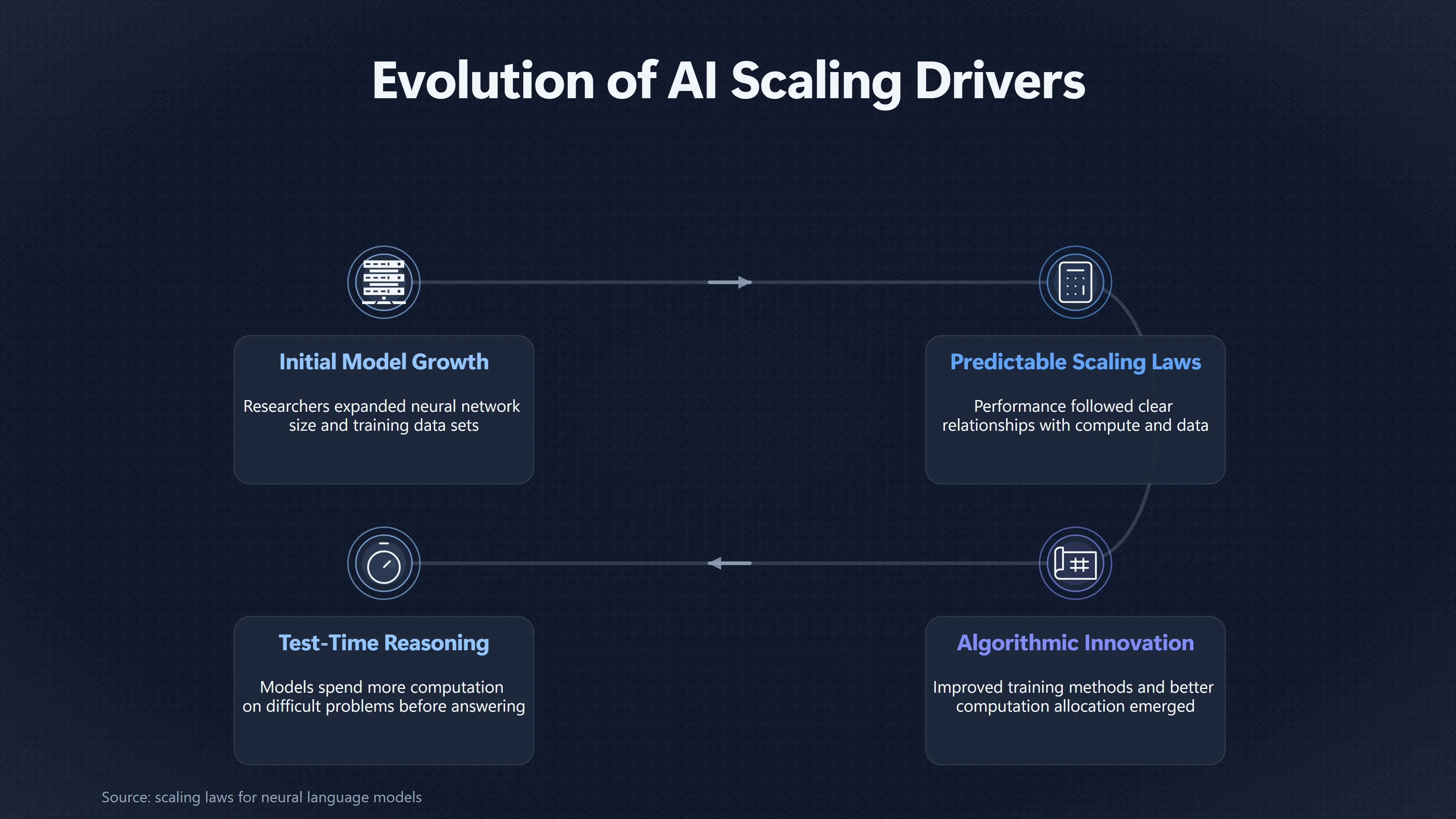
The recent AI boom was built on a combination of scaling and innovation. Large language models improved as researchers increased the size of neural networks, expanded training datasets and invested more computing resources. Early scaling-law research found that model performance followed predictable relationships with model size, data and training compute across large ranges, creating confidence that larger training runs would continue producing gains.[OpenAI]OpenAIscaling laws for neural language modelsJanuary 23, 2020…
This pattern encouraged a simple strategy: build bigger systems, provide more data and spend more computation. It helped produce major capability improvements in language understanding, coding, mathematics and other areas. However, scaling laws are descriptions of past trends, not guarantees that future systems will improve at the same rate indefinitely.
A major reason for optimism is that AI progress has not depended only on larger models. Researchers have also improved algorithms, training methods and ways of using computation after a model has already been trained. For example, recent work on test-time compute — allowing models to spend more computation on difficult problems before producing an answer — suggests that reasoning performance can sometimes improve through better allocation of computational effort rather than simply increasing model size.[ML Anthology]mlanthology.orgOpen source on mlanthology.org.
This matters for future take-off scenarios because an intelligence explosion would not necessarily require a single endless scaling curve. Progress could come from a combination of larger models, better algorithms, automated experimentation and AI systems assisting researchers in creating the next generation of systems.
Bottlenecks facing future systems
Data may become a limiting resource
One of the clearest challenges is the supply of high-quality training data. Earlier scaling approaches assumed that larger models could be matched with ever larger datasets, but the amount of useful human-generated text and other information is finite. Research on data-constrained language models has examined what happens when compute continues increasing while unique data becomes harder to obtain. These studies suggest that repeated exposure to the same data eventually provides diminishing returns, meaning additional computation may become less valuable without new sources of information or improved learning methods.[Journal of Machine Learning Research]jmlr.orgJournal of Machine Learning Research Scaling Data-Constrained Language ModelsJournal of Machine Learning Research Scaling Data-Constrained Language Models
The issue is not simply the total amount of data available online. Quality matters. Much internet data is repetitive, noisy or poorly suited for training advanced systems. Recent work has explored how data quality changes scaling behaviour, suggesting that better-curated information can sometimes substitute for simply adding more volume.[arXiv]arxiv.orgScaling Laws Revisited: Modeling the Role of Data Quality in Language Model PretrainingSeptember 30, 2025…
For intelligence explosion theories, this creates an important uncertainty. If advanced AI requires vastly more knowledge and experience to improve itself, limited access to high-quality information could slow progress. If AI systems become better at generating useful synthetic training environments, scientific simulations or self-improvement strategies, the constraint may become less severe.
Computing and energy demands may slow expansion
Modern AI development relies on enormous amounts of specialised computing infrastructure. Building larger systems requires advanced chips, data centres, electricity and supply chains. These physical requirements create limits that are different from the abstract idea of intelligence increasing.
Even if algorithms continue improving, expanding AI capability may face practical constraints from chip manufacturing, cooling, electricity generation and the time needed to build infrastructure. The growing importance of efficiency is already visible in research examining how to balance training costs, deployment costs and model performance. Studies extending traditional scaling laws have argued that real-world deployment costs, including inference — the computation needed each time a model is used — can change which systems are economically optimal.[Proceedings of Machine Learning Research]proceedings.mlr.pressProceedings of Machine Learning ResearchBeyond Chinchilla-Optimal: Accounting for Inference in Language Model Scaling LawsJuly 8, 2024…
For an AI bloom scenario, this distinction matters. A future where AI enables abundance depends not only on creating highly capable systems but also on making those systems affordable, energy-efficient and widely accessible. Intelligence that exists only inside extremely expensive infrastructure may produce major benefits but could also concentrate power.
Bigger models may face harder engineering problems
Scaling is not only a question of adding resources. As systems become more capable, researchers face increasingly difficult engineering challenges: improving reliability, reducing errors, increasing transparency and ensuring that models perform consistently outside controlled evaluations.
A model that achieves impressive benchmark results may still fail unpredictably in real-world settings. More computation can sometimes improve reasoning, but it does not automatically eliminate problems such as incorrect assumptions, poor generalisation or overconfidence. Research into reasoning systems has found cases where additional test-time computation can even reduce performance in certain situations, showing that “more thinking” is not always equivalent to better answers.[Alignment Science Blog]alignment.anthropic.comAlignment Science Blog Inverse Scaling in Test-Time ComputeAlignment Science BlogInverse Scaling in Test-Time ComputeJuly 22, 2025…
This creates a challenge for rapid take-off arguments. An AI system that helps accelerate scientific discovery or improve future AI systems must be dependable enough for high-stakes work. Capability growth alone may not create a positive feedback loop if reliability and oversight become bottlenecks.
Why past trends may mislead
The strongest argument for a rapid intelligence explosion comes from observing how quickly AI capabilities have improved. Systems that once struggled with language, coding and reasoning tasks can now assist with increasingly complex work. However, extrapolating this curve into the future involves several assumptions.
One assumption is that future problems will resemble past scaling challenges. Early improvements often come from solving relatively accessible bottlenecks: increasing model size, collecting more data and improving training methods. Later improvements may require deeper scientific breakthroughs rather than simply more resources.
Another assumption is that AI systems will become capable of meaningfully accelerating AI research itself. This is a crucial step in many intelligence explosion scenarios. A model that helps researchers write code, analyse results or design experiments may speed progress, but that is different from a system capable of autonomously driving rapid cycles of AI improvement.
The difference can be understood as the gap between assisted acceleration and recursive acceleration. Assisted acceleration means AI makes human researchers more productive. Recursive acceleration means AI systems contribute substantially to creating better AI systems, producing a feedback loop. Current evidence supports increasing AI assistance, but the strength and speed of any recursive loop remain uncertain.
The future may depend on new scaling paths
A slowdown in traditional scaling would not necessarily mean the end of major AI progress. Historically, technological advances often shift from one growth engine to another. If simply making models larger becomes less effective, progress could come from new architectures, better learning methods, improved reasoning systems, robotics integration or AI systems that learn through interaction with the physical world.
Several emerging approaches already suggest that the future may not look like a straightforward continuation of the largest-model race. Test-time reasoning, specialised models and more efficient training methods represent attempts to extract greater capability from existing resources.[ML Anthology]mlanthology.orgOpen source on mlanthology.org.
For the AI bloom vision, this uncertainty cuts both ways. A slower-than-expected take-off would reduce the chance of sudden transformation, but it could still allow decades of steady advances in medicine, science, education and automation. Conversely, unexpected breakthroughs could reopen faster pathways to superintelligence.
What would change the outlook?
The evidence needed to judge future take-off risk is not a single benchmark score or one new model release. More informative signals would include:
- Longer autonomous research ability: whether AI systems can reliably complete extended scientific and engineering tasks with limited human intervention.
- AI-driven AI improvement: whether systems begin making substantial contributions to designing better algorithms, training methods or architectures.
- Sustained efficiency gains: whether useful capability continues improving without proportionally larger demands for chips, energy and data.
- Real-world reliability: whether advanced systems become trustworthy enough for important scientific, economic and institutional roles.
A genuine intelligence explosion would likely require several of these trends to occur together. If progress continues but scaling becomes harder, AI may still transform civilisation through gradual acceleration. If AI systems begin reliably improving the tools used to create future AI systems, the possibility of much faster change becomes more plausible.
The central lesson is that AI progress has strong momentum but uncertain limits. The future of AI-enabled human flourishing depends not only on how intelligent systems can become, but on whether the technical, economic and physical foundations supporting that growth can continue expanding.
Amazon book picks
Further Reading
Books and field guides related to Will AI Progress Keep Accelerating?. Use these as the next step if you want deeper reading beyond the article.
Life 3.0: Being Human in the Age of Artificial Intelligence
'This is the most important conversation of our time, and Tegmark's thought-provoking book will help you join it' Stephen Hawking THE INT...
Artificial Intelligence: A Modern Approach
Rating: 4.5/5 from 10 Google Books ratings
Artificial intelligence: A Modern Approach, 3e,is ideal for one or two-semester, undergraduate or graduate-level courses in Artificial In...
The Coming Wave: Technology, Power, and the Twenty-first Cent...
"We are approaching a critical threshold in the history of our species. Everything is about to change. Soon you will live surrounded by A...
Scaling Up: How a Few Companies Make It... and Why the Rest D...
Winner of the International Book Awards for General Business Winner of the Readers' Favorite International Book Award for Non-Fiction Bus...
eBay marketplace picks
Marketplace Samples
Live-tested eBay searches with available results related to this page.
Selected fromtechnology poster oneBay.co.uk.




Endnotes
1.
Source: OpenAI
Title: scaling laws for neural language models
Link:https://openai.com/index/scaling-laws-for-neural-language-models/
Source snippet
January 23, 2020...
Published: January 23, 2020
2.
Source: arxiv.org
Link:https://arxiv.org/abs/2510.03313
Source snippet
Scaling Laws Revisited: Modeling the Role of Data Quality in Language Model PretrainingSeptember 30, 2025...
Published: September 30, 2025
3.
Source: mlanthology.org
Link:https://mlanthology.org/iclr/2025/snell2025iclr-scaling/
4.
Source: jmlr.org
Title: Journal of Machine Learning Research Scaling Data-Constrained Language Models
Link:https://www.jmlr.org/papers/v26/24-1000.html
5.
Source: proceedings.mlr.press
Link:https://proceedings.mlr.press/v235/sardana24a.html
Source snippet
Proceedings of Machine Learning ResearchBeyond Chinchilla-Optimal: Accounting for Inference in Language Model Scaling LawsJuly 8, 2024...
Published: July 8, 2024
6.
Source: [alignment]({{ ‘alignment/’ | relative_url }}). anthropic.com
Title: Alignment Science Blog Inverse Scaling in Test-Time Compute
Link:https://alignment.anthropic.com/2025/inverse-scaling/
Source snippet
Alignment Science BlogInverse Scaling in Test-Time ComputeJuly 22, 2025...
Published: July 22, 2025
7.
Source: doi.org
Link:https://doi.org/10.48550/ARXIV.2001.08361
8.
Source: proceedings.iclr.cc
Link:https://proceedings.iclr.cc/paper_files/paper/2025/hash/a91869936a63d814971b6423990ecf6e-Abstract-Conference.html
9.
Source: proceedings.iclr.cc
Link:https://proceedings.iclr.cc/paper_files/paper/2025/hash/1b623663fd9b874366f3ce019fdfdd44-Abstract-Conference.html
Additional References
10.
Source: alphaxiv.org
Link:https://www.alphaxiv.org/abs/2606.06888v1
Source snippet
Data-Constrained Language Model Pretraining: Improved Regularization and Scaling Laws | alphaXivJune 5, 2026 — DATA-CONSTRAINED LANGUAGE...
Published: June 5, 2026
11.
Source: sciencedirect.com
Title: The limits to growth in the AI-driven economy
Link:https://www.sciencedirect.com/science/article/pii/S1043951X25001683
Source snippet
December 1, 2025 — CHINA ECONOMIC REVIEW Volume 94, Part A, December 2025, 102510 THE LIMITS TO GROWTH IN THE AI-DRIVEN ECON...
Published: December 1, 2025
12.
Source: research.ed.ac.uk
Title: ed.ac.uk Inverse Scaling in Test-Time Compute
Link:https://www.research.ed.ac.uk/en/publications/inverse-scaling-in-test-time-compute/
Source snippet
Scaling in Test-Time Compute - University of Edinburgh Research ExplorerDecember 15, 2025 — INVERSE SCALING IN TEST-TIME COMPUTE * Aryo G...
Published: December 15, 2025
13.
Source: youtube.com
Link:https://www.youtube.com/watch?v=V1J-5y8SB6M
Source snippet
How Scaling Laws Will Determine AI's Future | YC Decoded...
14.
Source: youtube.com
Title: AI Scaling Laws, Deep Seek’s Cost Efficiency & The Future of AI Training
Link:https://www.youtube.com/watch?v=ryNNUY3KhE4
Source snippet
Scaling Laws of AI explained | Dario Amodei and Lex Fridman...
15.
Source: youtube.com
Title: Why AI Can’t Scale Forever (Physics Is the Problem)
Link:https://www.youtube.com/watch?v=8YRdTAo0lGQ
Source snippet
Beyond Scaling: How to Build Governable Superintelligence with the Energetic Paradigm...
16.
Source: youtube.com
Title: How Scaling Laws Will Determine AI’s Future | YC Decoded
Link:https://www.youtube.com/watch?v=d6Ed5bZAtrM
Source snippet
AI Scaling Laws, DeepSeek's Cost Efficiency & The Future of AI Training...
17.
Source: researchgate.net
Link:https://www.researchgate.net/publication/397127998_An_Information_Theory_of_Compute-Optimal_Size_Scaling_Emergence_and_Plateaus_in_Language_Models
18.
Source: sciencedirect.com
Link:https://www.sciencedirect.com/science/article/abs/pii/S0306457325003358
19.
Source: techcrunch.com
Link:https://techcrunch.com/2025/03/19/researchers-say-theyve-discovered-a-new-method-of-scaling-up-ai-but-theres-reason-to-be-skeptical/