Within Tutor vs Chatbot
Did Harvard Prove AI Tutors Beat Classrooms?
Harvard students learned more in less time, but the result depended on a tightly designed tutor rather than unrestricted chatbot use.
On this page
- How the randomised physics trial was designed
- Why the tutor outperformed active learning
- What the study cannot yet establish
Page outline Jump by section
Introduction
Did Harvard prove that AI tutors are better than classrooms? Not quite. What the university’s widely discussed physics trial actually demonstrated is both more impressive and more limited. In a carefully designed randomised controlled trial, Harvard researchers found that students using a purpose-built AI tutor learned substantially more, in less time, than students attending an already high-quality active-learning class. However, the winning system was not an unrestricted chatbot. It was a tightly engineered tutor built around decades of research on how people learn, with structured prompts, carefully sequenced activities, instructor-created materials and deliberate safeguards against simply giving away answers.[nature.com]nature.comOpen source on nature.com.
For the broader question of AI-enabled human flourishing, this distinction matters. The study offers unusually strong evidence that well-designed AI tutors could make high-quality education more widely available. It does not show that simply handing every student a general-purpose chatbot will produce the same results.
How the randomised physics trial was designed
Many AI-in-education studies compare new technology with conventional lectures or rely on self-selected users. Harvard’s study was considerably more rigorous.
The research took place in Harvard’s largest introductory physics course, involving 194 students. Rather than allowing students to choose their preferred method, researchers randomly assigned learning conditions using a crossover design. Across two different physics topics, every student experienced both approaches at different points during the experiment. Pre-tests established each student’s starting knowledge, while post-tests measured what they had learned immediately afterwards. Researchers also controlled for prior physics ability, previous ChatGPT experience, lesson topic and time spent learning.[nature.com]nature.comOpen source on nature.com.
Equally important was the comparison group. The AI tutor was not competing against traditional lectures. It was measured against an active-learning classroom, an instructional approach that already has a strong evidence base in science education and is widely regarded as substantially more effective than passive lecturing. Around 89% of students in the course reported that it used more active learning than their other STEM classes.[nature.com]nature.comOpen source on nature.com.
That makes the result unusually demanding. The AI system was tested against one of the strongest existing teaching methods rather than an easy target.
Why the tutor outperformed active learning
The headline finding was that students using the AI tutor achieved more than twice the median learning gains of those in the classroom while generally completing the material in less time. Students also reported higher engagement, greater motivation and a stronger sense that they could succeed. Statistical analyses suggested a large educational effect even after controlling for multiple background factors.[nature.com]nature.comOpen source on nature.com.
The critical question is why.
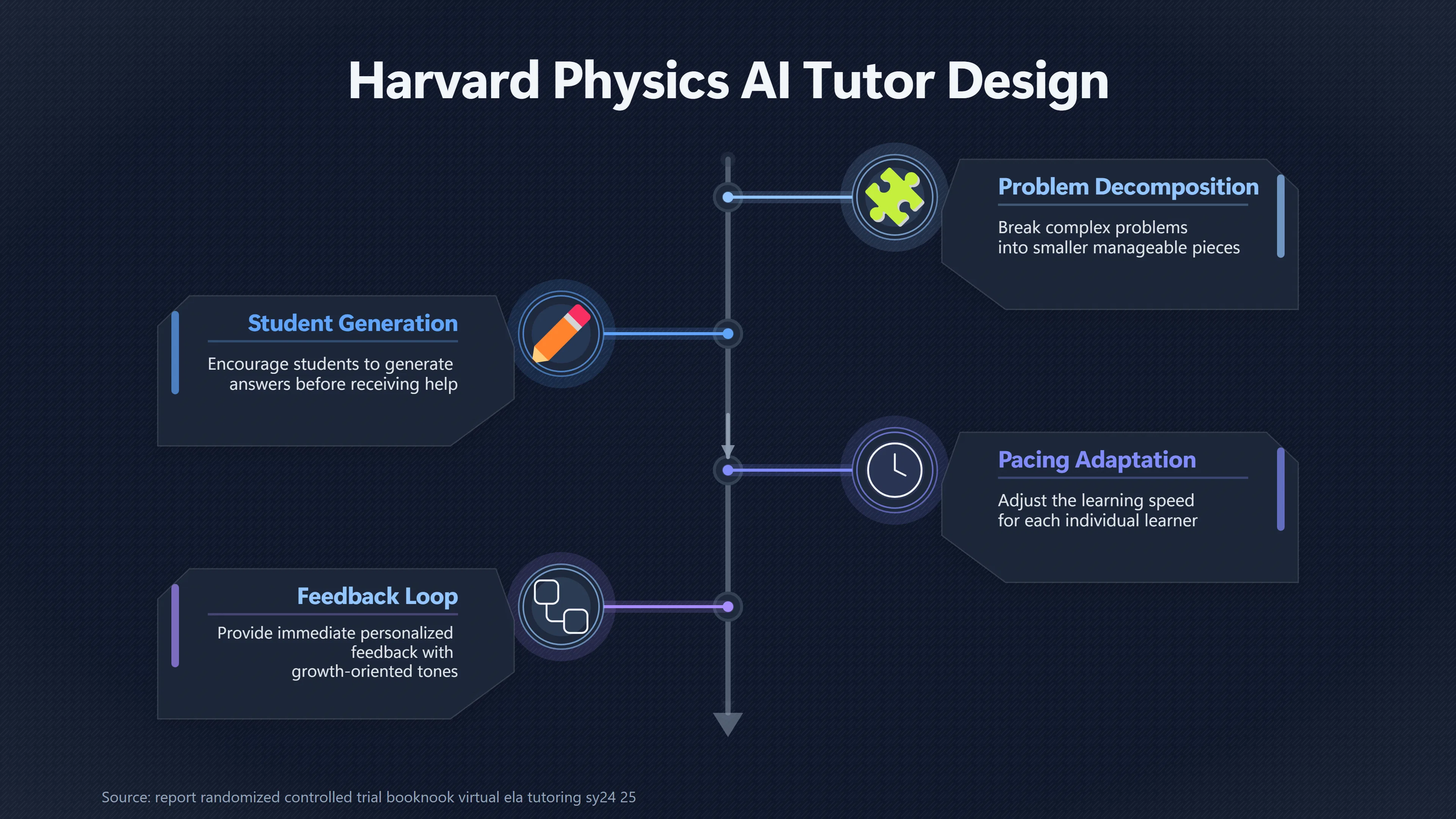
The paper argues that the advantage came from instructional design rather than from the language model alone. The researchers embedded established learning principles directly into the tutor’s behaviour, including:
- guiding students through problems one step at a time rather than allowing conversations to wander;
- encouraging students to generate answers themselves before receiving help;
- managing cognitive load by breaking complex problems into smaller pieces;
- adapting pacing to each learner instead of forcing everyone through the same timetable;
- providing immediate personalised feedback while maintaining a growth-oriented tone;
- integrating instructor-written explanations, worked examples and course-specific materials.[nature.com]nature.comOpen source on nature.com.
Interestingly, the researchers report that prompt engineering alone proved insufficient. Even a detailed system prompt sometimes caused the model to discuss problem parts out of sequence or introduce ideas prematurely. They therefore built additional software that constrained the conversation and enforced the intended instructional sequence. In other words, much of the educational value came from the surrounding tutoring system rather than the underlying language model by itself.[nature.com]nature.comOpen source on nature.com.
This is perhaps the study’s most important practical lesson. Good tutoring appears to require both capable AI and careful educational architecture.
What the trial did not prove
Public discussion sometimes overstated the findings. The study did not establish several broader claims that are often attributed to it.
First, it did not prove that general chatbots are naturally excellent teachers. Students did not receive unrestricted access to GPT-4 and simply learn more as a result. They used a heavily constrained tutoring environment designed by educators.[nature.com]nature.comOpen source on nature.com.
Second, it did not prove that AI should replace teachers. The experiment examined short instructional units on two topics within one undergraduate physics course. It did not compare complete semesters, schools or universities run entirely by AI.
Third, it did not show long-term retention. Learning was measured immediately after the instructional sessions. Whether the gains persist over months, transfer to later coursework or improve final examination performance remains an open research question. The authors themselves identify future work as necessary to understand how broadly the results generalise.[nature.com]nature.comOpen source on nature.com.
Fourth, it did not establish that similar gains will appear across every subject. Physics problem-solving has characteristics that suit structured Socratic guidance. Humanities, creative disciplines, laboratory work and collaborative projects may require different designs.
Finally, it did not eliminate concerns about AI accuracy or over-reliance. The tutor’s structure reduced some of these risks, but educational AI still depends on careful oversight, evaluation and continual improvement.
Why this single case matters despite its limits
Although the findings should not be overgeneralised, they deserve attention because relatively few educational AI studies combine several desirable features at once:
- random assignment;
- comparison against an effective existing teaching method;
- authentic university teaching rather than laboratory simulations;
- real course content;
- measurable learning outcomes rather than student satisfaction alone.[nature.com]nature.comOpen source on nature.com.
That makes this one of the strongest pieces of evidence available that carefully designed AI tutoring can improve learning outcomes under realistic conditions.
It also shifts the debate. Earlier discussions often asked whether large language models could answer educational questions correctly. Harvard’s trial instead asked whether AI systems could embody effective pedagogy. That is a more demanding and ultimately more useful question.
What the trial means for AI and human flourishing
Within the broader discussion of AI-enabled abundance, education occupies a special position. Personal tutoring has consistently produced some of the largest learning improvements ever measured in educational research, but one-to-one human tutoring has never been economically scalable for entire populations.
The Harvard trial suggests a possible route towards making elements of personalised tutoring much more widely available. If AI systems can reliably reproduce key features of expert tutoring while remaining affordable, they could help reduce educational inequalities, accelerate skill development and expand access to high-quality learning far beyond elite institutions.[nature.com]nature.comOpen source on nature.com.
However, the evidence points towards a specific model of progress. The likely breakthrough is not unrestricted conversational AI replacing education, but specialised tutoring systems that combine powerful language models with proven instructional methods, curriculum design and human educational expertise.
For the larger vision of AI helping humanity flourish, that is arguably the trial’s most significant contribution. It provides evidence that advances in artificial intelligence become substantially more valuable when they are coupled with equally careful advances in human-centred design. The technology mattered, but so did the educational science that shaped how students interacted with it.
Amazon book picks
Further Reading
Books and field guides related to Did Harvard Prove AI Tutors Beat Classrooms?. Use these as the next step if you want deeper reading beyond the article.
Make It Stick: The Science of Successful Learning
To most of us, learning something "the hard way" implies wasted time and effort. Good teaching, we believe, should be creatively tailored...
How People Learn II: Learners, Contexts, and Cultures
There are many reasons to be curious about the way people learn, and the past several decades have seen an explosion of research that has...
Visible Learning
The world’s most powerful research on the practices that improve learning in schools John Hattie’s groundbreaking book is the result of 1...
Why Don't Students Like School?
Research-based insights and practical advice about effective learning strategies In this new edition of the highly regarded Why Don't Stu...
eBay marketplace picks
Marketplace Samples
Live-tested eBay searches with available results related to this page.
Selected fromphysics poster oneBay.co.uk.
Endnotes
1.
Source: nature.com
Link:https://www.nature.com/articles/s41598-025-97652-6
2.
Source: cepr.harvard.edu
Title: report randomized controlled trial booknook virtual ela tutoring sy24 25
Link:https://cepr.harvard.edu/resource/report-randomized-controlled-trial-booknook-virtual-ela-tutoring-sy24-25
Source snippet
harvard.eduReport: Randomized Controlled Trial of BookNook Virtual ELA Tutoring (SY24–25) | Center for Education Policy ResearchJune 15...
3.
Source: news.harvard.edu
Title: what if ai could help students learn not just do assignments for them
Link:https://news.harvard.edu/gazette/story/2025/10/what-if-ai-could-help-students-learn-not-just-do-assignments-for-them/
Source snippet
Harvard GazetteOctober 21, 2025 — WHAT IF AI COULD HELP STUDENTS LEARN, NOT JUST DO ASSIGNMENTS FOR THEM? Professors find promise in ‘t...
Published: October 21, 2025
4.
Source: news.harvard.edu
Title: professor tailored ai tutor to physics course engagement doubled
Link:https://news.harvard.edu/gazette/story/2024/09/professor-tailored-ai-tutor-to-physics-course-engagement-doubled/
Source snippet
Engagement doubled. — Harvard GazetteSeptember 5, 2024 — Image: Physics professors Gregory Michael Kestin and Kelly Miller. Study authors...
Published: September 5, 2024
5.
Source: ui.adsabs.harvard.edu
Link:https://ui.adsabs.harvard.edu/abs/2025NatSR..1517458K/abstract
6.
Source: serl.fas.harvard.edu
Link:https://serl.fas.harvard.edu/publications
7.
Source: hks.harvard.edu
Title: coach not crutch ai assistance can enhance rather hinder skill development
Link:https://www.hks.harvard.edu/publications/coach-not-crutch-ai-assistance-can-enhance-rather-hinder-skill-development
8.
Source: serl.fas.harvard.edu
Link:https://serl.fas.harvard.edu/research
Additional References
9.
Source: pubmed.ncbi.nlm.nih.gov
Link:https://pubmed.ncbi.nlm.nih.gov/40537565/
Source snippet
2025 Jun 3;15(1):17458. doi: 10.1038/s41598-025-97652-6. AI TUTORING OUTPERFORMS IN-CLASS ACTIVE LEARNING: AN RCT INTRODUCING A NOVEL RES...
10.
Source: scale.stanford.edu
Link:https://scale.stanford.edu/ai/repository/ai-tutoring-outperforms-class-active-learning-rct-introducing-novel-research-based
Source snippet
tutoring outperforms in-class active learning: an RCT introducing a novel research-based design in an authentic educational setting | SCA...
11.
Source: pmc.ncbi.nlm.nih.gov
Link:https://pmc.ncbi.nlm.nih.gov/articles/PMC12179260/
Source snippet
2025 Jun 3;15:17458. doi: 10.1038/s41598-025-97652-6 AI TUTORING OUTPERFORMS IN-CLASS ACTIVE LEARNING: AN RCT INTRODUCING A NOVEL RESEARC...
12.
Source: youtube.com
Title: The Cognitive Debt Problem Nobody’s Talking About
Link:https://www.youtube.com/watch?v=CnsprHaaQq0
Source snippet
AI Tutors Outperform Active Learning: A Revolution in Education...
13.
Source: youtube.com
Title: Education & AI: Harvard Chat Bot Use Case
Link:https://www.youtube.com/watch?v=9psI0qjhwnA
Source snippet
Harvard Tested an AI Tutor—and Students Learned Nearly Twice as Much...
14.
Source: doaj.org
Link:https://doaj.org/article/594959a5f4f94bd8a7ad3d534581f3ec
15.
Source: youtube.com
Title: How DEPENDENT are we really on AI?
Link:https://www.youtube.com/watch?v=kSy9kx0yaEQ
Source snippet
The Cognitive Debt Problem Nobody's Talking About...
16.
Source: youtube.com
Title: Harvard Tested an AI Tutor—and Students Learned Nearly Twice as Much
Link:https://www.youtube.com/watch?v=LFlW-kfmi_o
Source snippet
How DEPENDENT are we really on AI?...
17.
Source: youtube.com
Title: AI Tutors Outperform Active Learning: A Revolution in Education
Link:https://www.youtube.com/watch?v=x0ouHeQ3n2g