Within Tutor vs Chatbot
How Can Schools Spot a Genuine AI Tutor?
Schools need evidence of learning gains, reliable content and growing learner independence before treating an AI system as a genuine tutor.
On this page
- Behaviours that support durable learning
- Warning signs of shortcut driven systems
- What progress data and oversight should show
Page outline Jump by section
Introduction
Schools should judge an AI tutor by the same standard they would apply to any educational intervention: does it produce lasting learning, not just polished answers? A system that helps pupils complete homework more quickly is not necessarily teaching them. The strongest evidence so far suggests that genuine AI tutors are distinguished by measurable improvements in understanding, retention and independent problem-solving, while general-purpose chatbots often improve immediate task performance without guaranteeing that learning has taken place.[oecd.org]oecd.orgoecd digital education outlook 2026 062a7394 enOECD Digital Education Outlook 2026 | OECDJanuary 19, 2026…
This distinction matters well beyond today’s classrooms. Within the broader vision of AI helping humanity flourish through greater educational opportunity, the quality of tutoring systems matters more than their conversational ability. If AI is to become a tool for expanding knowledge and human capability at scale, schools need practical ways to separate educational technology that genuinely develops learners from systems that simply make work easier.
What should schools actually measure?
Schools are often tempted to evaluate AI by asking whether pupils enjoy using it or whether teachers save time. Those outcomes matter, but they are secondary. The primary question is whether students know and can do more after using the system than they could beforehand.
A strong evaluation focuses on three broad outcomes:
- Learning gains: Do pupils perform better on assessments that require genuine understanding rather than memorisation?
- Knowledge retention: Can they still solve similar problems days or weeks later without AI assistance?
- Growing independence: Do students increasingly require fewer hints and demonstrate greater confidence tackling unfamiliar tasks?
These measures reflect decades of research on intelligent tutoring systems, where the objective has always been improved learning rather than improved task completion. Modern generative AI changes how tutoring is delivered, but not what success looks like.[oecd.org]oecd.orgs | OECD…
Behaviours that support durable learning
Schools should examine how the AI behaves during learning, not simply what answers it produces.
Effective tutors typically encourage productive thinking through behaviours such as:
- asking students to explain their reasoning;
- breaking difficult problems into manageable steps;
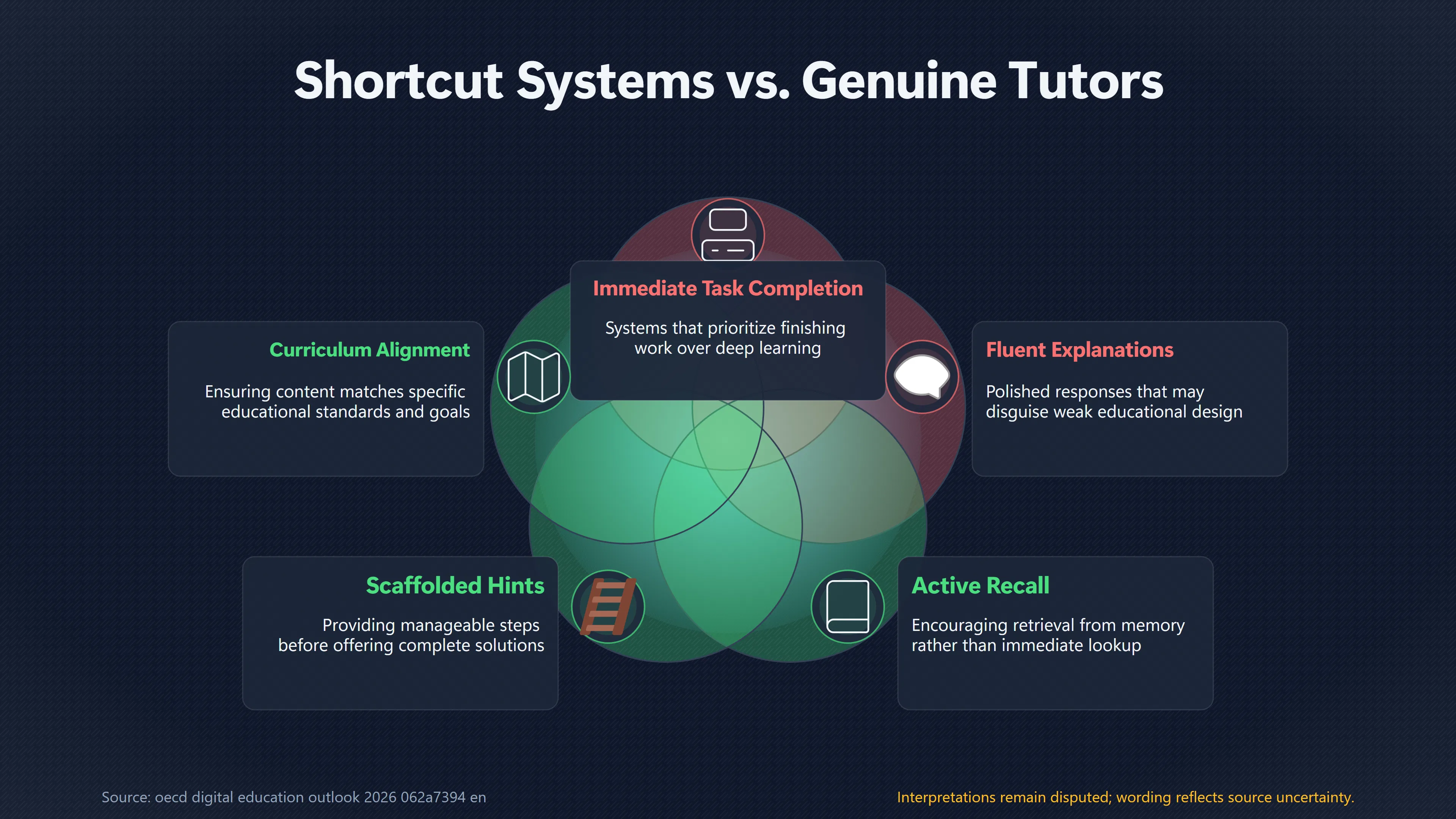
- offering hints before complete solutions;
- checking for misconceptions;
- adapting explanations to previous mistakes;
- returning to earlier concepts when weaknesses reappear;
- encouraging retrieval from memory rather than immediate lookup.
These features mirror established findings from learning science, where active recall, formative feedback and appropriately challenging practice consistently outperform passive explanation.
Recent evidence reinforces this point. The OECD’s review of generative AI in education concludes that educational AI is most effective when designed around explicit pedagogical goals instead of acting as an unrestricted conversational assistant. Intelligent tutoring systems increasingly combine natural language interaction with structured instructional strategies rather than relying solely on large language model responses.[oecd.org]oecd.orgoecd digital education outlook 2026 062a7394 enOECD Digital Education Outlook 2026 | OECDJanuary 19, 2026…
Warning signs of shortcut-driven systems
Many AI systems appear impressive because they generate fluent explanations. Unfortunately, fluency can disguise weak educational design.
Schools should be cautious when an AI tutor regularly:
- provides complete answers before students have attempted the task;
- rewards copying rather than reasoning;
- cannot explain why an answer is correct;
- changes its explanations inconsistently between similar questions;
- encourages students to finish work faster without demonstrating better understanding;
- gives every learner essentially the same support regardless of prior knowledge.
The OECD warns that successfully completing tasks with general-purpose generative AI does not automatically translate into learning. Students may appear highly capable while developing what researchers describe as a false sense of mastery because the AI performs much of the cognitive work on their behalf.[oecd.org]oecd.orgoecd digital education outlook 2026 062a7394 enOECD Digital Education Outlook 2026 | OECDJanuary 19, 2026…
This distinction is especially important when comparing purpose-built tutors with unrestricted chatbots. An AI that solves problems efficiently may improve assignment quality while reducing the mental effort that actually builds expertise.
Progress data should show more than usage statistics
AI companies often advertise engagement metrics such as minutes spent learning, number of conversations or completed exercises. These figures are useful operational indicators but weak evidence of educational value.
Schools should instead expect data that answers questions such as:
- Which misconceptions became less common?
- Which curriculum objectives improved?
- Which pupils benefited most?
- Did weaker learners narrow achievement gaps?
- Did improvements persist after AI access ended?
- Were gains achieved across different teachers and classrooms?
The strongest evidence comes from controlled evaluations comparing similar groups of students, ideally with random assignment where practical. Such studies help distinguish genuine learning effects from improvements caused by motivation, novelty or differences between classes.
The OECD’s international “Power of Feedback” project reflects this approach by combining AI tutoring with rigorous impact evaluation rather than assuming effectiveness from usage alone.[oecd.org]oecd.orgThe Power of Feedback | OECDThe Power of Feedback | OECD
Reliable content matters as much as clever conversation
A tutor cannot teach effectively if its knowledge is unreliable.
Schools should therefore evaluate whether the system:
- uses curriculum-aligned content;
- allows teachers to review or constrain instructional material;
- acknowledges uncertainty rather than inventing information;
- produces consistent explanations across repeated interactions;
- corrects mistakes transparently;
- provides references or supporting reasoning where appropriate.
Large language models remain susceptible to hallucinations—confidently producing inaccurate information—which means educational systems require additional safeguards beyond the underlying model itself. The OECD notes that current research still faces important questions about assuring the quality and reliability of AI tutor knowledge models.[oecd.org]oecd.org062a7394 en062a7394 en

Human oversight should become more targeted, not disappear
An effective AI tutor should reduce routine workload while increasing the quality of teacher attention.
Teachers should be able to see:
- where students struggle most;
- which misconceptions recur across the class;
- when intervention is needed;
- how much support individual pupils required before succeeding.
This allows educators to spend more time on motivation, discussion, emotional support and higher-level teaching rather than routine explanation.
Evidence from human-AI tutoring systems points in this direction. In the Tutor CoPilot trial, AI supported tutors by encouraging stronger questioning strategies rather than replacing them. Students were more likely to master topics, particularly when working with less experienced tutors, because the AI promoted better tutoring behaviours instead of simply generating answers.[arXiv]arxiv.orgarXiv Tutor Co Pilot: A Human-AI Approach for Scaling Real-Time ExpertiseTutor CoPilot: A Human-AI Approach for Scaling Real-Time ExpertiseOctober 3, 2024…
A practical evaluation framework for schools
Before adopting an AI tutor at scale, schools can ask a small set of practical questions.
QuestionStrong evidenceCause for concernDoes learning improve?Independent assessment scores rise and gains persist.Only homework or assignment quality improves.Does the tutor encourage thinking?Uses questions, hints and retrieval practice.Gives immediate completed solutions.Is content trustworthy?Curriculum-aligned with teacher oversight and correction mechanisms.Frequent factual errors or inconsistent explanations.Does it personalise learning?Adapts to misconceptions and prior performance.Treats every learner similarly.Can teachers monitor progress?Provides actionable learning data and misconception analysis.Reports only engagement statistics.Does reliance decrease over time?Students become more independent.Students increasingly depend on AI for every task.
A system that performs well across all these areas is much closer to a genuine tutor than a conversational assistant.
Why this distinction matters for AI-enabled human flourishing
The long-term promise of AI in education is not simply that every learner gains access to an always-available chatbot. It is that high-quality tutoring—historically one of the most effective but expensive forms of education—could become far more widely available.
That possibility depends on educational quality, not conversational sophistication. If AI merely automates answers, it risks creating dependency while leaving underlying skills unchanged. If it consistently develops reasoning, understanding and learner independence, it could expand access to personalised education at a scale previously impossible.
For schools, the practical implication is straightforward. The question is not whether an AI system sounds intelligent. It is whether students become more capable when the conversation ends. The systems that can demonstrate lasting learning gains, reliable instructional behaviour and increasing learner autonomy are the ones that deserve to be treated as genuine AI tutors rather than simply impressive chatbots.
Amazon book picks
Further Reading
Books and field guides related to How Can Schools Spot a Genuine AI Tutor?. Use these as the next step if you want deeper reading beyond the article.
Make It Stick: The Science of Successful Learning
To most of us, learning something "the hard way" implies wasted time and effort. Good teaching, we believe, should be creatively tailored...
How People Learn II: Learners, Contexts, and Cultures
There are many reasons to be curious about the way people learn, and the past several decades have seen an explosion of research that has...
Visible Learning
The world’s most powerful research on the practices that improve learning in schools John Hattie’s groundbreaking book is the result of 1...
The End of Average
'Must the tyranny of the group rule us from cradle to grave? Absolutely not, says Todd Rose in a subversive and readable introduction to...
eBay marketplace picks
Marketplace Samples
Live-tested eBay searches with available results related to this page.
Selected fromcoding toy oneBay.co.uk.
Endnotes
1.
Source: oecd.org
Title: oecd digital education outlook 2026 062a7394 en
Link:https://www.oecd.org/en/publications/oecd-digital-education-outlook-2026_062a7394-en.html
Source snippet
OECD Digital Education Outlook 2026 | OECDJanuary 19, 2026...
Published: January 19, 2026
2.
Source: oecd.org
Link:https://www.oecd.org/en/publications/innovating-assessments-to-measure-and-support-complex-skills_e5f3e341-en/full-report/component-17.html
Source snippet
s | OECD...
3.
Source: oecd.org
Title: 062a7394 en
Link:https://www.oecd.org/content/dam/oecd/en/publications/reports/2026/01/oecd-digital-education-outlook-2026_940e0dd8/062a7394-en.pdf
4.
Source: oecd.org
Title: The Power of Feedback | OECD
Link:https://www.oecd.org/en/about/projects/the-power-of-feedback.html
5.
Source: arxiv.org
Title: arXiv Tutor Co Pilot: A Human-AI Approach for Scaling Real-Time Expertise
Link:https://arxiv.org/abs/2410.03017
Source snippet
Tutor CoPilot: A Human-AI Approach for Scaling Real-Time ExpertiseOctober 3, 2024...
Published: October 3, 2024
6.
Source: oecd.org
Title: component 7
Link:https://www.oecd.org/en/publications/education-policy-outlook-2024_dd5140e4-en/full-report/component-7.html
Additional References
7.
Source: nature.com
Link:https://www.nature.com/articles/s41539-025-00320-7
Source snippet
May 14, 2025 — A systematic review of AI-driven intelligent tutoring systems (ITS) in K-12 education Download PDF Download PDF * Article...
Published: May 14, 2025
8.
Source: theaustralian.com.au
Link:https://www.theaustralian.com.au/higher-education/student-reliance-on-ai-is-a-shortcut-that-masks-a-failure-to-learn-the-oecd-warns/news-story/868d0c5769c42446ba140807e8de8fd4
Source snippet
A study cited in the report revealed that students using ChatGPT experienced higher procrastination, memory loss, and poorer academic per...
9.
Source: ieim.uqam.ca
Link:https://ieim.uqam.ca/ai-driven-intelligent-tutoring-systems-k-12-education/
Source snippet
systematic review of AI-driven intelligent tutoring systems (ITS) in K-12 education - Institut d'études internationales de Montréal (IEIM...
10.
Source: doi.org
Title: Pardos Authors Info & Claims L@S ‘
Link:https://doi.org/10.1145/3698205.3729555
Source snippet
When LLMs Hallucinate: Examining the Effects of Erroneous Feedback in Math Tutoring Systems | Proceedings of the Twelfth ACM Conference o...
11.
Source: youtube.com
Title: How AI tutors and teaching assistants will transform education
Link:https://www.youtube.com/watch?v=qlh8fiLiovI
Source snippet
The AI Revolution in Education with Shawn Jansepar, Director of Engineering at Khan Academy...
12.
Source: youtube.com
Title: Hamsa Bastani | Unpacking the unintended consequences of AI in education
Link:https://www.youtube.com/watch?v=YjkfsKzoNJE
Source snippet
ChatGPT Alone Makes Students Worse at Math...
13.
Source: youtube.com
Link:https://www.youtube.com/watch?v=um6BZFrD36k
Source snippet
Hamsa Bastani | Unpacking the unintended consequences of AI in education...
14.
Source: youtube.com
Title: Chat GPT Alone Makes Students Worse at Math
Link:https://www.youtube.com/watch?v=E42XvbM6e1w
Source snippet
How AI tutors and teaching assistants will transform education...
15.
Source: cudc.uqam.ca
Link:https://cudc.uqam.ca/en/pub/a-systematic-review-of-ai-driven-intelligent-tutoring-systems-its-in-k-12-education/
16.
Source: youtube.com
Link:https://www.youtube.com/watch?v=ati_ACj1Dic